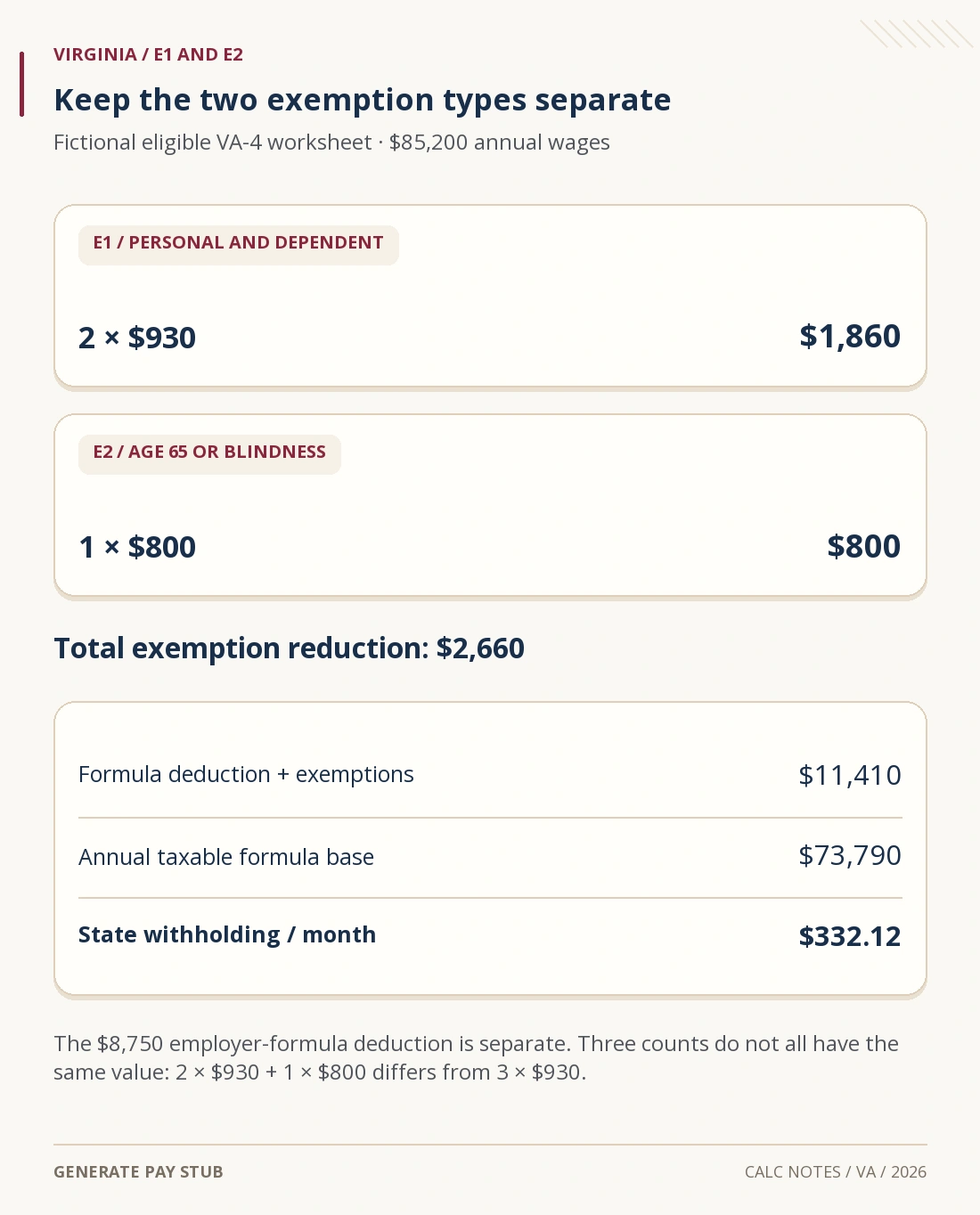
To estimate a Virginia paycheck in 2026, keep the two VA-4 exemption categories separate: personal and dependent exemptions reduce the annual payroll formula by $930 each, while qualifying age and blindness exemptions reduce it by $800 each. Entering the combined total in the first field can change the result.
This guide follows the updated employer formula, a fictional $85,200 monthly-paid salary and an eligible worksheet with two personal/dependent exemptions plus one age/blindness exemption. The checked result is $332.12 of Virginia withholding and $5,398.56 cash per month before unentered payroll deductions.
Read the two VA-4 subtotals before entering a count
The current Form VA-4 separates personal exemptions from exemptions for age and blindness. Worksheet line 4 totals personal exemptions; line 7 totals age and blindness exemptions. Certificate lines 1(a) and 1(b) carry those subtotals, with line 1(c) recording their combined count.
In the employer’s formula, these categories are E1 and E2. The calculator likewise asks for personal/dependent exemptions separately from age/blind exemptions. The combined certificate total is not a substitute for either input.
The worksheet controls eligibility. For example, a spouse cannot also be claimed on their own certificate, and a spouse is not a dependent. Follow the form’s January 1 age condition and blindness instructions before entering E2.
Virginia’s exemption guidance confirms the different $930 and $800 values. They reduce the formula base; neither is a dollar-for-dollar tax credit. Our case assumes the counts are valid rather than advising a reader to claim them.
Enter the fictional $7,100 monthly case
Open the Virginia paycheck calculator and select 2026, $85,200 annual wages and Monthly. That means twelve equal gross payments of $7,100.
For the federal calculation choose Single, leave multiple jobs off and keep all federal adjustments at zero. In the Virginia section select the revised formula, enter E1 = 2 and E2 = 1, and leave extra state withholding at zero.
Assume one employer, ordinary wages, a full year living and working in Virginia, and no deductions that change any wage base. Known local and other cash deductions are zero. The federal settings are independent of the state exemption categories.
These are deliberately simplified inputs. An age-related Virginia exemption does not, by itself, tell the federal calculator to apply a particular federal return deduction or credit. A reader should use their actual federal certificate settings.
Follow the updated Virginia employer formula
The Department of Taxation’s updated withholding publication annualizes the payment and subtracts $8,750 plus the two exemption amounts:
$85,200 − [$8,750 + (2 × $930) + (1 × $800)] = $73,790.
The $2,660 exemption reduction is separate from the $8,750 formula deduction. Combined they reduce the annual formula base by $11,410.
For a base over $17,000, the published annual formula is $720 plus 5.75% of the excess above $17,000. In this case, $720 + ($73,790 − $17,000) × 0.0575 = $3,985.425.
Dividing that unrounded annual amount by twelve gives $332.11875. The live calculator rounds to $332.12 per monthly payment; twelve rounded amounts total $3,985.44. That differs slightly from rounding the annual formula first.
The employer formula explicitly uses $8,750 here. Substituting the married joint-return standard deduction into that formula would not reproduce this method. Withholding is a payment toward tax, and a completed return can have different deductions and a different final balance.

What happens if all three exemptions are entered as E1?
Our second live check deliberately enters E1 = 3 and E2 = 0. This represents a classification error for the assumed worksheet, not another valid election for the same facts.
| Annualized state result | Correct E1 = 2, E2 = 1 | Misclassified E1 = 3, E2 = 0 |
|---|---|---|
| Exemption reduction | $2,660.00 | $2,790.00 |
| Formula base after all reductions | $73,790.00 | $73,660.00 |
| State withholding each month | $332.12 | $331.50 |
| Twelve rounded state deductions | $3,985.44 | $3,978.00 |
The incorrect entry overstates the exemption reduction by $130. It does not save $130 of tax. At this formula band, the unrounded annual tax difference is $130 × 5.75% = $7.475; after monthly rounding, the difference across twelve payments is $7.44.
A more favorable cash result is not proof that an input is valid. Compare both calculator counts with the actual form before changing a certificate or questioning payroll.
Reconcile twelve monthly payments using the correct categories
| Earning or employee withholding | Monthly amount | Twelve-payment total |
|---|---|---|
| Gross salary | $7,100.00 | $85,200.00 |
| Federal income-tax withholding | $826.17 | $9,914.04 |
| Virginia income-tax withholding | $332.12 | $3,985.44 |
| Employee Social Security | $440.20 | $5,282.40 |
| Employee Medicare | $102.95 | $1,235.40 |
| Cash before unentered deductions | $5,398.56 | $64,782.72 |
The monthly subtraction is $7,100 − $826.17 − $332.12 − $440.20 − $102.95 = $5,398.56. All annual figures above sum the twelve rounded payments. No retirement contribution, health premium, garnishment or other unknown deduction has been assumed.
Extra Virginia withholding is a per-payment amount. A confirmed $12 extra each month would add $144 to annual state withholding and reduce projected cash by $144. It would not change the E1 or E2 values.
Choose the table revision used by the employer
The tool offers the revised $8,750 formula and an earlier $8,500 version. The updated publication says an employer properly using a prior version may begin using the updated tables for wages paid on any date after July 1, 2025.
Accordingly, a difference between the selected calculator revision and an employer’s actual revision deserves investigation before being called a payroll error. This article uses the revised version throughout.
The publication’s wage-bracket tables are approximate; its formula gives the exact calculation before pay-period rounding. An employer using a valid table lookup can produce a slightly different amount.
If no VA-4 is filed, the current form instructs employers to withhold with no exemptions. Do not keep the calculator’s default count merely because it was prefilled. Virginia’s withholding FAQ also explains that the federal W-4 does not replace VA-4.
Check reciprocity before treating every Virginia job as a Virginia deduction
Virginia has conditional wage-tax reciprocity arrangements involving DC, Kentucky, Maryland, Pennsylvania and West Virginia. Residence, commuting or presence, income type and home-state taxation requirements matter.
Read the conditions and provide the required exemption certificate where eligible. Working in Virginia alone does not establish eligibility, and choosing a zero input in a calculator does not file an exemption with payroll.
This one-state example does not allocate remote-work days, resolve domicile or calculate another state’s liability. Compare the relevant employer records and both jurisdictions when facts cross a border.
For benefit deductions, distinguish a wage-base adjustment from a cash-only subtraction; our pre-tax and post-tax guide explains that distinction. The calculator estimates a wage scenario and does not issue VA-4, file a return or verify income.
Virginia paycheck calculator questions
Should I put VA-4’s total exemption count in the personal field?
Use the two subtotals separately. Age and blindness exemptions have a different formula value.
Does the $800 age or blindness exemption reduce tax by $800?
No. It reduces the formula base before the graduated tax calculation.
Will the calculator automatically select my employer’s older table?
No. Confirm the revision and select the matching option.
Is the cash figure a guaranteed deposit?
No. Actual wages, certificates, benefits and other payroll facts determine the payment.
Virginia’s current VA-4, employer formula, actual tool settings and both input classifications reviewed November 6, 2026.