Form 1099-G identifies certain government payments, but its boxes do not all have the same tax treatment. Unemployment benefits, a state income-tax refund and family-leave benefits require different reviews. Start with the payment category and year, then compare the statement with the underlying agency records.
This guide follows the December 2026 revision for 2026 payments, already posted by the IRS for use in the 2027 filing season. Our November 6, 2026 review checked the government guidance and the builder's separate 2025 and 2026 choices.
Who is responsible for issuing Form 1099-G?
The responsible government unit or specified reporting party prepares it. The 2026 instructions cover unemployment, state or local income-tax refunds, certain grants, agricultural payments and other listed categories.
A recipient usually obtains the statement from the paying agency. The ability to prepare a PDF is not authority to issue a government record. If an agency's statement needs correction, contact that agency.
In the 2026 reporting table, unemployment and state-tax refunds generally retain a $10 threshold. 2026 Publication 1099 lists $2,000 thresholds for specified RTAA, taxable-grant and governmental family-leave payments. Apply the payment-specific rules, including exceptions, rather than one threshold to every box.
How do gross unemployment benefits and withholding differ?
Box 1 preserves gross compensation before income-tax withholding. The IRS unemployment tax topic explains federal income inclusion, while program-specific exceptions and state tax treatment require their own review.
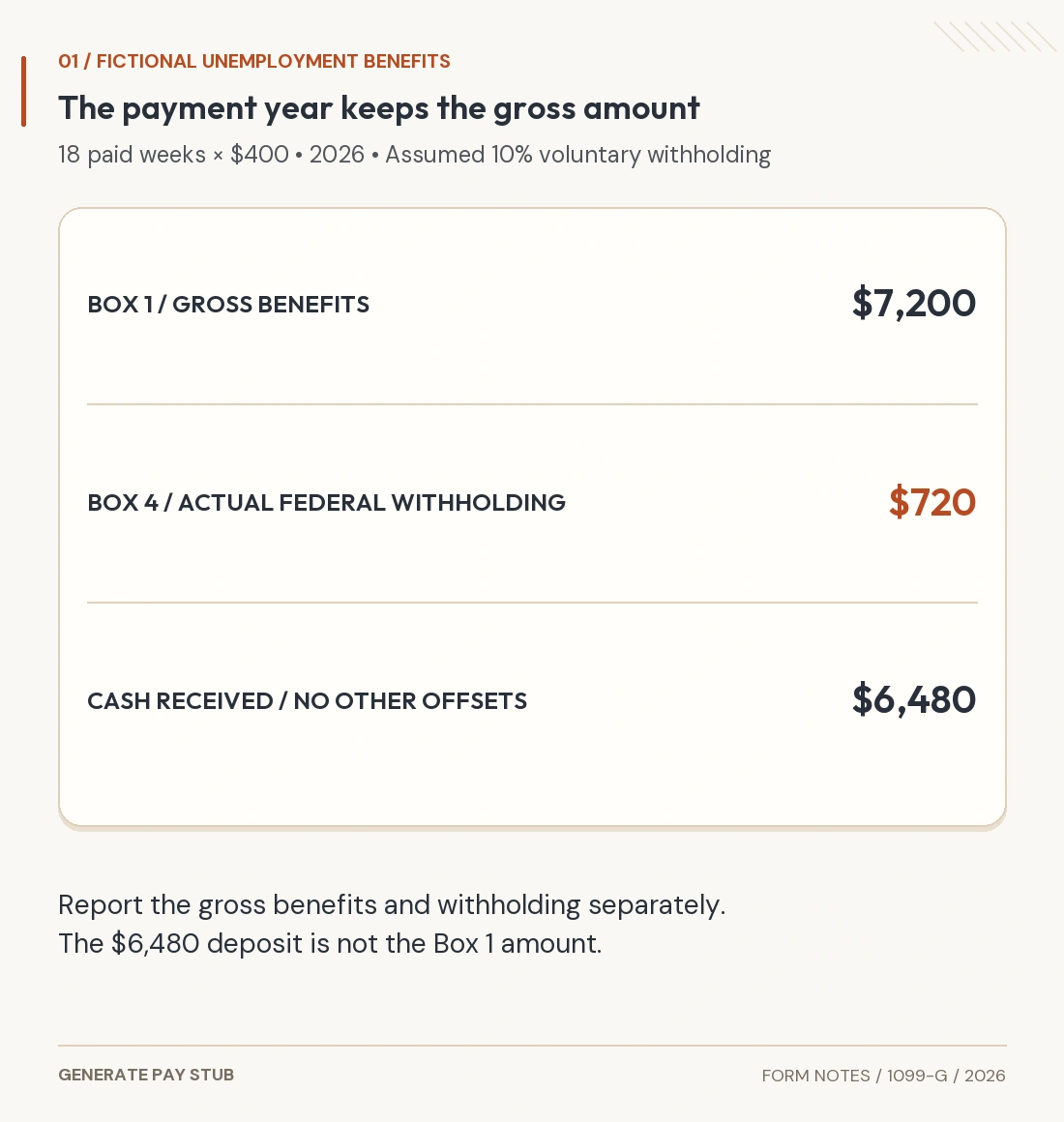
Assume a fictional person receives 18 weeks of regular state unemployment benefits at $400 per paid week in 2026. Gross benefits are $7,200. Assume an effective voluntary federal withholding election of 10%, no repayments, offsets, state withholding or other adjustments.
Actual federal withholding is $720, leaving $6,480 cash. The statement shows $7,200 in Box 1 and $720 in Box 4. Reporting only the deposit as unemployment income would omit the withheld portion.

Form W-4V provides the voluntary-withholding request, including the 10% unemployment option. Give the request to the payer rather than sending it to the IRS. Confirm the agency's process and when an election takes effect.
Withholding can be insufficient or excessive for the overall return. It is not an expense to subtract from unemployment compensation, nor a guarantee that no additional payment will be due.
Is the state income-tax refund in Box 2 always taxable?
No. Review whether the earlier deduction produced a federal tax benefit. A Box 2 payment can be taxable in whole, in part or not at all.
If the taxpayer used the federal standard deduction for the relevant earlier year, an ordinary personal state income-tax refund generally does not recover an itemized deduction. Itemizing also does not prove that the entire refund is taxable.
Publication 525's recovery rules explain the tax-benefit analysis. The applicable year, deduction limits, sales-tax alternative, AMT, credits, earlier taxable income and payments spanning tax years can change the calculation. Use the worksheet for the actual receipt year.
Box 3 identifies the tax year related to Box 2 when different from the payment year. A 2026 payment for 2025 taxes uses 2025 there; it does not turn the statement into a 2025 payment record. Separate earlier tax years can require separate statements.
What does a limited tax-benefit example show?
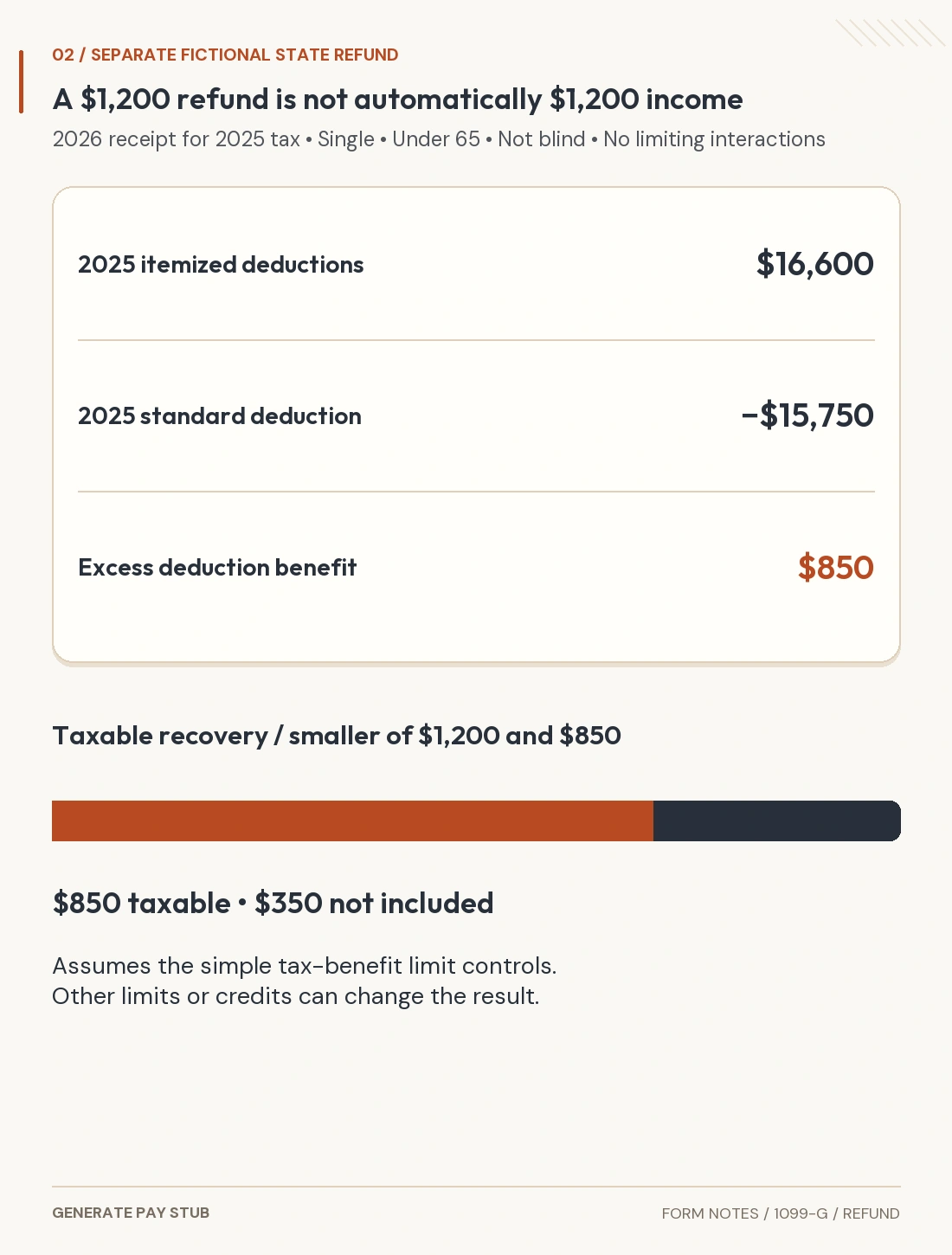
Assume a fictional $1,200 state income-tax refund received in 2026 for tax paid entirely during 2025. The taxpayer was single, under 65, not blind and not another person's dependent in 2025.
Suppose allowed 2025 itemized deductions were $16,600, including the refunded tax. The otherwise available standard deduction was $15,750, as shown in the 2025 Form 1040 instructions. Assume positive taxable income and tax, with no SALT limitation, AMT, credit interaction, alternative sales-tax restriction, other recovery or special rule changing the tax benefit.
| Review step | Amount |
|---|---|
| Allowed 2025 itemized deductions | $16,600.00 |
| Otherwise available 2025 standard deduction | $15,750.00 |
| Difference that produced the assumed benefit | $850.00 |
| Refund received in 2026 | $1,200.00 |
| Taxable recovery under these limited assumptions | $850.00 |
| Refund not included in income | $350.00 |

The calculation is $16,600 − $15,750 = $850, followed by the smaller of $1,200 and $850. The result is $850 income, not an $850 tax bill.
An agency may correctly report the full $1,200 refund even though only part is taxable to the recipient. Interest paid on a refund is a separate interest-income item, not another portion of Box 2.
What changed for family-leave reporting in 2026?
The revised form adds Box 10 for governmental family-leave benefits. Its state fields move to 11a, 11b and 12. The 2026 original and recipient explanations show the new layout; it should not be used for earlier payment years.
Revenue Ruling 2025-4 distinguishes family leave from medical leave under the state programs it describes. Family benefits are included in federal gross income but are not federal employment-tax wages under that ruling. Medical benefits require an analysis of employer and employee funding.
Notice 2026-6 extends specified transition relief through 2026 for employer-funded portions of state medical-leave benefits. That limited administrative relief is not a blanket exemption for all PFML income. It also does not extend the separate employer-pickup contribution relief; those amounts have their own wage-reporting rules.
Use the program's facts and current guidance before choosing a form or box. A generic description such as “paid leave” does not establish that all payments belong in Box 1 or the new Box 10.
What if the 1099-G is wrong or reports unfamiliar benefits?
Verify the source through the agency's official channel. Compare the gross amount, withholding, payment year, benefit weeks and refund-year detail with your records.
The IRS unemployment identity-theft guidance tells victims to report fraud to the issuing state and request a corrected form. For fraudulent benefits not received, file an accurate return using actual income rather than including the false payment merely because a statement exists.
Benefit overpayment repayments require another analysis. Same-year corrections and repayments of prior-year income can have different treatment; preserve the agency's repayment statement instead of subtracting an undocumented amount from any convenient box.
How should an authorized preparer review the builder?
Use records you are authorized to report and the correct payment-year version. The Form 1099-G overview leads to the government-payment statement tool.
The reviewed tool supports 2025 and 2026, separates refund-year detail and makes the family-leave field available for 2026. Actual withholding is entered from records. It fills Copies 1, B and 2 in a six-page packet while red Copy A remains blank.
Inspect the identities, government payer, payment types, year, account reference, prior tax year, flags and any applicable state information. Optional fields should reflect actual reporting requirements rather than guesses.
What remains after the PDF is prepared?
Recipient furnishing and agency filing still need completion. Standard 2026 deadlines roll to February 1, 2027 for recipient statements and March 1 for ordinary paper IRS filing; the usual electronic deadline is March 31. Confirm applicable exceptions and current instructions.
The ten-return electronic-filing threshold generally combines covered returns. The IRS's IRIS process, authorized paper submission, corrections and state obligations are separate from this document builder. Do not print the informational red Copy A as an IRS paper filing.
General U.S. federal information, checked November 6, 2026. Fictional 2026 examples assume the stated conditions. State tax law and benefit-program rules may differ.