Form 1099-R reports retirement and other covered distributions, including gross amounts, taxable-amount information, withholding and distribution codes. Read it with the account records: cash received, the payer's reported taxable amount and the amount ultimately taxable on a return can differ.
This guide uses the 2026 form, including its revised Box 7 fields. The current IRS original, instructions and the site's 2025/2026 tool were reviewed November 5, 2026. Our worked case compares three separate rollover choices for an entirely pretax employer-plan payment.
Who prepares and receives Form 1099-R?
The responsible plan, custodian, insurer or other reporting payer prepares the statement. The 2026 instructions generally cover designated distributions of $10 or more, including payments from retirement plans, IRAs, pensions and specified insurance arrangements.
A recipient ordinarily checks the issued statement rather than generating a replacement in the payer's name. Ask the issuer about an incorrect identity, amount or code and keep its response with the distribution records.
A distribution can be reportable even when a valid rollover prevents current income tax. Conversely, a low distribution amount does not by itself create an income-tax exemption.
Which 1099-R boxes should you reconcile first?
Start with gross distribution, taxable information, withholding and the applicable code. The 2026 original and recipient explanations distinguish these fields.
| Field | What to verify |
|---|---|
| Box 1 | Gross distribution, including applicable amounts not paid as cash to you |
| Box 2a | Payer-reported taxable amount, subject to recipient-level analysis |
| Box 2b | Taxable-amount-not-determined and total-distribution flags have different meanings |
| Box 4 | Actual federal income tax withheld |
| Box 7a | Distribution code or permitted code combination for 2026 |
| Box 7b | Whether the IRA / SEP / SIMPLE indicator applies |
| Boxes 5, 6 and other special fields | Contribution basis, employer securities or other applicable details |
A total-distribution checkbox concerns the account balance distributed during the year. It does not mean that the payment is completely taxable. Similarly, withholding is a payment toward tax, not the final amount of tax assessed.
Why can a $40,000 distribution produce $32,000 cash?
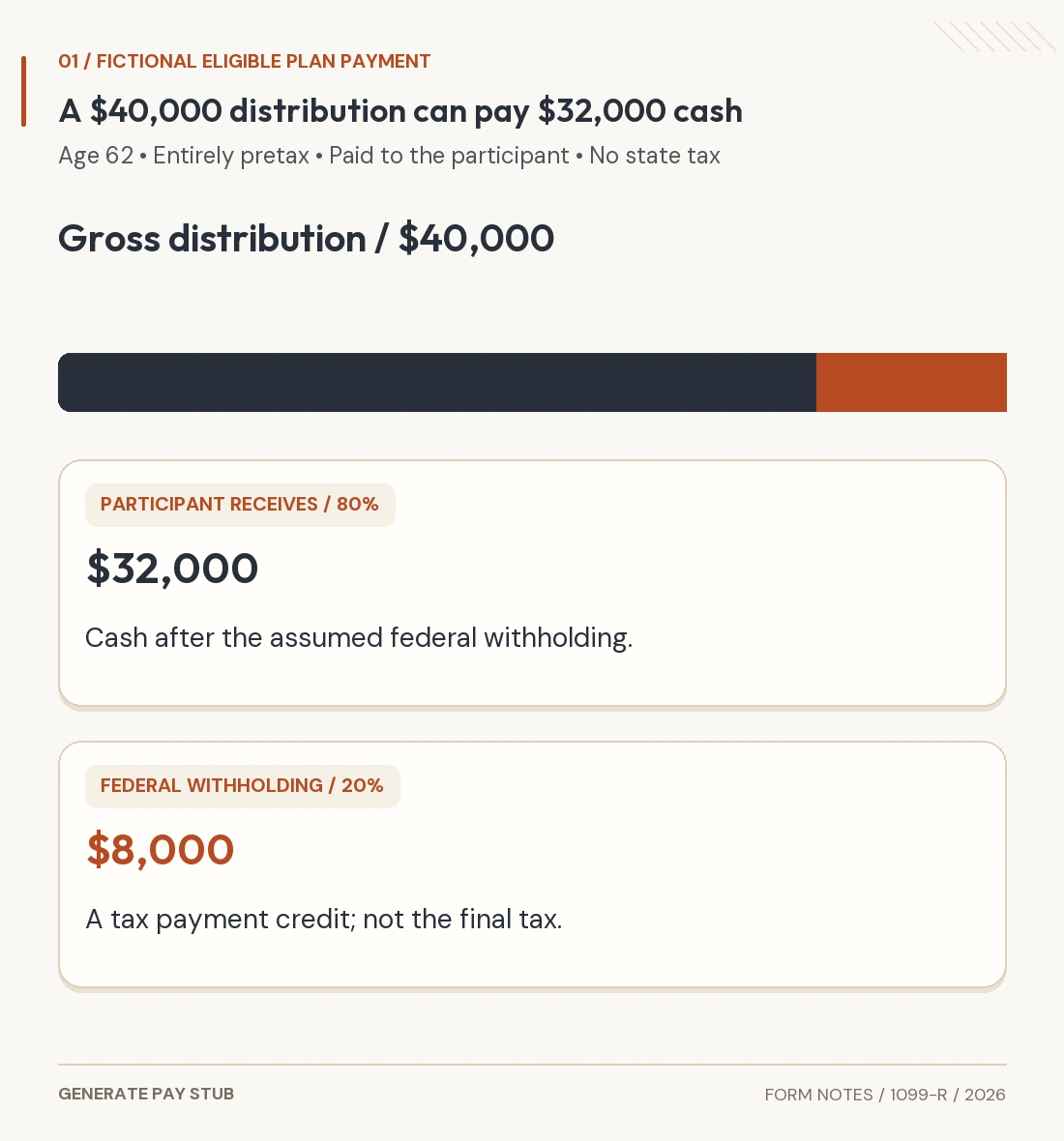
Mandatory withholding can reduce the payment delivered to the participant. The IRS rollover topic explains the usual 20% withholding on a taxable eligible rollover distribution from an employer-sponsored plan paid to the participant.
Assume a fictional participant, age 62, receives a $40,000 eligible lump-sum distribution from a qualified employer plan in 2026. It consists entirely of pretax money, contains no required minimum distribution and has no employer stock, after-tax basis or Roth component. Assume 20% federal withholding, no higher election and no state withholding.
The payer withholds $8,000 and delivers $32,000. The gross distribution remains $40,000. This example is not an IRA withdrawal or a periodic pension payment; their withholding rules can differ.

What changes under direct, full and partial rollover choices?
Track how much reaches an eligible receiving account through a valid rollover. The IRS rollover guide distinguishes direct payments, trustee transfers and the usual 60-day route.
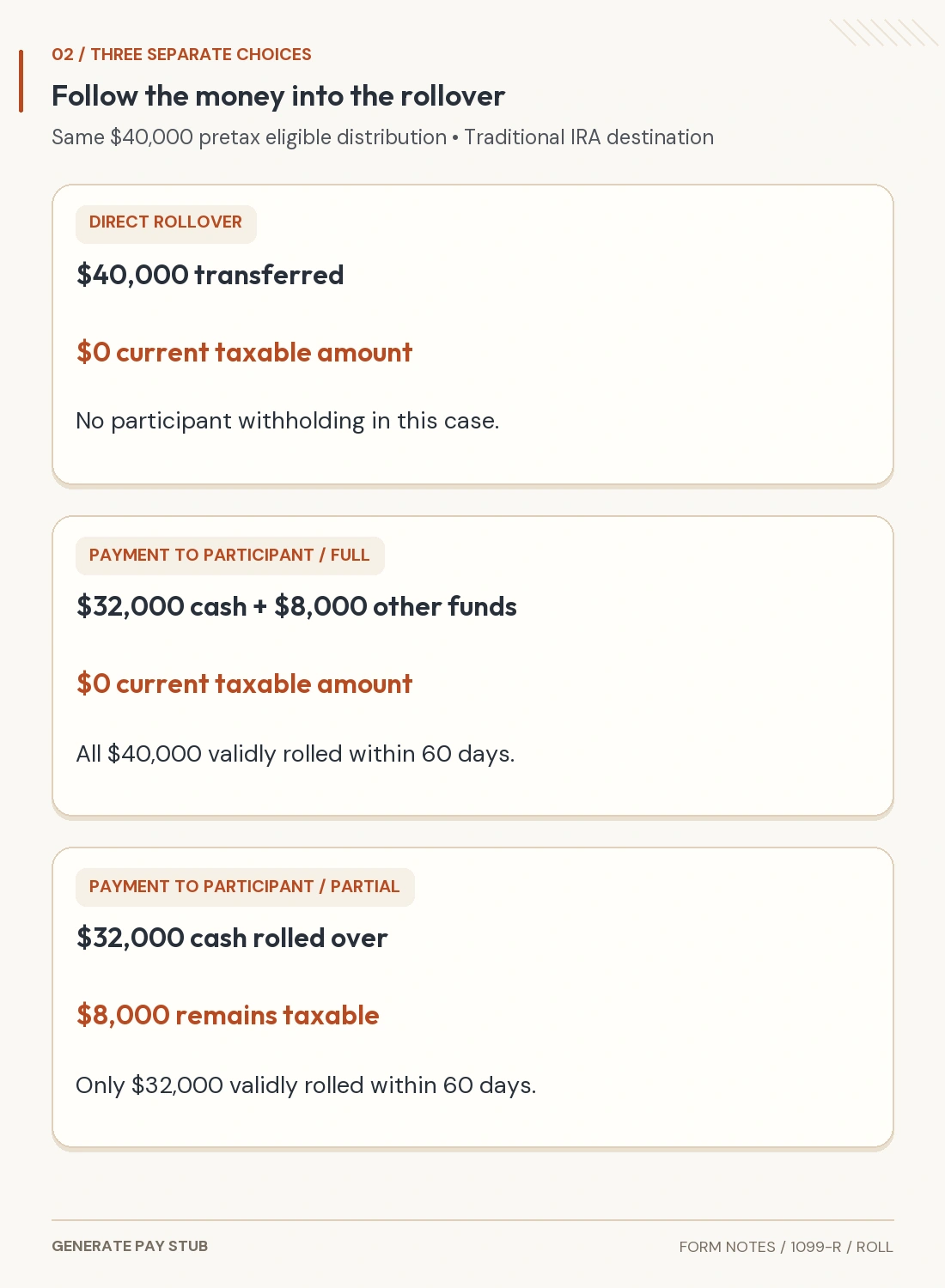
Compare these separate alternatives, each involving the same $40,000 and an eligible traditional IRA destination:
| Choice | Validly rolled over | Federal withholding | Currently taxable from this distribution |
|---|---|---|---|
| Direct rollover | $40,000.00 | $0.00 | $0.00 |
| Paid to participant; add $8,000 from other funds | $40,000.00 | $8,000.00 | $0.00 |
| Paid to participant; roll only the $32,000 cash | $32,000.00 | $8,000.00 | $8,000.00 |

For the full 60-day rollover, $32,000 cash plus $8,000 from another source restores the full $40,000. The withholding remains a credit on the tax return; it is not deposited into the IRA automatically.
For the partial case, the unrolled $8,000 is taxable under our assumptions. At age 62, the example does not incur the age-based 10% early-distribution tax. It still can owe ordinary income tax; the overall return determines the result.
A direct rollover to a Roth IRA can have a different taxable outcome. “Direct” does not mean that a pretax-to-Roth conversion is tax-free. Required minimum distributions and other ineligible payments cannot be fixed simply by depositing them in another account.
Does Box 2a always equal the final taxable amount on the return?
No. Recipient facts can require a separate calculation. In the participant-paid example, the payer generally reports the $40,000 payment as taxable before knowing the participant's later valid rollover. The recipient's return reflects the subsequent rollover and actual withholding.
A correctly issued statement does not become erroneous merely because a later rollover reduces current taxable income. Retain receipt and receiving-account evidence instead of changing the issuer's actual gross distribution.
For traditional IRAs, the “taxable amount not determined” flag is especially important. It does not mean zero tax. Form 8606 addresses nondeductible IRA contributions and specified IRA distributions or conversions. Basis can require a calculation across applicable IRA balances, not just the account that made the payment.
How do distribution codes and the 2026 changes matter?
Match the code to the actual transaction and correct year's layout. In our ordinary age-62 participant-payment case, Code 7 generally identifies a normal distribution. An eligible direct plan-to-traditional-IRA rollover ordinarily uses Code G.
The 2026 layout identifies the distribution code as Box 7a and the IRA/SEP/SIMPLE checkbox as 7b. It adds 7c for Trump-account reporting and 7d for specified earnings on excess contributions from those accounts. These fields are not additional ordinary distribution amounts to invent.
The 2026 instructions make Code Y optional for qualified charitable distribution reporting. When used, it must be paired with the permitted Code 4, 7 or K; the code does not itself establish QCD eligibility. Use the code table rather than combining codes that merely sound relevant.
Which situations need additional review?
Review the account and transaction rules before choosing a taxable amount. Important cases include inherited accounts, Roth qualification, after-tax plan contributions, employer securities, corrective distributions, qualified charitable distributions and loan offsets.
The IRS early-distribution exceptions table distinguishes retirement plans from IRAs. An exception to additional tax can leave ordinary income tax payable. A payer's Code 1 also does not prevent a recipient from documenting an applicable exception through the required return process.
The one-rollover-per-year rule for certain IRA-to-IRA rollovers should not be imposed indiscriminately on plan-to-IRA rollovers or trustee transfers. Likewise, a missed 60-day deadline requires actual relief eligibility, not an unsupported assumption that a late deposit is valid.
How do you prepare and file the 1099-R packet?
Use plan records and confirm the year before preparing the copies. The 1099-R overview links to the retirement distribution builder.
The reviewed tool offers 2025 and 2026, permits up to two compatible codes and provides applicable contribution, Roth, withholding, state and local fields. Its nine-page packet fills Copies 1, B, C and 2; red Copy A stays blank. It does not calculate every recipient's taxable amount or file the return with tax agencies.
Use 2026 Publication 1099 for agency filing and statement obligations. The ordinary 2026 recipient deadline falls February 1, 2027; standard paper and electronic IRS deadlines fall March 1 and March 31, respectively, subject to applicable exceptions or relief. Covered returns aggregate for the ten-return e-file threshold, and IRIS is the intake system for the 2027 filing season.
Review the distribution evidence, completed copies, secure recipient delivery and separate filing acceptance. A printable information copy is not a compliant red Copy A paper filing.
General U.S. federal information for the 2026 form. Examples assume age 62, an eligible entirely pretax employer-plan distribution, a traditional IRA destination and valid timely rollovers. They are not account-specific tax advice.