Form 4868 requests an automatic extension to file an eligible individual federal income tax return. It generally gives an ordinary calendar-year filer until October 15, but tax remains due by the original April deadline. A proper estimate and timely request matter; merely downloading a form does not establish an extension.
Current timing: this guide and the reviewed tool use the final 2025 edition. For most domestic 2025 filers, April 15 and October 15, 2026 have already passed. This is a form-and-record review, not an invitation to request a new timely 2025 extension now. The IRS Free File extension page currently says its extension-request period is closed and points readers to January 2027 for the next season.
What does an individual filing extension actually change?
It changes the time to submit the return, not the amount of tax or the ordinary payment deadline. The IRS extension overview explains the distinction and available request methods.
An extension gives time to finish a return when records are incomplete. It does not replace the return, make missing documents accurate or resolve a payment shortfall. Likewise, an extension of a business's information-return filing deadline is a separate Form 8809 matter.
How do you estimate liability and reconcile payments?
Prepare a reasonable draft calculation using the information available. Organize income statements, business results, deductions, credits, withholding and estimated payments. Reconcile year and taxpayer identity before adding anything.
A paycheck's federal withholding is only one payment component. Gross wages are not total tax, and Social Security or Medicare withholding should not be mistaken for ordinary federal income-tax payments.
The 2025 Form 4868 and attached instructions separate estimated total liability, payments already made, the resulting balance and the new payment accompanying the extension. A properly estimated liability is required even though paying the full balance is not a condition of obtaining the filing extension.
How do Lines 4–7 work in a checked example?
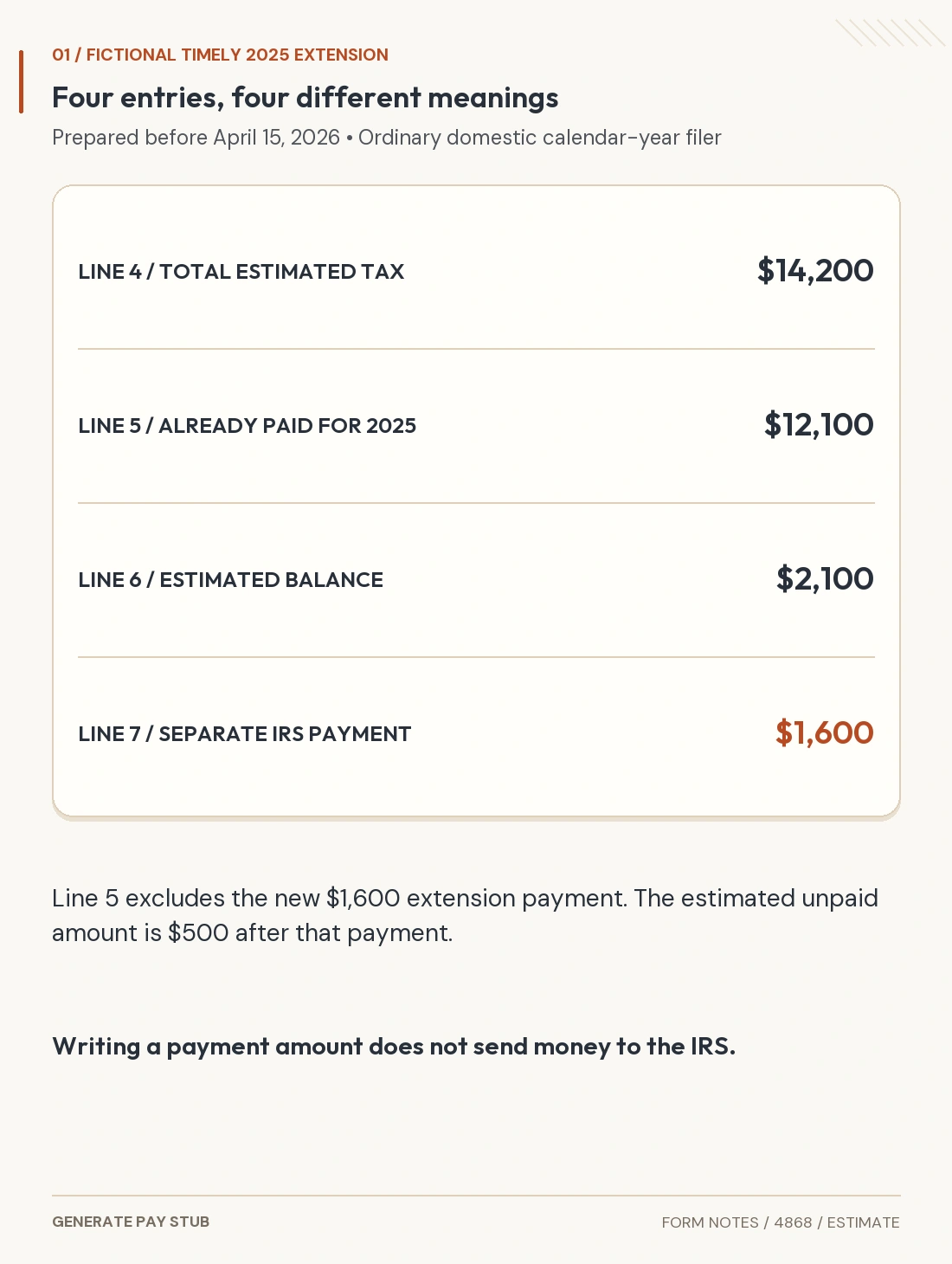
Assume a fictional domestic calendar-year taxpayer prepared a valid request before April 15, 2026. Their reasonable preliminary 2025 total-tax estimate is $14,200. Verified federal income-tax withholding is $10,900, and estimated payments already credited for 2025 are $1,200. No other payment or refundable-credit amounts apply.
| Line | Entry | Amount |
|---|---|---|
| 4 | Reasonably estimated total 2025 tax | $14,200.00 |
| 5 | Prior payments: $10,900 withholding + $1,200 estimates | $12,100.00 |
| 6 | Estimated balance: Line 4 minus Line 5 | $2,100.00 |
| 7 | New tax payment made separately with the extension | $1,600.00 |
The $1,600 new payment is excluded from Line 5. Entering it twice would understate the remaining balance. The original $2,100 balance less that payment leaves an estimated $500 unpaid, before the return's final calculation and applicable additions.

For clarity, every amount in this example belongs to the 2025 tax account. A payment for the wrong year or a document-preparation purchase does not become a 2025 IRS payment just because it appears beside the extension form.
What if the completed return shows more tax than estimated?
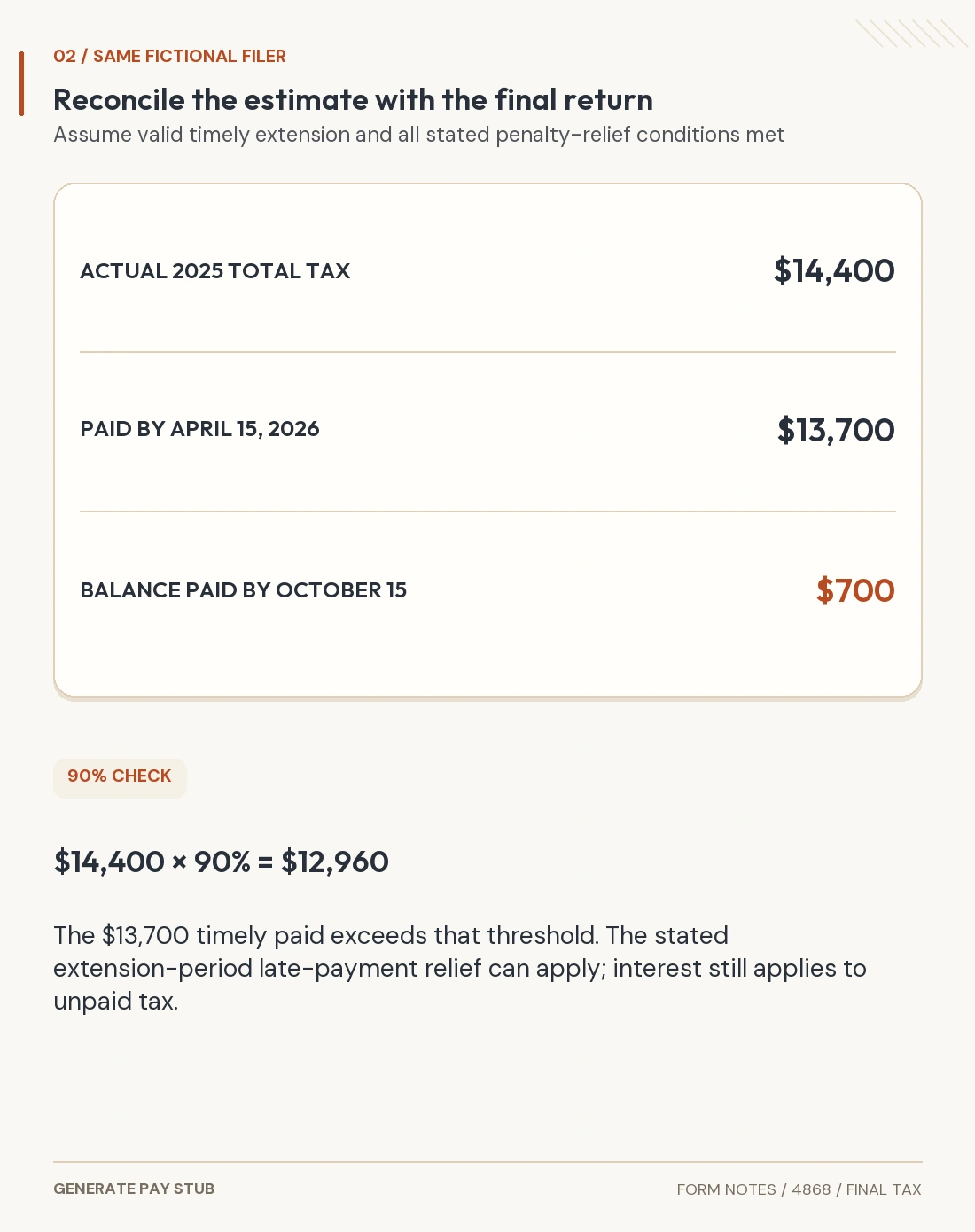
Reconcile the actual result against all credited payments. Suppose the completed return shows $14,400 total tax. The taxpayer had paid $10,900 + $1,200 + $1,600 = $13,700 by April 15. The actual remaining tax is $700, rather than the earlier $500 estimate.
Assume the return is filed and the $700 is paid by October 15, 2026 under the valid extension. Ninety percent of $14,400 is $12,960. The $13,700 timely paid exceeds that amount.

The 2025 form instructions provide an extension-period late-payment reasonable-cause rule when at least 90% of actual total tax is paid by the regular deadline and the remainder is paid with the timely extended return. This example assumes those conditions and all other relevant requirements are met.
The IRS late-payment guidance otherwise describes a usual 0.5% monthly or partial-month penalty on unpaid tax, with a 25% cap and applicable adjustments. Other relief depends on the facts.
Interest still accrues on tax unpaid after the regular due date. Rates can change quarterly, so a single guessed rate is not an accurate full-period calculation. The 90% extension rule also does not settle a separate estimated-tax underpayment issue.
What were the available ways to request the extension?
Choose a recognized submission route and retain its evidence. IRS Topic 304 describes electronic Form 4868 filing, paper filing and a qualifying electronic payment designated as an extension.
When properly using the electronic extension-payment option, a separate Form 4868 is not needed. Designating the purpose and tax year matters. An ordinary payment labeled for another purpose should not be assumed to request an extension.
IRS Free File offers extension requests without an income restriction during its available filing period. That service is distinct from a paid form-preparation tool, and current availability must be checked. Save the acceptance acknowledgment or payment confirmation; an unsent PDF is not filing evidence.
What changes for overseas, nonresident or ITIN applicants?
Check the applicable filing category before applying the ordinary calendar. Qualifying U.S. citizens and residents abroad may receive an automatic two-month filing and payment period under specific conditions, while interest can still run from the original due date. A further four-month filing request is different from receiving another six months.
Certain Form 1040-NR filers have a different ordinary due date. Fiscal-year taxpayers must use the required paper procedure. Combat-zone and disaster provisions can also change dates. A short trip abroad does not automatically establish the overseas category.
An applicant who needs an ITIN can follow the IRS no-ITIN extension instructions, including the prescribed “ITIN TO BE REQUESTED” entry where applicable. Do not attach W-7 to Form 4868. The later ITIN application packet has its own return and document requirements.
Federal extension rules do not establish each state's filing or payment procedure. Check the relevant state separately.
What should you do if the ordinary 2025 deadlines were missed?
Determine whether specific relief applies, then address the unfiled return promptly. A late Form 4868 ordinarily cannot retroactively create the requested automatic extension. Confirm any disaster, combat-zone or other special rule before concluding which deadline applied.
The IRS failure-to-file guidance explains that lateness is measured against the due date including valid extensions. Pay what you can and finish the return instead of waiting solely because you cannot pay in full. Review any IRS notice and supported penalty-relief options.
If a balance cannot be paid at once, review the IRS payment-plan options. A payment arrangement and a filing extension are different; interest and applicable penalties generally continue while the debt is unpaid.
What does the 4868 builder prepare?
It arranges the application details and calculations for review. The 4868 overview and individual-extension workspace currently offer the final 2025 edition, not a final 2026 edition.
The reviewed builder separates estimated liability, prior payments and the new tax payment; it calculates a nonnegative balance and includes the four-page original packet. Check names, identifiers, year, special-status boxes and the mailing route before any permitted submission.
Form 4868 itself has no signature requirement. The purchase prepares a document; it does not submit the request, transfer Line 7 money to the IRS or guarantee an extension. For a deadline that has passed, use the late-filing review above before purchasing preparation for that purpose.
U.S. federal information reviewed November 6, 2026. Uses the final 2025 form and fictional historical transactions. Ordinary 2025 dates have passed; special-jurisdiction or relief rules require an individual review.