Form 1099-OID reports original issue discount and related debt-instrument items. Taxable OID generally accrues while the instrument is held, so income can arise before a cash payment. Check the security's terms, ownership dates and adjustments before treating the statement as a final return calculation.
This guide explains the current January 2024 continuous-use original and uses two separate fictional examples: a full-period zero-coupon model and a 2025 gross-versus-net statement comparison. We checked the IRS references and both available builder years on November 6, 2026.
What is original issue discount?
OID generally reflects the excess of a debt instrument's stated redemption price at maturity over its issue price. Qualified stated interest is treated separately under the applicable rules. Publication 1212 explains the definitions and instrument-specific accrual methods.
OID is not simply any investment purchased below face value. A later purchase can create market discount, acquisition premium or bond premium, each with different consequences. The amount paid for a security and the issuer's original issue price are different records.
A responsible issuer, broker or intermediary prepares the information return when required. An investor generally receives it and checks the appropriate return treatment. Do not create a payer statement without authority over the actual reporting records.
What records should be assembled before preparing 1099-OID?
Identify the instrument before entering an accrual figure. Keep these together:
- Security description, CUSIP and issuer information.
- Original issue date, issue price, redemption terms and yield.
- Purchase price, settlement information and ownership dates.
- Accrual periods and annual daily-portion calculations.
- Qualified stated interest and payments other than that interest.
- Covered-security status, relevant elections and premium or discount adjustments.
- Actual withholding and any applicable state details.
The combined 1099-INT/OID instructions generally require an OID statement when the holder's total daily portions reach $10 and the reporting-party conditions apply. Other triggers and exceptions can matter. The threshold for issuing a form does not determine whether the holder has taxable income.
How can OID income arise without a coupon payment?
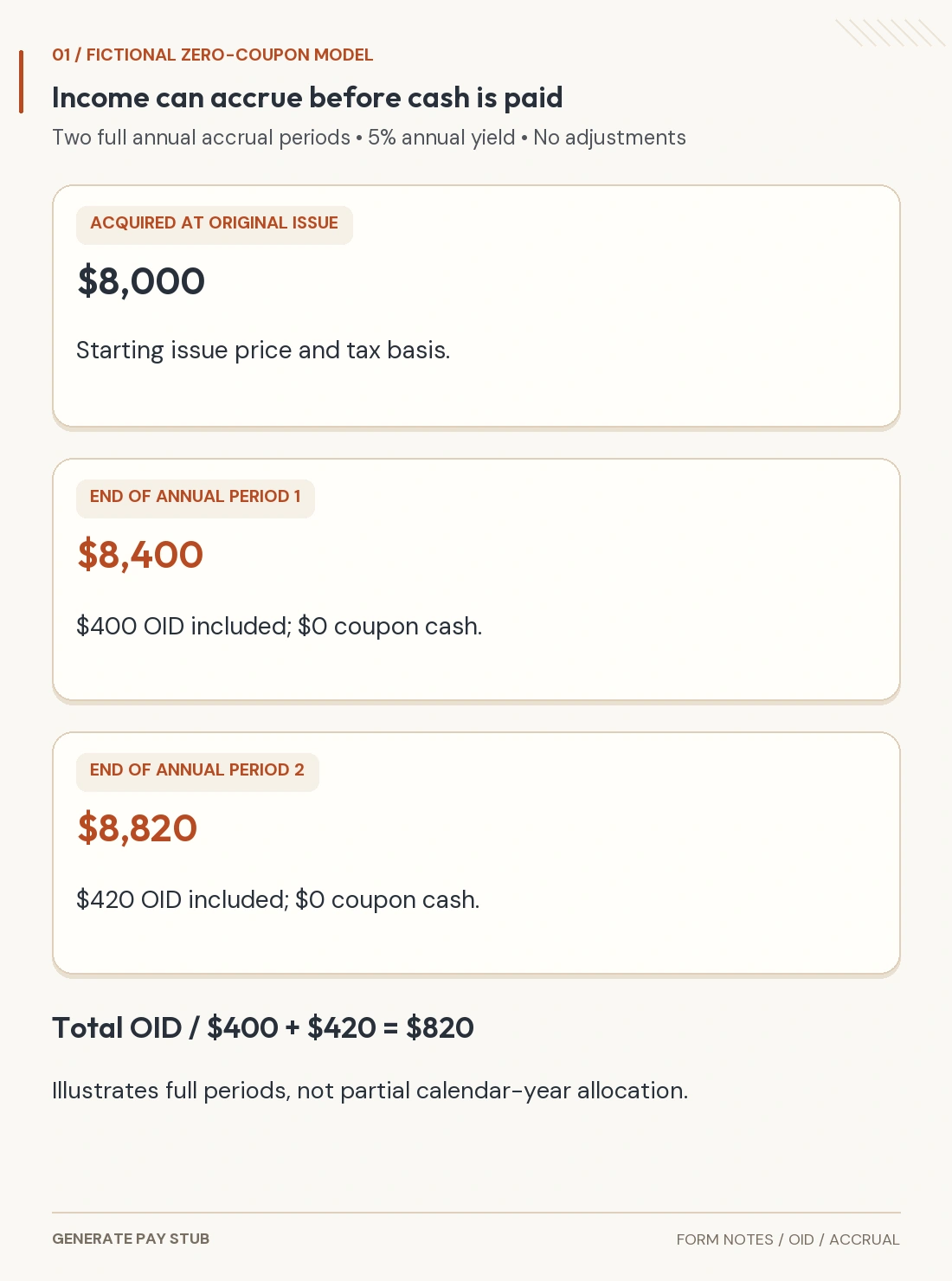
A constant-yield calculation can recognize growth during the holding period. Consider a fictional taxable zero-coupon instrument purchased at original issue for $8,000. Assume a 5% annual yield, two full annual accrual periods and an $8,820 redemption amount. There are no coupons, premium, intermediate principal payments or special instrument rules.
| Stage | Beginning amount | Period OID | Ending amount |
|---|---|---|---|
| Annual period 1 | $8,000.00 | $400.00 | $8,400.00 |
| Annual period 2 | $8,400.00 | $420.00 | $8,820.00 |
| Total OID | — | $820.00 | — |

The arithmetic is $8,000 × 5% = $400, then $8,400 × 5% = $420. The $820 total matches $8,820 less $8,000. Splitting the discount equally into two $410 entries would not reproduce this assumed yield.
The holder includes the applicable taxable OID and adjusts basis, even without coupon cash. The investment-income publication explains annual OID and related investment treatment.
This is an educational full-accrual-period model. It does not prescribe how much belongs in a particular calendar year's Box 1 when an accrual period crosses December 31, the holding is partial-year or an adjustment applies.
Which 1099-OID boxes describe which amounts?
Use the form's own box meanings; the numbering differs from 1099-INT. The seven-page original and recipient instructions provide the reference.
| Box | Meaning | Review point |
|---|---|---|
| 1 | Original issue discount for the year | Separate from Treasury OID |
| 2 | Other periodic interest | Check whether also reported elsewhere |
| 3 | Early-withdrawal penalty | Separate eligible adjustment; not ordinary OID |
| 4 | Federal income tax withheld | Actual tax payment, not invented offset |
| 5 | Market discount | Review the applicable election and security record |
| 6 | Acquisition premium | May already be reflected in a net OID figure |
| 7 | Description | Identify the security accurately |
| 8 | Treasury OID | Do not add the same amount again to Box 1 |
| 10 | Bond premium | Different from acquisition premium |
| 11 | Tax-exempt OID | Requires its own reporting and basis analysis |
Qualified stated interest may be reported on this form or Form 1099-INT under the permitted reporting approach. The same payment must not become income twice. See our interest and penalty guide for the related statement.
How do gross and net acquisition-premium reporting differ?
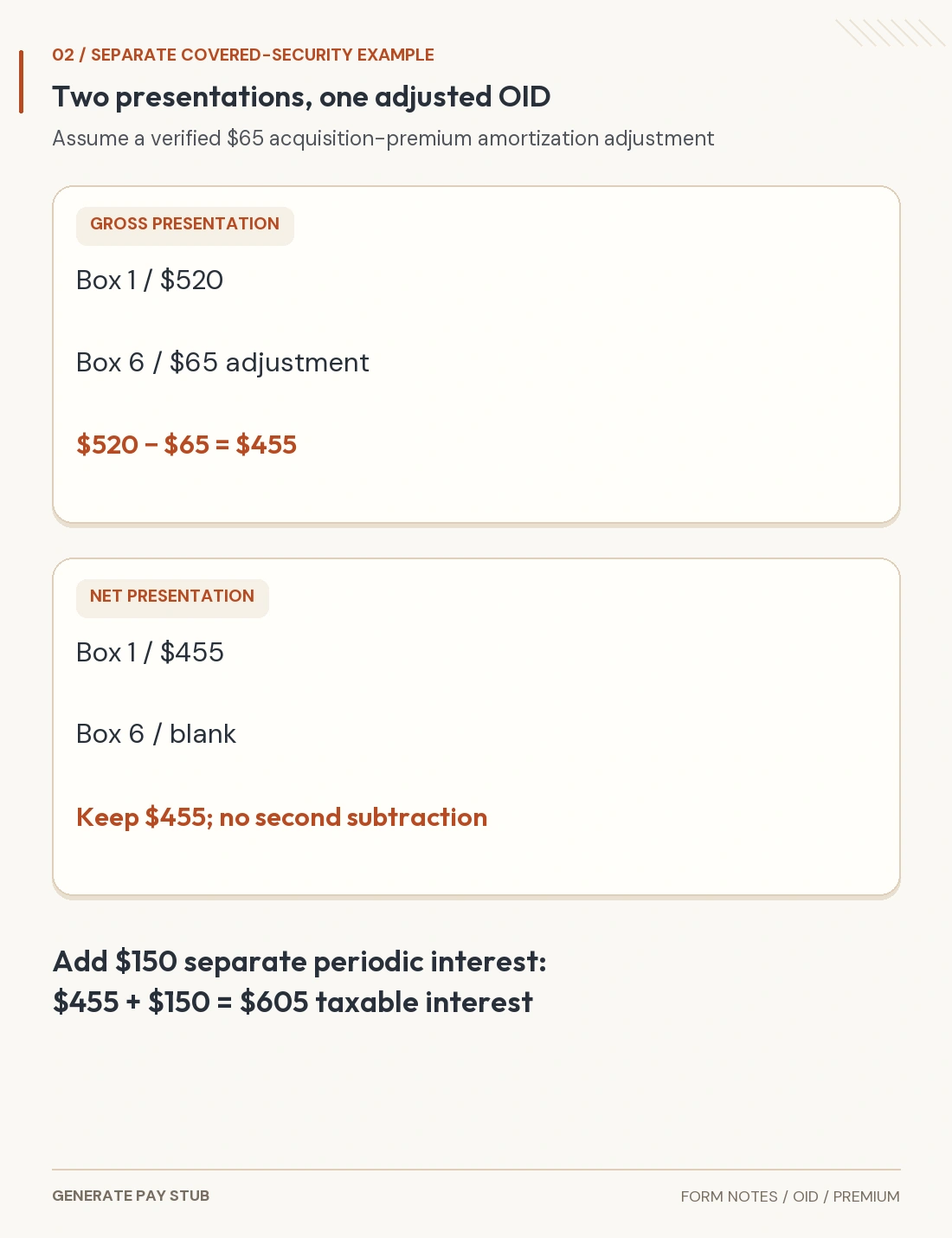
Determine whether the broker has already applied the adjustment. In a separate fictional 2025 covered-security case, assume the verified gross annual OID is $520 and the supported acquisition-premium amortization is $65.
Under the gross presentation, Box 1 shows $520 and Box 6 shows $65. The adjusted OID is $455. Under the permitted net presentation, Box 1 already shows $455 and Box 6 is blank. Subtracting another $65 would incorrectly reduce the amount to $390.

Assume $150 of separate taxable periodic interest belongs to this instrument and is reported only once. Either correct presentation gives $455 + $150 = $605 taxable interest. That total is not the investor's final tax.
The 2025 Schedule B instructions specifically distinguish an OID adjustment from a figure already reported net. Keep the annual workpaper so the reconciliation is reproducible.
What can change the basic OID calculation?
The instrument and transaction details control the adjustment. In particular:
- Purchase after issue: acquisition premium, market discount or bond premium may change the result.
- Partial ownership: use the required daily portions and holding dates rather than a casual fraction of annual income.
- Small original discount: a de minimis rule may apply, with special limits and exceptions.
- Inflation-indexed debt: TIPS can have positive or negative adjustments under their specific rules.
- Contingent payments or stripped instruments: specialized methods can replace the simple model.
- Tax-exempt debt: exemption, premium and basis questions need separate treatment.
Do not apply the two-period example to every discounted investment. Missing a statement also does not establish that no OID accrued.
How should the recipient review the return and basis?
Reconcile income and basis together. Check issuer figures against the acquisition and holding records, identify net reporting, and prevent duplicate stated-interest reporting across forms.
Maintain the history of included OID and other required basis changes. Otherwise, later sale or redemption proceeds may be compared with an outdated purchase basis and produce an incorrect gain. A market-value decline does not automatically cancel current accrued OID.
Ask the issuer about a genuine statement error. A difference caused by a valid recipient adjustment should be documented through the required return process; it is not permission to rewrite the payer's records.
How do you prepare and deliver the 1099-OID packet?
Select the year and use the finished accrual workpaper. Visit the 1099-OID information page or the OID form builder.
The reviewed builder supports 2025 and 2026, includes security description and adjustment fields, and allows a negative Treasury OID amount where applicable. It fills Copies 1, B and 2 in a seven-page packet, leaving red Copy A blank. It does not derive every accrual or file with the IRS.
For 2026 reporting, use Publication 1099 to confirm filing, recipient delivery and correction requirements. The standard recipient date rolls to February 1, 2027, with February 16 for qualifying consolidated statements. Ordinary IRS paper and electronic dates are March 1 and March 31, respectively, subject to applicable exceptions.
Verify the aggregate electronic-filing requirement, appropriate IRS submission method, recipient consent where needed and separate state obligations. Keep source calculations, the issued copy and filing acceptance; a prepared PDF alone proves none of the delivery steps.
General U.S. federal information, reviewed November 6, 2026. The full-period zero-coupon model and 2025 covered-security example are separate fictional cases with explicitly assumed terms.