Form 1099-INT reports interest and related items such as an eligible early-withdrawal penalty, actual withholding and specified bond adjustments. The boxes are not a single cash total: Treasury interest is separate from Box 1, while the private-activity-bond amount in Box 9 is included in Box 8.
The practical aim is to preserve each amount's meaning from the payer's record to the recipient's return. This guide uses a fictional 2025 CD and interest example. The current January 2024 continuous-use IRS form and the site's 2025/2026 builder were reviewed November 5, 2026.
Who issues Form 1099-INT, and when is interest reportable?
The responsible payer or reporting intermediary prepares the statement. A bank customer ordinarily receives it; an authorized payer works from its payment and identification records.
The IRS interest overview explains that interest generally becomes taxable when received or made available under the applicable rules. Moving it into another savings account does not itself make it tax-free.
Bank interest commonly has a $10 reporting threshold, but the form-specific instructions contain other payment categories, foreign-tax and backup-withholding triggers, and exempt-recipient exceptions. The payer's reporting threshold does not excuse a recipient from reporting taxable income below that amount.
Use rules for the payment year and category. Do not apply a threshold for one type of business payment to every savings account or assume that all foreign-person payments use this form.
How do the main 1099-INT boxes differ?
Separate income categories, included detail and adjustments. The original seven-page packet includes recipient explanations of the numbered fields.
| Box | Item | Review point |
|---|---|---|
| 1 | Interest income | Generally taxable interest other than Box 3 |
| 2 | Early-withdrawal penalty | Shown separately; do not net it against Box 1 |
| 3 | Treasury and U.S. savings-bond interest | Not also included in Box 1 |
| 4 | Federal withholding | Actual amount withheld, not an estimated tax bill |
| 8 | Tax-exempt interest | Separate category that still requires reporting review |
| 9 | Specified private-activity-bond interest | Included in Box 8; relevant to AMT review |
| 10–13 | Market discount and bond premiums | Follow security-specific rules; avoid a second adjustment |
Interest from a direct Treasury obligation generally is taxable federally and exempt from state and local income taxes. U.S. savings bonds can have special timing or education-exclusion rules; do not assume every Box 3 amount follows the simplest Treasury example.
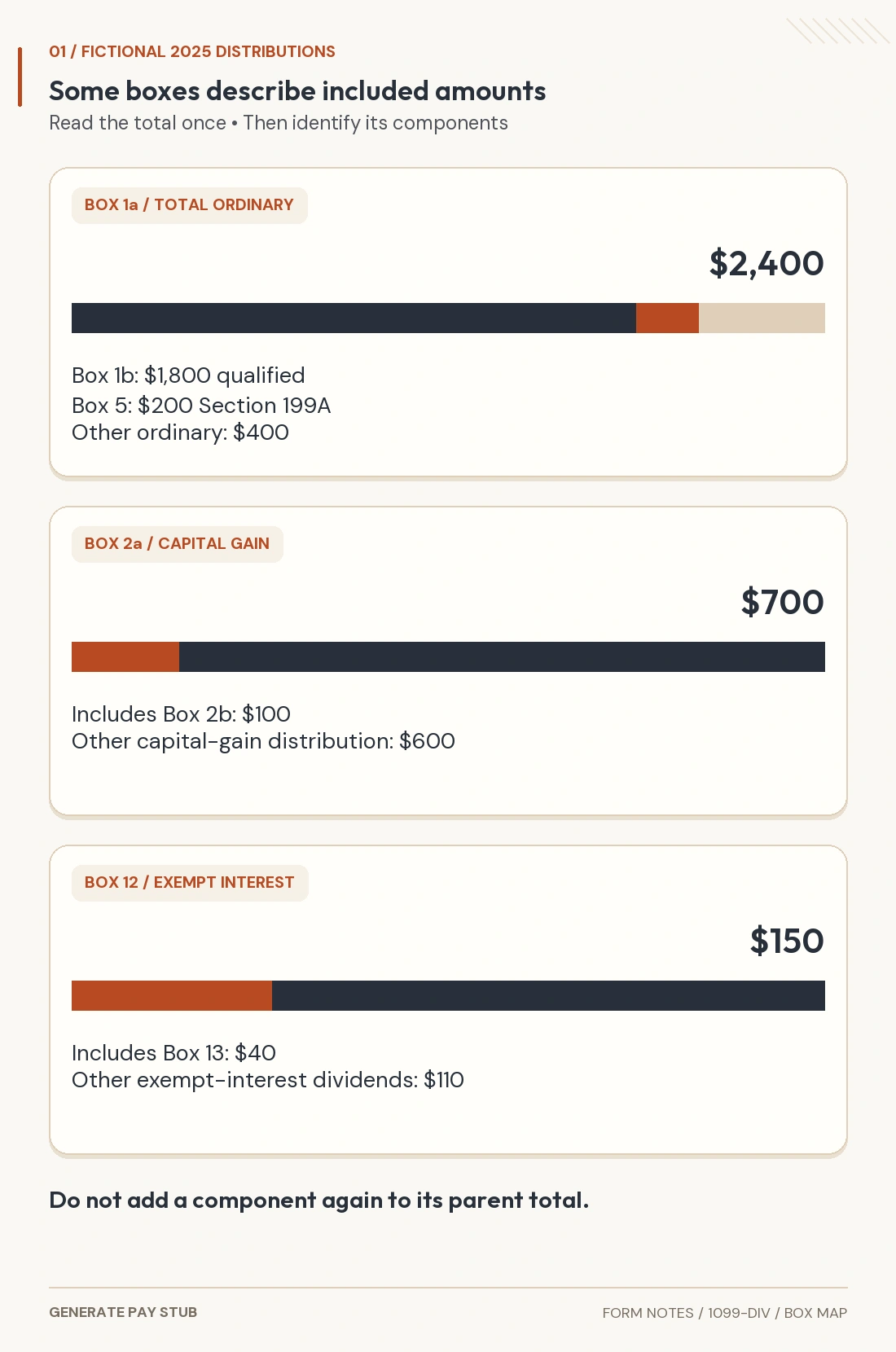
Municipal-bond interest and exempt-interest dividends from a mutual fund use different reporting forms. Our 1099-DIV box guide explains the fund-distribution route.
How should a CD early-withdrawal penalty be reported?
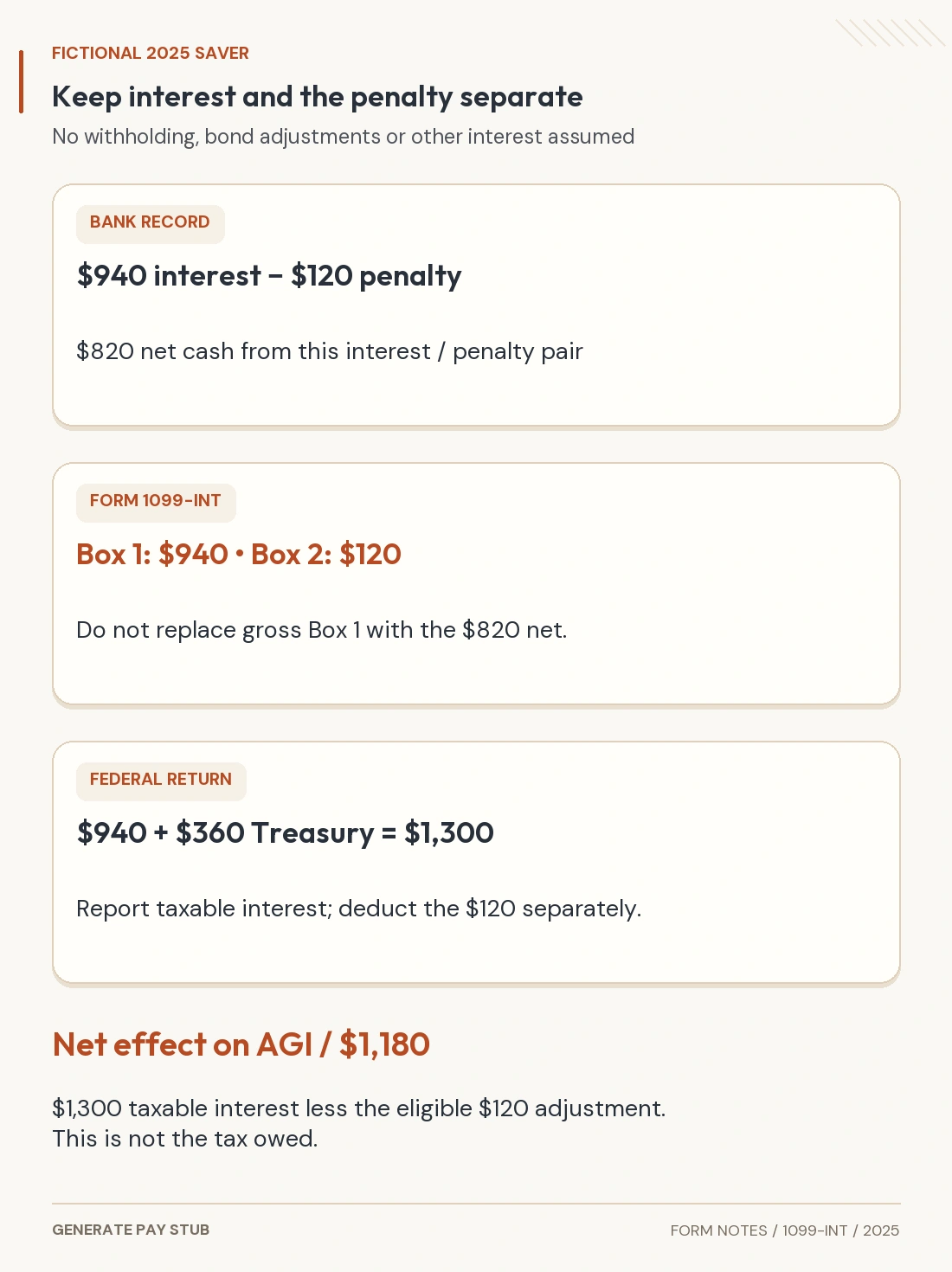
Keep the gross interest and eligible penalty in separate boxes. Suppose a fictional saver earns $940 on a bank CD during 2025 and forfeits $120 through an eligible early-withdrawal penalty. Assume no tax withholding, other bank fees or premium adjustments.
The interest-and-penalty pair produces $820 net cash, excluding the return of principal. But the payer reports $940 in Box 1 and $120 in Box 2; Box 1 is not reduced to $820.
Assume the saver also receives $360 of separate Treasury interest, fully taxable federally in 2025. The two taxable-interest amounts total $1,300. The eligible $120 penalty is deducted separately on 2025 Schedule 1, Line 18, rather than being hidden inside interest income.

The checked arithmetic is $940 + $360 − $120 = $1,180 net effect on AGI under these assumptions. That is not the tax owed or a guaranteed tax saving.
In a separate municipal-bond record, suppose Box 8 is $240 and includes $40 of specified private-activity-bond interest in Box 9. The total is $240, not $280. Keep that exempt-interest category separate from the $1,300 taxable-interest total.
What changes for bond premiums, OID or shared ownership?
Use the additional records before accepting a box amount as the final return entry. 2025 Publication 550 covers investment reporting, early-withdrawal deductions and nominee arrangements.
For a covered bond, interest may be reported gross with a separate premium amount or net under the applicable reporting method. Subtracting premium again from an already net figure understates income. Acquisition terms and elections can also affect the recipient's result.
Original issue discount is different from a CD withdrawal penalty. Taxable OID generally follows Form 1099-OID's rules, and interest on an obligation can be divided between forms under the permitted method. Do not count the same stated interest on both forms.
If the statement includes interest belonging to someone else, nominee reporting may be required. The bank's use of one account holder's TIN does not alone establish that person's ownership of all interest. Spouses and other ownership situations can have exceptions; preserve ownership evidence and follow the specific instructions.
For 2025 bond and nominee adjustments, the Schedule B instructions explain additional reporting requirements. The familiar $1,500 threshold is not the only reason Schedule B may be necessary, including certain foreign-account or trust questions.
What should a recipient reconcile?
Match the statement to annual tax records, then resolve genuine errors with the issuer. Review the payment year, account ownership, gross interest, any prior savings-bond reporting, eligible penalty and actual withholding.
Compare taxable and exempt amounts separately. Keep bond-level detail for premium, market discount and foreign tax. A bank deposit can differ from reported income because principal, withholding, penalties or reinvestment affect cash movement.
Record what you asked the issuer to correct and retain any replacement statement. A recipient should not prepare an invented issuer form to force a desired loan, income or tax result.
How do preparation, recipient delivery and IRS filing differ?
Each step needs its own completion check. The 2025 general information-return instructions set the standard 2025 statement deadline at February 2, 2026, with qualifying consolidated statements due February 17. Standard agency deadlines were March 2 for paper and March 31 electronically. All are past as of this review.
Covered information returns generally aggregate toward the ten-return e-file threshold. Corrections, electronic recipient consent, state obligations and extensions have their own requirements. A PDF download does not establish delivery or acceptance.
The original warns that its downloaded red Copy A is informational and not suitable for printing as an IRS paper filing. Arrange a compliant paper or electronic submission separately.
How do you review the 1099-INT builder packet?
Enter supported amounts for the selected year and inspect every applicable copy. Use the 1099-INT information page or the interest statement tool.
The reviewed tool supports 2025 and 2026 and fills Copies 1, B and 2 within the seven-page original packet. Red Copy A stays blank; filing with tax agencies is not included. Withholding is entered from actual records rather than calculated automatically.
Check payer and recipient data, year, account reference, interest categories, optional flags and state identification. An optional routing transit number is not the same thing as a payer TIN or state tax ID.
General U.S. federal guidance, reviewed November 5, 2026. The worked case uses 2025 amounts, a qualifying CD penalty and no withholding, savings-bond exclusion or bond adjustments.