Form 1099-DIV identifies dividends, capital-gain distributions and other reportable corporate distributions. Several boxes describe amounts already included in another box. Read the relationships before adding anything: qualified dividends in Box 1b, for example, are part of Box 1a.
This guide helps an authorized payer prepare a statement and helps a recipient check one against investment records. The examples use 2025 distributions; the site's builder offers 2025 and 2026. The IRS's currently posted January 2024 continuous-use original and related guidance were checked November 5, 2026.
Who prepares a Form 1099-DIV?
The payer or other responsible reporting party prepares the information return. An investor normally receives it from a broker, fund or corporation. A recipient should request a corrected statement from the issuer when its information is wrong rather than inventing a replacement issuer document.
The form-specific instructions generally require reporting distributions of at least $10, with additional triggers for foreign tax paid, backup withholding and liquidation distributions of at least $600. Exceptions and recipient classifications matter.
These are reporting thresholds, not universal tax exemptions. A taxpayer can have reportable investment income even when no statement arrives. Foreign-person reporting can require a different form and withholding analysis.
Which source records should you use?
Use the payer's finalized annual classifications and recipient information. Gather:
- The recipient's valid name, address and taxpayer identification record.
- The payer's identifying information and relevant account number.
- Annual distributions classified by the issuer or fund.
- Qualified-dividend, capital-gain and Section 199A detail.
- Actual withholding, foreign-tax and applicable state records.
- Nondividend, liquidation and exempt-interest details.
A brokerage cash ledger alone may not establish the final tax character. Keep revised issuer classifications with the statement. For identification preparation, see our Form W-9 name and tax-ID guide.
Which 1099-DIV boxes overlap?
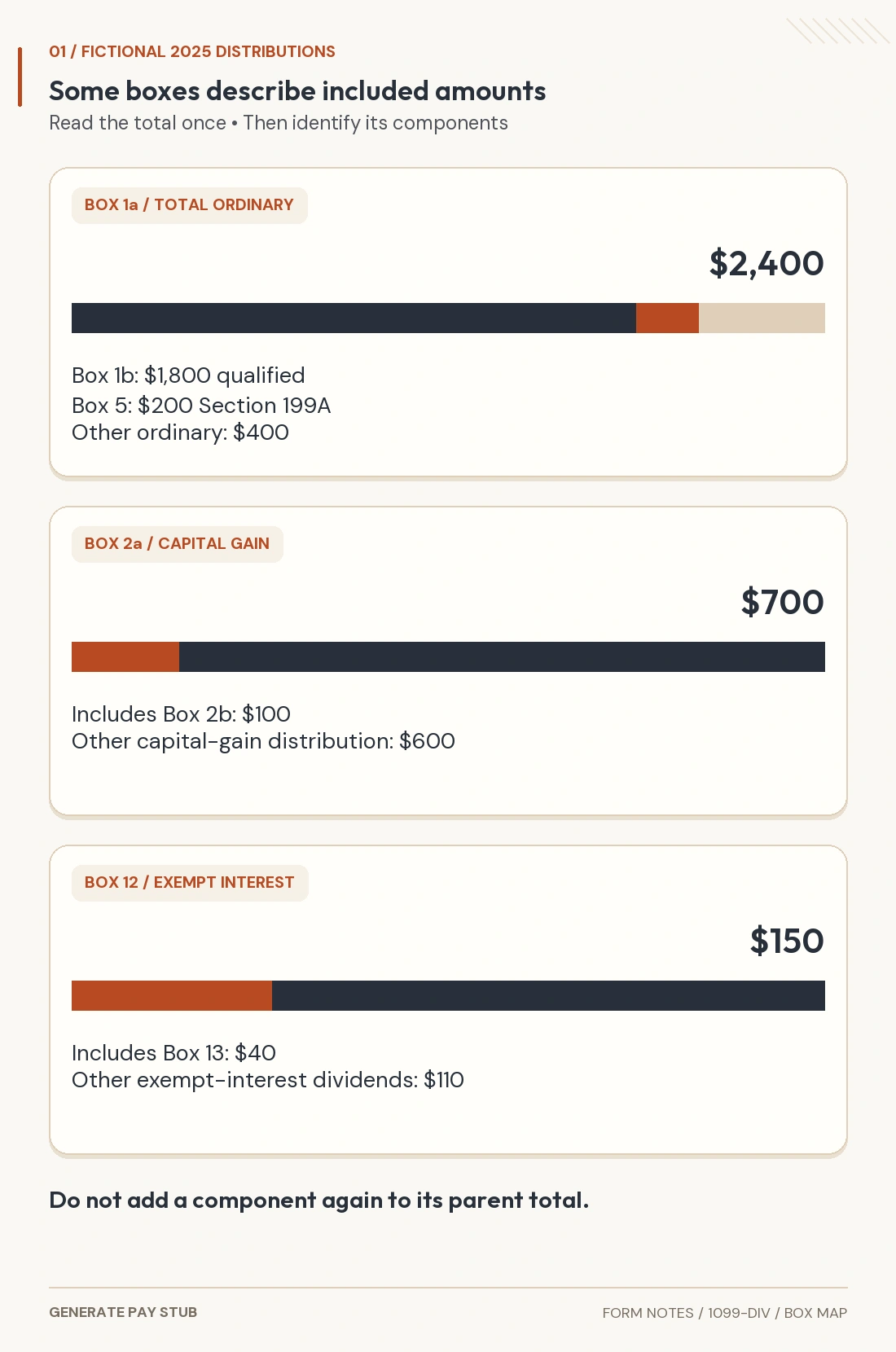
Identify the parent total and its included components. The current original and recipient instructions show the layout. Key relationships include Box 1b within 1a, Box 5 within 1a, specified capital-gain components within 2a, and Box 13 within 12.
Box 1b is the qualified-dividend portion; it is not an extra payment. Box 5 identifies Section 199A dividends and does not automatically establish the recipient's final deduction. Capital-gain detail can affect the tax calculation even though it does not increase Box 2a again.
What does a checked distribution example look like?
Assume a fictional consolidated portfolio record with these finalized 2025 classifications. The investor is a U.S. individual, and the ordinary-dividend components shown below do not overlap with one another.
| Box | Description | Amount | How to read it |
|---|---|---|---|
| 1a | Total ordinary dividends | $2,400.00 | Parent ordinary total |
| 1b | Qualified dividends | $1,800.00 | Already in 1a |
| 5 | Section 199A dividends | $200.00 | Already in 1a |
| 2a | Capital-gain distributions | $700.00 | Separate capital-gain total |
| 2b | Unrecaptured Section 1250 gain | $100.00 | Already in 2a |
| 3 | Nondividend distribution | $300.00 | Review share basis separately |
| 12 | Exempt-interest dividends | $150.00 | Separate exempt-interest total |
| 13 | Specified private-activity-bond interest | $40.00 | Already in 12 |

The ordinary total is $2,400, not $4,400 after adding Boxes 1b and 5. The capital-gain distribution is $700, not $800. Exempt-interest dividends are $150, not $190.
For an arithmetic check, $1,800 + $200 + $400 equals the $2,400 ordinary total. The $100 capital-gain component leaves $600 of other capital-gain distribution; the $40 private-activity component leaves $110 of other exempt-interest dividends.
These relationships do not calculate final federal tax. Holding periods, deductions, capital losses, other income and special-rate components still affect the return.
What happens to a Box 3 nondividend distribution?
A return of capital generally reduces stock basis before producing taxable gain. The IRS distribution overview distinguishes it from a dividend and explains the effect once basis reaches zero.
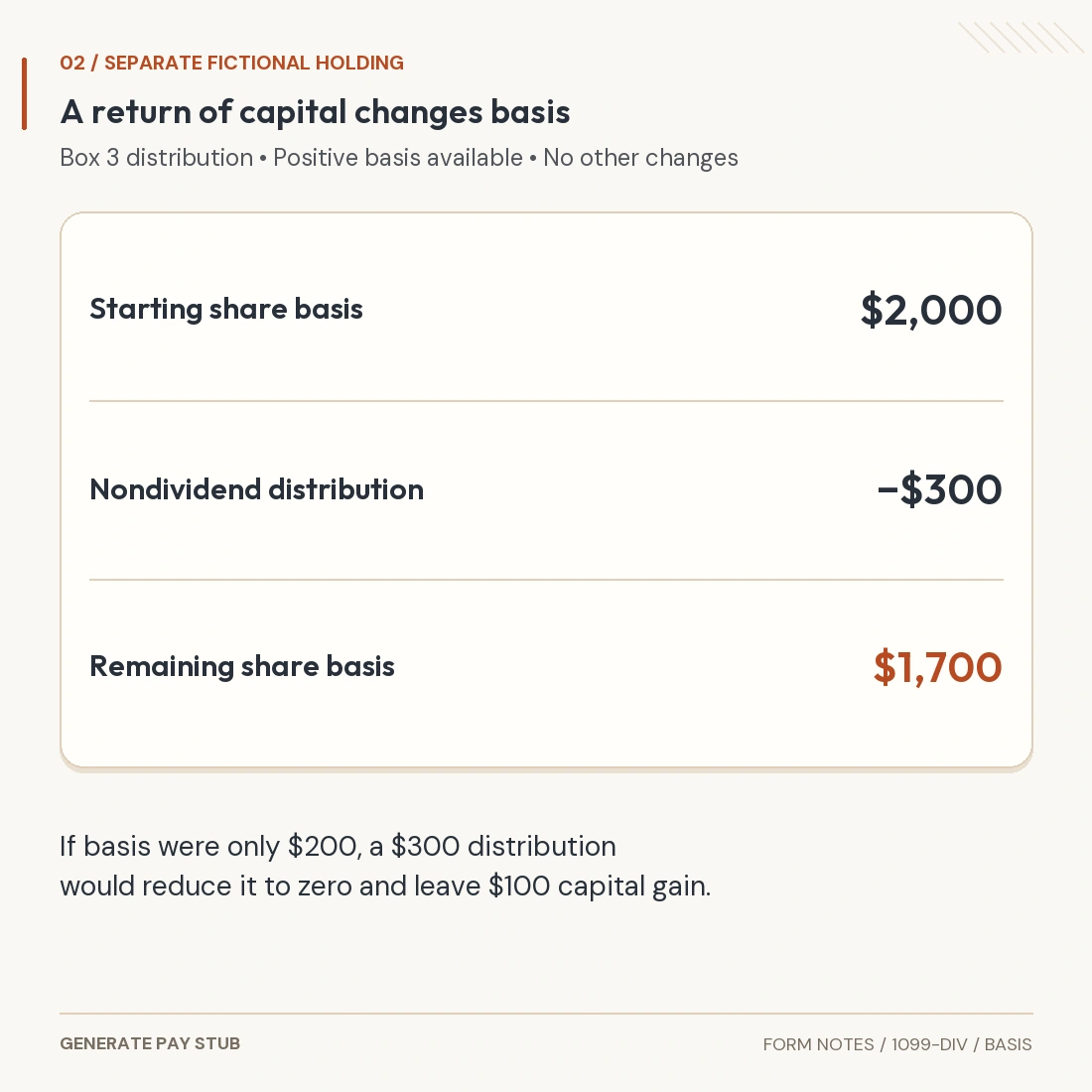
For a separate fictional holding, assume $2,000 of adjusted share basis immediately before a $300 nondividend distribution, with no other changes. Remaining basis is $1,700. The distribution is not simply added to ordinary dividend income.

If basis instead were only $200, the same $300 distribution would exhaust that basis and leave $100 capital gain. Its long- or short-term character depends on the holding period. Liquidating distributions have their own rules; do not substitute this simple nondividend example for a liquidation computation.
How should the recipient review the statement?
Reconcile the tax categories, not just the cash deposited. 2025 Publication 550 explains qualified-dividend holding periods, reinvestments and reporting.
For ordinary common stock, the usual qualified-dividend test requires holding the shares more than 60 days within the specified 121-day window around the ex-dividend date; risk-reduction rules and preferred-stock exceptions can change the analysis. Box 1b does not remove that recipient-level review.
Reinvesting a dividend at fair market value generally does not prevent income reporting. Record the new shares and their basis too. In our example, $2,400 of ordinary dividends exceeds the $1,500 Schedule B threshold.
Exempt-interest dividends may still require federal reporting and a separate state review. The private-activity-bond portion can matter for alternative minimum tax. A foreign-tax entry requires its own credit-or-deduction analysis rather than automatic dollar-for-dollar treatment.
Box 4 reflects actual federal withholding, not a tax estimate. Backup withholding guidance explains when the current 24% rate applies. Do not create withholding merely to make a statement resemble a paycheck.
What are the delivery and filing requirements?
Recipient delivery and IRS filing are separate obligations. Under the 2025 general information-return instructions, the ordinary recipient deadline for 2025 statements was February 2, 2026; qualifying consolidated statements had a February 17 deadline. Standard IRS deadlines were March 2 on paper and March 31 electronically. Those dates have passed at this review.
The electronic-filing threshold generally aggregates covered information returns: ten across types can trigger e-filing. An error may require both an agency correction and a corrected recipient statement; checking a PDF's CORRECTED flag alone does not complete either delivery.
The IRS offers IRIS information-return filing. Confirm the applicable tax-year procedures and actual filing acceptance separately from preparing the document.
How do you use the 1099-DIV builder carefully?
Choose the payment year and enter verified classifications. Open the 1099-DIV overview or go directly to the dividend statement builder.
The reviewed builder supports 2025 and 2026 and fills Copies 1, B and 2 in a six-page packet. Red Copy A remains blank, and tax-agency filing is separate. The IRS warns against printing the informational online red Copy A for paper filing; use an authorized filing method.
Check the year, names, TINs, addresses, account number, box relationships, optional reporting flags and actual withholding. Use state entries only when applicable. Keep recipient information secure and distribute copies only to the authorized parties.
General U.S. federal information, reviewed November 5, 2026. Worked figures concern fictional 2025 distributions and do not establish any investor's eligibility or final tax.