Form 2106 reports eligible employee business expenses for four limited groups, not for every worker with unreimbursed costs. Confirm the qualifying category first, separate meals from other expenses, account for relevant reimbursements and transfer the allowed amount to the correct place on the main return.
A receipt proves a purchase occurred. It does not, by itself, prove that the employee qualifies for this federal deduction. A useful preparation packet establishes both eligibility and the calculation.
Tax year 2025; reviewed November 5, 2026. This guide follows the final two-page 2025 original currently available in the builder. The worked case assumes a qualifying fee-basis local-government employee, substantiated eligible costs and no vehicle expense.
Who can use Form 2106 for 2025?
The original identifies four qualifying employee groups. Review the definitions and limits in the 2025 Form 2106 instructions before selecting a category.
| Category | Key qualification to review | Why a label is not enough |
|---|---|---|
| Armed Forces reservist | Qualifying reserve service and eligible reserve-related travel more than 100 miles from home, subject to limits. | Not every military-related or commuting expense qualifies. |
| Qualified performing artist | Employee services for at least two employers, specified wage, expense and AGI tests. | Calling yourself a performer does not satisfy the employee and income tests. |
| Fee-basis state or local government official | Qualifying government employment compensated partly or wholly through fees. | An ordinary private contractor is not automatically a fee-basis official. |
| Employee with impairment-related work expenses | Qualifying disability-related expenses enabling the employee to work. | General personal or medical costs do not automatically become work expenses. |
For a 2025 performing artist, the detailed tests include at least $200 wages from each of at least two qualifying employers, allowable performing-arts expenses exceeding 10% of performing-arts gross income and AGI no more than $16,000 before the deduction. Married-filer and combined-AGI rules also matter.
Ordinary unreimbursed W-2 expenses alone do not qualify an employee for this form. An educator's separate educator-expense adjustment is not a general Form 2106 permission. Self-employed business expenses ordinarily follow the relevant business schedule; our Schedule C preparation guide addresses that different situation.
What records should support an eligible expense?
Keep the amount and the work purpose together. A practical expense ledger records the date, location, expense category, amount, reason it was necessary for the qualifying work and the corresponding reimbursement.
The IRS business-travel overview explains travel away from the tax home and distinguishes personal expenses. Your tax home generally concerns the principal work area; it is not automatically wherever your family lives.
Use Publication 463 for 2025 for supporting records, accountable-plan treatment, meals and vehicle rules. Keep receipts, travel details, mileage records and employer expense reports securely. Ordinary commuting and personal purchases belong outside the deductible work column.
Do not interpret a recordkeeping exception as permission to estimate unsupported expenses. A standard meal allowance still requires evidence of the travel's time, place and work purpose.
How do expenses and employer reimbursements interact?
Separate meals into Column B and other eligible expenses into Column A. The 2025 Form 2106 original then compares each column's costs with its applicable reimbursement.
For Line 7, include relevant reimbursements, including applicable W-2 Box 12 code L amounts, but exclude payments already included in W-2 Box 1. A reimbursement covering both meals and other costs needs the prescribed allocation rather than an arbitrary split.
Subtract the appropriate reimbursement before applying the general meal limitation. Usually only 50% of the remaining eligible meals is deductible; exceptions require their own facts. The form's excess-reimbursement rules also matter when reimbursements exceed expenses.
Our pay-stub reimbursement guide explains the separate payroll presentation. Do not deduct a reimbursed cost again merely because the deposit and receipt appeared in different months.
What does a checked two-column example look like?
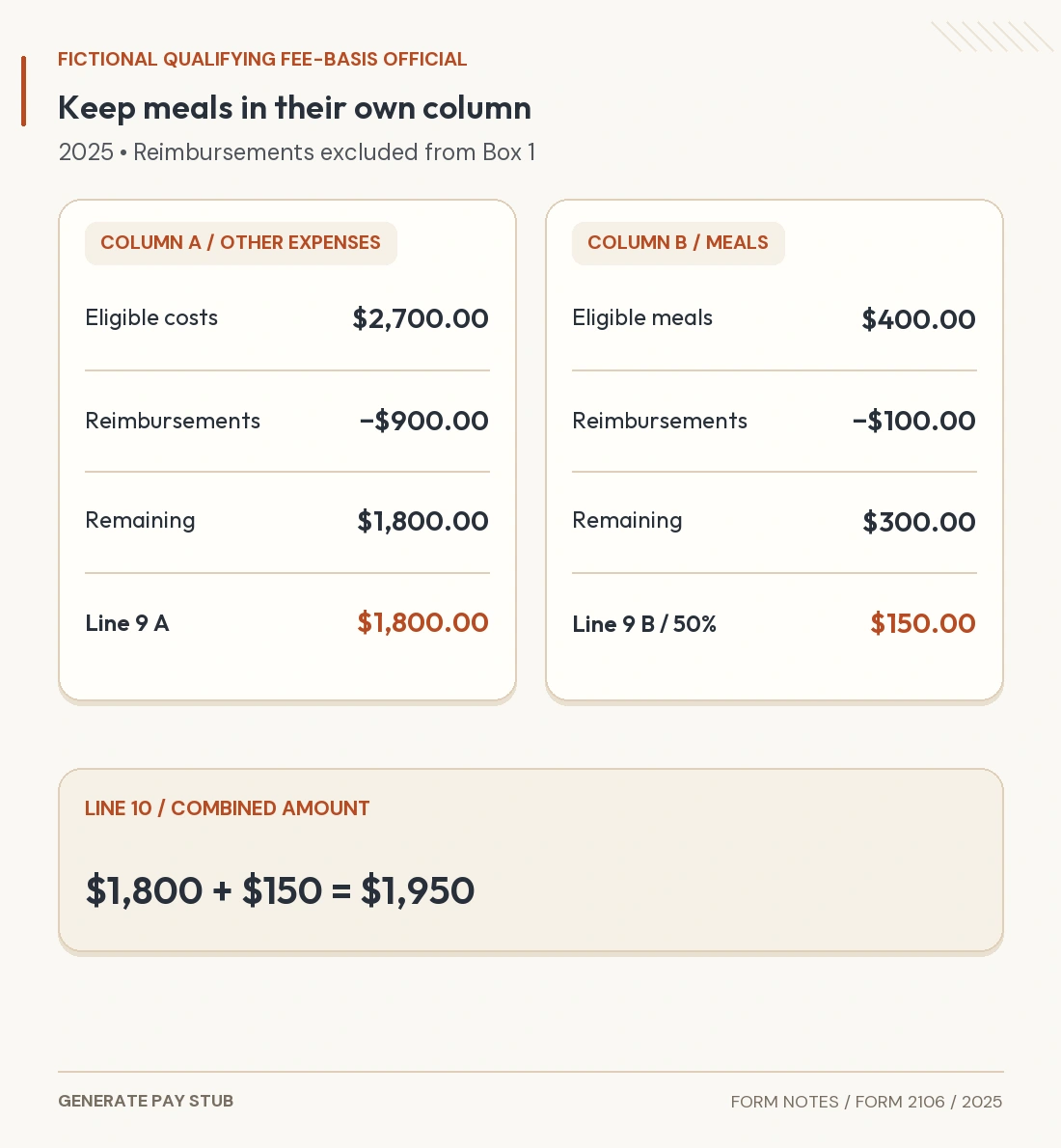
Assume a fee-basis local-government employee meets the federal category requirements. During 2025, this fictional employee incurs $600 eligible nonovernight transportation, $1,800 qualifying overnight travel excluding meals, $300 other eligible work costs and $400 eligible ordinary business meals.
The employer separately reimburses $900 of the nonmeal costs and $100 of meals. Those reimbursements are correctly excluded from W-2 Box 1. Assume all costs are substantiated, no entertainment or personal spending is included, and the ordinary 50% meal limit applies.
| Step | Column A: nonmeals | Column B: meals |
|---|---|---|
| Line 6: eligible expenses | $2,700.00 | $400.00 |
| Line 7: relevant reimbursements | $900.00 | $100.00 |
| Line 8: remaining expense | $1,800.00 | $300.00 |
| Line 9: allowed column amount | $1,800.00 | $150.00 |
| Line 10: combined amount | $1,950.00 | — |
Nonmeals are $600 + $1,800 + $300 = $2,700, less $900 reimbursement, leaving $1,800. Meals are $400 less $100 reimbursement, leaving $300; 50% is $150. The combined result is $1,950.
The final table row shows the combined Line 10 amount once; it is not another Column A expense. A $1,950 deduction does not mean a $1,950 refund. Its effect depends on the complete income-tax return.

What changes if eligible vehicle expenses are included?
Complete the vehicle information and use an eligible method for each vehicle. For 2025, the standard business-mileage rate is 70 cents per mile. Ordinary commuting miles do not become business miles because the employee kept a log.
The standard-mileage and actual-expense methods have different eligibility and record requirements. Prior method choices, vehicle ownership or lease history, business-use percentage and depreciation limitations matter. Do not deduct gasoline and depreciation again on top of standard mileage for the same use.
Actual expenses need the appropriate business allocation, basis, prior elections and applicable limits. A vehicle's purchase price alone does not establish the current deduction. Review the original's evidence questions honestly; checking a box cannot replace the records.
The main-site tool has space for one or two vehicles. If a situation requires more vehicle pages or other supporting forms, prepare the complete required attachments separately.
Where does the allowed Form 2106 amount go?
The qualifying category determines the destination and limits. The eligible fee-basis official in our example carries the $1,950 to 2025 Schedule 1, Line 12, with Form 2106 attached to the return.
Qualifying reservist travel is limited by its specific distance and federal-rate rules. Qualified performing-arts expenses also use the applicable Schedule 1 route. Impairment-related work expenses instead follow the specified Schedule A itemized-deduction route.
Do not automatically send every user's Line 10 amount to the same place. Our Schedule 1 walkthrough explains how adjustments affect AGI, while the main return determines the ultimate tax result.
How do you prepare the complete Form 2106 document?
Start with eligibility and a finished expense ledger. The Form 2106 details page links to the 2025 Form 2106 builder. Review the selected employee category, occupation and identifying information carefully.
Enter eligible costs and reimbursements in their proper columns. If using the vehicle section, check the service date, total, business and commuting miles, method eligibility and supporting evidence. Compare both original pages against your calculations.
Form 2106 has no separate signature line. Complete and sign the main return, and attach the expense form through the appropriate filing process. The builder supplies the prepared form; it does not create the entire income-tax return, establish eligibility or submit it to the IRS.
As of this guide's review, ordinary 2025 individual-return deadlines have passed. If an original return or correction remains outstanding, use the applicable current instructions rather than treating document preparation as an extension.
General U.S. federal information for tax year 2025. The fictional fee-basis-official example is not a determination of any reader's eligibility. State treatment can differ.