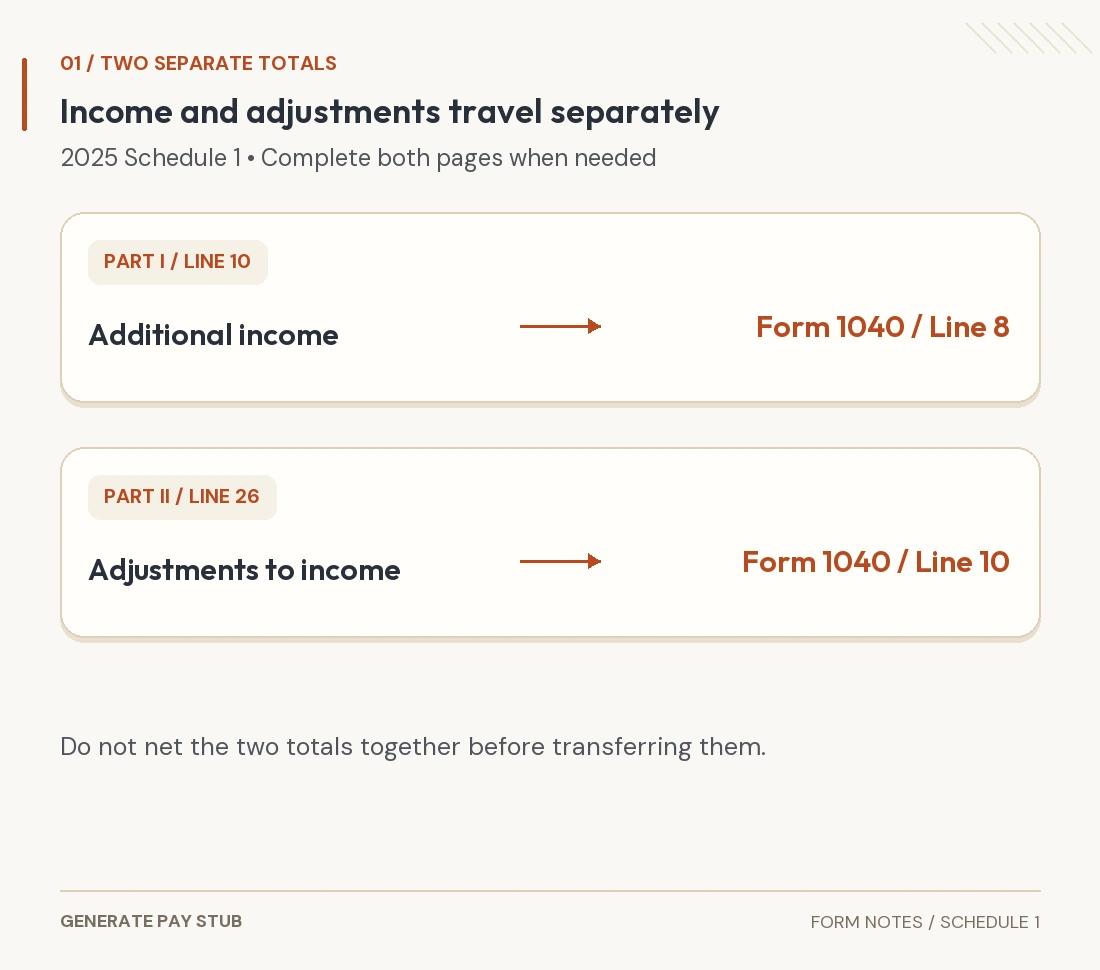
Schedule 1 adds certain income to Form 1040 and reports eligible adjustments that help determine adjusted gross income. Its two pages produce separate totals: additional income moves to the main return's Line 8, while adjustments move to Line 10. Do not combine them into one net transfer.
This schedule connects other calculations to the individual return. Some entries come directly from records; others need a completed supporting schedule, eligibility worksheet or loss-limit calculation first.
2025 edition, reviewed November 5, 2026. The examples and line references below use the final U.S. Schedule 1 offered by the linked tool. The worked case is a fictional individual return with only the specified income and fully eligible adjustments; it stops at AGI.
What does Schedule 1 do in an individual tax return?
It carries certain additional income and eligible adjustments into the main return. The 2025 original Schedule 1 labels Part I as additional income and Part II as adjustments to income.
Part I ends at Line 10, transferring to Form 1040, Line 8. Part II ends at Line 26, transferring to Form 1040, Line 10. Total income less adjustments produces AGI on the main return.
A reader can usefully think of the schedule as two organized lists, each with its own destination. An allowed deduction on the second page does not erase the need to report related income on the first page.
Not every taxpayer needs the same schedules. Wages, taxable interest, dividends and many retirement distributions have their own main-return locations. Our Form 1040 return roadmap shows the broader sequence from income to tax and payments.

Which income commonly belongs in Schedule 1 Part I?
Classify the source and use the appropriate taxable or allowed amount. Common entries include business results from Schedule C, rental or pass-through results from Schedule E, farm results from Schedule F and unemployment compensation.
Other-income categories include jury pay, prizes, eligible nonbusiness rental income and other items. The label “other income” is not permission to bypass a required business schedule. The 2025 Form 1040 instructions, including the Schedule 1 section, explain category-specific treatment.
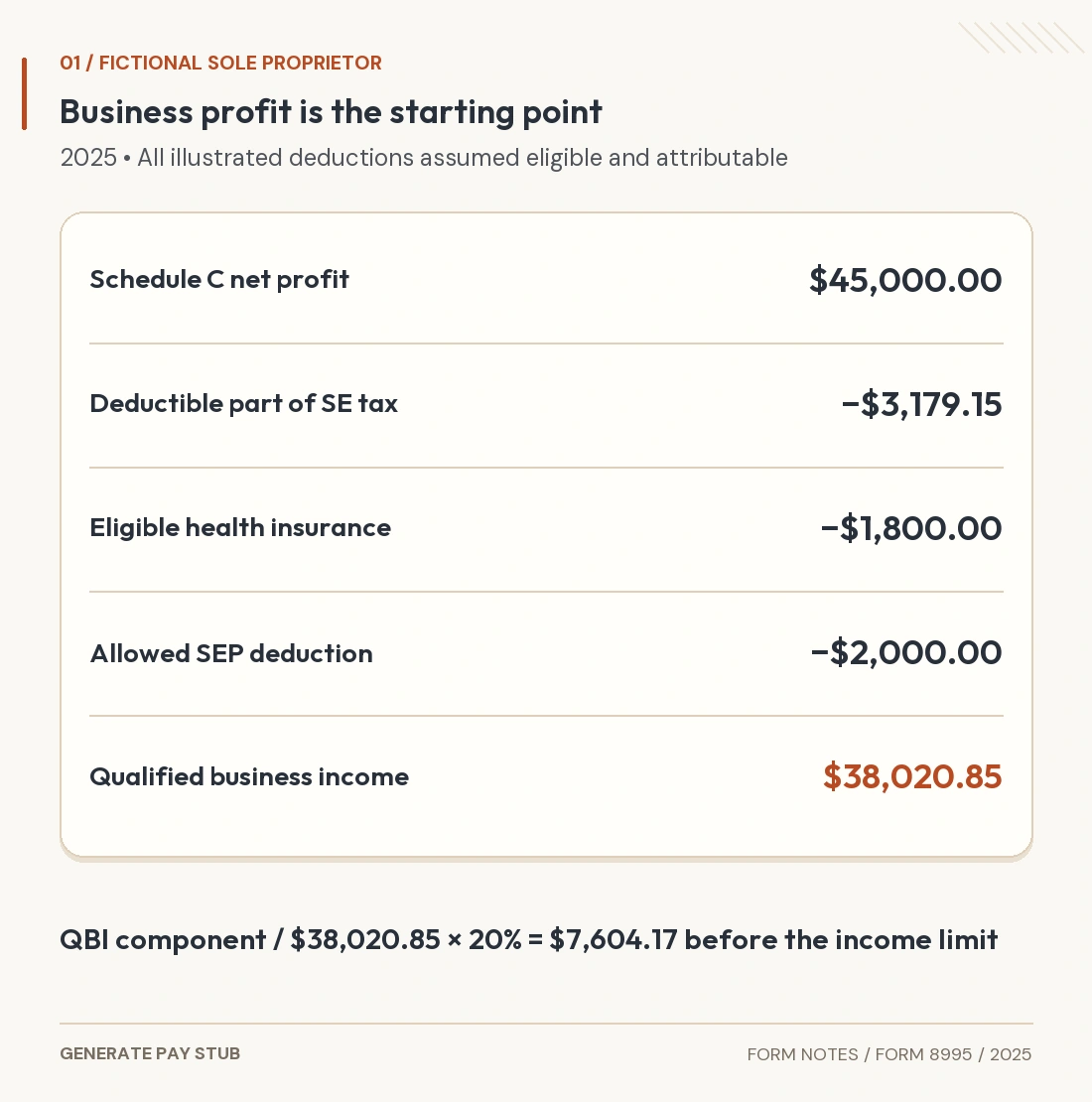
For a business, finish the income-and-expense calculation before transferring its result. A client's 1099 total is not necessarily the business profit. Similarly, a rental's preliminary loss may require restrictions before the amount carried into the return is known.
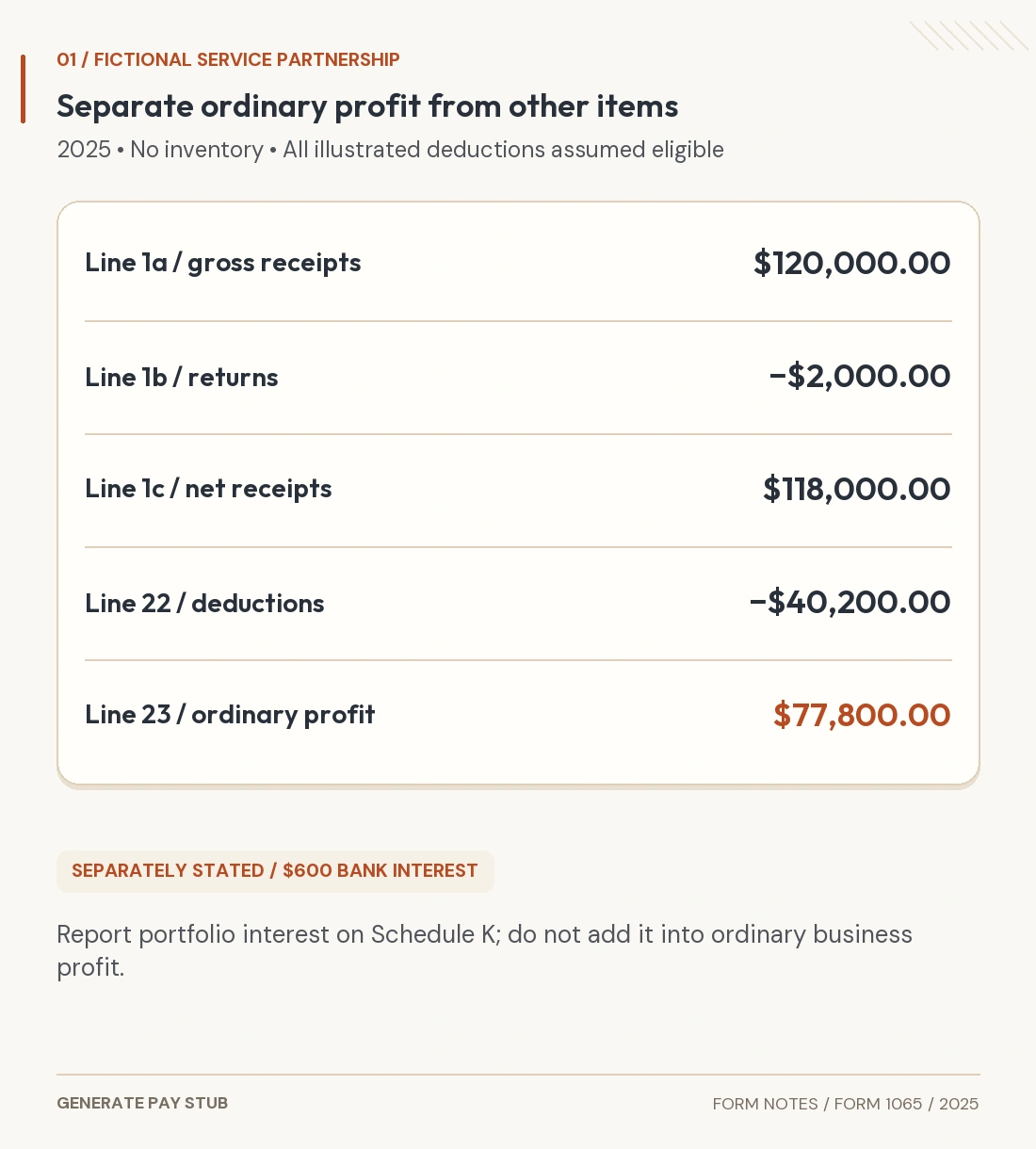
Use the dedicated guides for Schedule C, Schedule E and Schedule F to prepare those source calculations. Do not add their gross receipts again in another-income entry.
Ordinary taxable bank interest has a different route. IRS Topic 403 explains interest reporting, including when Schedule B is required. A payment being outside your job does not automatically place it in Schedule 1.
What is an adjustment to income, and who can claim one?
An adjustment is an eligible deduction used in arriving at AGI. It is not the same as withholding, a tax credit or every expense you paid personally.
Part II includes categories such as educator expenses, an eligible HSA deduction, the deductible part of self-employment tax, eligible self-employed retirement and health-insurance deductions, IRA deductions and student-loan interest. Their conditions and supporting calculations differ.
The student-loan-interest deduction illustrates why a payment total is only a starting point. IRS Topic 456 describes the qualified-loan and legal-obligation requirements, filing-status and dependency rules, income phaseout and maximum deduction of the lesser of $2,500 or eligible interest paid.
For retirement contributions, IRS Topic 451 distinguishes traditional and Roth IRAs. A traditional contribution may be partly or fully deductible depending on the facts; a Roth IRA contribution is not deductible.
Keep the calculation with the entry. A useful worksheet note might identify the contribution, year, eligible amount, limitation applied and final deduction. A form field that accepts a number does not establish the deduction's eligibility.
How do the separate totals affect AGI? A checked example
Follow the income and adjustment transfers independently. Assume this fictional taxpayer files Single for 2025, is not claimable as anyone's dependent and has:
- $50,000 W-2 wages, already reflecting the employer's continued salary during jury service.
- $150 ordinary taxable bank interest.
- $3,600 fully taxable unemployment compensation with no repayment adjustment.
- $400 jury-duty pay, all remitted to the employer because it continued the salary.
- $900 interest paid on a qualified student loan for which the taxpayer is legally obligated, with all deduction conditions met and no phaseout reduction.
- No other income or adjustments.
The jury-pay treatment follows the Schedule 1 instructions: report the pay as income and separately claim the eligible amount given to the employer. It is not simply omitted from both sides of the schedule.
| Entry | 2025 location | Amount |
|---|---|---|
| Unemployment compensation | Part I, Line 7 | $3,600.00 |
| Jury-duty pay | Part I, Line 8h | $400.00 |
| Total additional income | Line 10 → Form 1040 Line 8 | $4,000.00 |
| Eligible jury pay remitted to employer | Part II, Line 24a | $400.00 |
| Eligible student-loan interest | Part II, Line 21 | $900.00 |
| Total adjustments | Line 26 → Form 1040 Line 10 | $1,300.00 |
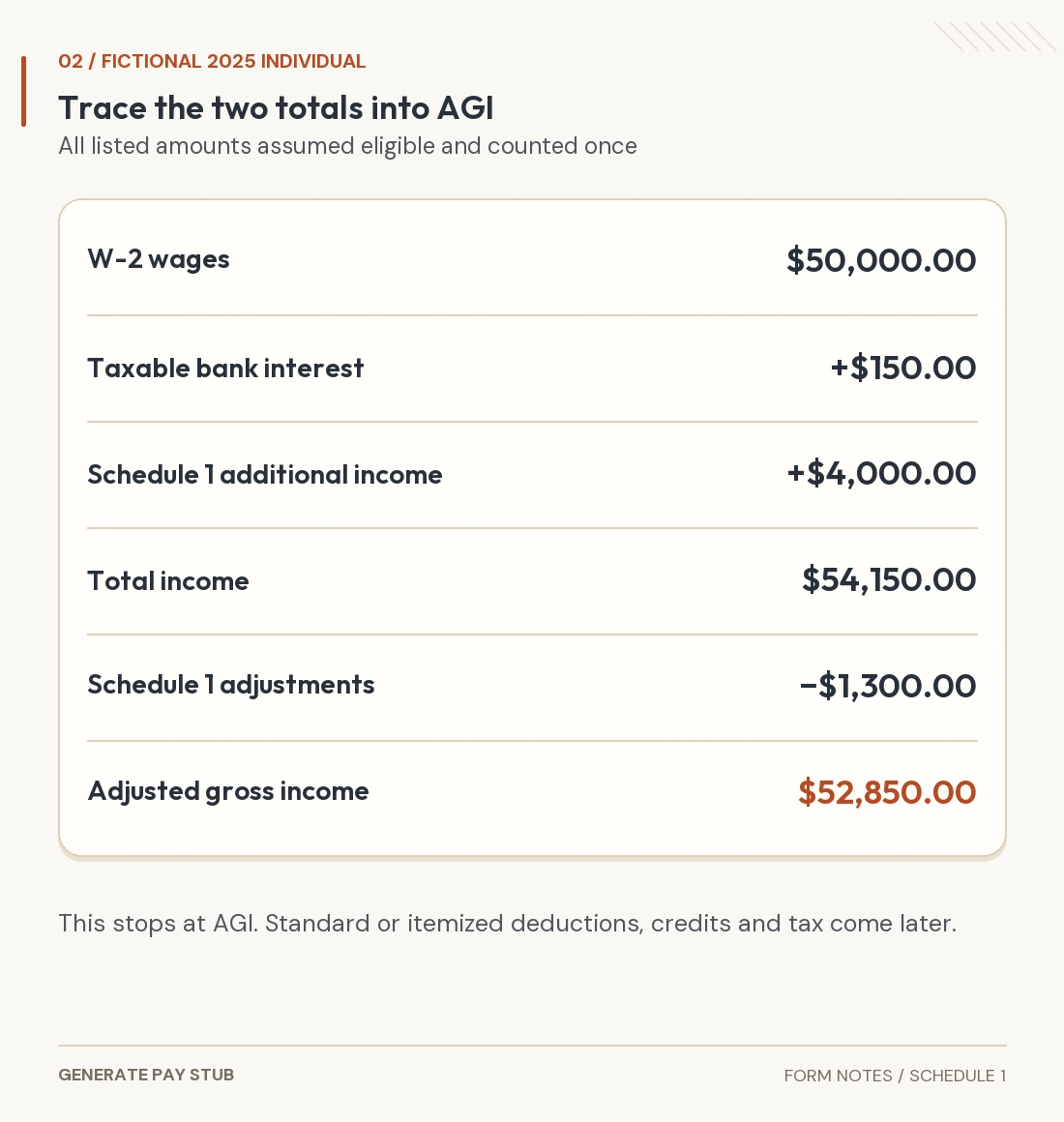
The main return combines $50,000 wages + $150 taxable interest + $4,000 additional income = $54,150 total income. It then subtracts $1,300 adjustments to reach $52,850 AGI.

This example does not calculate taxable income, the tax or a refund. The standard or itemized deduction, any separately permitted additional deductions, credits and payments come later in the return.
How is Schedule 1 different from Schedule 1-A or Schedule A?
Similar names do not make the schedules interchangeable. Schedule 1 organizes additional income and AGI adjustments. Schedule A is for itemized deductions. Schedule 1-A has the distinct 2025 additional-deduction provisions for qualified tips, qualified overtime, eligible vehicle-loan interest and qualifying seniors.
The IRS Schedule 1-A explanation describes those separate deductions and eligibility rules. Do not place them in an arbitrary Schedule 1 adjustment field or remove reported wages to approximate the result.
The fact that an adjustment can be claimed without itemizing also does not mean everyone can claim it. For each entry, first identify the actual provision and worksheet. Then follow its specific destination.
What does the 2025 Schedule 1 notice about Form 1099-K mean?
The notice is not another income subtotal. The 2025 form has a field above Part I for 1099-K amounts included in error or relating to personal items sold at a loss. Remaining transactions must be reported according to their nature elsewhere in the return.
The IRS 1099-K guidance explains using the statement together with other records to determine taxable income. A payment report does not itself establish profit or mean every receipt is taxable.
Reconcile transaction descriptions, gross receipts, refunds, fees and relevant cost records. Keep correction requests and explanations where needed. Do not add the notice amount to Line 10, and do not count business receipts once through Schedule C and again through an other-income entry.
Which entries deserve a closer eligibility or duplication check?
State or local tax refunds
A refund is not necessarily fully taxable. Publication 525 for 2025 explains the tax-benefit and recovery rules. The earlier return matters; a prior standard deduction or limited tax benefit can change the amount included. Reconcile the refund with the applicable worksheet instead of copying a 1099-G total automatically.
HSA contributions already excluded from wages
Do not claim the same benefit twice. Publication 969 for 2025 distinguishes deductible eligible contributions from employer contributions, including amounts through a cafeteria plan. Review W-2 coding and Form 8889 before entering an additional deduction.
Income exclusions and losses
Use the allowed calculation and the correct sign. Certain lines reduce an income subtotal, while other entries represent positive income. Check the printed form's parentheses and the tool's input instructions. Foreign earned income, debt cancellation and losses can require separate forms or exceptions.
Repayments and older agreements
The year and legal facts matter. An unemployment repayment can require treatment different from a simple current-year subtraction. Alimony also depends on the agreement's date and applicable modifications. Keep the relevant documents and use the specific instructions rather than assuming every receipt or payment has the same treatment.
How should you prepare, review and attach Schedule 1?
Prepare source calculations first, then check each transfer and both original pages. The Schedule 1 overview links to the Schedule 1 builder, currently offering the final 2025 original.
Compare the taxpayer identity with the main return. Enter eligible amounts from records and finished supporting work, review negative terms and avoid duplicate income. Match Line 10 and Line 26 to their separate Form 1040 destinations.
The main return, required attachments, filing and payment are separate from the prepared schedule. Schedule 1 has no separate taxpayer signature line. Because ordinary 2025 return dates are past at this review, follow the appropriate late, amended or relief process when relevant.
General U.S. tax information. The example assumes all specified eligibility conditions and excludes other income, adjustments and special rules. Use the full year-specific instructions for an actual return.