Backup withholding is federal income tax withheld from certain reportable nonpayroll payments when a withholding condition applies. For covered contractor payments in 2026, the rate is 24%. It reduces the cash received, but it does not reduce the gross service payment and does not turn a contractor into an employee.
This guide is for U.S. contractor payment records, with a fictional payment example and the federal rules reviewed for 2026. It is not a guide to foreign-person withholding, platform reporting, employee wage withholding or every type of investment payment. Check the exact payment category and reason before applying a rate.
Why is 24% being withheld from my contractor payment?
The IRS’s backup withholding overview explains that some otherwise nonwithheld payments become subject to withholding when required information or certifications are missing, incorrect or affected by an IRS notice. A familiar contractor situation is a missing taxpayer identification number (TIN) or an IRS name/TIN mismatch notice.
A payer should be able to identify the reason. A “tax” line on a remittance notice could instead be state withholding, a levy, a processing fee labelled poorly or an error. Do not infer backup withholding solely because a deposit is smaller than an invoice.
| Entry | Meaning | Record to request |
|---|---|---|
| Federal backup withholding | Income tax withheld from a covered nonpayroll payment under the applicable rule. | Gross payment, amount withheld, payment date and reason for withholding. |
| Employee Social Security / Medicare withholding | Payroll taxes on employee wages; different from contractor backup withholding. | Official payroll statement and worker-classification review if necessary. |
| Platform or processing fee | A charge that can reduce a deposit without being federal tax withheld. | Processor statement and fee detail. |
| State nonresident withholding | A separate state-law requirement that may apply to a payment. | State form, rate, jurisdiction and payment statement. |
For a genuine nonemployee service payment, do not add employee FICA lines merely to make the payment statement resemble a paycheck. The current IRS Form 1099-NEC and recipient instructions distinguish nonemployee compensation and federal tax withheld. Worker status still depends on the actual relationship; see why “1099 employee” is a confusing label.
A $2,000 gross payment and a $1,520 deposit can both be correct
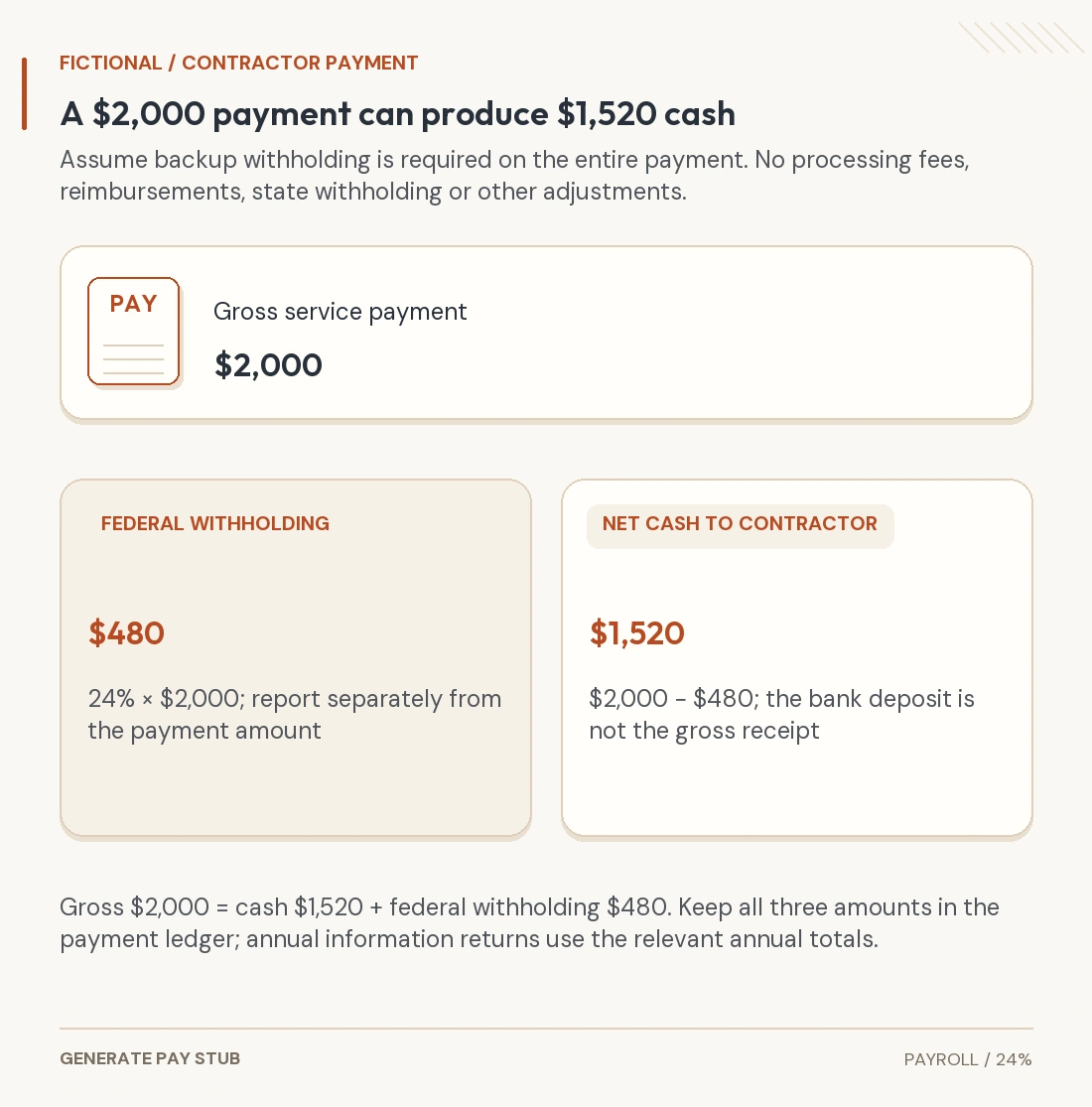
Assume a business makes a $2,000 covered service payment to a nonexempt U.S. contractor and backup withholding is required on the entire amount. There are no reimbursements, card fees, credits, state withholding or other adjustments. The calculation is:
$2,000 × 24% = $480 withheld.
$2,000 − $480 = $1,520 paid to the contractor.

| Payment record | Amount |
|---|---|
| Gross service payment | $2,000.00 |
| Federal backup withholding: $2,000 × 24% | −$480.00 |
| Other adjustments assumed | $0.00 |
| Net cash deposited | $1,520.00 |
| Cross-check: $1,520 cash + $480 tax withheld | $2,000.00 |
The contractor’s record should retain the $2,000 gross payment and the $480 withholding separately. Recording only the bank deposit understates the gross receipt. Treating the $480 as both a business expense and a tax-payment credit would also confuse two different categories.
Backup withholding is a payment toward federal income tax, not a final determination of the contractor’s total tax. Business expenses and self-employment-tax rules require their own calculation. The IRS overview explains that the recipient claims the withholding in the federal tax-payment calculation for the corresponding income year, using the amount actually reported. Whether the final return produces a refund or additional tax depends on the complete return.
For bookkeeping evidence, retain the invoice, the payer’s remittance advice and the bank record. An invoice requests payment; it is not proof that the gross amount was deposited unchanged. See the contractor payment statement guide for organizing those records.
How should backup withholding appear on the 2026 Form 1099-NEC?
The IRS’s current 1099-MISC and 1099-NEC instructions specify the December 2026 revision for reporting calendar-year 2026 information, first filed in early 2027. On that revision, box 1a is nonemployee compensation and box 4 is federal income tax withheld. Earlier forms can show different numbering; use the revision for the year being reported.
If the example were the only payment for the entire year, with no other reportable compensation or withholding, the corresponding totals would be $2,000 in box 1a and $480 in box 4. Do not put the $1,520 net deposit in the compensation box. If there are multiple payments, reconcile the annual ledger totals instead of copying one remittance statement.
The general 2026 threshold for covered nonemployee service-payment reporting is $2,000. Publication 15’s 2026 changes also describes the increase in the aggregate reportable-payment threshold for relevant payments subject to backup withholding. Different information-return categories have different thresholds; $2,000 is not a universal rule for every 1099.
Separately, the IRS’s information-return filing guidance says a Form 1099-NEC is required when federal income tax was withheld under the backup withholding rules, regardless of the payment amount. This does not mean every small contractor payment automatically requires withholding. First determine whether the payment and withholding condition are covered.
A reporting threshold is also not an exclusion from taxable income. A contractor still needs complete income records even when a particular payer has no filing requirement. The separate 1099-NEC threshold and payment-record guide addresses the wider annual review.
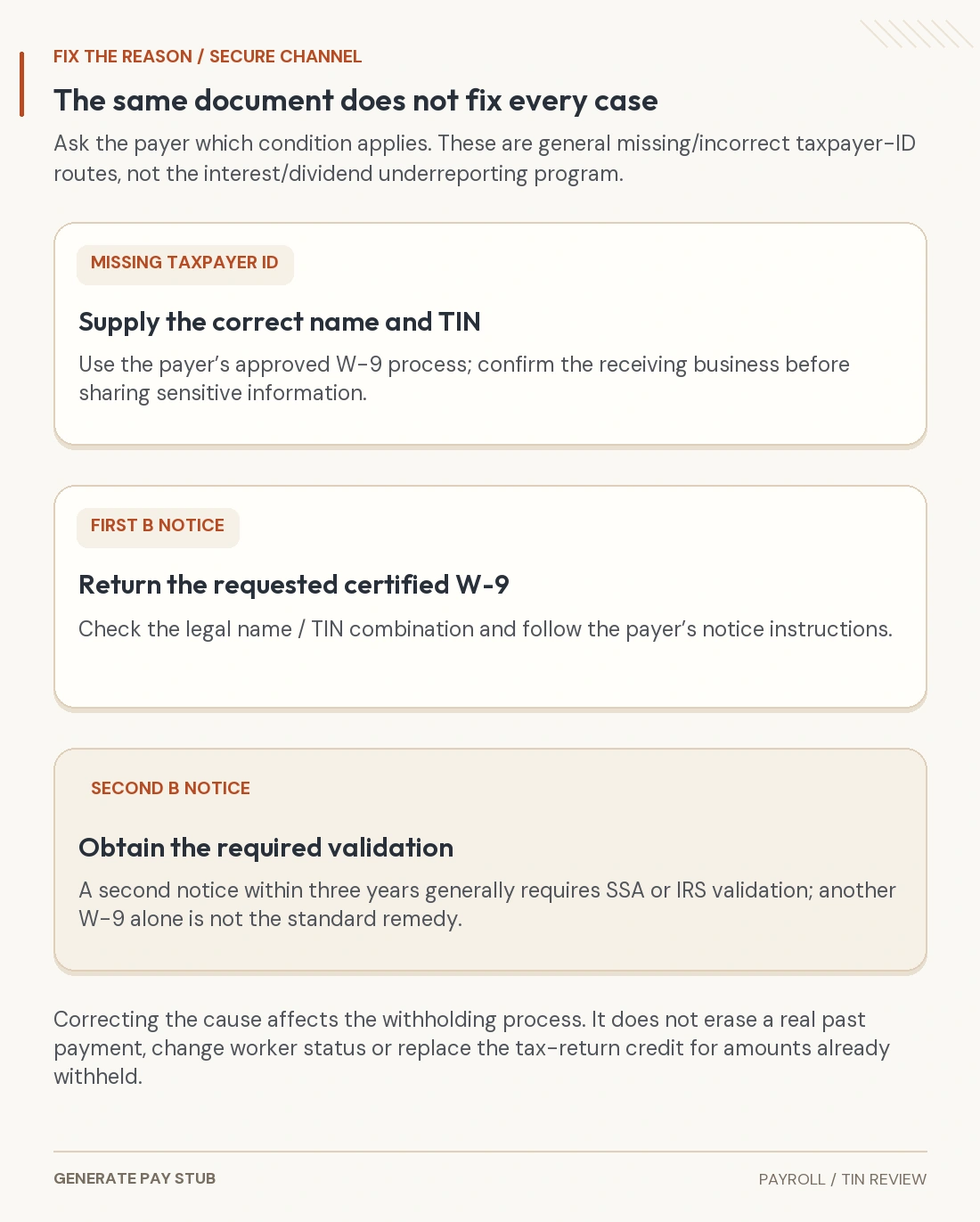
How do I stop withholding for a missing or mismatched TIN?
Correct the underlying cause through the payer’s documented process. Do not replace the payer’s records with a newly created payment statement or assume that changing an invoice name updates the tax account.
The IRS’s B program guidance distinguishes a first B notice from a second notice for the same account within three years. A properly completed and signed Form W-9 is generally the response to the first notice. The second generally requires external validation, such as the specified Social Security documentation or an IRS Letter 147C for an EIN, rather than another W-9 alone.
The detailed IRS Publication 1281 notice procedures explain the steps for missing and incorrect name/TIN combinations. Use the instructions for the notice actually received. If the payer never received a TIN, provide it using the approved method; do not assume the payer must wait for an IRS mismatch notice first.

A business name, an individual owner’s name and a disregarded LLC’s tax identity are not always interchangeable. Follow the IRS requester instructions for Form W-9 and the form’s name/TIN instructions rather than guessing which number belongs with a trade name. Our W-9 name, LLC and tax-ID guide explains common record mismatches.
Stopping is not necessarily instantaneous. Part N of 2026 Publication 1099 gives the applicable start/stop timing for different causes, including incorrect-TIN notices. Ask when the correction was accepted and which future payment will reflect it. A pending TIN application does not create the special interest/dividend waiting-period exception for ordinary nonemployee compensation.
IRS underreporting notices concerning interest and dividends use a different process from contractor TIN mismatches. A new W-9 is not a universal cure for all backup withholding. Nor does a current correction automatically erase past withholding properly taken and reported.
What should a business payer check?
- Identify the payment and payee. Confirm the reporting category, exemption rules and correct name/TIN records. Foreign-person documentation requires a different analysis.
- Document the trigger. Retain the relevant solicitation, notice and response dates. Use the detailed procedure rather than withholding as an optional penalty for slow paperwork.
- Calculate from the covered gross amount. Record the date, applicable rate, withheld amount and net payment. Keep unrelated fees and state withholding separate.
- Deposit and report through the correct system. Backup withholding is nonpayroll withholding. The 2026 Form 945 instructions describe its reporting and separate deposit rules; do not combine its deposits with employee payroll withholding simply because the same business pays both.
- Reconcile and correct. Match annual information returns and Form 945 records to the payment ledger. Follow the applicable correction procedure if an amount or recipient is wrong.
Do not wait until the annual form is due to investigate deposit obligations. Deposit timing depends on the applicable rules; creating a form or paying a contractor the net amount does not itself send withheld tax to the government.
A short request for an unexplained 24% deduction
Please provide the gross amount, federal backup withholding, any other adjustments and net amount for payment [reference/date]. Please identify the withholding reason and notice, if applicable, and the secure process to correct our name/TIN record. Please also confirm how the withheld amount will appear on the annual information return.
Send this to the known payer using its established contact route. Do not place a full SSN, EIN, identity-document image or completed W-9 in a public comment or an unverified email reply. Retain the official response, notice, corrected records and annual form. If a payment is actually employee wages, request a classification/payroll review rather than accepting a contractor-style tax label.
Short answers about contractor backup withholding
Is 24% my final tax rate?
No. Withholding is credited in the tax-return calculation. The final result depends on all income, deductions, credits and payments.
Should a pay stub maker show me as an employee because tax was withheld?
No. Federal backup withholding can apply to a nonemployee payment. Use accurate contractor payment records and preserve the actual relationship.
Can I recover past withholding by sending a W-9 now?
Correcting the cause affects future withholding under the applicable procedure. Ask the payer about any genuine error; otherwise reconcile amounts already withheld with the annual tax form and return rather than assuming an immediate repayment.
What single reconciliation should always work?
For the uncomplicated example, gross payment equals net cash plus federal backup withholding. When it does not, request the missing fee, state-tax, credit or other adjustment instead of changing the gross figure to match the deposit.