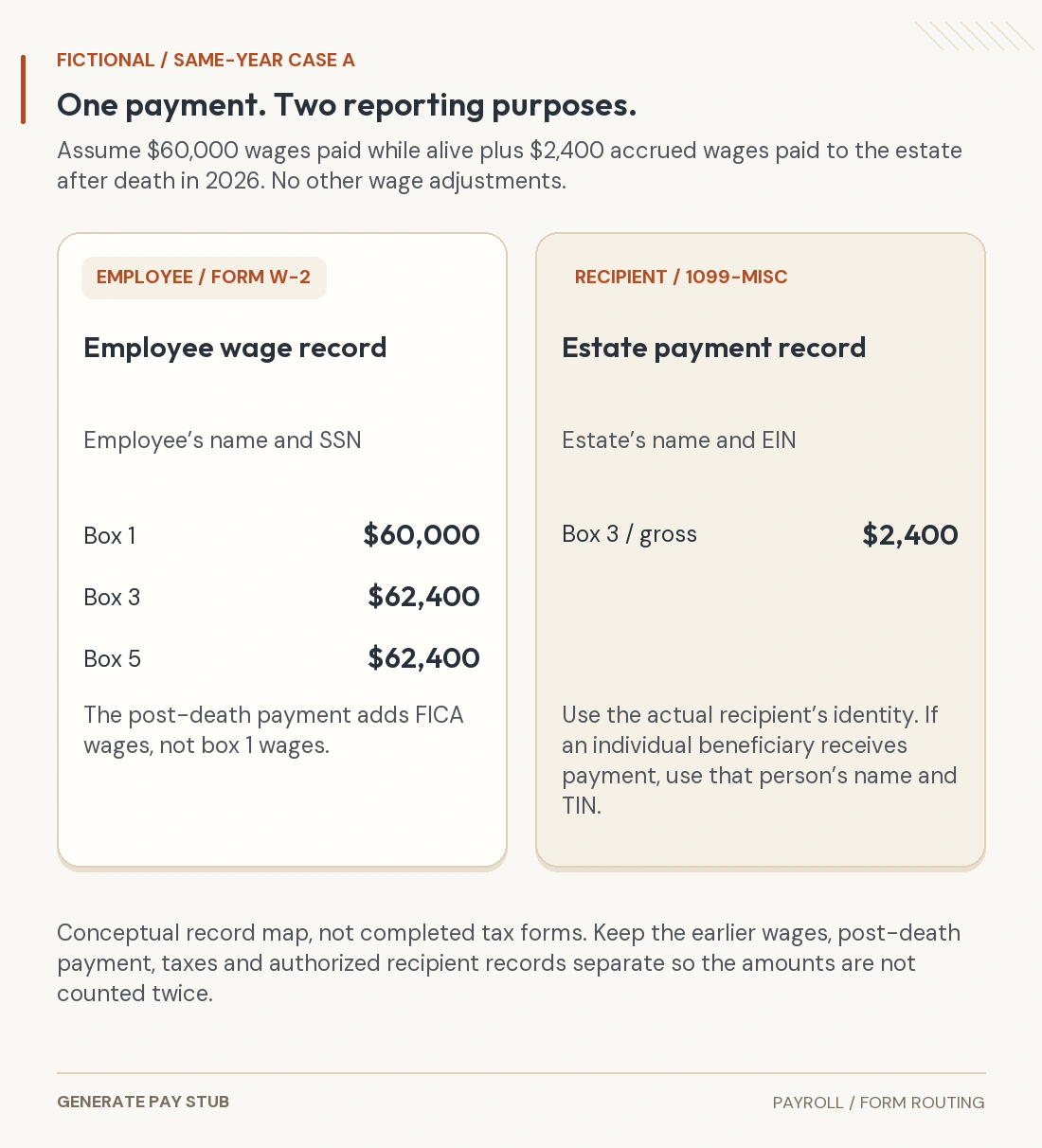
Accrued wages paid after an employee dies can require both a W-2 and a 1099-MISC, but for different purposes. When paid in the calendar year of death, ordinary accrued wages generally remain subject to Social Security and Medicare taxes and enter the employee’s related W-2 boxes. When paid after that calendar year, the post-death payment is not reported on W-2 and is not subject to those taxes. The recipient’s reportable payment is handled separately.
This guide covers U.S. federal records for ordinary accrued wages and vacation pay, using fictional 2026 payments. It does not determine a family member’s right to receive the money, state payment deadlines, estate administration or the taxation of every death benefit. Those issues need the employer’s appropriate legal, benefits and tax review.
First ask whether the wages were already available while the employee was alive
There is an important difference between unpaid compensation first paid after death and a replacement of wages already made available before death. A check that must be reissued to an estate is not automatically new post-death income merely because the replacement has a later date.
The 2026 IRS W-2 and W-3 instructions require ordinary reporting for wages available while the employee was alive and exclude a reissuance of wages constructively received while alive from the post-death 1099-MISC rule. Ask payroll to document availability and payment history rather than deciding from the bank posting date or printed check date alone.
Then identify what remains unpaid: regular wages, accrued vacation or a different benefit. A life insurance payment, qualified retirement-plan distribution, nonqualified deferred compensation benefit and ordinary wage balance are not interchangeable. This article’s calculation does not establish the reporting of those other categories.
Same calendar year versus a later calendar year
The 2026 Employer’s Tax Guide distinguishes payments to a beneficiary or estate during the year of death from payments after that year. Both are exempt from regular federal wage-income-tax withholding; FICA and federal unemployment treatment differ by the payment year. A separate backup-withholding obligation may still need review.
| Issue | Paid in the year of death | Paid after the year of death |
|---|---|---|
| Regular federal wage-income-tax withholding | Exempt for this post-death payment. | Exempt for this post-death payment. |
| Social Security / Medicare | Apply the relevant employee tax rules, wage base and thresholds. | Not subject to these taxes under the post-year-of-death rule. |
| Employee’s W-2 | Include applicable FICA wages/taxes; exclude this payment from box 1. | Do not put this post-death payment on W-2. |
| Recipient’s 1099-MISC | Report the required gross payment in box 3 using the actual recipient’s identity. | Report the required gross payment in box 3 using the actual recipient’s identity. |
The FICA exclusion for an employer’s payment to a survivor or estate after the calendar year of death is also set out in 26 CFR 31.3121(a)(14)-1. The boundary is the calendar year, not simply whether several weeks or months have passed.
Federal unemployment tax is an employer tax, not another deduction to take from the recipient’s check. Publication 15 treats the same-year payment as subject to FUTA under its applicable rules and the later-year payment as exempt. State unemployment and other state requirements need their own review.
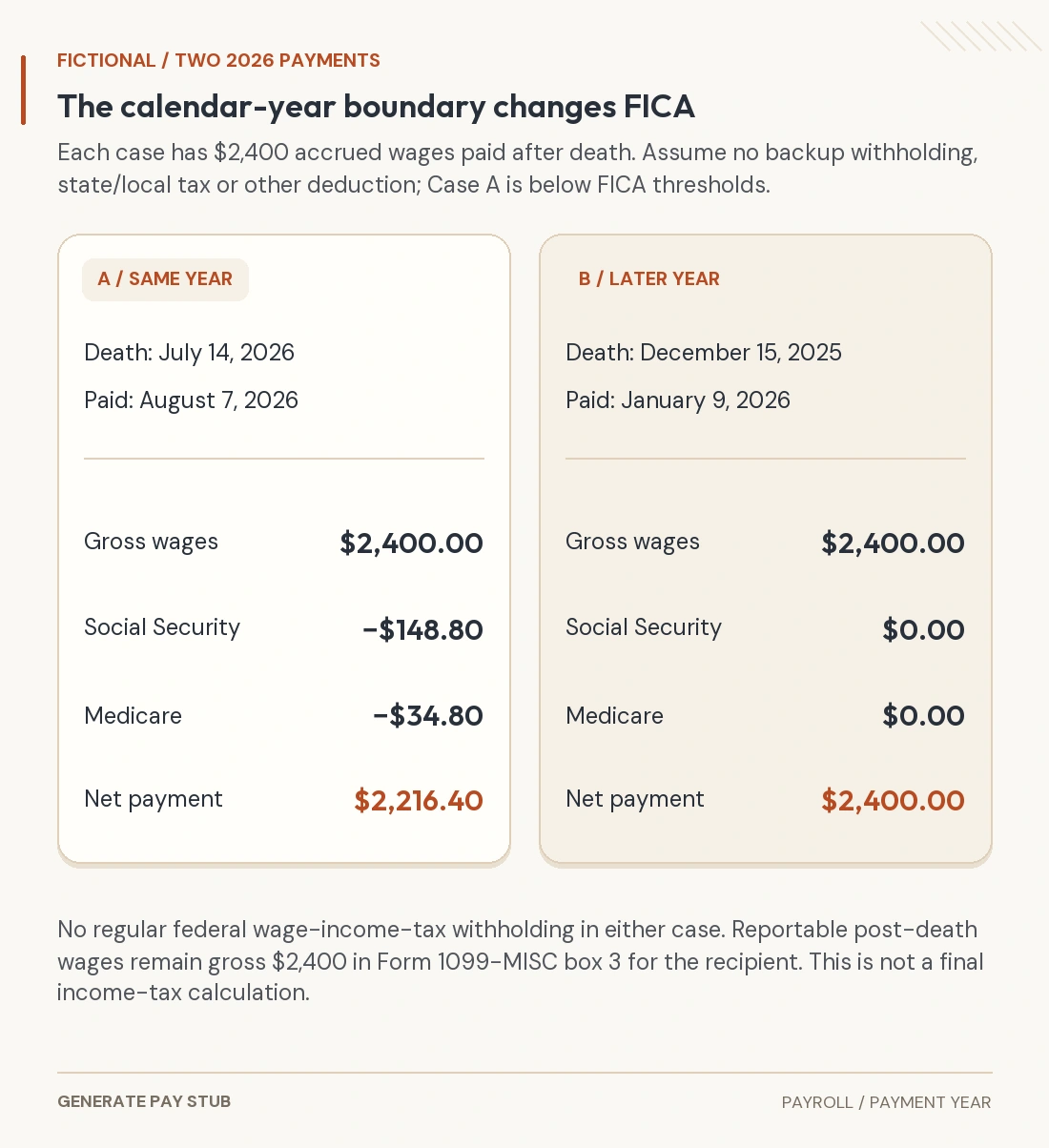
Two fictional $2,400 payments made in 2026
Assume ordinary accrued wages first paid after death to the properly authorized recipient. There are no other deductions, state/local withholding or backup withholding. Neither the 2026 Social Security ceiling nor the employer’s Additional Medicare withholding trigger affects Case A.
- Case A: the employee dies July 14, 2026; $2,400 is paid August 7, 2026. The employee Social Security amount is $148.80 ($2,400 × 6.2%), and Medicare is $34.80 ($2,400 × 1.45%). Net cash is $2,216.40.
- Case B: another employee dies December 15, 2025; $2,400 is paid January 9, 2026. Because the payment is after the calendar year of death, no Social Security or Medicare tax applies to this payment. Under the stated assumptions, net cash is $2,400.

| Item | Case A: same year | Case B: later year |
|---|---|---|
| Gross accrued wage payment | $2,400.00 | $2,400.00 |
| Employee Social Security withheld | −$148.80 | $0.00 |
| Employee Medicare withheld | −$34.80 | $0.00 |
| Regular federal wage-income-tax withholding | $0.00 | $0.00 |
| Net payment under the stated assumptions | $2,216.40 | $2,400.00 |
The dates explain the different FICA treatment. They are not a reason to delay payment to seek a different tax result. Confirm the applicable payment obligations and authorized recipient before disbursing.
Do not assume every same-year check uses the simple $183.60 FICA deduction above. Earlier earnings can affect Social Security and Additional Medicare calculations. A deduction or payment adjustment must come from the actual payroll record, not from copying this illustration.
Why can the W-2 and 1099-MISC both include information about the same payment?
In the same-year case, the employee’s W-2 preserves the appropriate Social Security and Medicare wage/tax record. The recipient’s information return reports the payment to the estate or beneficiary. These are different reporting functions, not permission to include the same wage balance twice in one income-tax calculation.
The current 1099-MISC instructions for deceased employee wages specify box 3, not nonemployee compensation. The gross amount is reported even when Social Security and Medicare were withheld. Use the actual recipient’s name and TIN: an estate’s name/EIN when the estate receives payment, or the individual beneficiary’s identity when that person is the recipient.
For a fuller Case A example, assume $60,000 was paid while the employee was alive, with $6,000 federal income tax withheld, $3,720 Social Security and $870 Medicare. There are no other tax adjustments or wage exclusions. Add the $2,400 accrued wage payment made after death in the same year.
| Record field | Annual amount | Explanation |
|---|---|---|
| W-2 box 1 | $60,000.00 | Excludes the $2,400 first paid after death. |
| W-2 box 2 | $6,000.00 | Only the assumed regular federal income tax withheld before death. |
| W-2 box 3 | $62,400.00 | Includes the same-year post-death FICA wages in this below-base example. |
| W-2 box 4 | $3,868.80 | $3,720 before death + $148.80 on the later payment. |
| W-2 box 5 | $62,400.00 | Medicare wages include the same-year post-death amount. |
| W-2 box 6 | $904.80 | $870 before death + $34.80 on the later payment. |
| Recipient’s 1099-MISC box 3 | $2,400.00 | Gross post-death payment, rather than the $2,216.40 net check. |

The annual example is limited to the stated facts. In Case B, the $2,400 later-year payment does not create a 2026 W-2 wage amount for that payment. The employee may still have ordinary W-2 reporting for wages properly paid in the earlier year; do not erase that separate history.
Form revisions and reporting thresholds must be checked for the payment year. Our $2,400 example avoids treating a historical threshold as a current universal rule. See how to distinguish 1099-MISC payment categories for the broader form context.
Does no regular income-tax withholding mean the recipient owes no income tax?
No. Unpaid employee compensation can be income in respect of a decedent, often abbreviated IRD. The IRS survivor and executor publication explains that such wages are not reduced by amounts withheld and that their tax treatment belongs in the appropriate estate or beneficiary analysis. This guide uses that publication’s general IRD explanation, not its older year-specific reporting thresholds.
The decedent’s final individual return and an estate’s return are separate records. The IRS explanation of estate administrator responsibilities describes that distinction and the representative’s role. Ask the responsible preparer to determine where the income belongs rather than adding every form total together or assuming all inherited payments are tax-free.
Also distinguish the legal recipient from the person who calls payroll. A relative is not automatically authorized to receive or redirect all wages and tax records. The employer should confirm the relevant state wage-payment and estate rules and the documentation required for the actual recipient. A direct-deposit account previously used by the employee is not itself a determination of entitlement after death.
For reportable payments, missing or incorrect recipient tax information can trigger a separate backup-withholding review. The backup withholding guide explains the basic name/TIN and record principles, though its numerical example concerns a contractor rather than deceased-employee wages. Do not substitute contractor compensation reporting for box 3 treatment here.
What should the final wage statement or payroll explanation show?
- Classify the underlying earnings. List accrued regular wages, earned vacation and other components separately. Identify anything already paid or made available before death.
- Document both dates. Record the date of death and the actual payment date/year, with evidence of any void, return or reissuance.
- Reconcile gross to net. Itemize employee tax withheld and any other lawful adjustments. Keep employer taxes outside the recipient’s cash deductions.
- Identify the recipient securely. Retain the authorized recipient’s name, applicable tax ID and supporting authority using the employer’s controlled process.
- Explain annual reporting. Ask which employee W-2 fields include the payment and which recipient information return will be issued. Preserve the employer’s written reconciliation and any corrected forms.
An authorized representative can ask: “Please identify which amounts were available before death, which accrued amounts were first paid afterward, the payment year, the tax deductions and the recipient used for information reporting.” This is more useful than asking payroll to make every box equal the net check.
Share death certificates, representative documents and taxpayer IDs only through verified employer or professional channels. For ordinary record reading, our final pay-stub versus W-2 guide explains common differences; the special post-death rules above must be applied before using its ordinary reconciliation approach.
Short answers about wages paid after death
Does a 1099-MISC make the deceased employee a contractor?
No. It reports the recipient’s post-death payment in the applicable category. It does not retroactively change the employment relationship.
Should the 1099-MISC show the net check?
For the illustrated reportable accrued wages, it shows the gross payment in box 3. Preserve the tax deductions separately to explain the smaller cash amount.
What if payroll simply reissued a check that was available before death?
Ask for a constructive-receipt review. The reporting can differ from wages first paid after death; a new check date alone does not settle the question.
Can one payroll example cover insurance and retirement death benefits too?
No. Identify each payment type and obtain the relevant benefit and tax instructions. Keep those documents separate from the ordinary accrued-wage reconciliation.