A contractor payment statement should summarize genuine business payments with enough detail to connect them to invoices and payment evidence. Identify the contractor, paying client, covered dates, amounts received and any supported adjustments. If you call it a “contractor pay stub,” make the self-employment relationship clear; the document should not imply employee wages or employer withholding that did not occur.
A clear summary helps explain a payment history, particularly when invoices are partly paid or deposits are reduced by processing fees. It remains a summary of supporting records, rather than independent verification of employment or income.
Checked November 5, 2026. This U.S. guide addresses ordinary independent-contractor payment records. The examples assume a sole proprietor, genuine client transactions, no sales tax or backup withholding, and the specific payment facts described. They are not a complete tax return or a lender's qualifying-income calculation.
What does a contractor payment statement actually show?
It explains specified payments in a defined period. It can identify what was received, from whom and for which work. It does not automatically establish an employee relationship, a fixed salary or a full-year tax result.
Start by naming the document's purpose. An invoice requests payment. A receipt acknowledges a payment. A client payment statement can summarize several transactions. A 1099 is an information return with its own reporting rules. Our invoice and pay-stub comparison explains the broader document choices.
The IRS classification resource considers the actual business relationship and evidence of independence and control. A title, design or contractor checkbox cannot settle that classification.
If the person is actually paid as an employee through an employer's payroll, use the appropriate employee record. If an owner is taking money from their own business, review the entity and transaction rather than calling every transfer a client payment or salary.
Which supporting records should you gather?
Collect records that establish both the transaction and its payment status. The IRS business-recordkeeping guidance describes books supported by invoices, receipts, bank information and other transaction documents.
- The engagement or agreement describing the work.
- Invoices and any approved revisions or credit notes.
- Receipts, cleared bank transactions or client remittance details.
- Processor settlement reports where fees or refunds affect deposits.
- The contractor's business ledger and relevant reporting-year records.
- Any applicable tax statements and correction correspondence.
A bank credit proves a deposit occurred, but its description may not establish the gross customer payment or the service period. An invoice establishes a request, but not necessarily that it was paid. Use the records together rather than asking one document to answer every question.
Keep the original source records after producing the summary. A polished PDF should make the history understandable without becoming the only surviving evidence of it.
What should the payment summary identify?
Include enough context to interpret each amount and verify its source. The following structure can help you prepare the record without borrowing employee-payroll terminology incorrectly.
| Detail | What to identify | Review question |
|---|---|---|
| Parties | Actual contractor/business and paying client. | Are their roles described accurately? |
| Dates | Statement period, payment dates and relevant service period. | Does “received” describe a payment rather than an unpaid invoice? |
| References | Invoice or project reference and payment reference. | Can the entry be traced to its supporting documents? |
| Amounts | Gross payment, supported adjustments and cash received, clearly defined. | Does a fee or partial payment explain a difference? |
| Context | Who prepared the statement, when, and from which records. | Is it presented as an accurate summary rather than independent employer verification? |
Use a meaningful title, such as “Contractor payment summary for September–October 2026.” Do not label a client as an employer simply to fit a familiar template. Also avoid including a full SSN or bank-account number merely to make the page look more official.
A “net” amount needs a definition. Net after a processor fee, business profit after expenses and cash remaining after a personal tax transfer are different figures. Label the actual calculation rather than using “net pay” without context.
How should partial payments and outstanding invoices be shown?
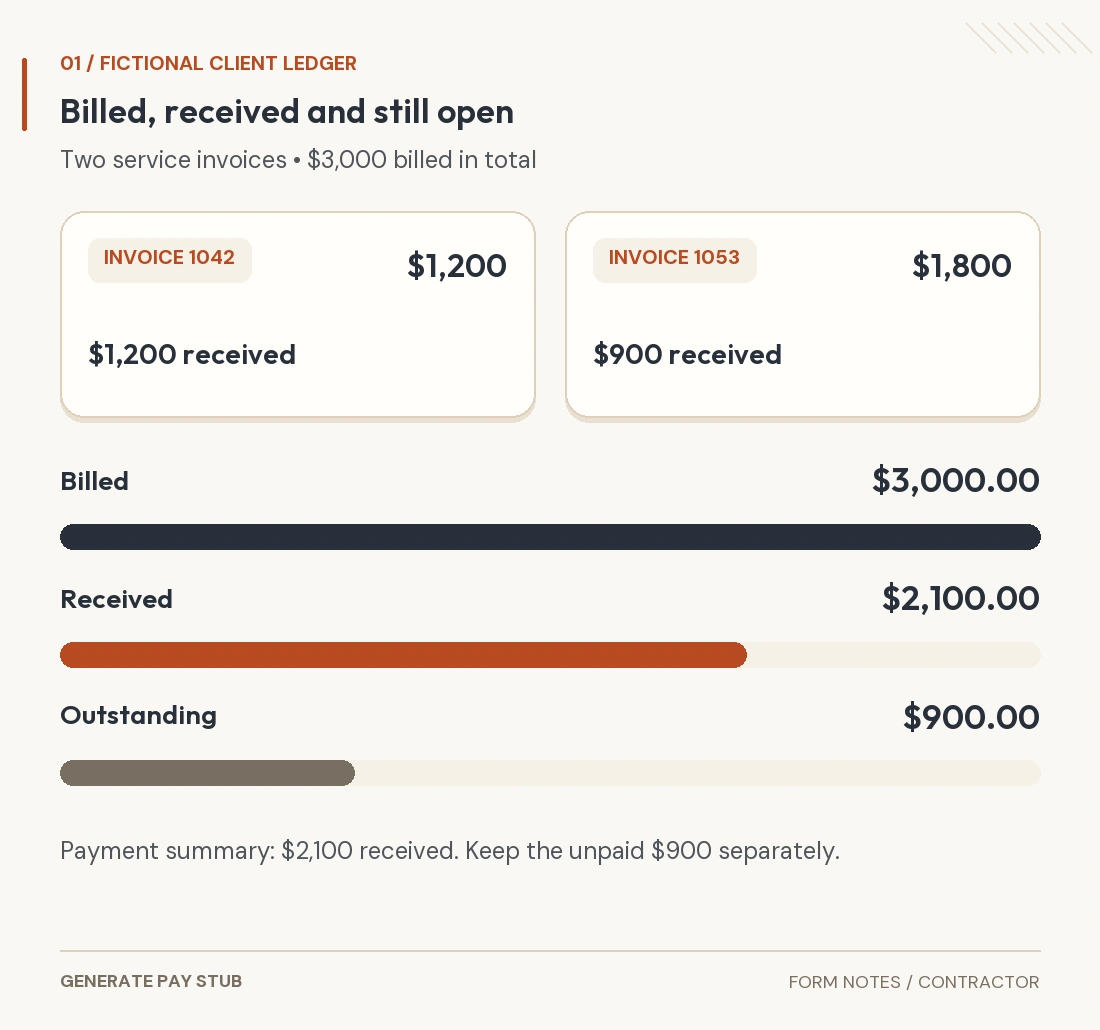
Separate what was billed from what was received. Consider a fictional contractor's two invoices for the same client:
| Invoice | Billed | Received | Outstanding |
|---|---|---|---|
| 1042 | $1,200.00 | $1,200.00 | $0.00 |
| 1053 | $1,800.00 | $900.00 | $900.00 |
| Total | $3,000.00 | $2,100.00 | $900.00 |
Assume the $1,200 payment arrived September 10, 2026, and the $900 partial payment arrived October 15. The remaining $900 was still outstanding at the October 31 statement cutoff. A summary of payments received through that cutoff shows $2,100, with the unpaid $900 identified separately.

When the balance is later paid, connect the new receipt to the original invoice and update the outstanding amount. Do not issue another full-value invoice and count both invoices as separate work.
This example describes payment status; it does not choose the business's tax accounting method. The cash and accrual approaches described in IRS Publication 538 can recognize income differently. Use the relevant tax rules and accounting records when preparing a return.
Why can the bank deposit differ from the gross customer payment?
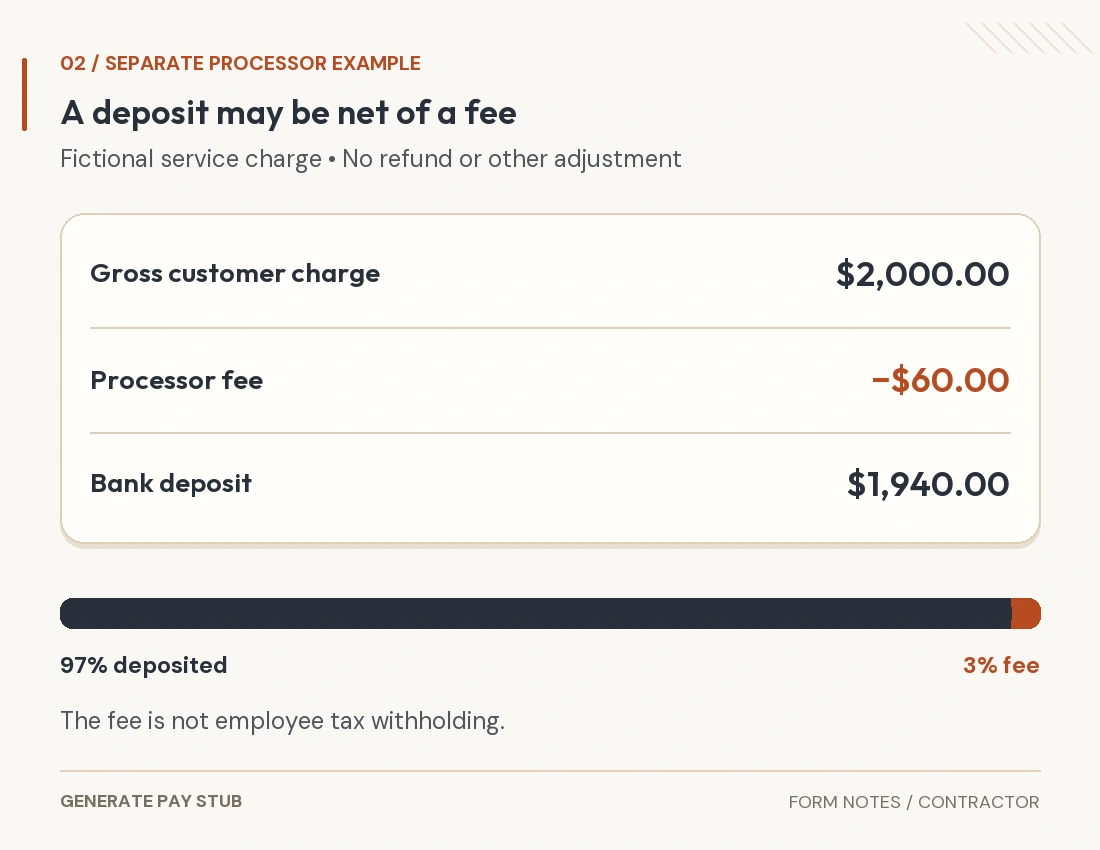
A processor may deduct a fee before transferring funds. That makes the gross charge, fee and deposit distinct parts of the transaction.
As a separate fictional example, assume a client pays $2,000 for services, the processor retains a $60 fee and deposits $1,940. There are no refunds, reserves or other adjustments. Preserve all three figures and the settlement report.

The IRS 1099-K review guidance explains that reported gross payments are not adjusted for items such as fees and refunds. Compare processor records with bank deposits and the books rather than assuming every figure should be identical.
The fee's business-expense treatment requires its own support. A payment summary should not claim that the $1,940 deposit is profit after all expenses when no other expenses have been analyzed.
How should taxes and a personal tax reserve be described?
Separate actual payer withholding from money you set aside yourself. A transfer from your business account to savings for estimated tax is not employer withholding from wages.
The IRS self-employed tax center explains that self-employed people generally address income and self-employment taxes through their return and estimated-tax process. A client payment summary does not calculate that full liability.
Do not add fictional Social Security, Medicare or federal-withholding deductions to make a contractor statement resemble an employee stub. If applicable backup withholding actually occurred, document it from the payer's record and follow its separate reporting treatment.
Likewise, a personal tax-reserve percentage is a budgeting choice, not an IRS-certified tax calculation. The amount needed can depend on other income, deductions, credits, business profit and prior payments.
How do you combine several clients without counting income twice?
Reconcile at the transaction level before preparing a combined summary. Use an invoice or payment reference that makes duplicates recognizable.
For each client, match invoices to receipts and identify open balances. Then compare the combined ledger with settlement reports, bank activity and annual information returns. The same customer payment can appear in several supporting documents without becoming several separate receipts.
If two tax forms appear to report the same payment, investigate their underlying transactions and request corrections where needed. Do not simply add the two form totals to the bank deposits and label the result annual revenue.
The IRS gig-economy guidance also makes clear that reportable income does not disappear merely because no information return was received. Build the history from the actual business activity, including supported cash payments.
Can a contractor summary establish proof of income?
Ask the recipient what evidence it requires. A lender, landlord or other reviewer may need tax returns, a profit-and-loss statement, bank records, contracts, payment histories or verification through its own process.
An accurate summary can help explain those records, but it does not independently authenticate them or guarantee acceptance. Identify who prepared it and avoid presenting a self-prepared statement as an unrelated employer's verification.
Our loan income-document guide and rental income-packet guide discuss recipient requirements. Use a self-employment route when that is the true relationship.
How should you review a contractor document tool?
Choose a format that communicates the actual relationship and payment facts. The contractor option in Generate Pay Stub's maker provides a document workspace. The pay-stub guide explains the shared sections.
Confirm contractor treatment, the true paying party and the service provider's identity. Check actual dates, amounts and cumulative figures. Do not force a monthly salary or employee tax result onto irregular client receipts.
Review the complete output and its terminology before continuing. If the selected format cannot accurately express the payment or implies employment, use an appropriate invoice, receipt or clearly identified business-payment summary instead. Appearance is useful only when the meaning remains accurate.
The maker does not verify client payments, establish worker classification, file taxes or guarantee a third party's acceptance. Follow its current completion instructions and keep the underlying transaction evidence.
Common contractor-record questions
Can a contractor have a payment statement without a 1099?
Yes. A supported statement can describe genuine payments even when no information return was issued. The payer's filing threshold and the contractor's income-reporting obligations are separate matters.
Can I call unpaid invoices income received?
No. A payments-received summary should identify the actual receipts. Preserve unpaid receivables separately and apply the proper accounting method for tax reporting.
Is transferring business money to myself another client payment?
Not simply because it moves between accounts. Review the entity and transaction. Our owner-draw and payroll guide explains why a transfer and employee wages can have different treatment.
General U.S. recordkeeping information. Fictional examples do not establish income, employment, deductible expenses or eligibility for a loan or rental. Unusual accounting and tax issues require appropriate review.