Write an employment offer letter around the terms the organization has approved: the employer, candidate, role, compensation, work arrangement, proposed start date, conditions and response instructions. Check that every figure and promise agrees with the supporting records, then review the complete wording before sending it to the candidate.
A good offer lets someone imagine the next working day and understand the decision in front of them. They should be able to find who they will work for, what the job involves, how pay is expressed, what still needs to happen and whom to contact with questions. That clarity helps the employer, candidate and payroll team start from the same information.
Guidance reviewed November 5, 2026. This article concerns U.S. employment offers and document preparation. State and local law, collective bargaining agreements and individual contracts can change the required wording or accompanying notices. The examples below are fictional and do not establish a worker's legal classification.
What should an employment offer letter accomplish?
It should present the proposed employment terms accurately enough for an informed response. Treat it as a document with potential legal consequences. Calling a file an “offer letter” does not, by itself, settle whether particular provisions are enforceable or whether another agreement controls.
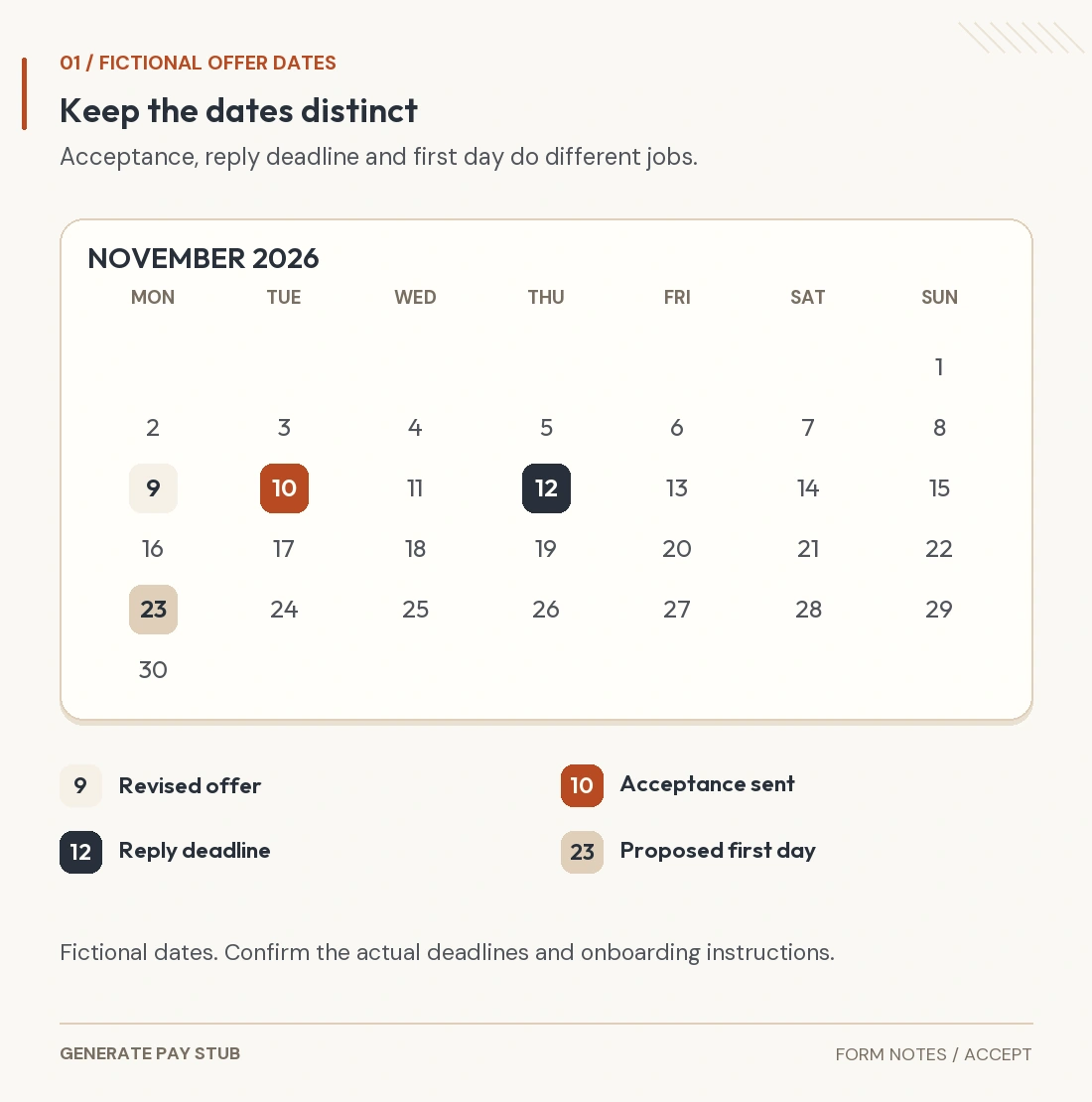
Separate the proposed start date, the deadline for responding and any conditions that remain outstanding. An applicant can accept an offer before the first day of work; a proposed date can also depend on completion of a stated condition. Ambiguity about those events can create practical problems with notice to a current employer, relocation and payroll setup.
The document should also identify the organization actually offering employment. A familiar brand name can be useful, but the candidate should understand the employing entity and the person authorized to present the offer.
What should be approved before you draft a job offer?
Bring the approved job and compensation records together before choosing the letter design. Confirm the role, reporting relationship, work location, schedule, employment type, pay basis, benefits description, applicable conditions and authorized signatory.
Resolve disagreements between the recruiter, hiring manager and payroll team before the candidate receives the letter. A verbal estimate during an interview should not silently become a guaranteed term merely because it was copied into a template.
- Role approval: title, department, essential responsibilities and reporting line.
- Compensation approval: base pay, pay basis and frequency, plus separately described bonus or commission arrangements.
- Working arrangement: proposed start date, location, remote or hybrid expectations, schedule and any relevant end date.
- People review: required notices, lawful screening process, appropriate contract language and who can authorize changes.
For a remote position, “remote” alone may not answer where the employee is authorized to work or which office they report to. Explain the approved arrangement without promising unrestricted work from any jurisdiction.
What should you include in an employment offer letter?
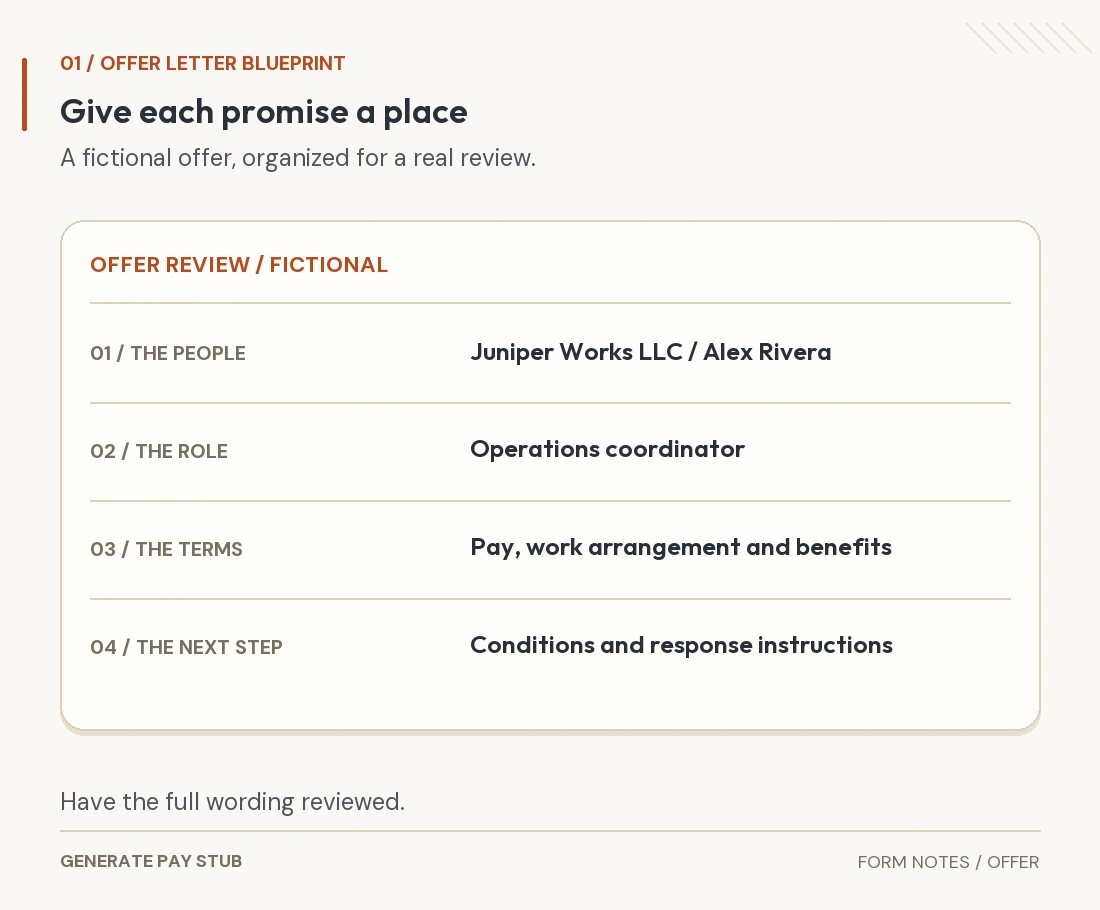
Organize the facts in the order a candidate needs them. The structure below is a preparation framework. It does not replace any required statutory notice or jurisdiction-specific agreement.

| Section | Details to make clear | Review point |
|---|---|---|
| Employer and candidate | Employing entity, candidate name, issue date and authorized sender. | Do names and authority match the approved offer? |
| Role and arrangement | Position, reporting line, location, schedule and employment type. | Would the candidate understand the expected work arrangement? |
| Compensation | Amount, pay basis, frequency and separate variable-pay terms. | Are recurring salary and conditional payments distinguishable? |
| Benefits | Accurate eligibility summary and relevant plan or policy references. | Does the wording match the actual benefit terms? |
| Conditions and next steps | Lawful outstanding requirements, proposed start, response date and contact. | Can the candidate tell what remains to be completed? |
| Review and acceptance | How to respond, authorized signature and referenced attachments. | Is everyone reviewing the same final version? |
Use short paragraphs and descriptive labels. A candidate should not need to search through an unrelated policy passage to learn the base salary or response deadline. At the same time, keep important qualifications close to the promise they modify.
How do you state salary, pay frequency and additional compensation?
Identify the amount and its basis, then explain how it will be paid. “$78,000 per year, paid biweekly” gives different information from “$78,000 per month.” Avoid an unlabeled number or a pay-frequency description that the reader could mistake for the salary basis.
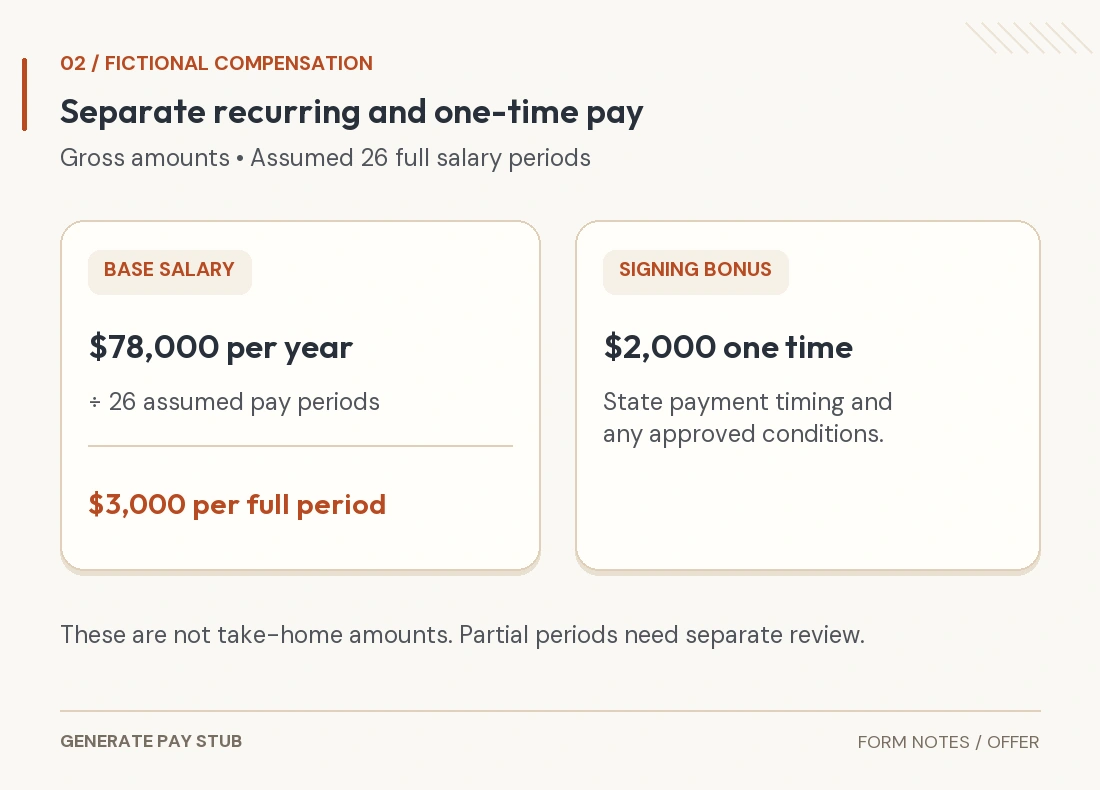
Assume a fictional offer has a $78,000 annual base salary and a payroll arrangement using 26 full salary periods. Dividing $78,000 by 26 gives $3,000 gross per full period. This is a simple illustration of the stated arrangement, not a take-home-pay estimate or an instruction for every payroll calendar.
Now assume a separately approved $2,000 signing bonus. State its payment timing and applicable conditions independently. The bonus does not turn the annual base salary into $80,000 of recurring salary, and it should not be promised in the first paycheck unless that timing is actually approved.

If a start date falls in the middle of a pay period, confirm how the first payment will be calculated under the applicable rules. For the document distinction, our salary and hourly pay guide explains how the pay basis connects to a statement. Our payroll schedule guide explains why biweekly and twice-monthly arrangements should not be used interchangeably.
For commissions or performance payments, identify the relevant written plan, eligibility, measurement period and payment conditions. Avoid presenting a target as a guaranteed amount. Repayment provisions and other restrictive terms warrant jurisdiction-specific review before inclusion.
Does a salary or professional job title make the employee overtime-exempt?
No. The letter's label does not determine the exemption. The U.S. Department of Labor explains that job titles do not establish exempt status; the applicable salary and duties requirements must be satisfied. Different exemptions have different tests, and state law may impose additional protections. DOL Fact Sheet 17A.
A salary field in a generator cannot perform that analysis. Have the organization establish the correct classification using the real work and applicable law, then describe the approved arrangement accurately. Do not use “salaried” as shorthand for “no overtime” or ask a candidate to waive wage protections through a sentence in the offer.
Our exempt versus nonexempt pay guide explains why this distinction also matters after the employee begins work. The payroll setup and records should agree with the actual classification and compensation arrangement.
How should you describe a conditional offer?
Name the lawful outstanding requirement and the process for resolving it. If an offer depends on a permitted check, credential or other approval, use wording reviewed for the particular role and jurisdiction. The candidate should understand the condition without being asked to sign an inaccurate statement about something that has not happened.
If the employer obtains a background report from a consumer-reporting company, the Fair Credit Reporting Act can require a stand-alone written disclosure and written permission, along with additional procedures when taking adverse action. Do not treat a general sentence in the offer as a substitute for that process. State and local restrictions also need review. FTC and EEOC: Background checks.
Medical inquiries need separate care. EEOC guidance generally restricts disability-related questions and medical examinations until after a conditional offer; permitted post-offer inquiries have conditions, including consistent treatment of people selected for the same job. Do not insert a general medical-history request into a routine offer workflow. EEOC: Pre-employment inquiries and disability.
If a condition changes the proposed start date, communicate the revision clearly and keep the approved version. Avoid leaving the candidate to infer whether an old date is still operative.
Which onboarding documents should you review separately?
An offer letter is one part of the hiring packet. Work-authorization verification, employee withholding elections, required wage notices and benefit enrollment each serve their own purpose.
The official Form I-9 states that an employee completes Section 1 no later than the first day of employment, but not before accepting a job offer. Its instructions also protect the employee's choice among acceptable documents. Avoid an offer condition demanding a particular passport or immigration document for I-9 purposes. USCIS: Form I-9; DOJ: Form I-9 and E-Verify.
State notice requirements may go beyond the offer summary. For example, California's Labor Commissioner describes a wage notice under Labor Code 2810.5 for covered employees, with specified pay and employer information and stated exceptions. Check the applicable notice requirements rather than assuming a generic offer PDF satisfies them. California DLSE: Notice-to-employee FAQ.
Similarly, a benefits summary should agree with the actual plan's eligibility and terms. A checkmark beside “health insurance” does not explain an enrollment waiting period, employee premium cost or the details of coverage. Supply the relevant documents through the appropriate process.
What does clear factual offer wording look like?
Use precise, welcoming language for the approved facts. Here is a fictional factual paragraph to illustrate presentation, not a complete letter ready for signature:
Juniper Works LLC is pleased to offer Alex Rivera the position of Operations Coordinator. The proposed start date is November 23, 2026. The annual base salary is $78,000, paid biweekly under the company's payroll arrangement. Please review the work arrangement, benefits information and stated conditions in the accompanying offer documents, and contact the named hiring representative with questions before responding.
Before using wording like this, fill the gaps elsewhere in the actual letter: reporting line, location, schedule, any additional compensation, conditions, response instructions and appropriate legal terms. A polished paragraph should not conceal missing substantive details.
If an at-will provision, fixed employment term, confidentiality clause, restrictive covenant or repayment obligation is proposed, have it reviewed for the relevant law and agreement. Do not assume a clause borrowed from another employer fits this role or jurisdiction.
What should the employer and candidate check before signing?
Read the complete offer and every referenced attachment as one packet. Compare it with the agreed facts, not just the headline salary.
- Check identity and role. Confirm the employer, candidate, title, reporting arrangement and authorized signatory.
- Check pay and timing. Compare salary basis, frequency, variable-pay terms, proposed start and response deadline.
- Check promises and conditions. Identify benefit qualifications, outstanding requirements and terms needing professional review.
- Resolve discrepancies in writing. Obtain an approved revision when the actual offer changes, and read it again before responding.
- Retain the accepted version. Record which letter and attachments were supplied, accepted and used for onboarding.
Keep questions factual. “Is the $2,000 bonus paid after the start date or after a stated service period?” is easier to resolve than assuming it is part of the first regular salary payment. The final wording should reflect the actual answer.
How can you prepare an offer letter in Generate Pay Stub's tool?
Enter approved facts first, then review both wording and presentation. The offer-letter tool provides company details, candidate and role information, compensation, dates and benefit fields. Its review controls let you adjust individual passages and compare the screen and PDF preview.
Check custom passages again after changing a salary, date or role detail: custom text may retain its earlier wording. Review the signature choice and candidate-acceptance section, inspect any additional PDF pages and follow the current completion instructions shown by the tool.
Candidate email is a record field in the current tool; it does not automatically send the offer. The employer decides when and how to share the reviewed document. Keep any private editing or order link confidential, and finish substantive edits before completing the document.
This guide is educational document-preparation information. Fictional wording and calculations do not replace legal, HR or payroll review for a particular employment arrangement.