An ESPP deduction on a pay stub usually sets aside after-tax wages to buy employer stock through an employee stock purchase plan. The deduction is your purchase funding, not a tax payment and not the stock’s market value. For a qualifying U.S. Section 423 plan, the payroll contribution, share purchase and later sale are separate events with different records and tax consequences.
Reviewed November 22, 2026. This guide addresses ordinary U.S. federal Section 423 ESPPs. Nonqualified purchase plans, international arrangements and other awards can differ. Fictional examples assume valid plan qualification, no fees, no wash-sale or other basis adjustments, accurate lot identification and no special equity-deferral election. They explain records and arithmetic, not whether you should buy, hold or sell employer stock.
What does ESPP mean on a pay stub?
ESPP stands for employee stock purchase plan. In a typical payroll-funded arrangement, the employer collects elected contributions during an offering period and uses the accumulated money on a purchase date. Fidelity’s ESPP explanation describes after-tax payroll collection and the distinction between the offering and purchase stages. Your own plan determines eligibility, elections, eligible compensation and purchase mechanics.
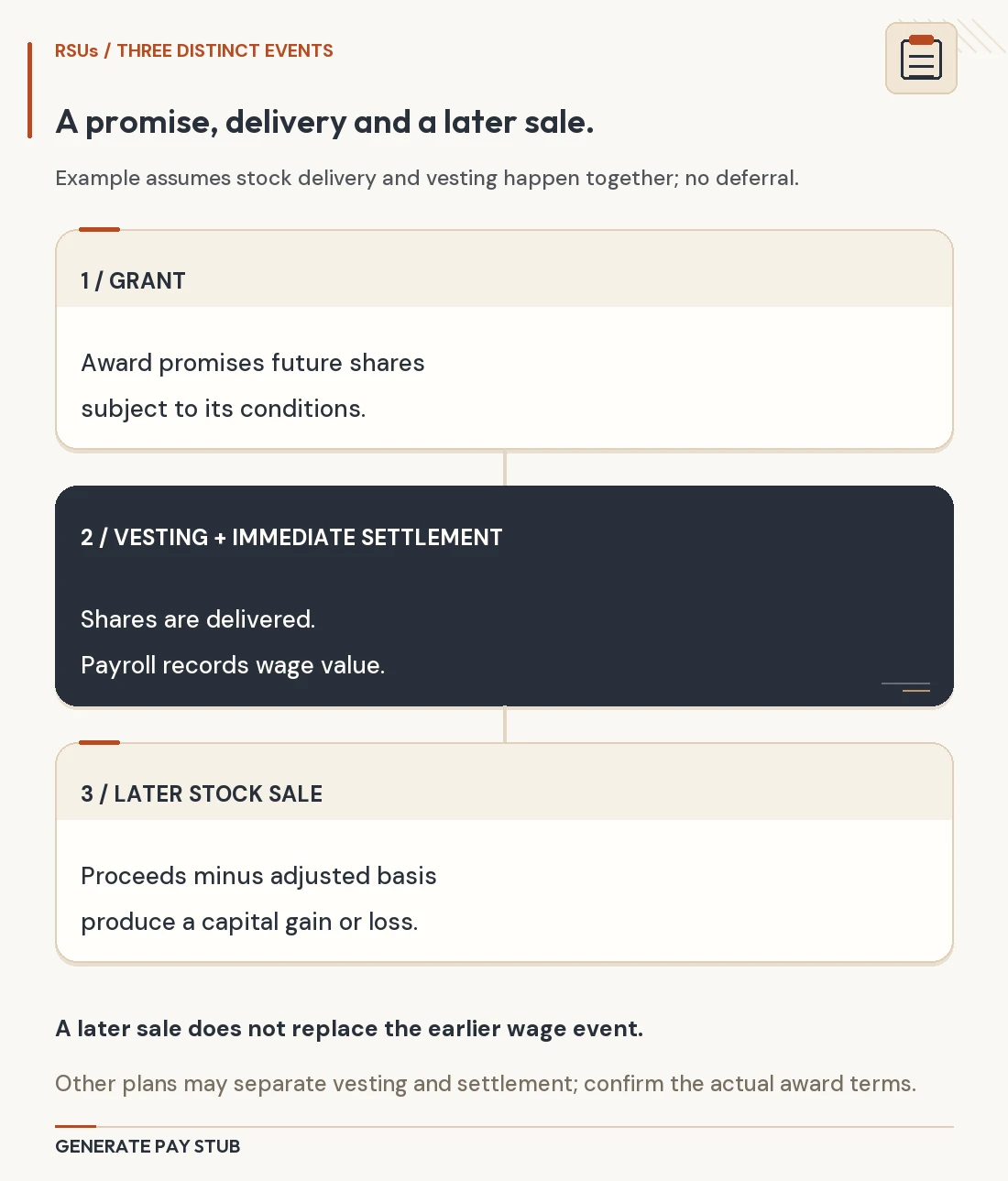
Start with the plan document or enrollment confirmation: is this a Section 423 statutory plan or a nonqualified arrangement? A payroll code such as “stock,” “ESPP” or “share purchase” cannot establish that classification by itself. Our RSU guide covers a different transaction: an award delivered as compensation rather than employee savings used to buy stock.
Also distinguish the percentage’s calculation base from its tax treatment. An election may use eligible gross compensation to calculate the dollars while collecting those dollars from after-tax pay. “Ten percent of eligible pay” does not mean the contribution is a pre-tax salary deferral. Use the actual definition of eligible compensation before including bonuses or overtime in the contribution calculation.
How does an ESPP contribution change take-home pay?
Suppose a fictional paycheck has $3,000 cash wages, $500 employee taxes and $200 other employee deductions. These are supplied results, not a withholding calculation. An authorized $212.50 ESPP contribution leaves $2,087.50 net cash: $3,000 − $500 − $200 − $212.50.
The contribution buys an asset with the employee’s money. It does not erase $212.50 from the wages on which applicable payroll taxes were calculated. The pre-tax versus post-tax guide explains why the deduction’s location and wage-base effect need separate checks.
Look at the current contribution, the cumulative payroll amount and the offering-period balance. They need not reset on the same date. Calendar-year YTD can include contributions for more than one offering, while a current offering balance can return to zero after a purchase. Neither number is automatically the current market value of shares already owned.
From twelve payroll deductions to sixty shares
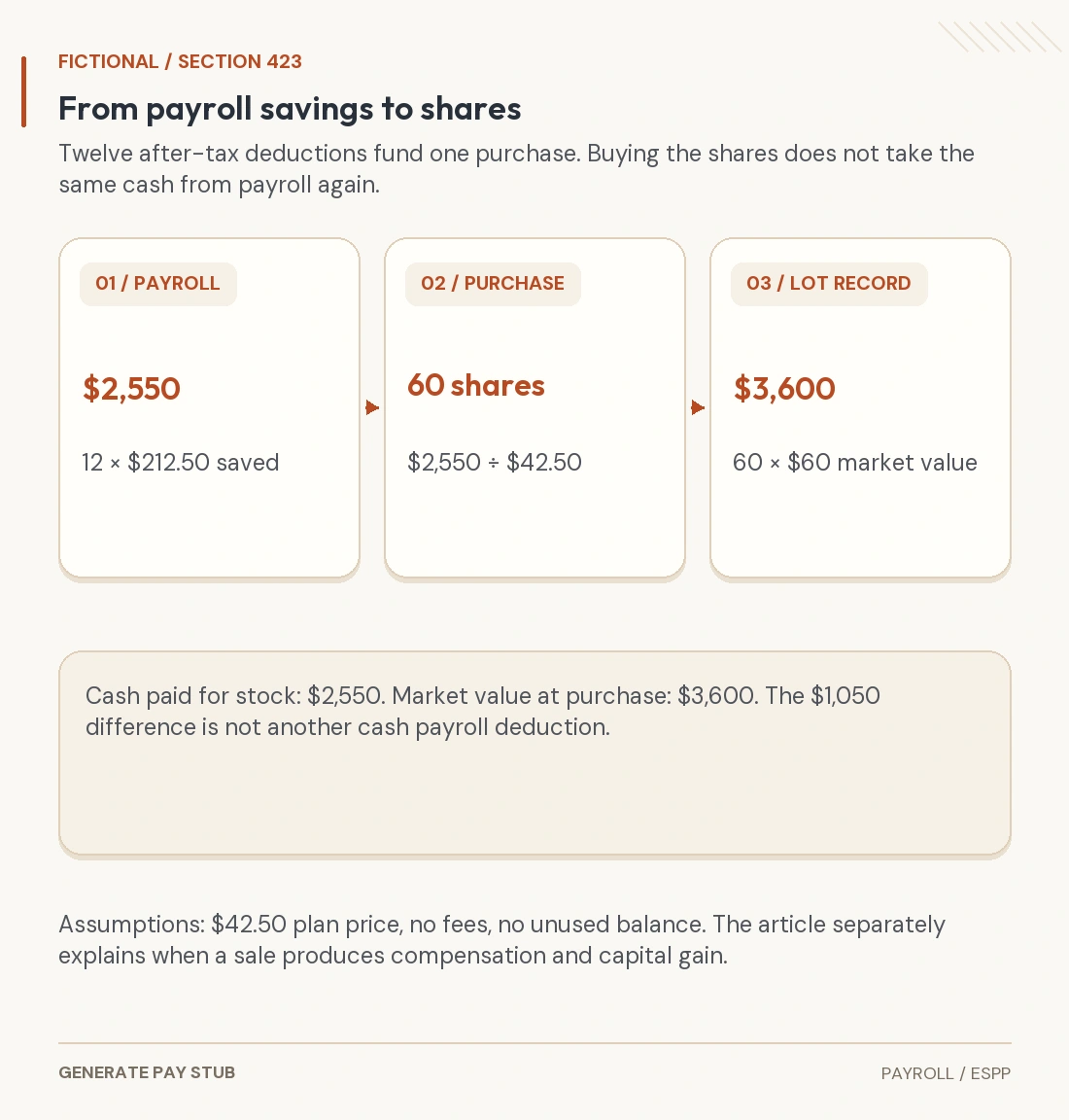
Continue with twelve actual deductions of $212.50, no earlier balance, no interest and no refunds. The accumulated purchase cash is 12 × $212.50 = $2,550. Assume the valid plan prices shares at 85% of the lower grant-date or purchase-date fair market value. The illustrative grant-date value is $50 and the purchase-date value is $60, producing a $42.50 purchase price: 85% × $50.
| Measure | Calculation | Amount or quantity |
|---|---|---|
| Accumulated payroll cash | 12 × $212.50 | $2,550.00 |
| Plan price in this example | 85% × $50 | $42.50 per share |
| Shares bought | $2,550 ÷ $42.50 | 60 shares |
| Purchase-date market value | 60 × $60 | $3,600.00 |
| Market value less cash paid | $3,600 − $2,550 | $1,050.00 |
The $2,550 has already been collected across those paychecks. Spending it to purchase the shares should not, by itself, take another $2,550 out of the next paycheck. The $3,600 market value is not another bank deposit, and the $1,050 difference is not another employee contribution.

The IRS’s stock-option guidance distinguishes statutory purchase-plan options from nonstatutory options. The IRS Section 423 reporting FAQ explains that grant and exercise of the qualifying purchase option do not themselves produce gross income; a later sale can produce compensation and capital gain or loss. Do not import an RSU’s ordinary vesting-and-payroll treatment into this purchase example.
Which dates decide qualifying versus disqualifying treatment?
The Section 423 holding tests use both the grant date and the stock-transfer date. The IRS FAQ describes the later of the two-year period after grant and the one-year period after transfer. A sale must satisfy both relevant periods for qualifying treatment. A payroll deduction date does not start a separate stock holding period for each contribution.
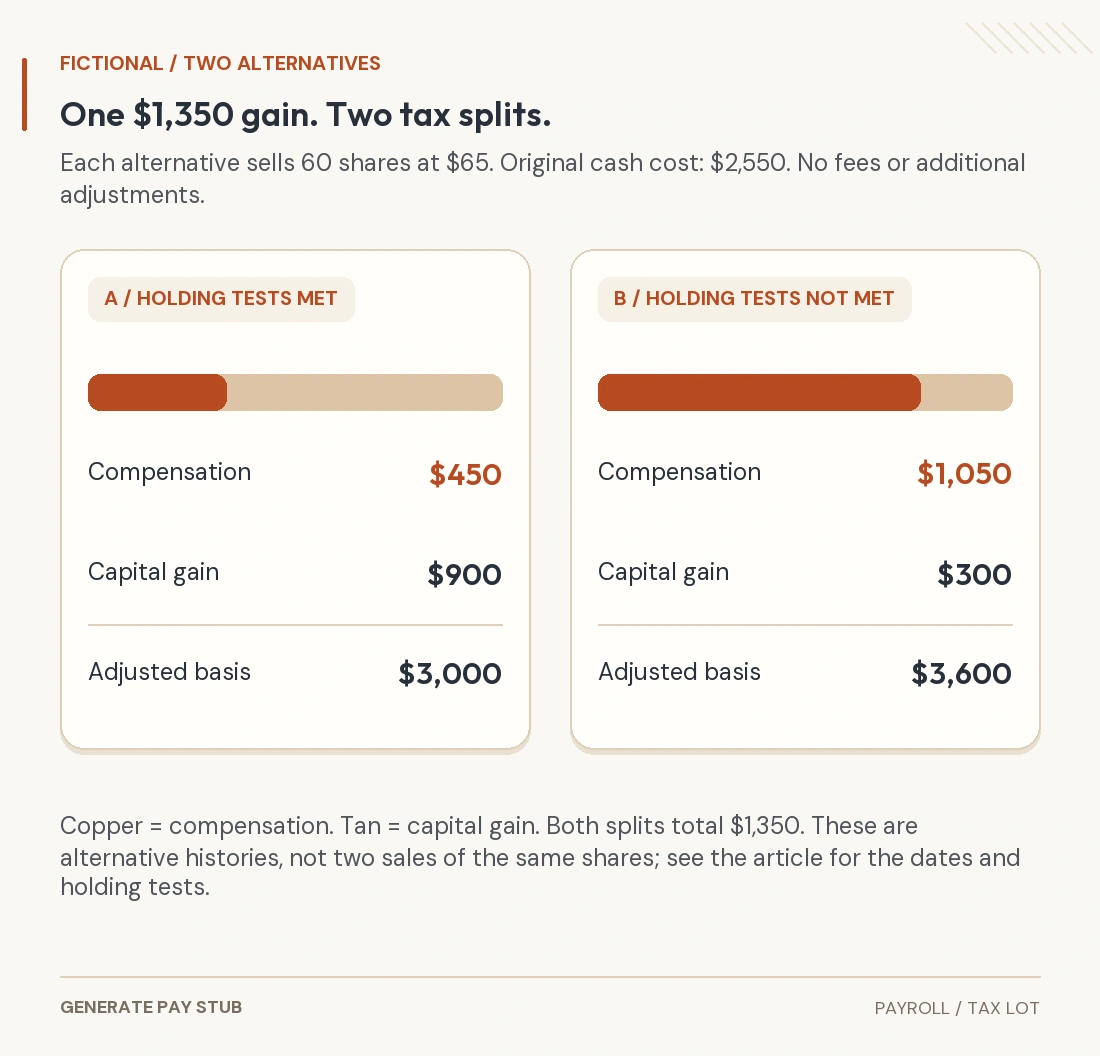
The following are two alternative histories for the same sixty-share economic illustration. They are not two sales of one lot, and you should not add their income together. Both assume a sale on October 15, 2026; only the grant and acquisition dates change.
| Event | Alternative A: older lot | Alternative B: newer lot |
|---|---|---|
| Option granted | January 2, 2024 | January 2, 2026 |
| Shares purchased and transferred | June 28, 2024 | June 30, 2026 |
| Shares sold | October 15, 2026 | October 15, 2026 |
| Holding-period result | Both tests satisfied | Neither test satisfied |
Alternative A is comfortably beyond both periods. Alternative B sells within the year of purchase and grant. These examples avoid anniversary-day boundary questions. A transfer to another account, gift, death or other disposition can need separate analysis; do not decide every event solely from an ordinary broker “long-term” label.
How does the same sale gain split between compensation and capital gain?
For either alternative, assume all sixty shares sell for $65 each. Proceeds are $3,900, compared with $2,550 original purchase cash: a $1,350 economic gain before tax and fees. The question is how that gain is classified, not whether the full $3,900 is newly earned wages.
Alternative A: both holding tests are met
For this discounted option, use the Section 423 rule comparing the grant-date discount with the actual gain. With the assumed pricing formula, the price calculated as if exercised at grant is also $42.50. The grant-date discount is ($50 − $42.50) × 60 = $450, less than the $1,350 gain. Compensation is therefore $450 under these assumptions.
Add the $450 compensation to the $2,550 purchase cost, giving $3,000 adjusted basis. Proceeds of $3,900 less that basis give $900 long-term capital gain. Compensation plus capital gain is $450 + $900 = $1,350.
The primary Section 423 statutory text supplies the qualifying-disposition lesser-of rule and basis increase. When an option price is not fixed at grant, its special grant-date pricing rule matters; the current market quote is not a substitute for the plan’s grant-date records.
Alternative B: the holding tests are not met
The currently posted 2025 Publication 525 explains the established disqualifying-disposition rule: compensation uses the purchase-date spread, with a corresponding basis increase. Applying that rule here gives ($60 − $42.50) × 60 = $1,050 compensation. Adjusted basis is $2,550 + $1,050 = $3,600; $3,900 proceeds less basis gives $300 short-term capital gain. Again, $1,050 + $300 = $1,350.
| Measure | A: tests met | B: tests not met |
|---|---|---|
| Sale proceeds | $3,900.00 | $3,900.00 |
| Original cash cost | $2,550.00 | $2,550.00 |
| Compensation | $450.00 | $1,050.00 |
| Adjusted stock basis | $3,000.00 | $3,600.00 |
| Capital gain | $900.00 | $300.00 |
| Compensation plus capital gain | $1,350.00 | $1,350.00 |

The examples show classifications rather than tax owed. They do not compare marginal rates or recommend holding stock. A price decline can change the result substantially. Under the disqualifying rule, compensation is not limited to the eventual economic gain, so wage income and a capital loss can occur together. Capital-loss limitations can affect the return. Do not apply the profitable-sale numbers to a loss sale.
Why can W-2 compensation appear without normal wage-tax withholding?
Section 423 disposition compensation has specific federal employment-tax rules. The IRS’s 2026 Publication 15-B, Employee Stock Options section, explains the Social Security, Medicare and FUTA exclusions for the identified statutory-option transactions and says federal income-tax withholding is not required on the specified disposition income. It also requires the relevant compensation reporting in W-2 Box 1. Do not assume an ESPP sale line must increase Boxes 3 and 5 merely because it increases Box 1.
A lack of required withholding does not make the income tax-free. Review the full-year tax position and whether additional withholding or estimated payments are appropriate. The estimated-payment guide explains the separate payment-planning question. State and local treatment still require review.
Payroll may record a noncash compensation entry connected with the sale without paying that compensation again in cash. Match the event to the employer’s report and the broker’s sale confirmation. Do not create a second wage payment to match a securities-sale deposit, and do not subtract the compensation twice when reconciling a stock offset.
Use Form 3922 and the broker supplement together
The April 2025 instructions for Forms 3921 and 3922 describe the ESPP transfer reporting and its fields. Form 3922 can identify grant, exercise and transfer dates, share count, market values and purchase price. Box 8 concerns the price as if exercised at grant when the actual option price was not fixed or determinable then; it is not simply another statement of today’s price.
Form 3922 is not the later sale’s Form 1099-B. Preserve the lot supplement and compensation calculation when checking broker-reported basis. If the broker shows only the $2,550 cost in Alternative B, treating that as the final adjusted basis would show $1,350 capital gain while also reporting $1,050 wages. That would count the $1,050 compensation again in the gain calculation.
The Form 8949 instructions explain reporting incorrect or unreported basis. The linked edition is currently 2025; use the final instructions for the actual sale year when preparing the return. Do not change a broker basis that already includes the correct compensation adjustment, and do not copy a prior year’s line numbers uncritically.
What about the $25,000 limit, unused cash and plan changes?
Section 423’s $25,000 restriction concerns the rate at which purchase rights accrue, measured using grant-date fair market value under the statutory rules. It is not a universal $25,000 after-tax payroll-contribution allowance. Overlapping offerings and affiliated-company plans can require coordinated tracking. Ask the administrator for its limit calculation before treating every stopped deduction as an error.
Plan-specific rules govern contribution changes, withdrawal, refunds, residual cash and termination of employment. Reconcile the actual refund with accumulated cash that was not used to purchase shares. A refund of unused after-tax purchase funds is different from selling stock at a gain. Do not promise that every plan permits mid-period changes, carries residual cash forward or refunds on the next payday.
Nonqualified plans and cross-border work can produce different compensation or tax timing. Stock splits, gifts, fees, multiple lots and other adjustments also change a simple basis calculation. Keep the administrator’s actual dates and prices rather than extending this sixty-share illustration to those cases.
A useful ESPP review file has three connected records
- Payroll: the election, effective dates, current deductions, cumulative contributions and any refunds.
- Purchase: offering/lot identifier, plan classification, grant and transfer dates, pricing formula, market values, share count and Form 3922 where applicable.
- Disposition: sale confirmation, reported compensation, W-2, broker form and supplemental adjusted-basis calculation.
Send a contribution discrepancy to payroll, a purchase or lot discrepancy to the stock-plan administrator, and an uncertain return classification to a qualified tax adviser. Identify the specific lot and date through secure channels; do not post full brokerage or identity records in public.
If authorized to create a pay stub from approved payroll, keep an ESPP purchase-funding deduction separate from any later noncash compensation entry. A check stub maker cannot determine plan qualification, buy shares or replace the broker’s lot records. Use the preparation checklist to establish the source for each reported figure.
Common ESPP pay-stub questions
Does the first payroll deduction start the stock holding period?
No. Track the relevant grant and stock-transfer dates. Saving money across several paychecks is different from acquiring the shares, and the Section 423 holding tests use their own dates.
Are my contributions the same as taxable ESPP compensation?
No. The $2,550 in the example is employee purchase funding. The later compensation calculation depends on the statutory rules, dates and prices; it is not simply the total deducted from wages.
Should I add my ESPP sale deposit to wages on the next stub?
A broker sale and a wage payment are separate transactions. Reconcile the sale proceeds, any reportable compensation and the stock basis with their proper records; a sale deposit does not establish another cash payroll payment.