During qualifying unpaid FMLA leave, the employee generally remains responsible for the usual employee share of group health premiums, even when there is no paycheck from which to deduct it. The employer must maintain the required coverage on the applicable terms. A later “benefit arrears” or “premium catch-up” line should identify the coverage periods, employee share advanced and payments already credited; it should not silently charge the employer’s own normal share to the employee.
Reviewed November 22, 2026. This U.S. guide addresses group health coverage under the Department of Labor’s FMLA regulations and relevant cafeteria-plan rules. It assumes an eligible employee, a covered employer and qualifying designated leave. It does not decide individual eligibility, coverage disputes, federal civil-service rules or every state leave and wage-deduction requirement. All dollar examples are invented.
Does unpaid FMLA mean health coverage becomes free?
No. Job-protected leave, wage replacement and insurance funding are different questions. The DOL’s FMLA overview explains qualifying leave and continued group health benefits. An employee can have no cash wages for a period while group coverage continues and an employee premium obligation remains.
Under 29 CFR §825.209, required group health coverage generally continues on the same basis as if the employee had remained at work. If covered employees receive a plan change, the worker on leave does not automatically stay on an obsolete version of the plan. Check the actual coverage, dependents, premium rate and effective dates.
The FMLA continuation duty is not indefinite. Exhausted entitlement, an employment relationship that would have ended independently of leave, or unequivocal notice of an intent not to return can affect that duty under the regulation. Any separate continuation rights and coverage after the FMLA obligation ends need their own review.
Do not infer that every absence labeled “medical” is FMLA leave or that every employee has the same entitlement. Ask HR for the applicable eligibility, rights-and-responsibilities and designation notices. The unpaid-leave salary guide addresses wage reductions and PTO separately; this article concentrates on the insurance-payment ledger.
How can premiums be paid when there is no paycheck?
Section 825.210 addresses the employee’s usual premium share, changes to premium rates and permitted payment arrangements during unpaid leave. The employer must give advance written notice of the payment terms. It may not add an administrative charge to the employee’s premium payment under that provision.
Possible arrangements include direct payment on an allowed schedule, an optional prepayment arrangement or an appropriate agreed payment system. When FMLA runs with paid leave, the ordinary paid-leave collection method applies. Do not assume the employer must use one universal method for every worker.
The cafeteria-plan regulation, 26 CFR §1.125-3, Q&A-3, describes pre-pay, pay-as-you-go and catch-up options. A planned catch-up arrangement involves an advance agreement to continue coverage, have the employer advance the employee share and repay it after return. The regulation also addresses recouping missed employee payments when an employer elects to keep coverage in place.
Before leave, obtain a written schedule showing what is due, when, where it goes and how it will be credited. If paying directly, keep the payment confirmation and coverage-period reference. A payroll contribution left blank during leave does not prove the premium was waived, but neither does it prove an amount is overdue if you already paid the same share outside payroll.
Employee arrears are different from the employer’s own premium share
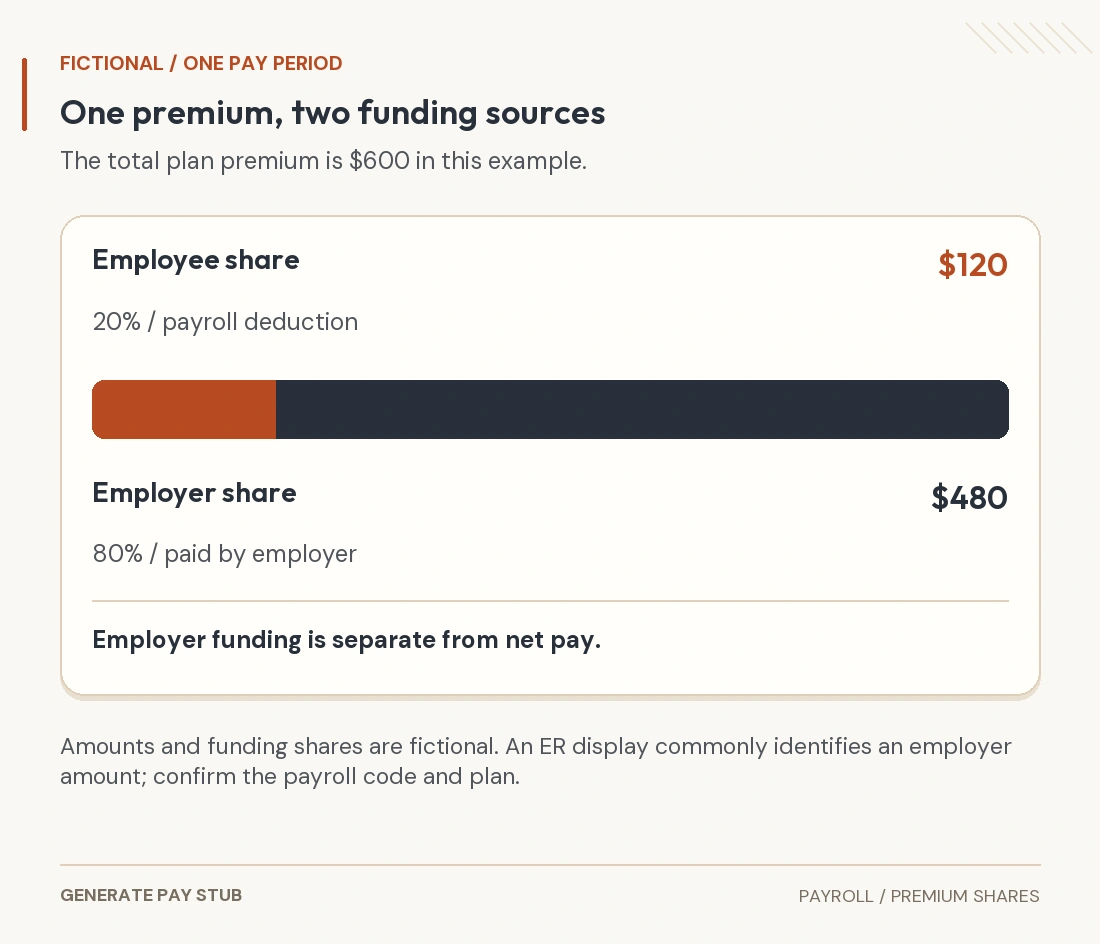
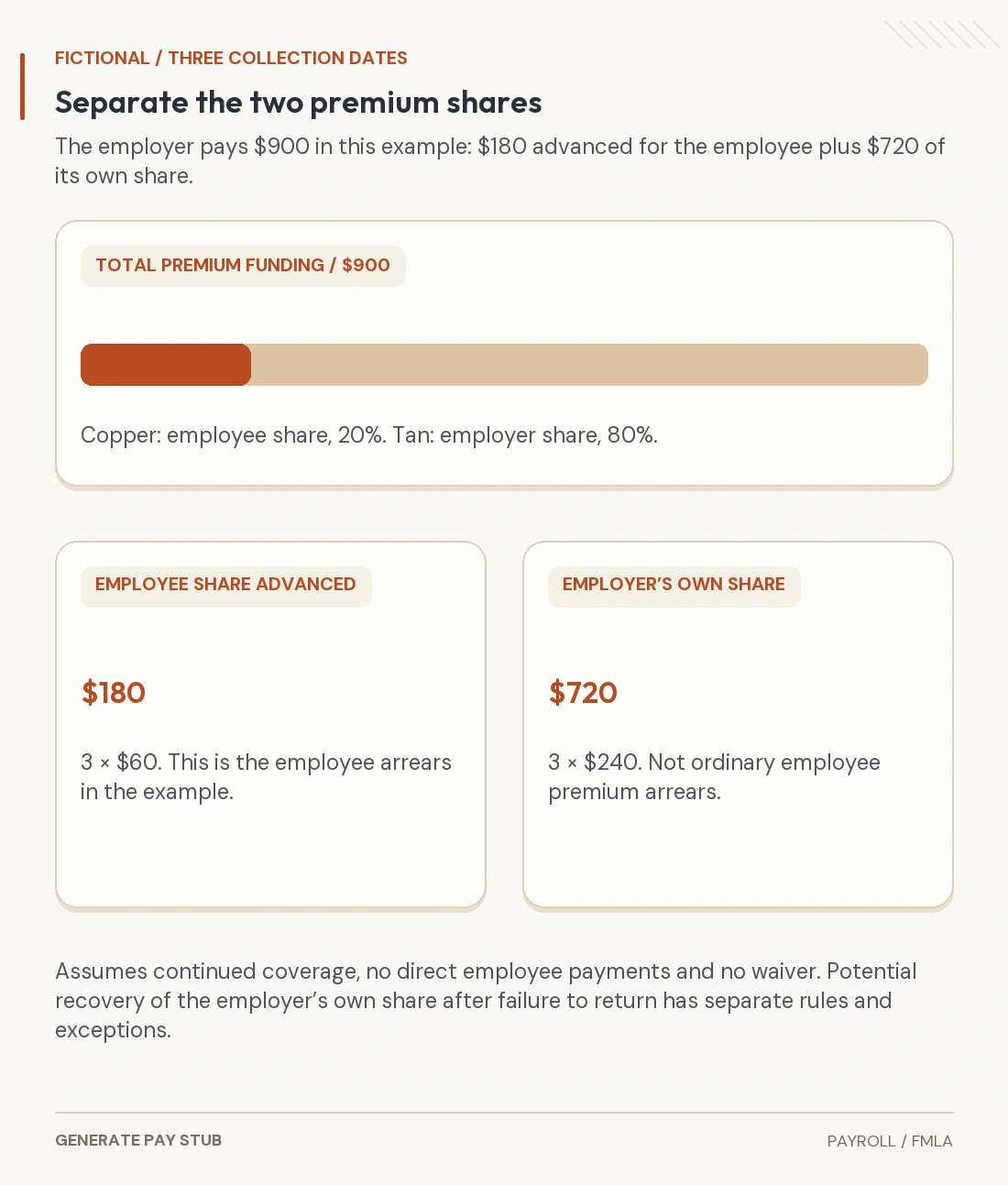
Assume three scheduled collection dates during unpaid FMLA leave. For each relevant period, the employee share is $60 and the employer’s normal share is $240. Assume coverage continues, the employer advances the employee share, no employee direct payments occur and there is no waiver or premium-rate change.
| Funding category | Per period | Three periods |
|---|---|---|
| Employee share advanced by the employer | $60.00 | $180.00 |
| Employer’s own normal share | $240.00 | $720.00 |
| Total premium funding in this example | $300.00 | $900.00 |
The ordinary employee-share arrears in this example are $180, not $900. The $720 is the employer’s own share. There is a separate, conditional rule about recovering that share when an employee does not return, discussed below; it is not automatically part of every returning worker’s catch-up balance.

Real insurance bills may be monthly while payroll collections occur weekly or biweekly. Map each payroll amount to its actual coverage period before using this simplified three-period illustration. Include direct payments, prior deductions, credits and refunds. Do not multiply the full carrier invoice by the number of missed paychecks and assume that is the employee debt.
How should a return-to-work catch-up deduction reconcile?
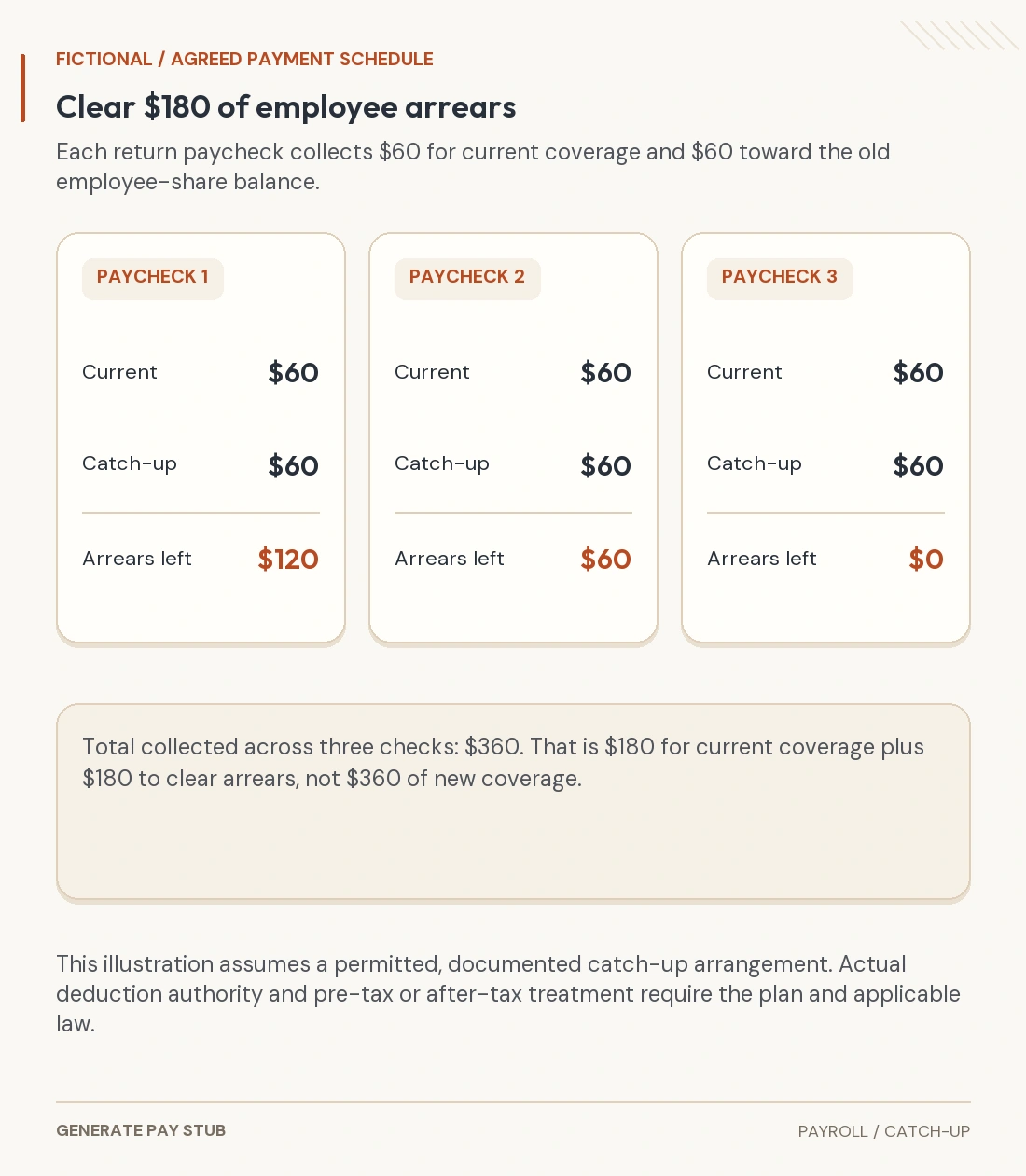
Continue the fictional $180 employee balance. Assume a documented, permitted arrangement collects the usual $60 current premium plus $60 toward old arrears from each of the next three paychecks. The extra deduction is temporary and should stop when the old balance is cleared.
| Return paycheck | Current premium | Arrears payment | Arrears left |
|---|---|---|---|
| First | $60.00 | $60.00 | $120.00 |
| Second | $60.00 | $60.00 | $60.00 |
| Third | $60.00 | $60.00 | $0.00 |
Each illustrated paycheck has $120 of total employee premium collection. Across three checks, $360 is collected: $180 for new current coverage and $180 to repay the earlier employee share. It is neither $360 of arrears nor $360 of newly provided coverage.

For a limited cash illustration, suppose all the other actual payroll calculations leave $1,550 before these health-premium collections. Subtracting $120 leaves $1,430. Subtracting only the usual $60 would leave $1,490, a $60 difference with those other figures held fixed. This does not calculate taxes or assume a pre-tax catch-up leaves real withholding unchanged.
When the balance reaches zero, investigate an unexplained continuing arrears deduction. Likewise, ask how a smaller paycheck affects the collection schedule; an empty or negative net amount is not permission to collect any amount by any method. Our negative-net-pay guide explains why a displayed shortfall and a valid debt need separate review.
Can coverage end immediately after a missed premium?
A missed deduction does not itself establish an immediate coverage cancellation. Section 825.212 sets out the late-premium and notice requirements. Without an established longer grace period, it addresses a payment more than thirty days late. Required written notice must be mailed at least fifteen days before coverage is to cease and identify the specified date and opportunity to pay.
The DOL’s late-premium advisor explains the same distinction. The grace period and advance notice are two conditions to examine together; they are not a universal forty-five-day allowance created by simply adding the numbers.
Here is a timing illustration only. Assume a July 1, 2026 due date, an ordinary thirty-day grace period, no payment and a notice dated and mailed July 20 specifying August 10 as the proposed end date unless payment arrives. August 10 is more than thirty days after July 1 and twenty-one days after July 20. Those intervals illustrate the two tests; they do not establish that an actual cancellation is valid without the policy, notice wording, mailing, payment and coverage facts.
The regulation separately addresses permitted retroactive termination when an applicable established unpaid-leave policy supports it. Do not assume every plan can backdate coverage to the missed due date, or that a grace period means claims are permanently payable regardless of later action. Ask the administrator for the actual effective date and claims status.
Section 825.212 also provides for equivalent coverage restoration on return from FMLA after a lapse for nonpayment, without imposing the specified new qualification hurdles. Restoring future coverage and deciding what happened to claims during a lapse are different questions. Save any termination and reinstatement notices; do not assume a restarted payroll deduction alone proves that the insurer has restored coverage.
What if the employee does not return after FMLA?
Recovery of the employer’s own share has conditions and exceptions. Section 825.213 permits recovery in specified failure-to-return circumstances after unpaid FMLA entitlement expires or is exhausted. Exceptions include qualifying serious-health circumstances and other circumstances beyond the employee’s control. An invoice labeled “FMLA repayment” does not establish that those conditions have been met.
The rule generally treats at least thirty calendar days back at work as a return and includes a special retirement provision. It also distinguishes periods covered by substituted paid leave and specified paid disability coverage from unpaid periods for recovery of the employer share. Ask for a period-by-period explanation rather than accepting a charge for every insurance dollar paid during the entire absence.
The employer may request supporting medical certification for the relevant health-condition exception under the regulation’s requirements. Provide necessary documents through the designated confidential process; a routine payroll ticket does not need to circulate a diagnosis to unrelated staff.
The DOL’s FMLA statutory text supplies the underlying failure-to-return recovery rule and its exceptions. Even when recovery is permitted, a deduction from money due must respect applicable federal and state wage-payment laws. Ask separately whether a debt exists, which share and periods it covers, and whether the proposed collection method is allowed.
Are catch-up deductions always pre-tax?
No. The cafeteria-plan rule describes permitted pre-tax and after-tax payment routes, subject to its conditions and the plan. A normal pre-tax premium does not mean every later arrears entry may be treated identically without review. Payments already made another way must be credited so that the employee does not pay twice or receive duplicate tax treatment.
Crossing plan years adds restrictions, especially for prepayment. Section 1.125-3 includes a calendar-year example in which pre-tax prepayment cannot shift compensation into the following plan year. Have payroll identify the applicable route instead of relabeling a prior-period charge to obtain a desired wage-base result.
Health FSA coverage has additional rules in that regulation; an HSA deposit, retirement contribution or life-insurance premium is not automatically governed by the same funding and restoration details as the group medical premium. Use the health FSA guide for its separate elected-coverage and contribution concepts. The health-insurance deduction guide explains ordinary employee/employer coding and wage-base checks.
What should you request when the catch-up line looks wrong?
- Confirm the leave category and dates. Identify unpaid FMLA periods separately from paid leave or another program.
- Get the payment terms. Retain the premium schedule and the relevant rights-and-responsibilities notice.
- Identify the shares. Separate the employee premium, any employee amount advanced and the employer’s own funding.
- Match every payment to coverage. Include deductions, direct payments, refunds and credits.
- Check the remaining balance. After each catch-up, reconcile opening arrears minus credited repayment.
- Confirm coverage separately. Ask for any lapse, restoration and insurer-status details rather than inferring them from a payroll code.
A useful question is: “Please itemize the [amount] benefits-arrears deduction on [pay date] by coverage period and employee share. My records show [direct payments or earlier deductions]. Please confirm the remaining balance, future collection schedule and coverage status.”
Section 825.300 describes employer FMLA notices, including relevant premium-payment responsibilities and consequences. If the underlying rights remain disputed, the Wage and Hour Division contact page is an official route for FMLA questions. Coverage-claim and state wage-deduction issues may need their own administrator or authority. An internal inquiry should not be assumed to extend a legal deadline.
For authorized payroll preparation, a pay stub maker should distinguish the current premium from arrears supported by actual records. Preparing a statement cannot continue insurance, approve FMLA, authorize collection or settle a debt. Request the employer’s official correction when the issued record is wrong.
Common FMLA premium and pay-stub questions
Does a zero paycheck mean I owe the entire insurance bill?
No. Identify the employee share, employer share, actual advances and payments. The fictional $900 funding total includes only $180 ordinary employee arrears; recovery of an employer share requires a separate analysis.
Can a deduction be correct while the insurer’s record is wrong?
Yes, the payroll collection and coverage administration are different records. Ask payroll about the amount and the plan administrator about effective coverage and posting. Obtain a resolution connecting them.
Does returning after leave erase all missed employee premiums?
Not automatically. An employee share actually advanced while coverage continued can remain recoverable under the applicable rules. Check the ledger, waiver terms and lawful collection method; do not confuse it with conditional recovery of the employer’s own share.
Should I use FMLA rules for every unpaid leave?
No. Verify that the leave and employee are covered by the relevant FMLA framework. Other leave, state programs and plan terms may supply different protections or payment arrangements.