Prepare Form 1065 by reconciling the partnership's books, separating ordinary business results from separately stated items and preparing each partner's Schedule K-1 under the applicable allocation rules. The partnership return, partner statements and partners' own tax returns are connected but distinct documents.
A strong preparation review follows each item from the ledger to the correct return line, then from partnership totals to partner-level reporting. A bank distribution is not a shortcut for determining taxable income.
Tax year 2025; reviewed November 5, 2026. This guide uses the final six-page 2025 original currently supported by the builder. Its worked example is a domestic service partnership with two individual partners, a valid unchanged 60%/40% allocation, no inventory, no guaranteed payments and no international activity.
Who needs to prepare a partnership return?
Generally, a domestic partnership files Form 1065 when it receives income or incurs expenditures treated as federal deductions or credits. An LLC classified as a partnership follows the applicable partnership-return rules. A sole proprietorship and a corporation have different return paths.
The IRS partnership overview describes the usual pass-through treatment: partners report their shares, and the partnership supplies Schedule K-1. Partners generally are not employees of their partnership and should not receive a W-2 for acting as partners.
“Pass-through” does not mean the entity has no filing or payment responsibilities. Employment taxes for actual employees, foreign-partner withholding, audit-related underpayments and other special items can create separate obligations.
Spousal businesses, qualified joint ventures, foreign entities and elections need their own analysis. Do not infer federal classification solely from the business's informal name or the fact that two people share a bank account.
What records should the partnership collect first?
Bring a complete year-end accounting packet and the agreement governing partner interests. Useful records include:
- The EIN, entity records, tax year and accounting method.
- The partnership agreement, amendments and ownership changes during the year.
- A trial balance, profit-and-loss report and beginning and ending balance sheets.
- Receipts, refunds, expenses, fixed assets and depreciation workpapers.
- Separate records for portfolio income, rentals, capital transactions and contributions.
- Guaranteed payments, distributions, capital contributions and partner loans.
- Partner identities, profit/loss/capital percentages and liability information.
- Prior returns, elections, suspended items and required supporting schedules.
Classify transfers before totaling deductions. Employee wages, an ordinary vendor bill, a partner distribution and repayment of loan principal are different transactions even if each reduced the same checking account.
Publication 541 explains partnership agreements, distributions and basis. Keep those records alongside the bookkeeping reports rather than reconstructing ownership facts from year-end balances alone.
How do ordinary business profit and separately stated items differ?
Page 1 computes the ordinary trade-or-business result; Schedule K separately reports items needing their own treatment. The 2025 Form 1065 original includes this separation and the associated schedules.
Portfolio interest, capital gains, charitable contributions and Section 179 deductions do not simply belong in one undifferentiated ordinary-profit figure. Rental activities may require their own supporting forms and separate reporting. Classify the item before selecting a field.
Do not deduct an item on Page 1 and again as a separately stated deduction. Similarly, a qualified-dividend subset is not an extra receipt to add a second time. The classification should be traceable in a workpaper.
What does a checked service-partnership example look like?
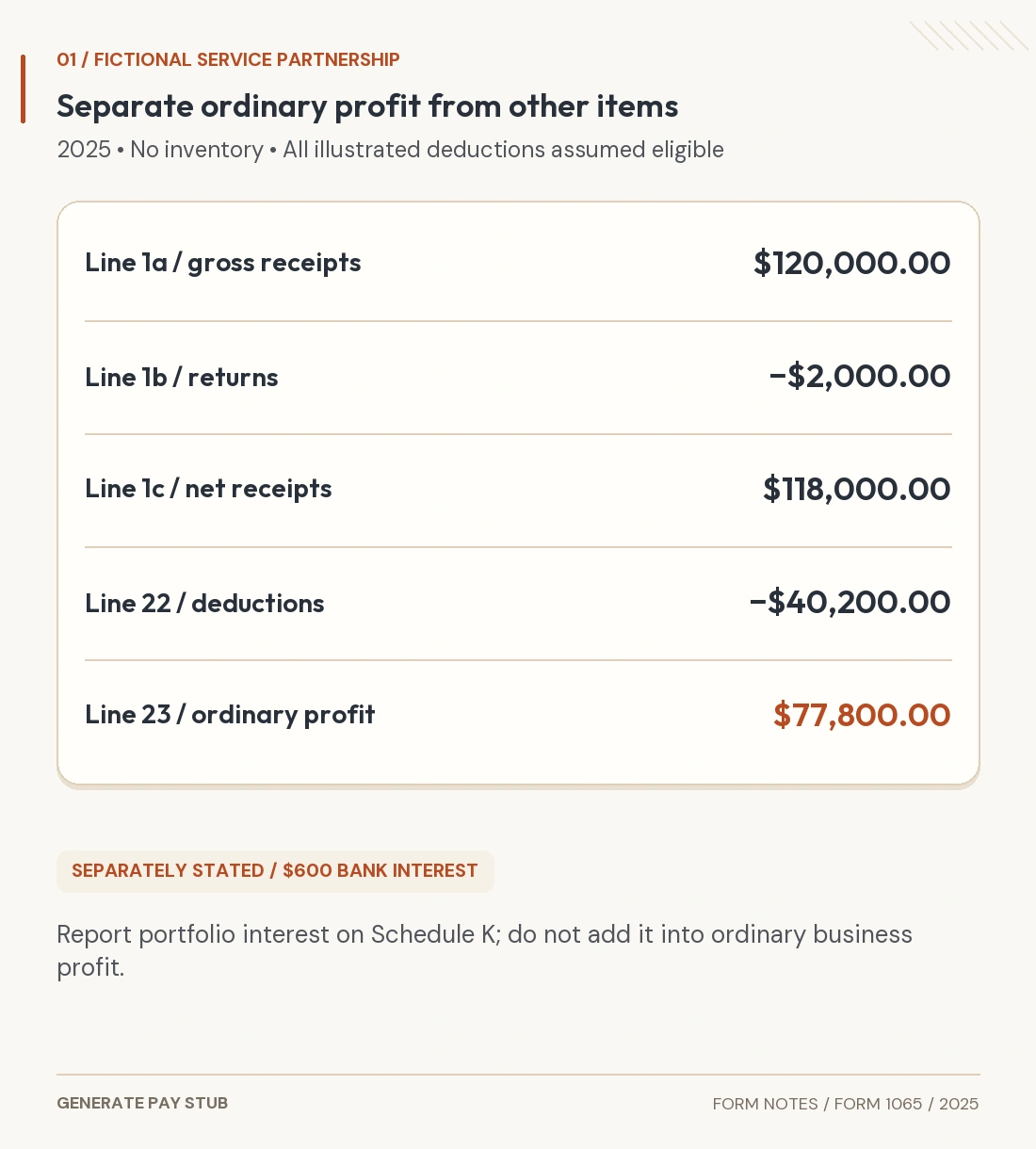
Assume a cash-method domestic service partnership with fully supported eligible costs. For 2025, it has $120,000 gross service receipts and $2,000 customer refunds or allowances. It has no inventory, cost of goods sold or other ordinary income.
Ordinary deductions are $24,000 wages paid to actual nonpartner employees, $12,000 rent and $4,200 other eligible current business costs supported by an attached deduction statement. There are no guaranteed payments, depreciation adjustments or other deductions in this simplified case.
| Entry | Calculation or support | Amount |
|---|---|---|
| Line 1a: gross receipts | Service-receipt ledger | $120,000.00 |
| Line 1b: returns and allowances | Customer-refund records | $2,000.00 |
| Line 1c: net receipts | $120,000 minus $2,000 | $118,000.00 |
| Line 8: total ordinary income | No COGS or other ordinary income | $118,000.00 |
| Line 9: employee wages | Excludes payments to partners | $24,000.00 |
| Line 13: rent | Eligible business rent | $12,000.00 |
| Line 21: other deductions | Supported current-cost statement | $4,200.00 |
| Line 22: total deductions | $24,000 + $12,000 + $4,200 | $40,200.00 |
| Line 23: ordinary business income | $118,000 minus $40,200 | $77,800.00 |
The partnership also receives $600 bank portfolio interest. That goes separately to Schedule K, Line 5; it does not increase the $77,800 ordinary business figure.
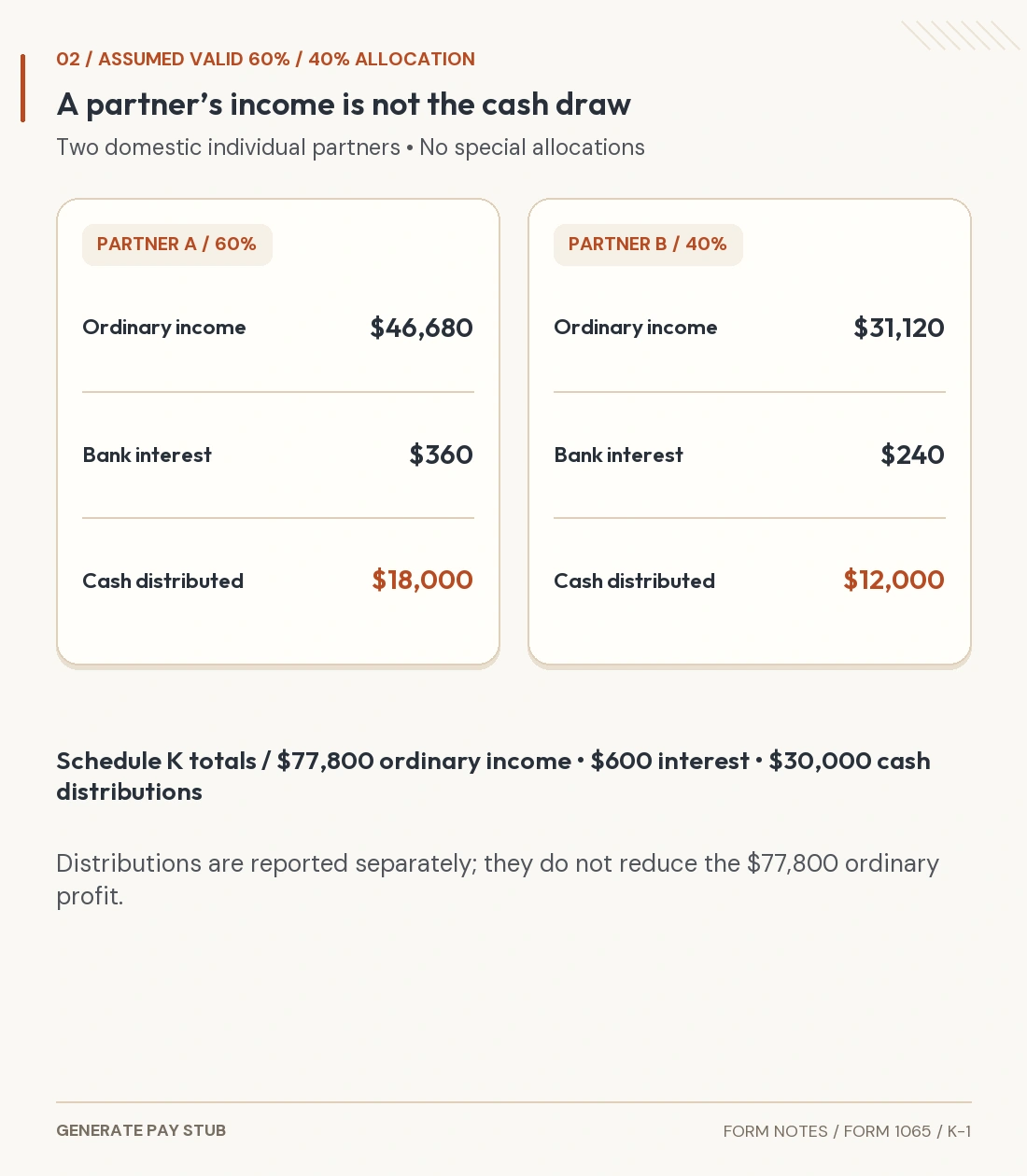
Assume it makes $18,000 and $12,000 ordinary cash distributions to Partners A and B, respectively. These are distributions in their capacity as owners, not compensation for services or guaranteed payments. They do not reduce ordinary business profit.

How do Schedule K totals connect to each partner's K-1?
Schedule K reports partnership totals; each K-1 reports the applicable partner's share and other required information. The 2025 Schedule K-1 original separately identifies ordinary income, interest and distributions.
Assume the agreement's unchanged 60%/40% allocation applies to these income items and satisfies the relevant tax rules. This ratio is an express example assumption, not a rule that ownership percentages always control every allocation.
| Reported item | Schedule K total | Partner A: 60% | Partner B: 40% |
|---|---|---|---|
| Ordinary business income | $77,800.00 | $46,680.00 | $31,120.00 |
| Portfolio bank interest | $600.00 | $360.00 | $240.00 |
| Actual ordinary cash distributions | $30,000.00 | $18,000.00 | $12,000.00 |
Each partner's ordinary income plus interest can exceed their cash distribution. Distributions are reported from actual records, not derived by subtracting the partner's estimated tax from profit. Their tax consequences require the partner's basis and the relevant distribution rules.

The partner K-1 instructions explain basis and loss limitations. Tax-basis capital shown on a K-1 is not necessarily the partner's adjusted outside basis; liabilities and partner-level adjustments can matter.
Self-employment tax, passive-activity rules, at-risk limits and QBI information also need their applicable facts. Do not calculate every partner's tax by applying one flat percentage to the distribution or to ordinary income.
What do the remaining schedules and disclosures require?
Review all six pages and every applicable attachment. Schedule B asks substantive questions about ownership, international matters, elections and the audit regime. A small partnership should not automatically answer every disclosure “No.”
Schedule B Question 4's limited exemption requires all four conditions: timely K-1 filing and delivery, no filed or required M-3, less than $250,000 of defined annual receipts and less than $1 million of assets at year-end. The receipt test uses its defined measure, not simply Page 1 profit.
When the conditions hold, the specified balance-sheet and reconciliation reporting can be omitted. The exemption does not eliminate K-1s or other required schedules. Our example does not establish the assets, timely-filing or other facts needed to claim it.
Otherwise, reconcile Schedule L's book balances, Schedule M-1's book-to-tax differences and Schedule M-2's capital analysis as required. Larger or otherwise qualifying partnerships may need M-3. Book capital, tax-basis capital and outside basis should not be treated as interchangeable.
The complete 2025 instructions address the partnership representative and any permitted election out of the centralized audit regime. Eligibility, partner types, counts and supporting Schedule B-2 matter; an unchecked box is not an analysis.
Which filing dates and correction rules matter?
The ordinary calendar-year 2025 deadline was March 16, 2026. A timely Form 7004 could request an extension under its rules. As of November 5, the ordinary calendar-year filing dates have passed; fiscal and short years require their actual periods.
Check electronic-filing requirements. The 2025 instructions generally require partnerships filing 10 or more returns of any type during the year to e-file, subject to applicable exceptions. There is also a separate rule for partnerships with more than 100 partners. A printable PDF does not determine whether paper filing is permitted.
A correction may require an administrative adjustment request under the centralized partnership audit regime rather than an ordinary amended return. Do not issue revised K-1s without checking the applicable correction procedure and authority.
How do you review the complete preparation packet?
Compare the six-page original with the supporting workpapers and partner statements. Use the Form 1065 overview to open the 2025 partnership-return builder. Its calculations use entered figures; it does not determine all deductions or allocate K-1 amounts for you.
Check the tax period, EIN, accounting method, applicable return boxes, K-1 count, ordinary result, separate items and partner-category analysis. Count everyone who was a partner at any point in the year, not only those remaining at year-end.
Prepare each partner’s K-1 separately. Ownership reporting can require B-1; an audit-regime election can require B-2. International K-2/K-3 reporting, M-3 and other supporting documents also remain separate when applicable. Review international exceptions before omitting an international schedule. Complete the appropriate partner/member signature and any applicable preparer section; an AAR has its own signing rules.
IRS submission, partner delivery and any required payments remain separate from PDF preparation. Keep the complete filed return, furnished K-1s, workpapers and acceptance records securely. State partnership obligations also require their own review.
General U.S. federal information for 2025. The fictional service example is not a complete partnership return and excludes special allocations, foreign partners, property distributions, guaranteed payments and losses.