Schedule E reports rental real estate, eligible royalties and certain pass-through income or losses. It is not a list of all deposits or a guarantee that every calculated loss is deductible. Identify the activity, reconcile its records, apply the relevant restrictions and carry the allowed result to the individual return.
A good preparation packet keeps each property or entity recognizable. That makes it easier to explain an advance-rent payment, distinguish interest from principal and trace a K-1 amount without mixing unrelated activities.
Reviewed November 5, 2026. This U.S. guide uses the final 2025 Schedule E offered in the linked builder. Its worked example assumes one wholly owned, for-profit, cash-method residential rental with no personal use, substantial tenant services, prior suspended losses or special limitations affecting the displayed amounts.
What income belongs on Schedule E, and what belongs elsewhere?
Match the activity to the reporting route before entering figures. The 2025 Schedule E instructions cover real-estate rentals, eligible royalties, partnerships, S corporations, estates, trusts and REMIC residual interests.
Ordinary rental real estate is commonly reported in Part I. Providing substantial services mainly for a tenant's convenience can instead lead to Schedule C. The IRS rental-income topic also distinguishes personal-property rentals: a rental business generally uses Schedule C, while a qualifying nonbusiness rental of personal property uses Schedule 1.
Royalties need a similar classification check. A self-employed writer or artist's business receipts can belong on Schedule C even when a payment description says “royalty.” An investor's eligible royalty interest can have a different route. Use the nature of the activity rather than the payment label alone.
Farm rental income from Form 4835 has a separate Schedule E connection. Entity-owned property can also require an entity return instead of placing the entity's entire activity directly in an individual's property column.
For an operating sole proprietorship, see the Schedule C business-record guide. Choosing the correct schedule comes before choosing a convenient form layout.
Which records should you collect for each property or entity?
Build a packet that can explain both income and deductions. Start with an ownership and activity list, then keep the underlying statements under the matching source.
- Property address, type, ownership share and purchase or conversion history.
- Lease, payment ledger, management statements and relevant information returns.
- Separate tracking for refundable deposits, advance rent and retained deposits.
- Invoices and receipts for expenses, with business-use allocations where required.
- Loan statements separating interest, principal and escrow activity.
- Depreciation schedules, asset additions and disposal records.
- Fair-rental and personal-use day records.
- K-1s, basis records and prior-year limitation or carryover schedules where applicable.
Use one consistent property label across the packet. For example, “Property A” in a working paper should refer to the same address in the lease file and the return draft. Keep a short explanation for adjustments rather than replacing source totals without a trace.
The IRS real-estate tax tips describe rental income, expenses and the importance of records. A statement from a manager is useful evidence, but its net payout should still be reconciled to gross rent and separately classified costs.
How do rent, advance rent and security deposits differ?
Cash received and reportable rent can differ. Advance rent is generally included when received, even if it covers a later period. A genuinely refundable security deposit held for return is not rent on receipt. A deposit intended as the final rent payment is advance rent instead.
If you retain a deposit because of a tenant's failure to meet lease terms, review the amount and year of inclusion. Tenant-paid owner expenses and noncash rent can also create reportable income. The rental-income topic explains these distinctions.
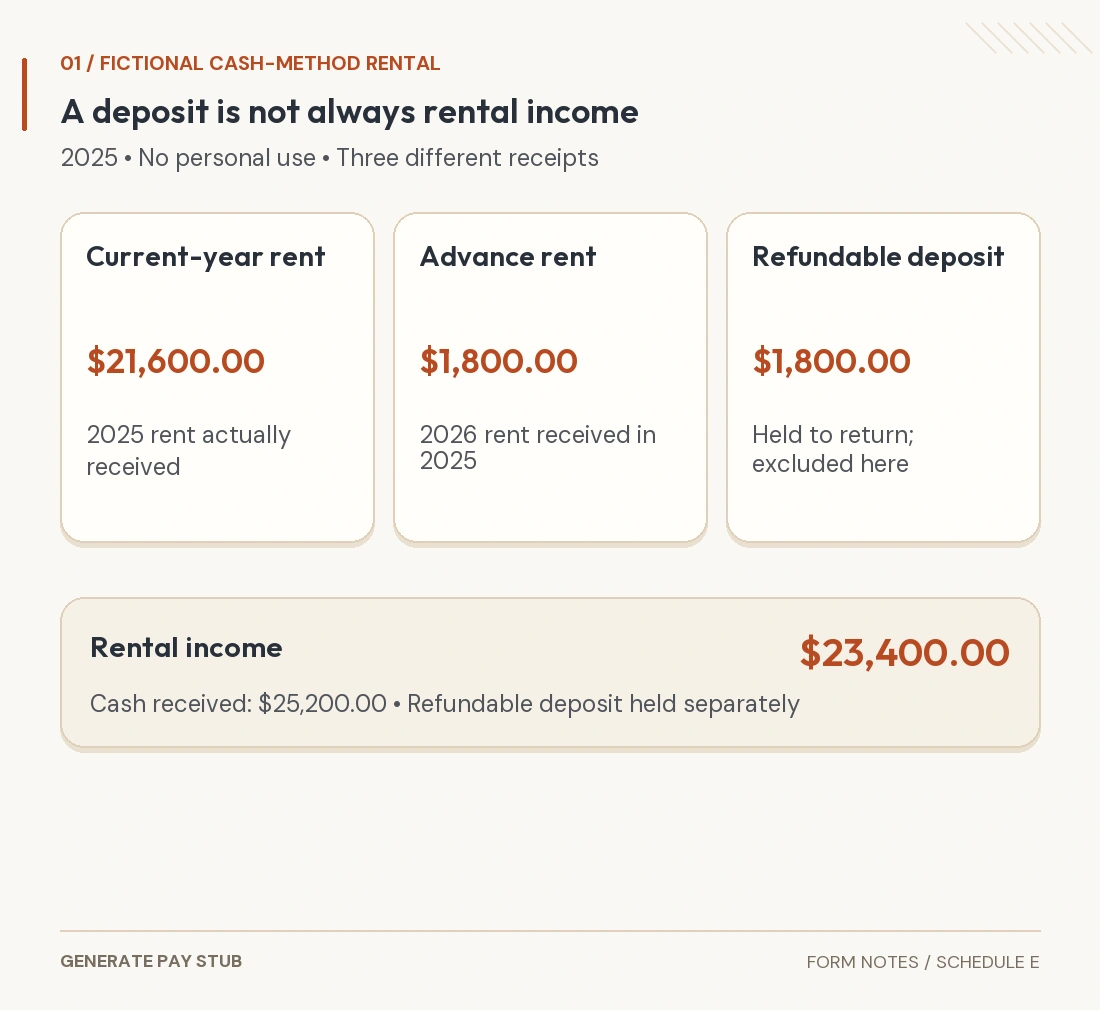
Here is an original 2025 illustration. The owner receives $21,600 of current-year rent, $1,800 of advance rent covering 2026 and a separate $1,800 refundable deposit that remains held for return. Total cash received is $25,200, while rental income in this example is $23,400.

Which expense entries need extra attention?
Classify the allowed rental expense, not every payment connected with a property. In Publication 527 for 2025, the IRS explains rental costs, improvements, depreciation and allocations.
Separate a loan's principal from interest. Also reconcile escrow deposits with actual payments; putting money into escrow does not necessarily establish a deduction for the same amount that year.
Distinguish a repair from an improvement that may need capitalization. Buying or substantially improving a building is not the same transaction as paying for a current repair. Keep acquisition and asset records so depreciation follows the appropriate basis, service date, method and convention. Land is not depreciated.
For mixed personal and rental costs, enter only the eligible rental share. Do not repeat one expense in several categories or deduct a management fee again after already treating the net payout as the full rent figure. Reconcile both sides first.
What does a checked 2025 rental example look like?
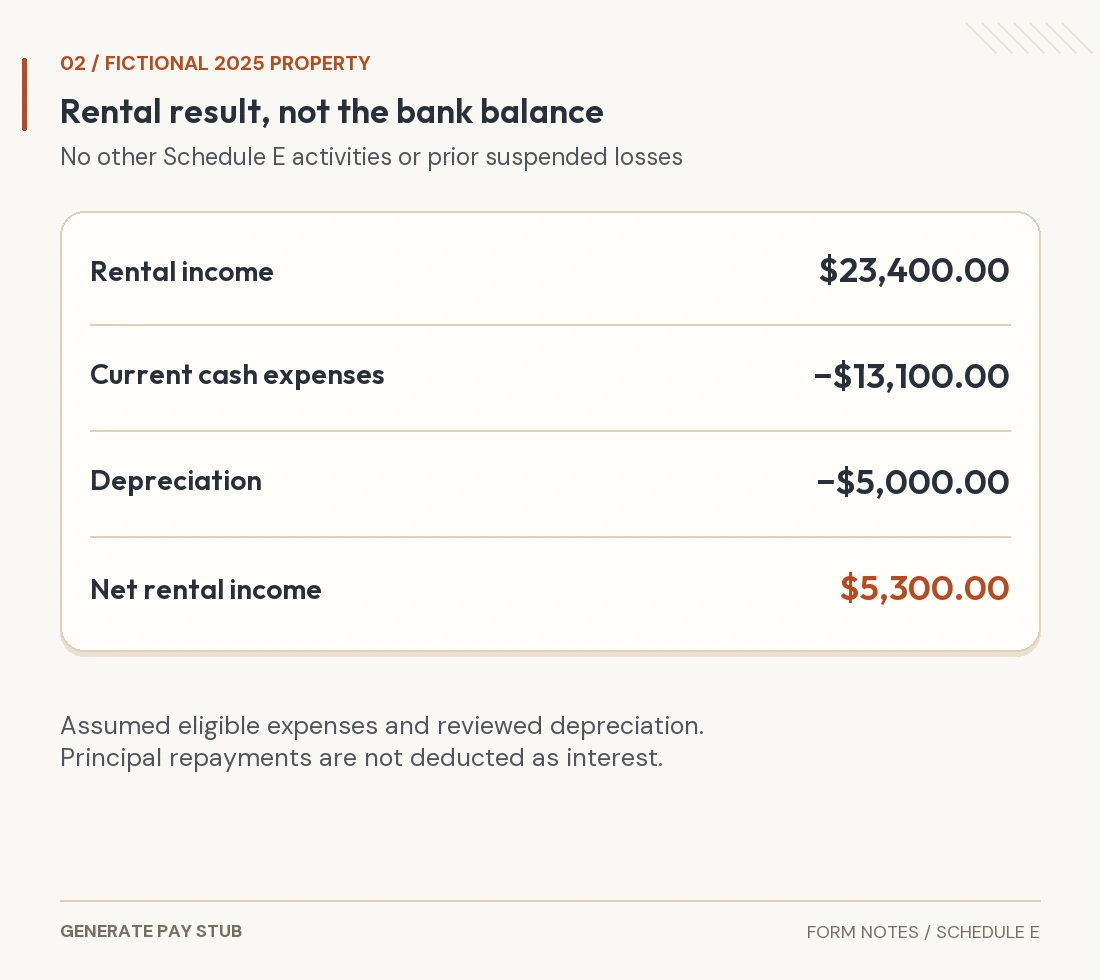
Use the $23,400 income above and review the expenses independently. Assume each listed cash expense is eligible, supported, attributable entirely to this rental and counted once. Assume the $5,000 depreciation amount comes from a separately reviewed schedule; it is a given input here, not a universal annual allowance.
| Item | Schedule E location | Allowed amount |
|---|---|---|
| Mortgage interest to bank | Line 12 | $6,200.00 |
| Property taxes | Line 16 | $2,400.00 |
| Insurance | Line 9 | $1,100.00 |
| Current repairs | Line 14 | $900.00 |
| Management fees | Line 11 | $1,600.00 |
| Utilities | Line 17 | $900.00 |
| Reviewed depreciation | Line 18 | $5,000.00 |
| Total expenses | Line 20 | $18,100.00 |
The six cash-expense entries total $13,100. Adding $5,000 depreciation produces $18,100 total expenses. Rental income of $23,400 less $18,100 gives $5,300 net rental income.
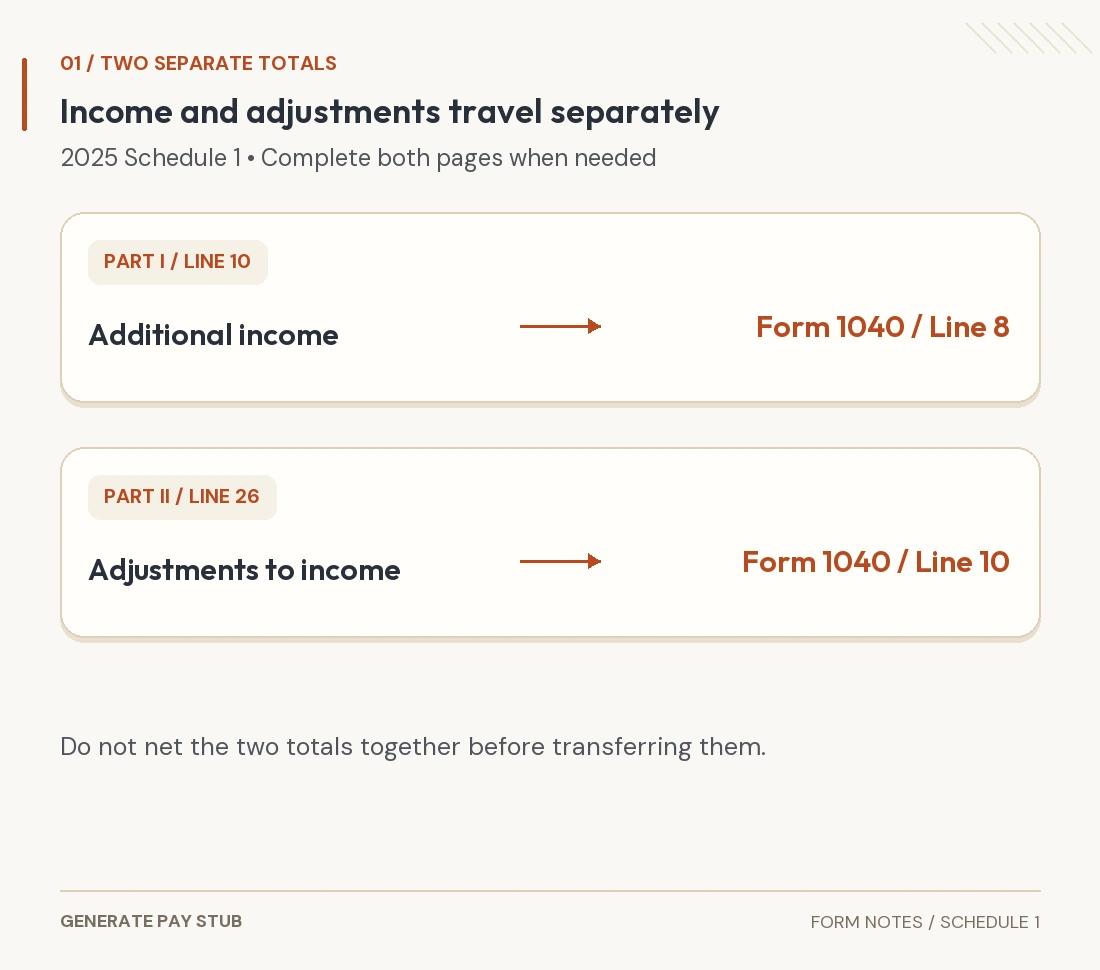
On the 2025 original Schedule E, that positive property result appears on Line 21. With no other properties, royalties, relevant adjustments or second-page activities in this example, it also gives the $5,300 Part I total that carries to Schedule 1, Line 5.

Suppose the owner also paid $3,600 of loan principal. That does not turn the interest deduction into $9,800 or reduce this example's result to $1,700. Principal and interest need their separate treatment. Likewise, the refundable deposit is not added to the $23,400 rent total.
What changes when you also use the dwelling personally?
Keep a day-by-day use record before applying a simple expense percentage. IRS Topic 415 treats a dwelling as a residence when personal use exceeds the greater of 14 days or 10% of days rented at a fair price.
Personal-use days can include certain family, exchange and below-market arrangements. The exceptions matter, so do not equate every day without paying guests with the same category.
If a dwelling used as a home is rented for fewer than 15 days, the rental income generally is not reported and rental expenses are not deducted as rental expenses. For other home-use situations, allocation and deduction limits can apply. The home's otherwise permitted personal deductions follow their own rules.
A booking platform's “short-term rental” label does not decide all these questions. Check personal use, services and the separate passive-activity rules rather than applying one rule to every vacation property.
Can a rental loss reduce income from your job?
Sometimes, but a negative property calculation is not automatic permission. IRS Topic 425 explains that rental activities are generally passive even with material participation, with important exceptions. Disallowed passive losses generally carry forward.
The limited special allowance for qualifying active participation is not available to everyone. Filing status, modified AGI, ownership and other conditions matter. Real-estate-professional status also has specific tests and does not by itself replace the required material-participation review.
Publication 925 for 2025 explains the at-risk and passive-activity calculations and exceptions. Form 6198 and Form 8582 can be required. Keep suspended amounts identifiable by activity so they can be evaluated in a later year.
For a practical review, distinguish three amounts in your working papers: the property's preliminary loss, the amount allowed this year and the amount carried forward. A document containing the preliminary loss alone does not show that all restrictions were applied.
How do partnership, S-corporation, estate and trust amounts fit?
Use the relevant K-1 items and their instructions, not the cash distribution alone. The IRS partner instructions for Schedule K-1 describes reporting a partner's share of income, deductions and credits.
Keep each entity's identity, tax year and statement attachments together. K-1 items can belong in different places on the individual return; they should not all be added to one Schedule E income box.
For losses, review basis restrictions before the other applicable limitations. S-corporation stock and debt basis may require Form 7203. Review distribution, disposition and loan-repayment situations too. A cash distribution is not a substitute for that computation.
Estates and trusts have Part III entries. REMIC residual interests use Part IV and special excess-inclusion rules. These sections require the matching statements and calculations, not estimated figures borrowed from a bank summary.
How do you prepare and finish Schedule E?
Review each activity, its allowed result and the combined return connection. Keep property columns separate and use continuation schedules when needed. Reconcile total income and total allowed losses, rather than concealing distinct activities in an unexplained net amount.
The Schedule E document overview opens the Schedule E builder, currently offering the final 2025 original. It includes property and royalty entries, relevant entity sections and inputs for separately verified allowed amounts and attachments.
Inspect both pages, property addresses, taxpayer information, activity types, day counts and signs. Review limitation forms, depreciation records and any required basis computation alongside the PDF. Schedule E has no separate signature line; the main return and its filing requirements remain separate.
The ordinary 2025 filing dates have passed as of this review. If preparing late, correcting an earlier return or relying on relief, follow the applicable procedure. Downloading a schedule does not submit a return or pay a tax. Our Form 1040 roadmap explains the larger return structure.
General U.S. tax information. The fictional rental excludes co-ownership, personal use, special services, losses, foreign activity and other complications. Use the full applicable instructions and qualified help where needed.