Form 1098 reports mortgage-interest information; it is not a summary of everything in a house payment and does not certify the borrower's deduction. Separate interest, principal, escrow and special entries before comparing the statement with a tax return.
Our example follows a fictional 2025 existing home loan. It reconciles $36,000 paid during the year, $20,000 of mortgage interest and an opening principal amount that differs from the closing balance.
On November 6, 2026, we checked the current April 2025 original, the applicable year-specific guidance and the site's 2025/2026 preparation tool. The 2026 mortgage-insurance change is discussed separately from the 2025 example.
Who prepares Form 1098, and who is the payer?
The responsible interest recipient generally prepares it. On this form, the recipient/lender received the interest, while the payer/borrower paid it. Do not reverse those roles when entering identification information.
The current form instructions generally require reporting mortgage interest of at least $600 received during a trade or business from an individual, including a sole proprietor. Each mortgage is tested separately, and exceptions apply.
A homeowner ordinarily obtains the statement from the lender or servicer. A missing statement does not necessarily prevent an otherwise supported deduction; nor should a borrower manufacture a lender-issued record to replace an agency or lender's actual information.
Which records should you compare with the form?
Use a servicing record and the relevant loan documents together. Useful records include:
- Yearly interest and principal payment totals.
- The correct opening, origination or acquisition principal record.
- Original loan date and any lender-transfer information.
- Property identification and the number of properties securing the debt.
- Escrow deposits and actual tax and insurance disbursements.
- Closing disclosures for points and acquisition costs.
- Refinancing records, proceeds use and any overpaid-interest refund.
The four-page original and borrower instructions help distinguish the boxes. A monthly statement's balance and a Form 1098 principal field may concern different dates.
How does $36,000 paid become $20,000 of mortgage interest?
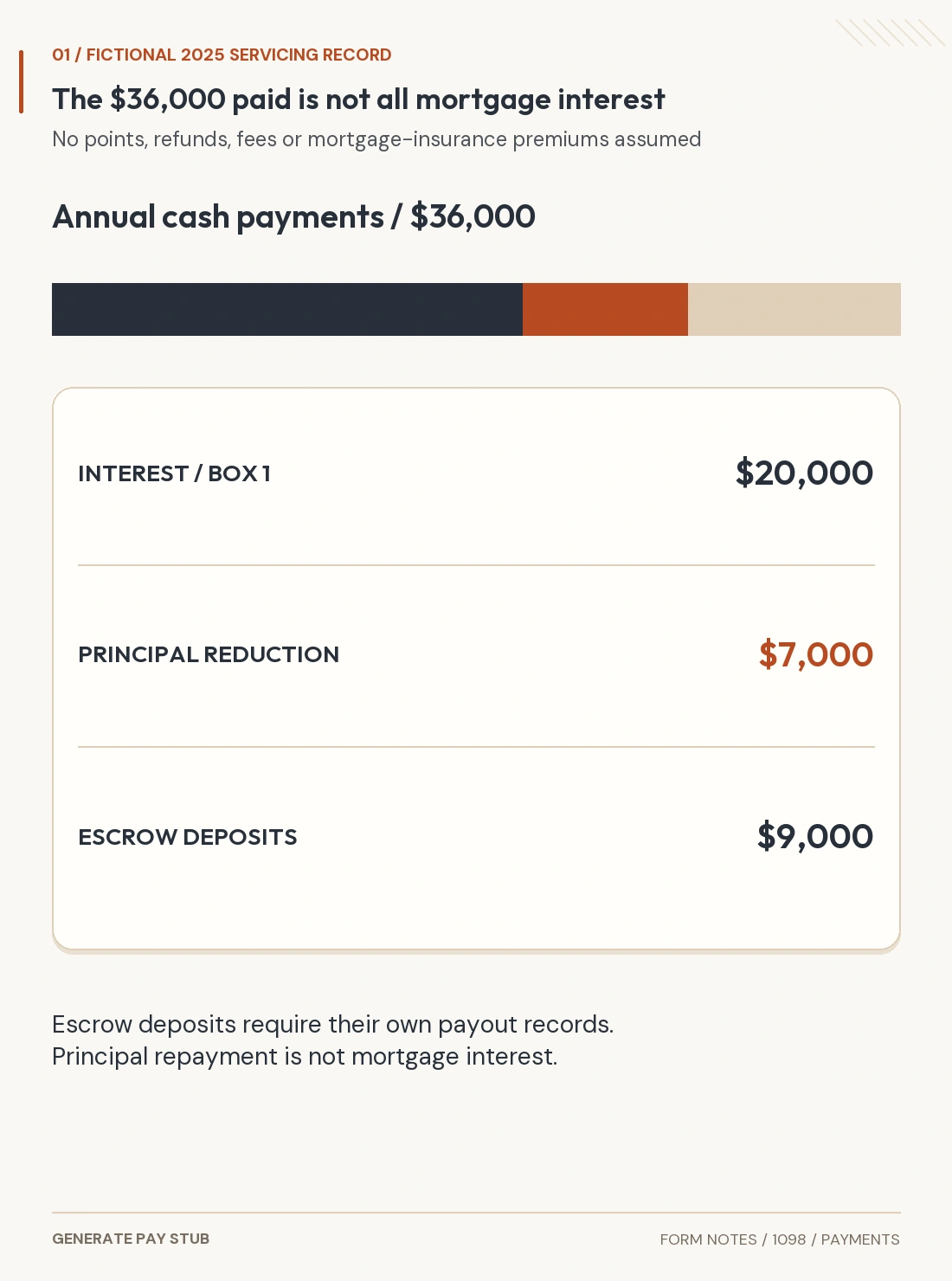
Reconcile the components instead of copying total bank withdrawals. Assume the 2025 servicing history shows $36,000 of cash payments: $20,000 applied to current-year interest, $7,000 to principal and $9,000 deposited into escrow. There are no fees, points, interest refunds or mortgage-insurance premiums.
| Payment component | Amount | Role in the reconciliation |
|---|---|---|
| Mortgage interest | $20,000.00 | Box 1 amount under the stated records |
| Principal paid | $7,000.00 | Reduces the debt; not interest |
| Escrow deposits | $9,000.00 | Track separately until disbursed |
| Annual cash payments | $36,000.00 | Sum of the three components |

The checked total is $20,000 + $7,000 + $9,000 = $36,000. The $7,000 is not an additional interest expense, and the $9,000 does not automatically join Box 1.
Does depositing money into escrow create a deduction?
A deposit is different from an eligible expense actually paid. Publication 530 explains that real-estate taxes paid from escrow must be distinguished from contributions to the account. Personal homeowners' insurance and principal payments generally are not deductible personal house expenses.
Continue the fictional case with no opening escrow balance, advances or other activity. The $9,000 deposits fund $6,300 paid to the property-tax authority and $2,100 paid for homeowners' insurance; $600 remains in escrow.
| Escrow record | Amount | Tax-review point |
|---|---|---|
| Deposited during 2025 | $9,000.00 | Contribution to the account |
| Property tax paid out | $6,300.00 | Review the eligible tax and applicable deduction limits |
| Homeowners’ insurance paid out | $2,100.00 | Personal insurance; not mortgage interest |
| Remaining escrow cash | $600.00 | Still held; not an expense paid to the taxing authority |
The ledger balances: $6,300 + $2,100 + $600 = $9,000. Even if a lender displays property taxes in an optional information field, that does not transform them into mortgage interest.
Why can Box 2 differ from the December 31 loan balance?
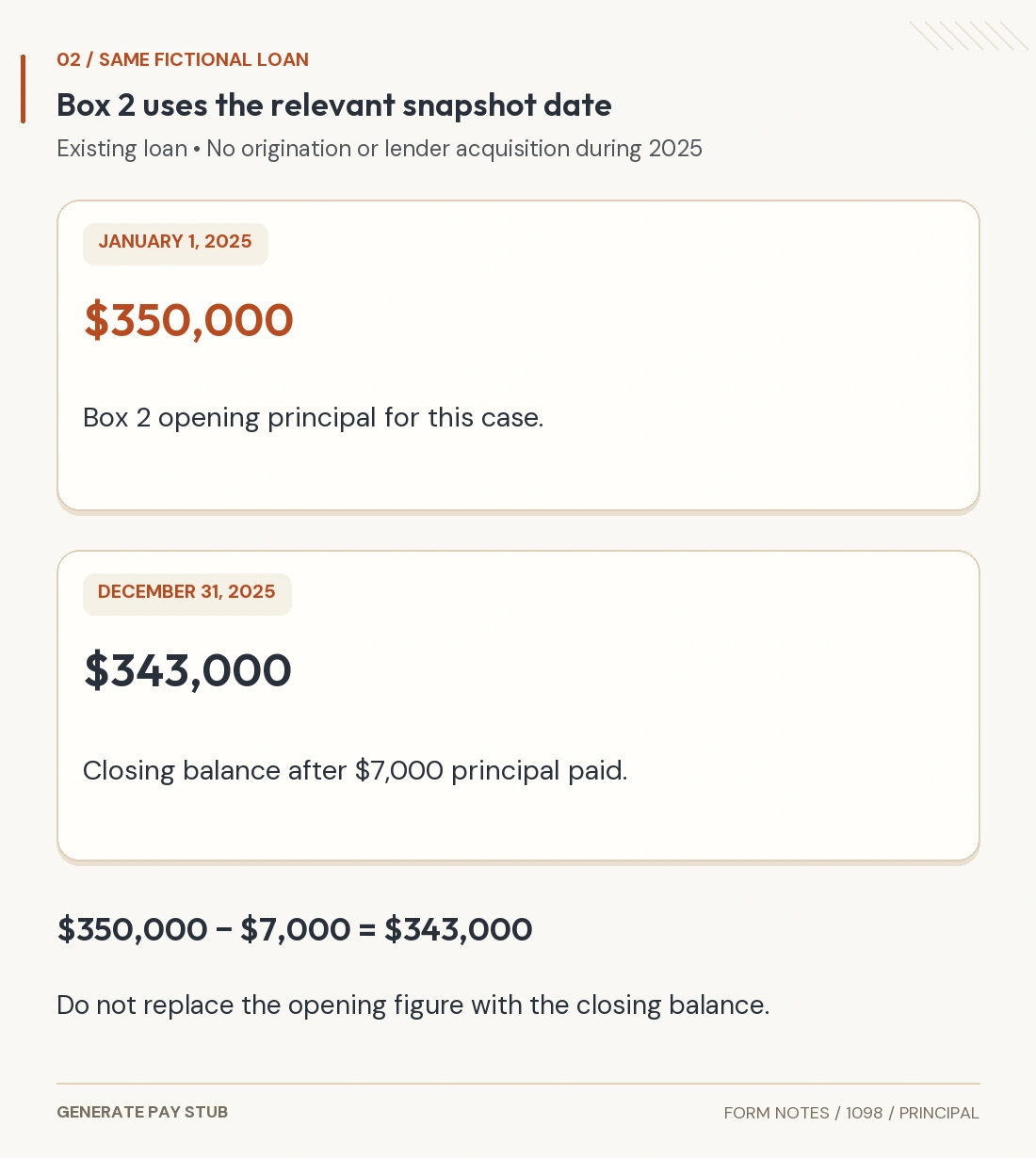
Box 2 uses a specified snapshot, not automatically the ending balance. The 2025 form-field instructions use January 1 principal for an existing loan. A mortgage originated or acquired by the lender during the reporting year uses the applicable origination or acquisition snapshot.
Assume our loan originated in March 2023 and was not originated or acquired by this lender during 2025. Principal is $350,000 on January 1, 2025. With $7,000 paid toward principal and no other balance changes, it ends December 31 at $343,000.

The closing balance does not make the opening figure wrong. Box 3 preserves the original mortgage date; Box 11 can identify a reporting lender's acquisition during the year. A transfer of servicing alone should not be mistaken for a brand-new borrower loan.
Is the full Box 1 amount deductible?
The borrower's deduction depends on eligibility, use and limits. For 2025, Publication 936 addresses itemizing, qualified homes, secured debt, proceeds use and the combined home-acquisition debt limitations.
For our limited example, assume the taxpayer is legally liable, owns and uses the property as a qualified main home, itemizes, actually paid the interest, used all proceeds to buy that home and has no other home debt or limitation reducing the amount. The $350,000 existing loan remains below the applicable 2025 debt limit, so the supported $20,000 is deductible home-mortgage interest under those assumptions.
The standard post-December 15, 2017 acquisition-debt limit for 2025 is $750,000, or $375,000 if married filing separately, with special rules for older debt. Review all qualified-home mortgages together. A loan secured by a house does not automatically make interest deductible if the proceeds funded personal spending unrelated to buying, building or substantially improving the qualified home.
Shared borrowers also need evidence of ownership, liability and payments. Receiving a form in one name does not authorize each borrower to claim the entire interest amount.
What about points, refunded interest and mortgage insurance?
Read these entries individually and apply the relevant payment year. The IRS points topic explains why qualifying purchase points can differ from refinancing points that generally are spread over the loan term. Charges for separate services do not become deductible interest merely because they appear at closing.
Box 4 concerns refunds or credits of interest overpaid in an earlier year. Its tax treatment can involve the earlier deduction's tax benefit. Do not blindly subtract it from current-year Box 1; same-year reimbursements follow different reporting rules.
Mortgage insurance is also distinct from homeowners' insurance. The 2025 premium deduction had expired for that year. 2026 Publication 505 describes the restoration beginning in 2026 for qualified mortgage-insurance premiums. Check applicable eligibility and limitations before claiming an amount, even when it appears in Box 5.
Prepaid interest can require a timing adjustment, and a lender transfer can produce more than one statement. Reconcile coverage periods and amounts to prevent omissions or duplicate interest.
How do you prepare and review the mortgage statement?
An authorized lender preparer should use actual mortgage records. Open the 1098 information page or the mortgage-interest statement builder.
The reviewed builder supports 2025 and 2026. It separates lender and borrower information, Box 2's snapshot, the original loan date, lender acquisition date, property details and optional entries. Copy B is filled in the four-page packet; red Copy A stays blank. The tool does not calculate loan amortization, the permitted deduction or tax-agency filing.
For 2026 submissions, Publication 1099 supplies the general filing framework. Ordinary recipient and paper IRS deadlines roll to February 1 and March 1, 2027; the usual electronic date is March 31. Confirm exceptions, delivery consent, aggregate e-file requirements and any state obligations separately.
For an inaccurate issued statement, seek the lender's correction and retain the supporting records. Complete compliant agency filing and recipient delivery independently of PDF preparation; the informational red Copy A is not a scannable paper submission.
General U.S. federal information checked November 6, 2026. The fictional payment and balance examples concern 2025, while the separate mortgage-insurance note identifies a 2026 change.