Form 1098-T is a tuition statement issued by an eligible institution or certain insurers. It helps support an education-credit review; it does not calculate a credit or determine who can claim it. Match its entries with the student account, payment dates, financial aid and separately purchased course materials before completing Form 8863.
This guide uses an original 2025 American opportunity tax credit example and distinguishes the institution's reporting from the taxpayer's calculation. The reviewed builder offers 2025 and 2026 editions; use the matching year.
Who should prepare Form 1098-T?
The institution or another responsible, authorized filer prepares the tuition statement. A student normally retrieves it from the school rather than creating a replacement issuer record.
The 2026 issuer instructions cover institutions, payment collectors acting for them and insurers. Exceptions can apply to noncredit courses, certain nonresident students, entirely waived or scholarship-paid tuition, and specified formal billing arrangements.
A reporting exception and credit eligibility are different questions. A school may not have to issue a statement for a particular situation even when the taxpayer has other records relevant to a credit.
What do the 1098-T boxes actually mean?
Start with payments, then review aid and adjustments separately. The official 2026 student copy and instructions explain these entries:
| Field | Meaning | Check alongside it |
|---|---|---|
| Box 1 | Reportable qualified payments received, net of applicable same-year refunds | Calendar-year student-account transactions |
| Boxes 2 and 3 | Reserved | Do not insert billed tuition or a calculation here |
| Box 4 | Prior-year tuition adjustments | Earlier statement and credit calculation |
| Box 5 | Scholarships or grants processed by the institution | Award terms and aid from other sources |
| Box 6 | Prior-year scholarship or grant adjustments | Earlier aid treatment |
| Box 7 | Payments include a term beginning in the following January–March | Payment date and academic start date |
| Boxes 8 and 9 | Half-time and graduate indicators | Enrollment history and credit-specific eligibility |
| Box 10 | Reportable insurer reimbursement or refund | Insurance payment and affected expenses |
Neither an unchecked enrollment box nor a large scholarship amount should be interpreted without the underlying facts. Prior-year entries may require a recapture analysis instead of a simple subtraction from this year's tuition.
How can $9,200 of tuition lead to $3,850 of credit expenses?
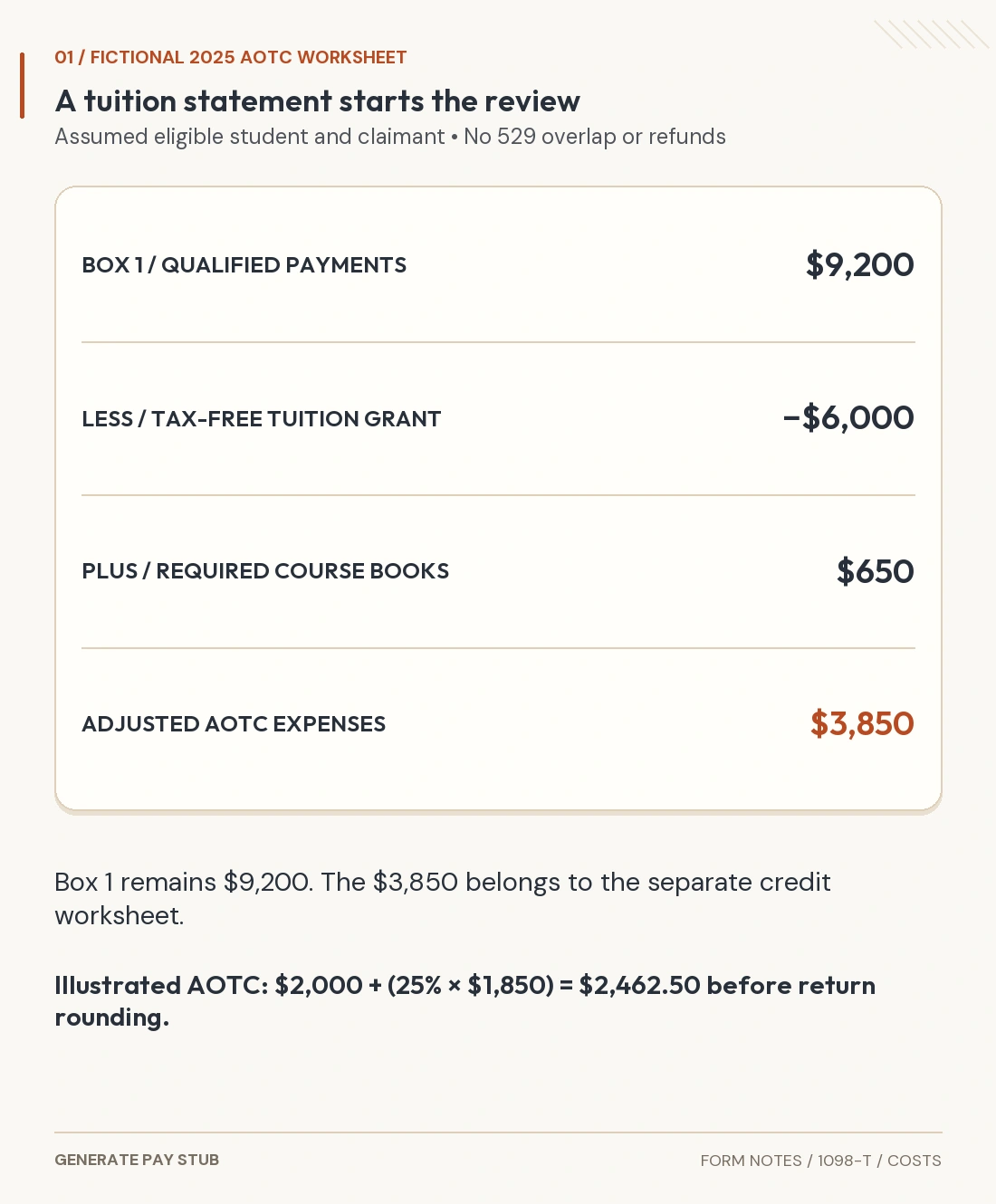
Because issuer reporting and adjusted credit expenses measure different things. Consider fictional student Elena, whose school correctly reports $9,200 of qualified tuition payments for 2025 and a $6,000 grant in Box 5. The grant is restricted to tuition and is fully tax-free.
Elena also pays $650 for required course books from an independent bookstore. Those books are not in the school's $9,200. There are no refunds, employer benefits, veterans' benefits, Coverdell or 529 allocations, additional grants or other overlapping claims.
| Worksheet component | Amount |
|---|---|
| Qualified tuition payments | $9,200.00 |
| Tax-free grant used for those costs | −$6,000.00 |
| Separately paid required course books | $650.00 |
| Adjusted qualified AOTC expenses | $3,850.00 |

Assume Elena is a qualifying first-year degree student, enrolled at least half-time, with no disqualifying conviction or previous AOTC claims. Her parents properly claim her as their dependent, file jointly with $92,000 credit MAGI, meet the identification and residency requirements, and have enough tax liability to use the nonrefundable portion. Assume all other credit conditions are satisfied.
The 2025 education-benefits publication calculates AOTC as all of the first $2,000 plus 25% of the next $2,000 of eligible adjusted expenses. Here: $2,000 + ($1,850 × 25%) = $2,462.50 before return rounding. This is a conditional credit illustration, not an automatic refund or completed tax return.
Which credit rules must you check before using the figures?
Check the claimant and the student separately. Under the 2025 Form 8863 instructions, AOTC has first-four-years, four-claim-years, degree-program, half-time and conviction conditions. Lifetime learning credit can cover later study and qualifying job-skill courses, with different expense rules.
AOTC can reach $2,500 per eligible student and may be partly refundable. Lifetime learning credit is nonrefundable and capped at $2,000 per return. They cannot both be claimed for the same student in one year. Special rules limit refundable AOTC for some younger claimants.
For 2025, the credits phase out across $80,000–$90,000 of MAGI for eligible nonjoint statuses and $160,000–$180,000 for joint filers. Married filing separately is ineligible. Review dependency, identification deadlines and nonresident restrictions rather than treating tuition payment as sufficient.
In Elena's case the parents, not Elena, claim the illustrated credit because they claim her as a dependent. Keeping one household calculation avoids two returns claiming the same costs.
Do books, housing, loans and 529 payments qualify the same way?
No. Classify each expense and funding source. The IRS qualified-expenses guidance allows required course materials for AOTC even when purchased elsewhere. For lifetime learning credit, course-material costs generally must be paid to the institution as a condition of attendance.
Room, board, personal insurance and transportation generally do not qualify for either credit. Loan-funded qualifying payments can count when paid to the school, rather than when the loan is later repaid. Tax-free aid reduces available credit expenses, and the same costs cannot also support tax-free education-account earnings.
Unrestricted scholarship allocation can sometimes change the combined tax outcome; restricted tuition aid cannot simply be reassigned at will. Compare both returns and aid terms before making that decision. Our example deliberately uses a tuition-restricted grant.
Which year counts, and what if the statement is missing or wrong?
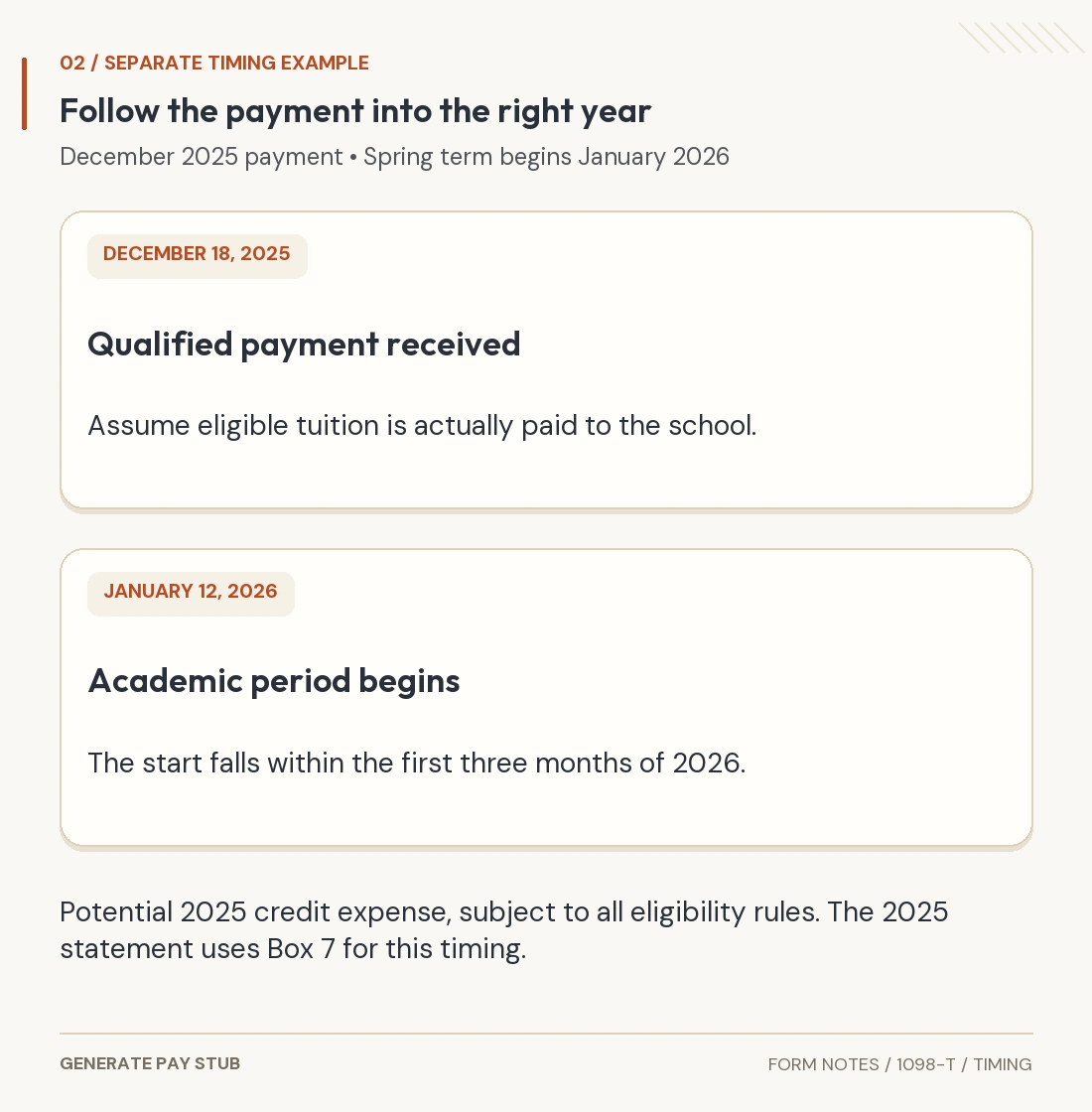
Check the payment year and the academic-period start together. A qualifying payment made in December 2025 for a term beginning in January 2026 can be considered for a 2025 credit. Our separate illustration assumes payment on December 18 and a January 12 start.

Request a correction from the school for an incorrect amount or identifier and retain the account history. If a required statement is missing, the Form 8863 instructions describe requesting it after January 31 of the following year, cooperating with the institution and substantiating enrollment and payment before claiming an otherwise permitted credit. Exceptions for institutions not required to furnish a form have their own conditions.
How do you prepare the statement and complete the filing workflow?
Use the institution's verified ledger and authorized student records. The 1098-T preparation overview links to the tuition-statement builder.
The reviewed workspace separates qualified payments, grants, prior-year adjustments, enrollment indicators and insurer amounts. It supports 2025 and 2026, provides a preview and fills student Copy B in a four-page packet; red Copy A remains blank. It does not compute Form 8863, verify eligibility or perform agency filing.
Review the student identifier securely, the institution's contact office, selected year and account reference. The TIN-solicitation certification must be supported by actual records; checking a box does not create a missing solicitation.
For 2026 reporting, ordinary recipient, paper-IRS and electronic-IRS deadlines are February 1, March 1 and March 31, 2027. Follow current general filing instructions, exceptions and any relief. Aggregate covered return types for the ten-return electronic-filing test. A downloaded red information copy is not a scannable paper filing.
U.S. federal information reviewed November 6, 2026. Credit amounts and conditions in the worked case are for 2025. Illustrations use fictional records and exclude the complications expressly listed above.