Form 1099-C reports a creditor's qualifying cancellation-of-debt event; it does not calculate the debtor's final taxable income. Check the creditor's facts first, then test applicable exceptions or exclusions and any required tax-attribute reduction.
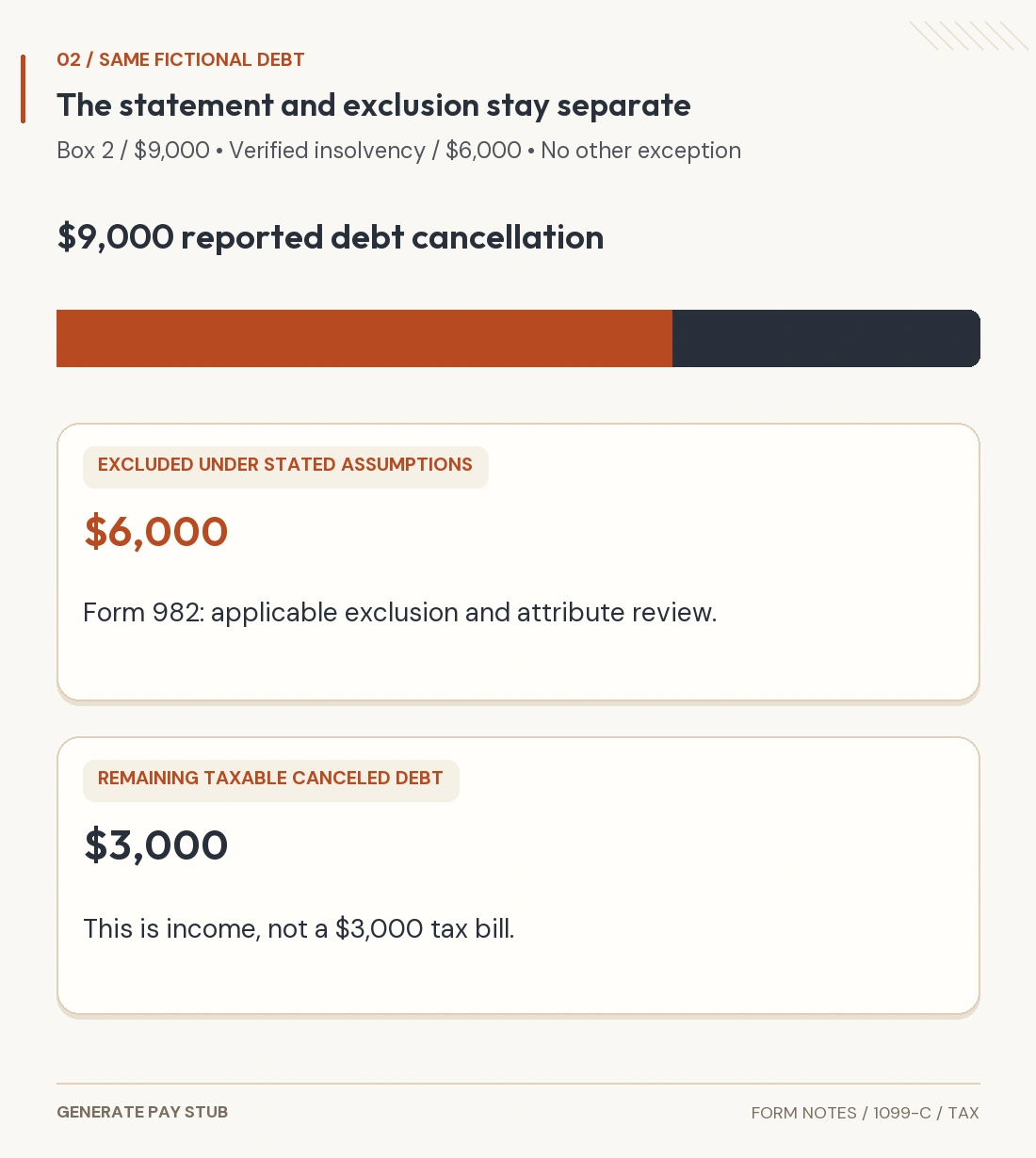
A statement can report more than the amount ultimately included in income. Our fictional 2025 personal-card example shows a $9,000 cancellation, a $6,000 supported insolvency exclusion and $3,000 remaining taxable debt income.
We checked the currently posted April 2025 continuous-use form, current official guidance and the site's 2025/2026 builder on November 6, 2026.
Who must issue Form 1099-C?
Specified creditors report qualifying events under the information-return rules. The 1099-A and 1099-C instructions generally require covered entities to report canceled debt of at least $600 when an identifiable event occurs. Not every person forgiving a private debt is a covered issuer.
The 2026 reporting table also retains the $600 threshold for 1099-C. Do not import a different form's $2,000 threshold into debt-cancellation reporting.
The debtor's income analysis is separate. A creditor can have a reporting requirement even when the debtor qualifies for an exclusion, and the absence of a form does not establish that a taxable cancellation can be ignored.
The IRS canceled-debt topic explains general income treatment and tells taxpayers to contact creditors about incorrect information. Continued collection activity after a form arrives also warrants clarification of the actual facts.
What should you check in each 1099-C box?
Match the form to the debt and identifiable event. Use the current original and debtor instructions as the field reference.
| Box | Entry | Source to confirm |
|---|---|---|
| 1 | Identifiable-event date | Creditor event record, not simply the date you opened the letter |
| 2 | Debt discharged | Reconcile the canceled balance and any included nonprincipal amounts |
| 3 | Interest included in Box 2 | Already within the reported total |
| 4 | Debt description | Identify the underlying obligation or relevant property |
| 5 | Personal-liability indicator | Check the actual debt terms |
| 6 | Event code | Use the applicable event category; not a tax-exclusion code |
| 7 | Property fair market value | Review when acquisition or abandonment information is required |
Keep creditor and debtor identities, the account reference and supporting correspondence together. A similar account number or an old address does not by itself establish that the debt belongs to the recipient.
Is Box 3 interest extra income or an automatic deduction?
Neither conclusion follows from the box alone. If the issuer includes interest in Box 2, Box 3 identifies that included amount. Do not add it a second time.
In our example, assume the creditor validly reports $9,000 in Box 2, including $900 of interest disclosed in Box 3. The reported total is $9,000, not $9,900.
Whether a canceled interest amount can be left out of income depends on whether it would have been deductible if paid and other applicable rules. Assume the card was used solely for personal purchases and the $900 would not have been deductible. Do not subtract it automatically.
How do you measure insolvency for canceled debt?
Use the asset and liability snapshot immediately before the cancellation. Insolvency generally is the amount by which total liabilities exceed the fair market value of all assets at that moment.
Publication 4681 provides an insolvency worksheet and explains that assets can include retirement interests and assets protected from creditors. A low checking-account balance alone is not the test.
Use supported fair market values and the applicable liability rules. Nonrecourse obligations, contingent liabilities, joint debts and multiple cancellations can require more analysis than a simple balance list.
What does a checked $9,000 cancellation example show?
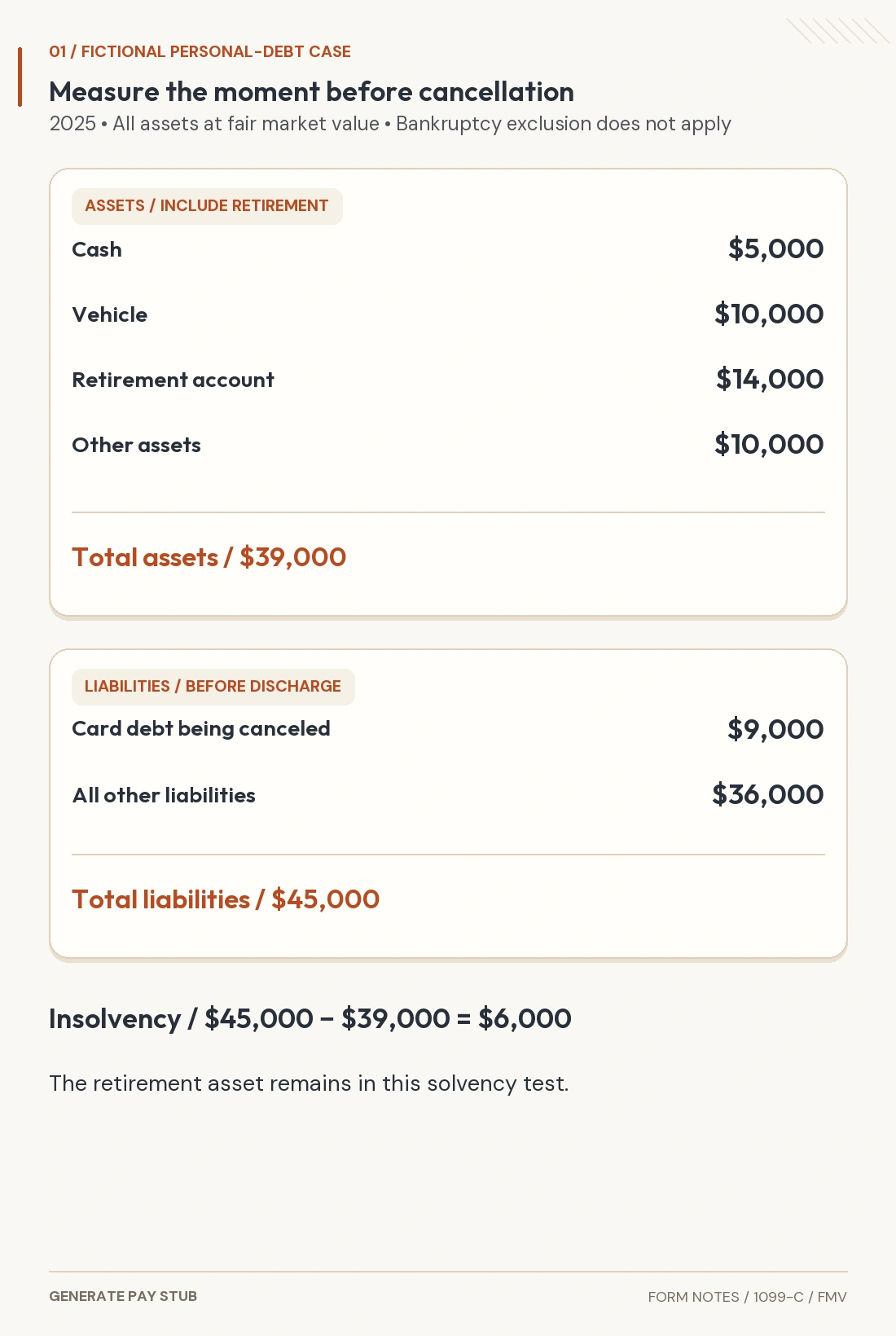
Assume one individual has the following verified records immediately before a 2025 cancellation. There is no bankruptcy case, no other applicable exclusion or exception, no property disposition, no joint debtor and no additional event requiring a separate calculation.
| Item | Fair market value or liability |
|---|---|
| Cash | $5,000.00 |
| Vehicle | $10,000.00 |
| Retirement account | $14,000.00 |
| Other assets | $10,000.00 |
| Total assets | $39,000.00 |
| Personal-card debt being canceled | $9,000.00 |
| Other liabilities | $36,000.00 |
| Total liabilities | $45,000.00 |
| Insolvency: liabilities less assets | $6,000.00 |

The $45,000 liability total includes the $9,000 debt that is about to be canceled. Using a liability balance after that cancellation would answer a different question.
The exclusion is limited to the smaller of the $9,000 cancellation and $6,000 insolvency: $6,000. The remaining $3,000 is taxable canceled-debt income under the stated conditions. The $900 nondeductible personal interest remains within this analysis.

The Form 982 original provides the insolvency checkbox on Line 1b and the excluded-debt entry on Line 2. In this example those entries identify the applicable exclusion and $6,000 amount.
That does not complete every required Form 982 entry. The separate instructions explain tax-attribute and basis reductions. Review Part II and the appropriate personal-debt rules; exclusion can affect future deductions, credits or asset basis.
Which other exceptions and exclusions matter?
Check the applicable categories and their ordering before relying on insolvency. Title 11 bankruptcy, qualifying farm debt and qualifying real-property business debt have separate conditions. A genuine gift or qualified purchase-price adjustment is also different from an ordinary consumer-debt cancellation.
Date limits matter. The broad rule for certain student-loan discharges during 2021–2025 should not be assumed to cover every 2026 discharge; narrower exclusions can still apply. Qualified principal-residence debt has a pre-January 1, 2026 discharge or qualifying prior written-arrangement condition under current guidance, plus other requirements.
Do not select an exclusion because its name sounds appropriate. A mortgage, student loan or business debt can require evidence that the specific statutory conditions are met. State tax treatment may differ from the federal result.
What if collateral is transferred, foreclosed or repossessed?
Analyze the property disposition as well as any canceled debt. Recourse and nonrecourse obligations can produce different amount-realized and cancellation results. A Form 1099-A or combined reporting approach may be relevant.
Do not treat the collateral's fair market value as an automatic offset against Box 2 in every case. Property basis, proceeds, liability terms and the transaction structure matter. Business-property gains may also require a Form 4797 disposition review.
How do you prepare, correct and file the record?
An authorized creditor preparer should use the actual reporting event, not the debtor's desired tax result. See the 1099-C overview and the debt-cancellation statement tool.
The reviewed builder supports 2025 and 2026 and separates the event date, amount, included interest, liability indicator, event code and applicable property value. Its four-page packet fills Copy B and leaves red Copy A blank. It does not determine insolvency, discharge an obligation or file with tax agencies.
A debtor should request correction from the issuer when the statement is wrong and preserve the response. An exclusion supported on the debtor's return does not necessarily mean the issuer's gross cancellation amount is incorrect.
Complete recipient furnishing and compliant agency filing separately. The 2025 general instructions set standard deadlines of February 2, 2026 for recipients, March 2 on paper and March 31 electronically. Those have passed. For 2026 events, ordinary dates roll to February 1, March 1 and March 31, 2027, respectively, subject to exceptions or relief.
Count the applicable return types together when testing whether ten returns require electronic filing. Check applicable filing procedures and retain the issued statements and supporting records. A downloadable red information copy is not a scannable IRS paper filing.
General U.S. federal information reviewed November 6, 2026. The 2025 insolvency case is fictional and excludes bankruptcy, secured-property dispositions, other exclusions and joint ownership or debt complications.