Form 4562 reports applicable depreciation, Section 179 deductions, listed-property information and amortization. Prepare it from an asset register showing basis, acquisition and service dates, business use, prior recovery, elections and the asset-specific method—not from purchase totals alone.
The practical question is how each cost is recovered under the applicable rules and where that recovery belongs on the return. Buying an asset, placing it in service and deducting its cost are separate events.
This article follows the final three-page 2025 form. Sources and the current builder were reviewed November 5, 2026. The worked case assumes a $10,000 computer workstation, 100% business use, no Section 179 deduction and a valid class election out of bonus depreciation.
When do you need Form 4562?
Check the specific filing triggers rather than assuming every business expense requires this form. The 2025 Form 4562 instructions cover current-year depreciation, Section 179, listed property, newly beginning amortization and other required situations.
A current ordinary supply expense is different from a depreciable asset. Conversely, a long-lived business purchase is not automatically deductible in full merely because it was paid from a business account.
The IRS depreciation topic explains cost recovery, business use and depreciable property. Land is not depreciable. Personal-use property does not become a business deduction simply because it appears on an asset list.
Use the appropriate separate activity forms and supporting schedules. A sole proprietor, partnership and S corporation can have different treatment of amounts flowing from Form 4562; do not send every total to the same return line.
What should your asset register contain?
Keep enough information to reproduce the current deduction and the remaining basis. A useful register includes:
- Asset description, invoice and business activity.
- Acquisition date and relevant contract terms.
- The date it was ready and available for the intended use.
- Cost or other basis, including appropriate capitalized acquisition costs.
- Business or investment percentage and personal-use evidence.
- Classification, recovery period, convention and method.
- Section 179, bonus, credits and other basis adjustments.
- Prior depreciation allowed or allowable and remaining tax basis.
- Disposal dates, changes in use and any required recapture review.
Reconcile the register with prior returns. A missing book entry does not necessarily mean that no tax depreciation was allowable, and an accounting depreciation figure does not necessarily equal the federal deduction.
Why do acquisition and placed-in-service dates differ?
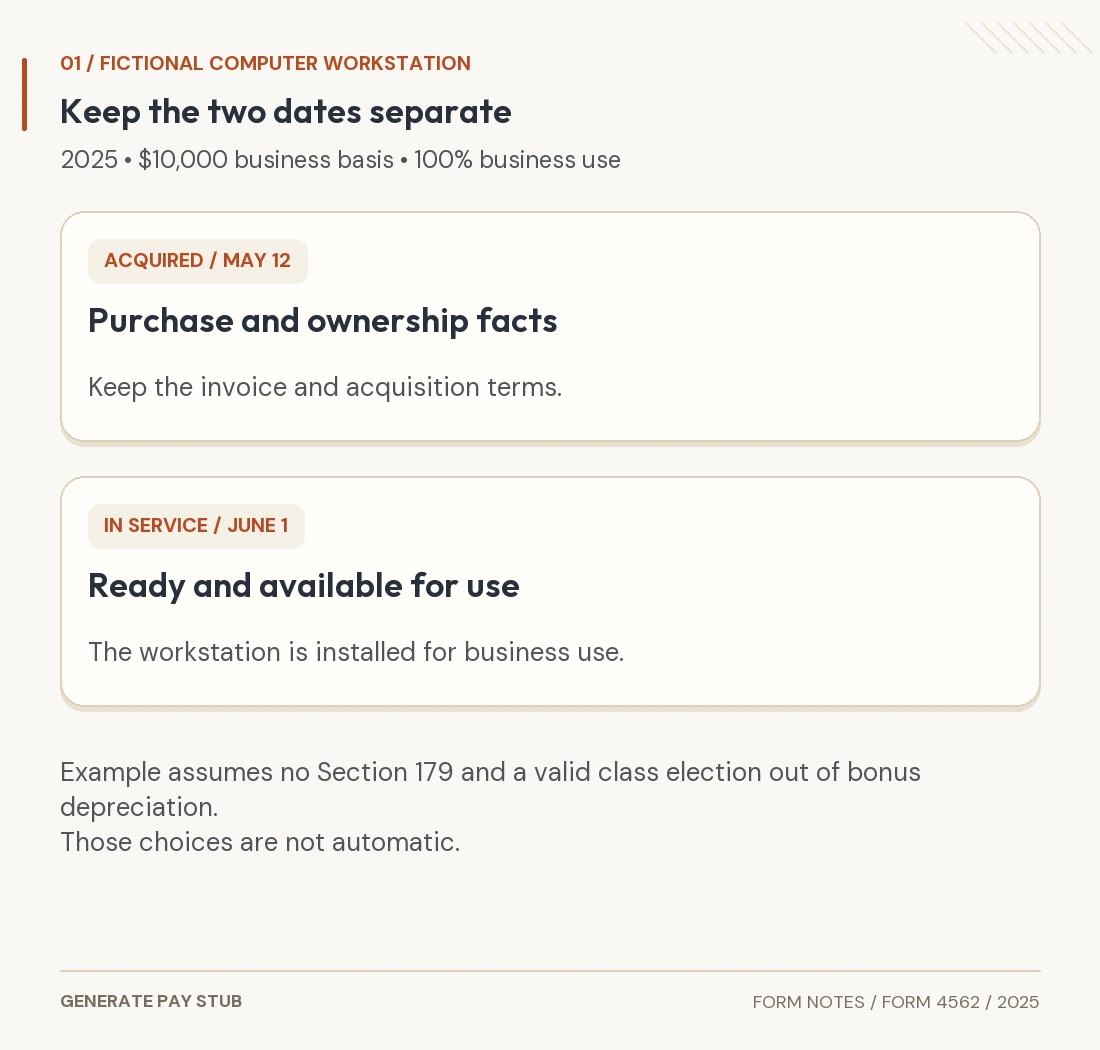
The acquisition record and the start of usable service answer different questions. Assume the fictional business acquires a workstation on May 12, 2025, but it is installed and ready for business use on June 1.
The June 1 service date matters to the depreciation analysis. Payment or delivery alone does not always establish that the asset was available for its intended function. Acquisition terms can separately affect bonus eligibility.

How do Section 179, bonus and regular depreciation interact?
Apply the correct sequence and avoid recovering the same basis twice. Generally, applicable Section 179 expensing precedes bonus depreciation, followed by regular depreciation on the remaining eligible basis.
For tax years beginning in 2025, the standard Section 179 ceiling is $2.5 million, reduced when qualifying property cost exceeds $4 million. Business-income and asset-specific limits can also restrict the deduction. These ceilings do not mean every smaller purchase is automatically expensed.
Bonus treatment changed within the 2025 rules. The IRS notice announcement explains restored 100% additional first-year depreciation for qualifying property acquired after January 19, 2025, with applicable conditions and elections.
Do not apply one bonus percentage to every 2025 asset. Acquisition timing, service timing, property eligibility and elections matter. A choice to elect out generally follows the applicable property class and election procedure; it is not accomplished merely by typing zero in a builder's bonus field.
Our example assumes a valid election out for the five-year class and no Section 179. It illustrates regular depreciation; it does not recommend an election or promise that an expired election deadline can be ignored.
What does a checked workstation example look like?
Use the asset's eligible basis and the correct table for the selected method and convention. Assume the sole proprietor's entire 2025 depreciable-property acquisition is the workstation, with $10,000 tax basis after applicable acquisition-cost treatment.
Assume calendar-year reporting, 100% qualifying business use, ordinary five-year GDS treatment using 200% declining balance, the half-year convention, no credits, no disposal and the valid bonus election described above.
| Item | Record or calculation | Amount |
|---|---|---|
| Business depreciation basis | Eligible tax basis | $10,000.00 |
| Recovery period | 5 years | — |
| Method and convention | 200% declining balance; half-year | — |
| Section 179 and bonus | None under the stated election assumptions | — |
| First-year table percentage | 20% | — |
| 2025 deduction | $10,000 × 20% | $2,000.00 |
| End-of-2025 remaining basis | Original basis less depreciation | $8,000.00 |
The 2025 Publication 946 explains the classification, conventions and Table A-1 percentages. The half-year result is not calculated by counting seven months from June to December.
For this nonlisted-property case, the $2,000 regular deduction belongs in the applicable five-year GDS row, Line 19b, and reaches the summary under the original's instructions. With no other amounts, Line 22 is $2,000. An ordinary Schedule C business generally transfers the appropriate depreciation amount to its depreciation line.
The computer is not treated as listed property merely because it is portable. The IRS removed computers and related peripheral equipment from that category; vehicles require a different analysis.
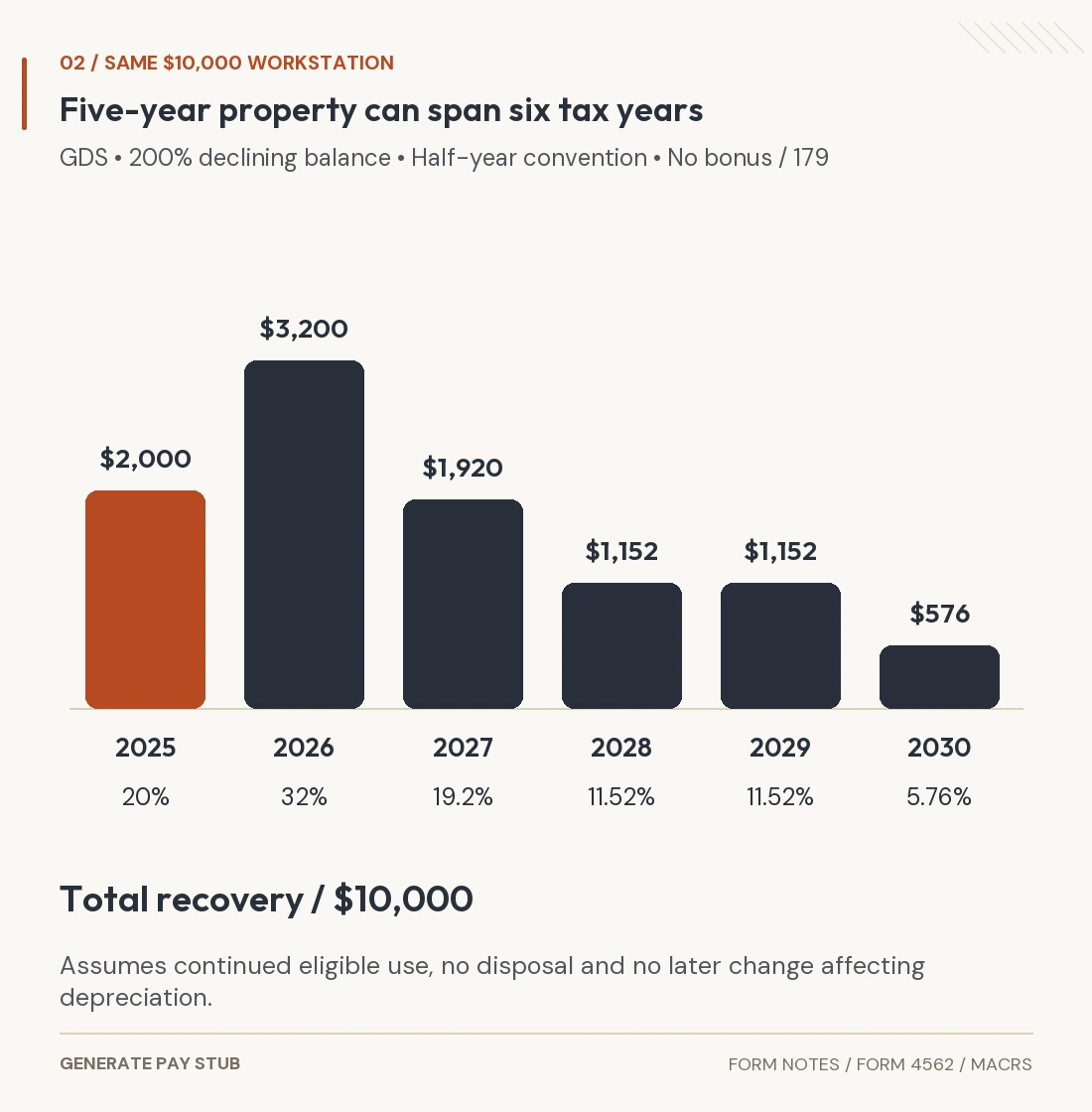
Why can five-year property span six tax years?
The half-year convention creates first and final partial-year treatment. For the stated unchanged $10,000 example, Table A-1's five-year percentages recover the basis across six tax years:
| Tax year | Table percentage | Deduction |
|---|---|---|
| 2025 | 20% | $2,000.00 |
| 2026 | 32% | $3,200.00 |
| 2027 | 19.2% | $1,920.00 |
| 2028 | 11.52% | $1,152.00 |
| 2029 | 11.52% | $1,152.00 |
| 2030 | 5.76% | $576.00 |
| Total | 100% | $10,000.00 |

The percentages total 100%. Five-year property does not mean deducting one-fifth of original cost every year, and a shorter holding period can change the final recovery and gain calculation.
What changes for vehicles and other listed property?
Use Part V and the applicable use tests and limits. The three-page 2025 original separates listed property from the nonlisted depreciation parts.
Maintain business-use records, commuting and personal mileage, service dates and required evidence. Qualified business use for an accelerated-depreciation test can differ from the business/investment percentage printed on the form.
Passenger-auto limits and the 2025 $31,300 Section 179 SUV cap require their precise definitions and exceptions. The SUV cap is not a general permission to deduct that amount for any vehicle.
When using standard mileage or deducting lease expense, the required vehicle information does not justify another depreciation or Section 179 deduction for the same use. A decline in qualified business use can require recapture or a method change.
How is amortization different from depreciation?
Amortization addresses eligible costs under their applicable code provisions and recovery periods. Part VI separately records description, start date, amortizable amount, code section, period and current deduction.
Do not assume every software, startup, research or intangible cost uses the same period. Timing and current law can change the treatment. Use a supported cost-specific workpaper.
Part VI's Line 44 amortization total is separate from Part IV's Line 22 depreciation summary. Carry each to the appropriate main-return location; adding the amortization total again to Line 22 can duplicate the deduction.
How do you review the completed form and filing packet?
Match every populated line to the asset register and required statements. The Form 4562 overview links to the 2025 depreciation and amortization builder. Its packet includes all three original pages.
Confirm activity identification, Section 179 taxpayer-level limits, basis reductions, correct nonlisted or listed route, methods, conventions and amortization entries. A taxpayer with multiple activities may need a Section 179 summary and activity allocations under the instructions.
The builder totals entered amounts and supports its stated fields; it does not determine every asset's eligibility, election, method or limitation. Required asset schedules and election statements remain separate.
There is no separate Form 4562 signature line. Attach the form through the appropriate separately prepared return, complete that return's signing and filing requirements and retain the supporting records. Ordinary calendar-year 2025 deadlines have passed as of this review; PDF preparation does not extend them.
General U.S. federal information for 2025. The workstation example assumes valid elections and ordinary calendar-year GDS treatment. It excludes listed property, short years, mid-quarter treatment, credits, business-use changes and dispositions.