Use Form 8829 to calculate qualifying actual expenses for a Schedule C home office and any allowed carryover. Establish eligible use, measure the business share, separate direct from whole-home costs and apply the income limitation before transferring the deduction to Schedule C.
A home-office percentage is a calculation after eligibility, not proof of eligibility. Working occasionally at a dining table does not automatically make a share of the rent deductible.
2025 form; reviewed November 5, 2026. This guide uses the final one-page original currently offered by the builder. The main example is a renter with one qualifying full-year office and one Schedule C business, no daycare, inventory allocation, casualty loss, depreciation or earlier carryovers.
Who should use Form 8829?
The form serves qualifying Schedule C actual-expense home use. The 2025 Form 8829 original directs the resulting allowed amount to Schedule C, Line 30.
Do not use this form for a home using the simplified method that year. A partner's home-use expenses and Schedule F home expenses follow the appropriate Publication 587 worksheet route instead. Employee home-office expenses do not qualify for this Form 8829 deduction.
Expenses properly allocated to inventory costs require their own treatment. Also exclude amounts attributable to tax-exempt income as required; calling an expense “business related” does not remove that allocation rule.
What makes a home workspace eligible?
Ordinarily, the area needs regular and exclusive qualifying business use. Depending on the facts, it may be the principal business location, a place for normal client or customer meetings, or a qualifying separate structure.
Publication 587 for 2025 explains these tests and the exceptions. A home used exclusively and regularly for administration or management may qualify as the principal location when there is no other fixed location for substantial administration or management.
A space used for personal activities can fail the ordinary exclusivity requirement even if the business uses it daily. Certain inventory or product-sample storage and qualifying daycare have exceptions with their own conditions; those exceptions should not be generalized to every shared room.
Keep evidence of the actual use, dates and measurements. A floor plan, photographs showing the space and a record of what work occurs there can help explain the facts, although no single item automatically proves the deduction.
Should you use actual expenses or the simplified method?
Compare permitted methods without claiming both for the same home in the same year. Actual expenses use records and allocation; the IRS simplified option generally uses $5 per qualifying square foot, up to 300 square feet, subject to its limits.
The simplified method does not relax the qualifying-use rules. For a full-year 120-square-foot eligible office with sufficient qualifying income, its area-based amount is $600, before considering any other applicable facts.
Our actual-expense example below produces $2,330, but that comparison is specific to the stated costs and eligibility. Recordkeeping, limitations, prior carryovers and depreciation can affect the choice.
The method election follows the timely original-return rules; it is not an unrestricted change after filing. Ordinary 2025 return deadlines have passed as of this review. Check the applicable filing situation before assuming either method can now be newly elected or changed.
How do you calculate the business-use percentage?
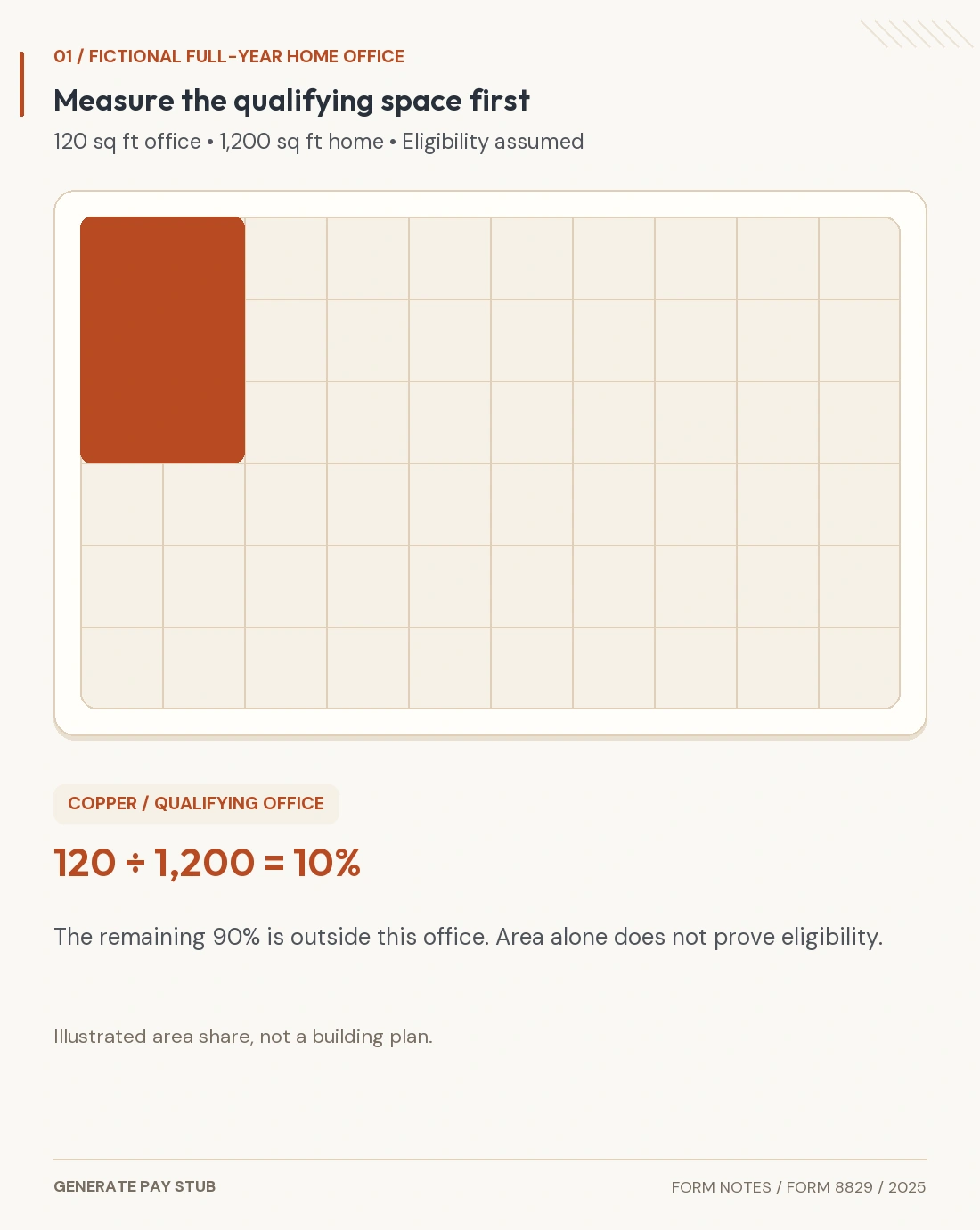
Use consistent measurements and include only qualifying space. Assume a sole proprietor rents a 1,200-square-foot home and uses 120 square feet regularly and exclusively as a qualifying office for the entire year.
The percentage is 120 ÷ 1,200 = 10%. For this ordinary office, that is the Part I business percentage. It is not 120 divided by the home's nonbusiness area, and it is not the share of hours spent working.

Daycare space shared with personal use may need a time fraction; mixed exclusive and shared daycare areas require the special computation. A full year has 8,760 hours in 2025, but business-use hours are not automatically all available hours.
How should direct and indirect expenses be treated?
Direct costs benefit the office alone; indirect costs benefit the whole home. The 2025 Form 8829 instructions explain the two columns and exceptions for costs requiring a different allocation.
An eligible repair confined to the office can be a direct expense. Whole-home rent or utilities generally need the appropriate business share. A repair to a wholly personal room is not made deductible by multiplying it by the office percentage.
Distinguish a current repair from an improvement that may require capitalization and depreciation. Also separate ordinary business supplies and advertising deducted elsewhere on Schedule C from expenses of using the home.
What does a checked renter example look like?
Assume the 10% office qualifies for the full year and each listed cost is eligible. The renter has $50,000 of adjusted business income available under Form 8829 Line 8, all attributable to this home-based business after the relevant nonhome expenses.
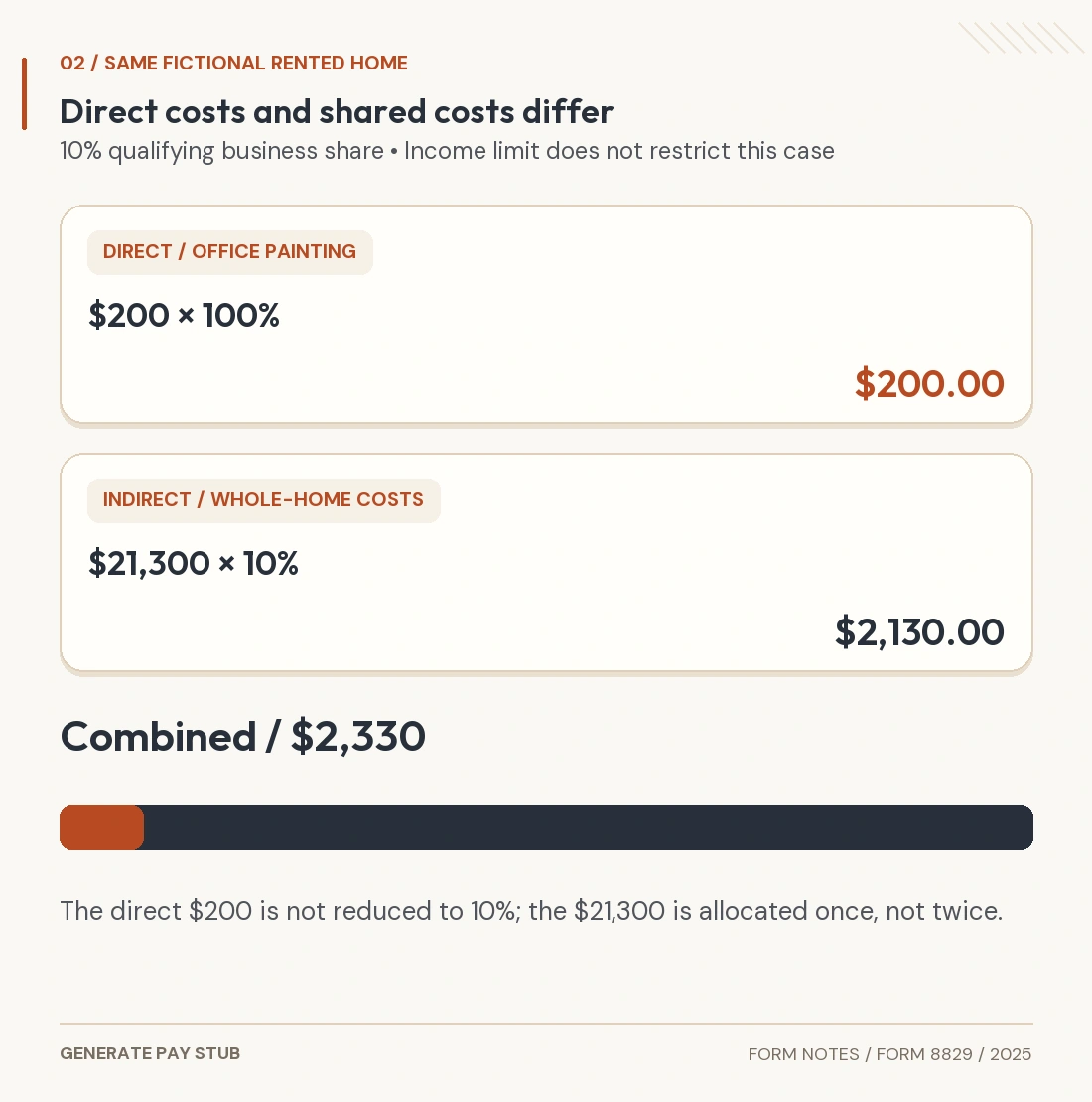
Whole-home costs are $18,000 rent, $2,400 utilities, $300 eligible renter's insurance and $600 current general repairs. A separate $200 current painting expense benefits only the office. No expense is deducted elsewhere.
| Cost | Whole-home amount | Business share | Allowed example amount |
|---|---|---|---|
| Rent | $18,000.00 | 10% | $1,800.00 |
| Utilities | $2,400.00 | 10% | $240.00 |
| Eligible insurance | $300.00 | 10% | $30.00 |
| General current repairs | $600.00 | 10% | $60.00 |
| Office-only painting | — | 100% of $200 | $200.00 |
| Total | — | — | $2,330.00 |
Indirect costs total $18,000 + $2,400 + $300 + $600 = $21,300. Their 10% business share is $2,130. Add the $200 direct painting cost for $2,330.
Do not reduce the direct painting cost to $20, and do not multiply an already allocated $2,130 business amount by 10% again. The two mistakes produce different errors but both understate this example.

For this case, Line 23 has $200 direct and $21,300 indirect operating costs; Line 24 is $2,130 and Line 26 is $2,330. With the stated $50,000 limit and no other tiers or carryovers, Line 27 allows the full operating amount.
Line 36 is $2,330, transferred to Schedule C Line 30. A $50,000 Schedule C Line 29 amount then becomes $47,670 net profit. That is profit after the home deduction, not the final income-tax or self-employment-tax bill. Our Schedule C walkthrough explains the surrounding business calculation.
What if income limits the actual-expense deduction?
The order and income limitation matter. The actual form applies its expense tiers and calculates qualifying carryovers; gross receipts alone are not the usable Line 8 limit.
In a separate variation with the same $2,330 operating costs but only $1,500 available at the operating-expense stage, and no competing tiers or prior carryovers, $1,500 is currently allowed and $830 remains as the operating carryover.
The carryover is not an additional current-year deduction. Simplified-method years have different treatment, including restrictions on deducting earlier actual-expense carryovers. Keep the prior actual-method forms even if a simplified year intervenes.
What additional work do owners and special cases need?
A homeowner's calculation involves more than replacing rent with the mortgage payment. Principal repayments are not home-office mortgage interest. Interest, real-estate taxes and casualty amounts follow their own worksheets and personal-deduction interactions.
For 2025, the instructions distinguish itemizers from standard-deduction taxpayers and address the revised state-and-local-tax limits. Do not copy a prior-year allocation without reviewing the current worksheet and any iterative calculation.
Building depreciation requires the correct basis, land exclusion, business share, service date and applicable method. Land is not depreciable. Later improvements and changes in use can need separate calculations; a fixed percentage should not be applied blindly to today's property value.
Multiple homes, multiple businesses, daycare, inventory use, part-year use and casualty losses require the relevant special rules. Keep the deduction from being claimed twice across forms or businesses.
How do you review the form and supporting packet?
Compare the original page with measurements, cost records and the separate Schedule C. The Form 8829 overview links to the 2025 Form 8829 builder. Confirm ownership or rental status, qualifying use, area, income limit and direct/indirect entries.
Review mortgage, tax, casualty and depreciation worksheets when applicable. The tool can include specified computation statements for mixed daycare or later improvements; it does not replace all supporting worksheets or determine eligibility.
Form 8829 has no independent signature line. Attach it through the main return with Schedule C and any other required documents. Filing and payment remain separate from creating the PDF. Retain the final return, source expenses and carryover workpapers securely.
General U.S. federal tax information for 2025. The full-year renter example assumes qualifying exclusive use and sufficient adjusted business income. It does not establish any reader's eligibility or compare every method-related tax effect.