Form 8995 calculates the simplified qualified business income deduction by comparing eligible business and REIT/PTP components with a taxable-income limit. It is not simply 20% of gross sales, Schedule C profit or the owner's cash withdrawal.
Prepare the business calculation and the main return together: attributable deductions affect QBI, while personal taxable income and qualified dividends can restrict the final deduction.
Figures below follow tax year 2025. We checked the final one-page original and the tool’s supported edition on November 5, 2026. Its fictional case is a single individual with one qualifying domestic sole proprietorship, no cooperative, REIT/PTP income, qualified-loss carryforward or suspended losses.
Who can use Form 8995 for 2025?
Eligible individuals and certain estates or trusts use the simplified form within its income and cooperative restrictions. The 2025 Form 8995 original sets the taxable-income threshold before the QBI deduction at $197,300 for returns other than married filing jointly, or $394,600 for joint filers.
The amount test is inclusive: being exactly at the threshold can satisfy that part of the simplified-form test. It is not a gross-revenue or AGI threshold. Patrons of a specified agricultural or horticultural cooperative use the appropriate Form 8995-A procedure instead.
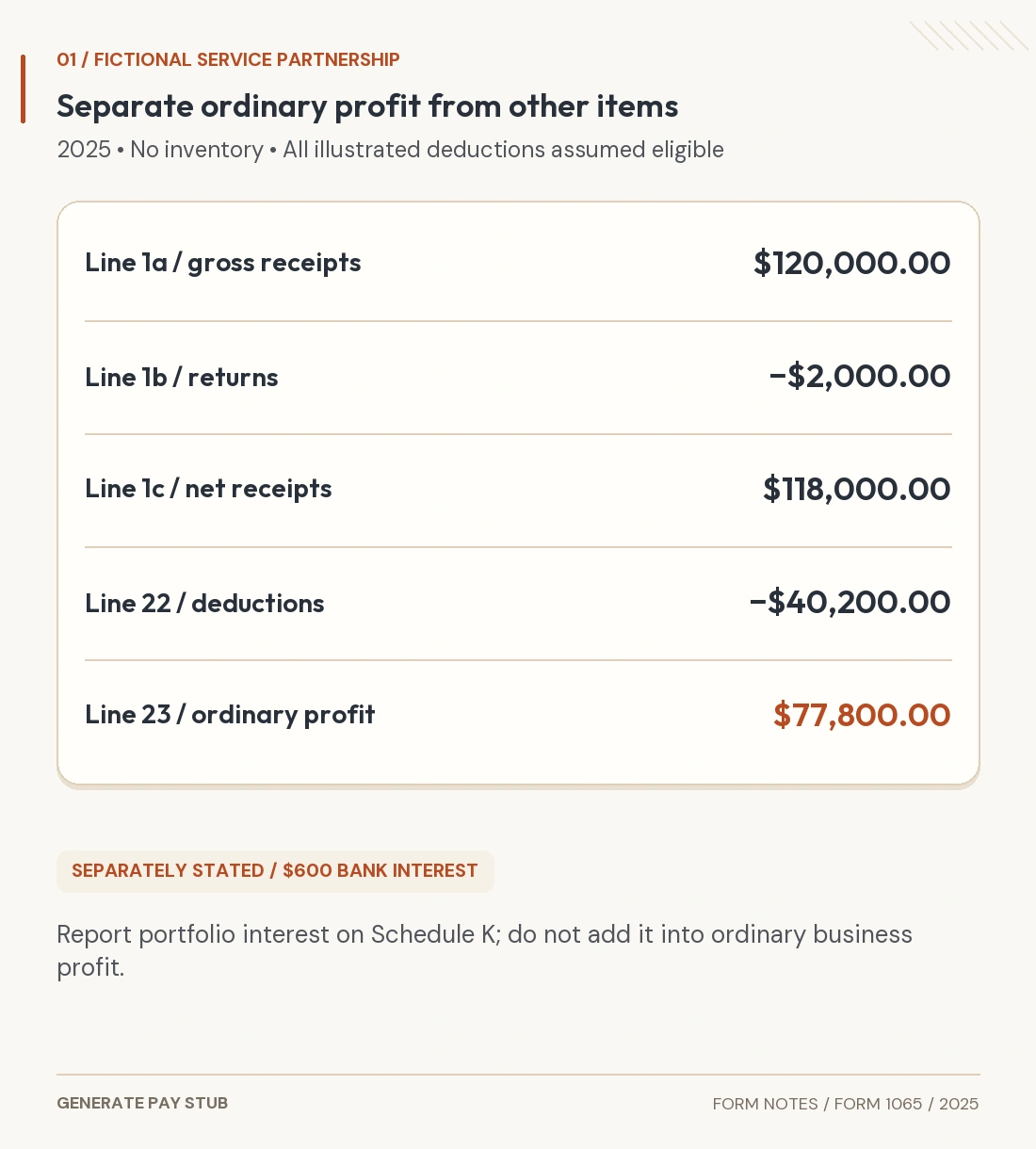
Partnerships and S corporations generally pass necessary information to their owners rather than claiming the owner-level deduction themselves. Our Form 1065 guide explains the separate partnership-return role.
The IRS QBI overview discusses the broader deduction and changes applying after 2025. This article does not insert a 2026 minimum-deduction rule into a 2025 calculation.
What counts as qualified business income?
QBI is the net eligible business amount after applicable attributable deductions and tax limitations. Ordinary employee pay, an S-corporation owner's reasonable compensation, partnership guaranteed payments and portfolio capital gains are not automatically QBI.
Interest unrelated to the business and ordinary investment dividends are also different from business QBI. Qualified REIT dividends and qualifying PTP items have their own component rather than being entered again as ordinary business QBI.
The deductible part of self-employment tax, eligible self-employed health-insurance deduction and qualifying retirement-plan deduction can reduce QBI when attributable to the business. Do not use a Schedule C net-profit figure without reviewing those adjustments.
Ordinary employee services do not qualify, but statutory-employee situations have specific instructions. Specified service businesses can qualify at or below the applicable threshold; being called a consultant is not by itself a universal disqualification.
Which records should you collect before preparing Form 8995?
Collect the records supporting both QBI and the separate income limitation. Keep:
- The completed business schedules and relevant K-1 QBI statements.
- Allowed attributable adjustments, including the deductible SE-tax portion.
- Support for eligible health-insurance and retirement deductions.
- Prior qualified-loss carryforwards and separate suspended-loss tracking.
- Qualified REIT-dividend and PTP statements, if applicable.
- Main-return taxable income before the QBI deduction.
- Qualified dividends and the applicable net-capital-gain calculation.
- Required aggregation or rental-enterprise statements.
A 1099 receipt or bank deposit alone does not supply all these figures. The business ledger establishes profit; the additional work establishes how much of that profit qualifies and how much deduction the return allows.
How do you move from business profit to QBI?
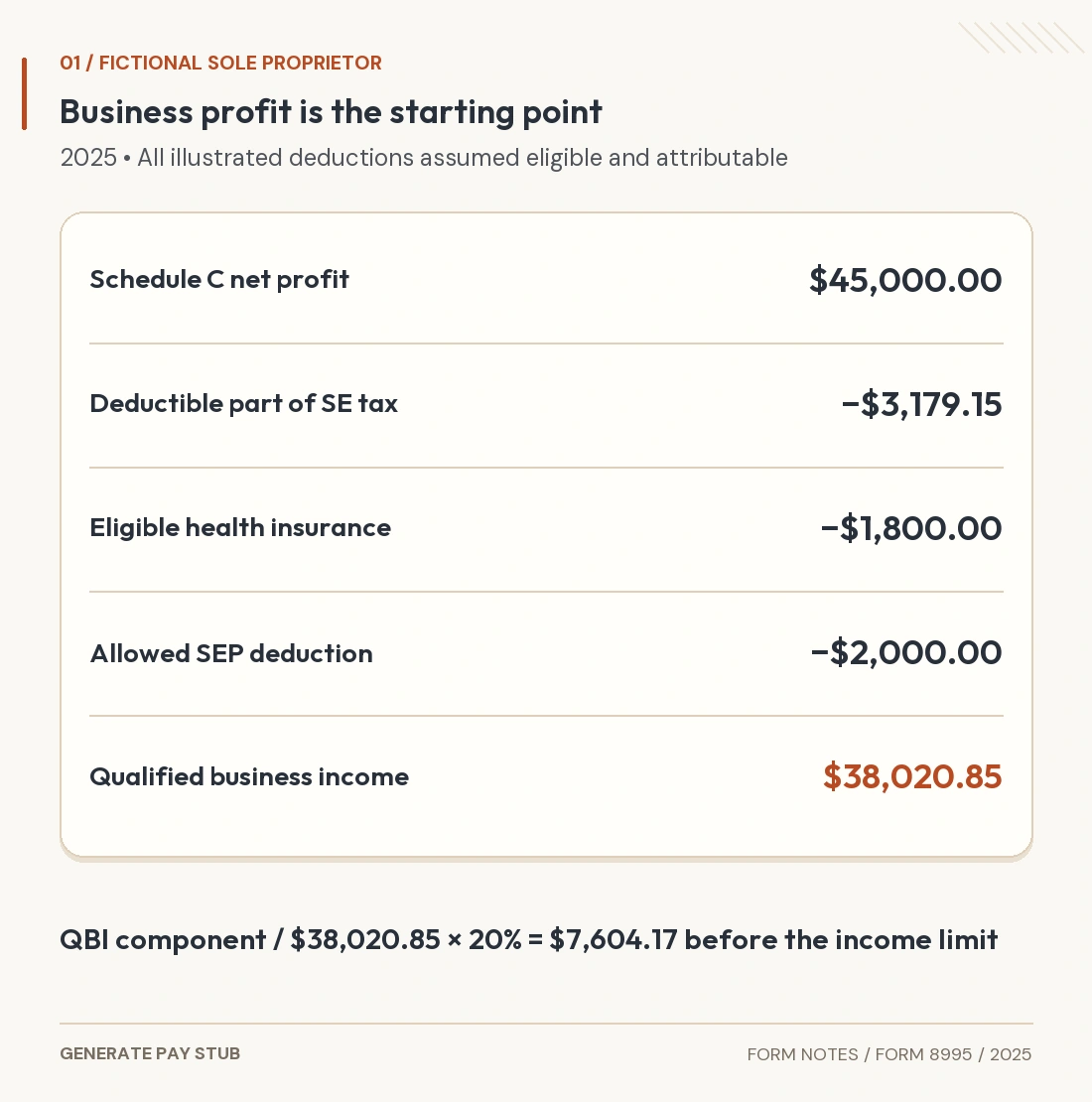
Subtract allowed deductions attributable to the business without deducting them twice on the return. Assume a fictional single taxpayer, age 40, not blind or anyone's dependent, has $45,000 Schedule C net profit for 2025.
Assume the regular SE-tax method, no special exclusions and combined wages and self-employment earnings below the Social Security ceiling. The 2025 Schedule SE calculation gives $45,000 × 92.35% = $41,557.50 net earnings. Its ordinary Social Security and Medicare total is $6,358.30; the deductible half is $3,179.15.
Also assume a separately verified $1,800 health-insurance deduction and $2,000 allowed SEP deduction, fully attributable to this business. No disqualifying subsidized-employer-plan eligibility or premium-credit interaction affects the health amount. The 2025 Form 7206 instructions explain why that eligibility must be checked.
| Measure | Amount |
|---|---|
| Schedule C net profit | $45,000.00 |
| Less deductible SE-tax portion | $3,179.15 |
| Less eligible self-employed health insurance | $1,800.00 |
| Less allowed attributable SEP deduction | $2,000.00 |
| QBI entered for this business | $38,020.85 |
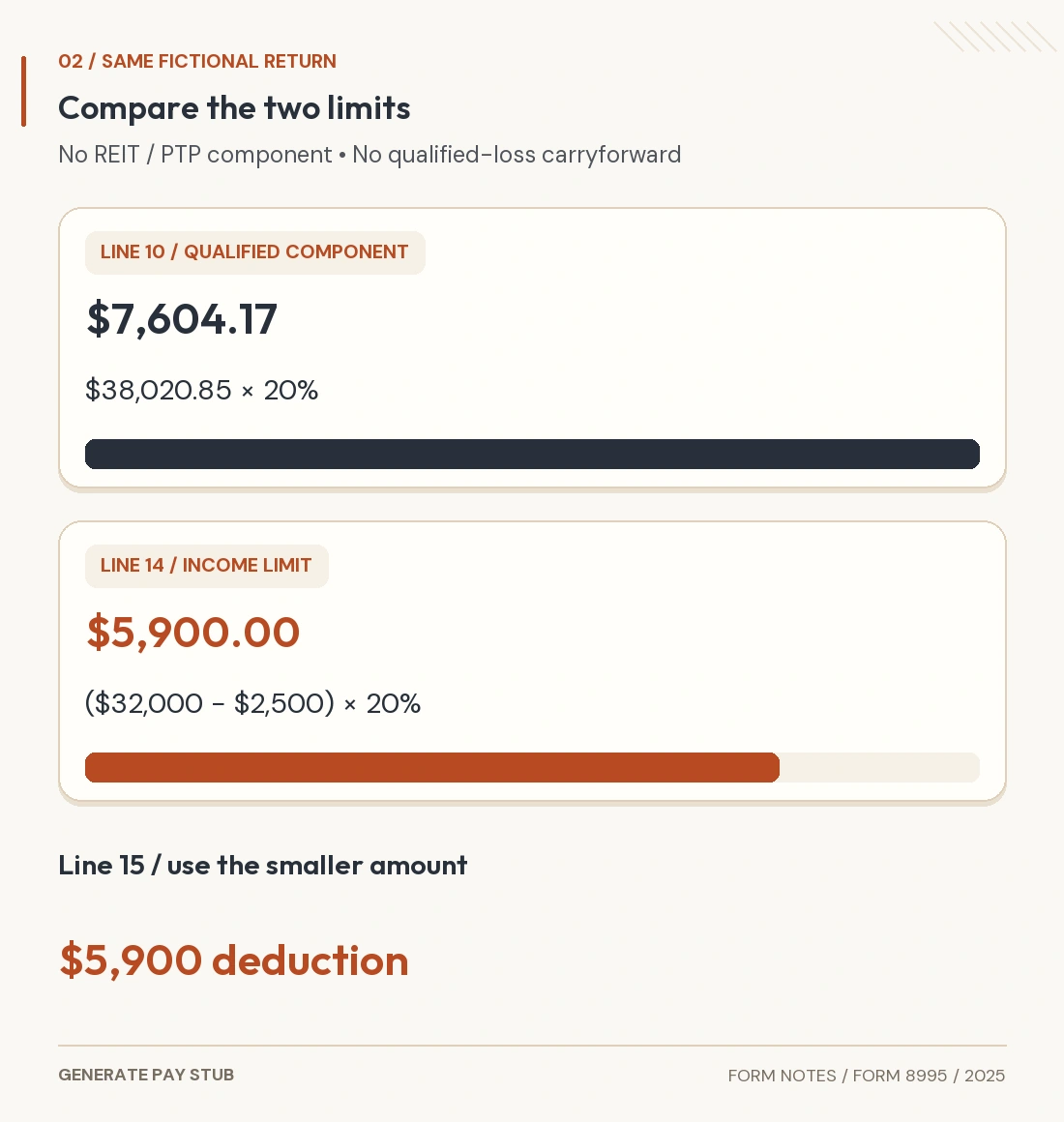
| 20% QBI component before income limit | $7,604.17 |
The calculation is $45,000 − $3,179.15 − $1,800 − $2,000 = $38,020.85. At 20%, its QBI component is $7,604.17. These adjustments are supplied as eligible facts; they are not an instruction to claim every premium or retirement payment.

How does the taxable-income limit change the deduction?
The smaller of the qualified components and the income limitation controls the ordinary 2025 result. For this taxpayer, also assume $7,229.15 ordinary W-2 wages and $2,500 qualified investment dividends, with no other income or adjustments.
AGI is $45,000 + $7,229.15 + $2,500 − $3,179.15 − $1,800 − $2,000 = $47,750. Using the ordinary $15,750 2025 single standard deduction, with no Schedule 1-A deduction, taxable income before QBI is $32,000. The 2025 Form 1040 instructions explain the main-return deductions and lines.
Assume there is no net capital gain beyond the stated qualified dividends. Form 8995's income-limit base is $32,000 − $2,500 = $29,500; 20% is $5,900.
| Line or measure | Checked amount |
|---|---|
| Line 10: qualified component, no REIT/PTP amount | $7,604.17 |
| Line 11: taxable income before QBI | $32,000.00 |
| Line 12: qualified dividends, no additional net capital gain | $2,500.00 |
| Line 13: difference | $29,500.00 |
| Line 14: 20% income limitation | $5,900.00 |
| Line 15: smaller of Lines 10 and 14 | $5,900.00 |

Transfer the $5,900 deduction to 2025 Form 1040 Line 13a. With no other changes, taxable income becomes $26,100. The deduction does not create a $5,900 refund or reduce this example's Schedule SE tax.
The complete Form 8995 instructions specify how Line 11 and net capital gain are computed for each return type. When Schedule D is required, do not automatically use its largest gain number or add capital-loss amounts as positive gains.
What happens to qualified losses and income-limited deductions?
A qualified net-loss carryforward is different from an unused positive deduction. In our example, the $1,704.17 gap between $7,604.17 and $5,900 does not become a QBI loss carryforward merely because the income cap restricted the deduction.
Actual qualified business losses and qualified REIT/PTP losses have separate carryforward computations. Losses still suspended under basis, at-risk, passive or other tax rules require separate tracking until allowed. Do not enter the same loss in the current business row and again as a carryforward.
A negative business component does not necessarily eliminate every possible REIT/PTP deduction. Work through the separate component and overall limitation instead of combining unlike losses casually.
Which situations need additional review?
Higher income, cooperatives, aggregations and pass-through details can change the required work. The IRS Form 8995-A page identifies the longer form and related schedules. Do not force a case into Form 8995 merely because it is shorter.
Rental real estate needs a qualifying-business analysis or the applicable safe harbor. Aggregation has conditions and disclosure requirements; combining names in a field is not an election by itself. Estates, trusts and ESBT portions require allocation and separate-computation rules.
For 2025, the instructions also address certain qualified tip income excluded when determining QBI. The example has no tips. Keep year-specific changes and supporting statements with the calculation rather than applying an old worksheet mechanically.
How do you review the completed Form 8995?
Check the one-page computation against the underlying return and workpapers. The Form 8995 overview leads to the 2025 QBI builder. It accepts entered eligible figures; it does not establish qualification from a business name or receipt total.
Confirm the filing status and threshold, business entries, attributable deductions, prior losses, REIT/PTP component and taxable-income limitation. Review the final deduction and the two carryforward lines independently.
The original has five business rows. The tool can include an additional-business statement for more entries; required aggregation, rental and loss-tracking support remains separate. Form 8995 has no independent signature: attach it to the separately prepared main return.
The ordinary 2025 individual filing dates are past as of this review. Creating the form does not file a return, make a payment or establish an extension. Use current original-return or correction procedures for the actual filing situation.
General U.S. federal information for 2025. The fictional single-filer example assumes every stated deduction is allowed and excludes special businesses, tips, loss carryforwards and international or trust allocations. Follow consistent rounding on the actual return.