Form 4797 reports applicable business-property dispositions and certain recapture amounts. Start with the asset's tax history, calculate the supported gain or loss, then classify it. A deposit from a buyer is not itself the taxable gain, and holding an asset longer than a year does not make every dollar of gain capital income.
This guide follows the final two-page 2025 form, reviewed November 5, 2026. It develops one fictional machine sale from closing records through depreciation recapture and the five-year Section 1231 lookback.
Which transactions belong on Form 4797?
Use the property type and transaction facts to choose the reporting route. The 2025 instructions address business-property sales, certain involuntary conversions and recapture. Parts I, II and III serve different classifications; Part IV addresses specified business-use reductions.
Inventory, investment stock, personal possessions and depreciable business equipment are not interchangeable categories. The IRS capital-gain overview discusses personal and investment capital assets and explains that personal-use losses generally are not deductible. A household item does not become deductible business property merely because its sale appears on an information return.
Qualifying Section 1231 property generally involves business or income-producing property held more than one year, with important exclusions. Shorter-held property and other ordinary transactions follow their appropriate rules. A sale involving several assets requires allocation and classification rather than one blended entry.
What records should you gather before entering a sale?
Build a separate disposition workpaper for each asset. Connect these records:
- The original acquisition document and the date ownership began.
- The asset description and business activity using it.
- Capitalized cost, improvements and other basis changes.
- Prior depreciation and the supported deduction through disposition.
- The sale agreement, disposal date, gross proceeds and selling costs.
- Business and personal use, related-party status and any unusual terms.
- Other current-year Section 1231 transactions and remaining losses from the preceding five years.
Publication 551 explains basis adjustments, including depreciation allowed or allowable. Missing a deduction does not necessarily preserve the original basis. Resolve gaps in the depreciation history before calculating the sale.
A loan payoff and the asset's adjusted basis also answer different questions. Keep financing, closing cash and tax gain in separate reconciliation lines. Debt assumed by a buyer or a foreclosure may change the amount-realized analysis.
How do sale proceeds and basis become taxable gain?
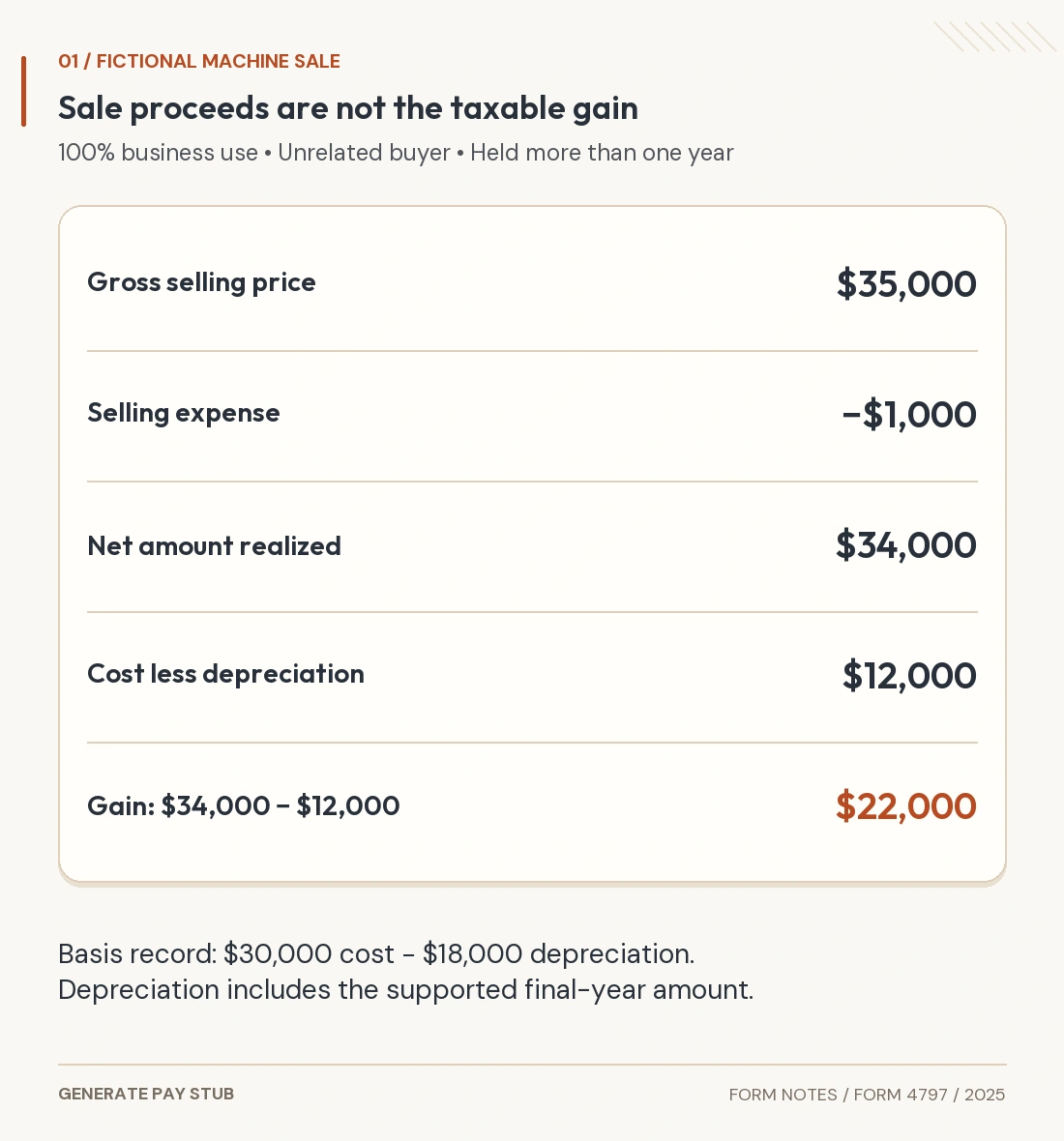
Our fictional sole proprietor sells one machine to an unrelated buyer on October 15, 2025. The business acquired it January 10, 2022 and used it entirely for business. Assume an ordinary fully taxable cash sale, no debt assumption, no credits or other basis changes, and no casualty.
The original supported cost is $30,000. The verified depreciation total through sale is $18,000, including any appropriate final-year deduction. This is an assumed tax-record figure, not a new depreciation schedule calculated from the dates.
| Component | Calculation or record | Amount |
|---|---|---|
| Gross proceeds | Closing statement | $35,000.00 |
| Selling expense | Supported sale cost | $1,000.00 |
| Net amount realized | $35,000 − $1,000 | $34,000.00 |
| Original tax cost | Asset register | $30,000.00 |
| Depreciation through sale | Verified allowed / allowable amount | $18,000.00 |
| Adjusted asset basis | $30,000 − $18,000 | $12,000.00 |
| Gain | $34,000 − $12,000 | $22,000.00 |

Where do these amounts go on the original form?
For this qualifying Section 1245 gain disposition, begin with Part III. On the 2025 original, enter the property description and dates, then review these amounts:
- Line 20: $35,000 gross sale price.
- Line 21: $31,000, combining $30,000 cost and $1,000 selling expense.
- Line 22: $18,000 depreciation.
- Line 23: $13,000 under the form's presentation.
- Line 24: $22,000 gain.
Line 23 here incorporates the selling expense included in Line 21. That is why its $13,000 differs from the $12,000 asset basis in the net-proceeds calculation. Both presentations produce the same $22,000 gain; do not deduct the selling cost twice.
How do depreciation recapture and the five-year lookback divide the gain?
First calculate the ordinary recapture, then review the remaining gain. Publication 544 explains the interaction between Section 1245 recapture and Section 1231 treatment.
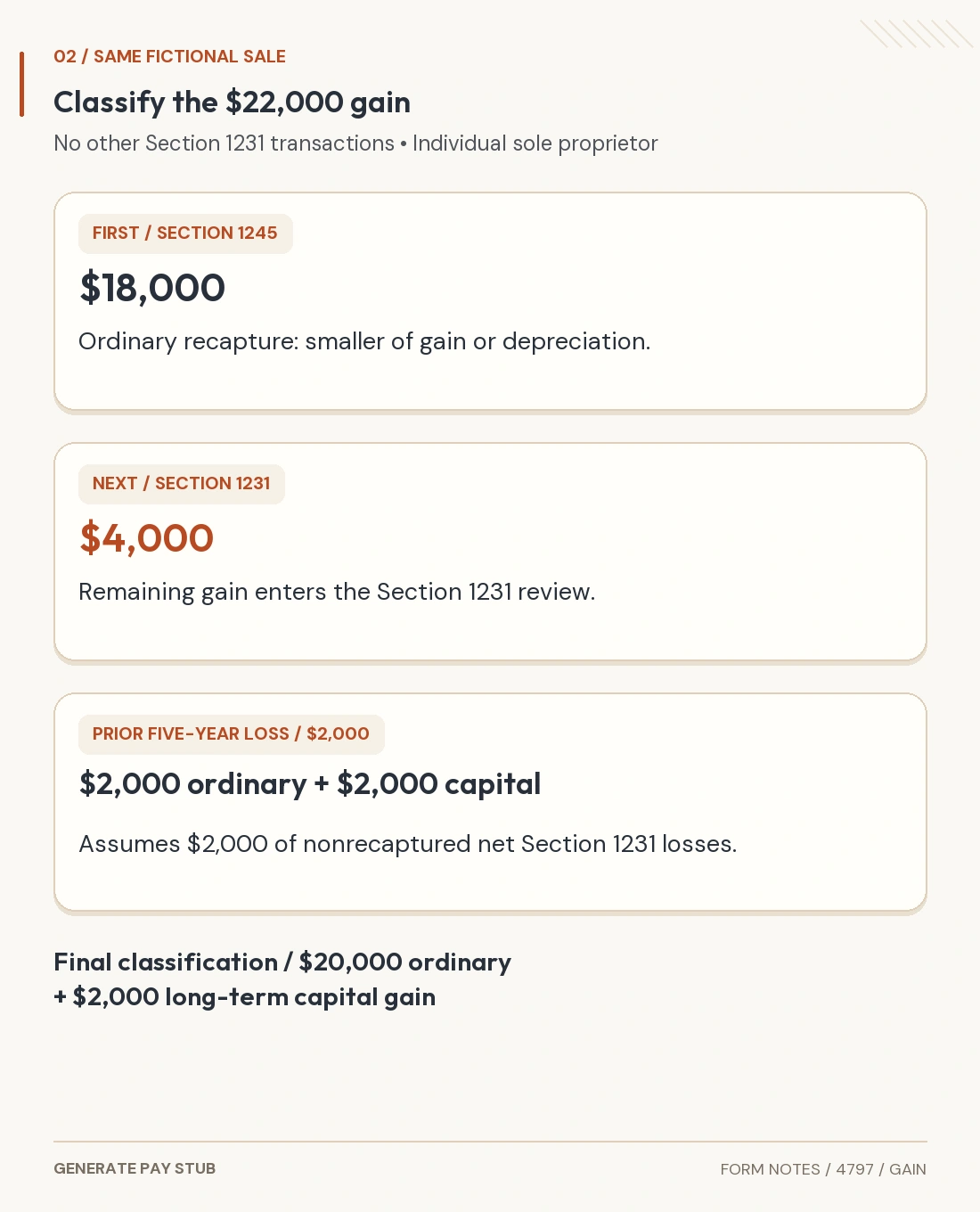
For our stated machine sale, the smaller of $22,000 gain and $18,000 depreciation is $18,000 ordinary recapture. The remaining $4,000 enters the Section 1231 computation.
Assume there are no other Section 1231 transactions in 2025. The owner has $2,000 of nonrecaptured net Section 1231 losses from the preceding five years. The lookback therefore makes $2,000 of the remaining gain ordinary; $2,000 retains long-term capital-gain treatment.

Part III's ordinary total transfers through Line 31 to Line 13; the noncasualty remainder passes through Line 32 to Line 6. In this individual example, the lookback uses Lines 8 and 9, and the ordinary portion joins the appropriate Part II total. Follow the return-specific instructions for the final transfers.
Do not re-enter the same sale as another Part I or II property row after the Part III totals have transferred. That would count the transaction twice.
Which transactions require additional analysis?
The machine example does not cover every disposition. Review these differences before using its route:
- Losses: a loss does not create Section 1245 gain recapture. Use the appropriate loss classification and applicable limits.
- Real estate: Section 1250 ordinary recapture, corporate adjustments and unrecaptured Section 1250 capital gain are distinct concepts.
- Installment terms: depreciation recapture generally is recognized in the sale year even when proceeds arrive later. A separate Form 6252 analysis may be necessary.
- Related parties: gain character and loss allowance can change.
- Mixed use or conversion: separate business and personal portions and review gain/loss basis rules.
- Casualty, exchange or special assets: other forms, elections, allocations or recapture provisions may control.
Partnerships and S corporations follow their Schedule K reporting instructions and do not apply the individual lookback lines in the same way. Owners may need their own prior-loss review. Do not assume an entity-level result completes every owner's return.
Can Form 4797 recapture arise without a sale?
Yes. Part IV addresses specified prior deductions when qualified business use falls to 50% or less. The applicable Section 179 or listed-property computation compares prior recovery with recomputed depreciation under the relevant rules.
A business-use change is not a fictional sale. Prepare its own supporting calculation, avoid duplicating listed-property recapture in both columns, and send the result to the activity location required by the instructions.
How do you assemble and review the completed packet?
Use the tool after establishing the tax treatment. The Form 4797 information page leads to the 2025 business-property form builder.
Select the applicable parts and supply supported figures. The builder provides separate sale, recapture and business-use sections, including informational totals that must not be added again. It does not replace asset classification, prior-year workpapers or special-transaction advice.
Check both original pages, required attachments, property descriptions, dates, gross-versus-net presentation, ordinary totals and return routing. Form 4797 has no independent signature block; file it through the applicable return with that return's required signing and submission steps.
The standard calendar-year 2025 filing windows have passed at this November 2026 review. Preparing a PDF neither files the return nor repairs a missed deadline. Keep the disposition workpaper with the asset history and filing copy.
General U.S. federal information for the 2025 form. The example excludes installments, related parties, debt relief, casualty, credits, mixed use and other current-year Section 1231 transactions.