Form 8809 requests more time to file covered information returns, such as certain 1099s, with the tax agency. It does not extend recipient-statement deadlines or an individual's Form 1040 deadline. Most eligible initial requests provide 30 days automatically when properly and timely made; W-2 and 1099-NEC requests have stricter conditions.
Use this guide to identify the correct request, map its fields and plan separate delivery and filing dates. The current original is revised December 2025. The examples concern 2026 information returns filed during 2027, with no special disaster relief assumed.
Is Form 8809 the right extension for your task?
Identify the return and the obligation before choosing a form. The IRS Form 8809 overview covers listed information returns including W-2, W-2G, 1042-S, specified ACA forms, 1097, 1098, 1099, 3921, 3922, 5498 and 8027.
An income-tax return, a recipient copy and an agency information return may concern the same person but have separate extension procedures. Form 1042 also differs from Form 1042-S. Verify the exact number rather than selecting a form because it looks similar.
Electronic-filing hardship relief is another distinct request. A waiver can change how a return may be filed without giving more time to file it.
Which requests are automatic, and which need a reason?
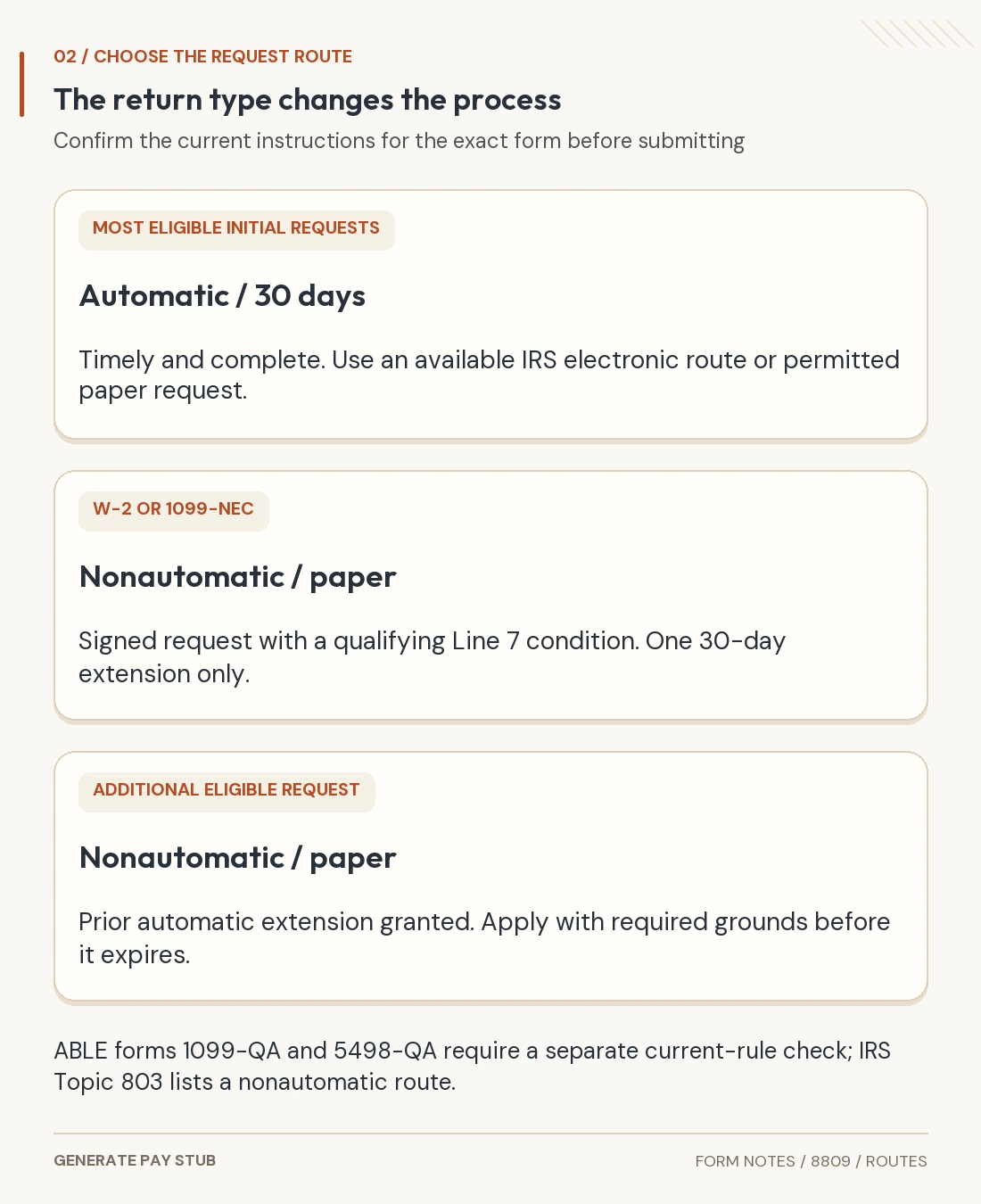
Check both the return type and whether this is an initial or additional request. Current IRS Topic 803 distinguishes ordinary eligible automatic extensions from special paper-request routes.
| Request | Key requirement | Follow-through |
|---|---|---|
| Initial request for most eligible information returns | Complete and timely initial request | Ordinarily 30 days; use the supported electronic or paper route |
| W-2 or 1099-NEC | Qualifying Line 7 condition and signed paper request | Nonautomatic; only one 30-day extension available |
| Additional extension for an eligible other return | Initial automatic extension granted and required grounds supported | Signed paper request before that extension expires |
The listed grounds include a qualifying disaster, fire or casualty, death or serious illness affecting filing, first-year establishment, or delayed required payee-statement data. Choose only the condition the actual records support.
For ABLE forms 1099-QA and 5498-QA, check the specific current procedure: Topic 803 lists them among forms ineligible for an automatic extension. Do not assume the broad wording on an older instruction sheet makes every form automatic.
A busy season alone is not evidence that a listed hardship criterion occurred. Assign someone to retain the relevant dates, incident records or delayed-source correspondence when a conditional request is needed.

How does a 2026 Form 1099-INT extension affect 2027 dates?
It can change the agency filing date while the recipient date stays the same. Assume fictional filer Brookline Savings must electronically file 2026 Forms 1099-INT, obtains a valid initial automatic extension and has no unusual reporting arrangement.
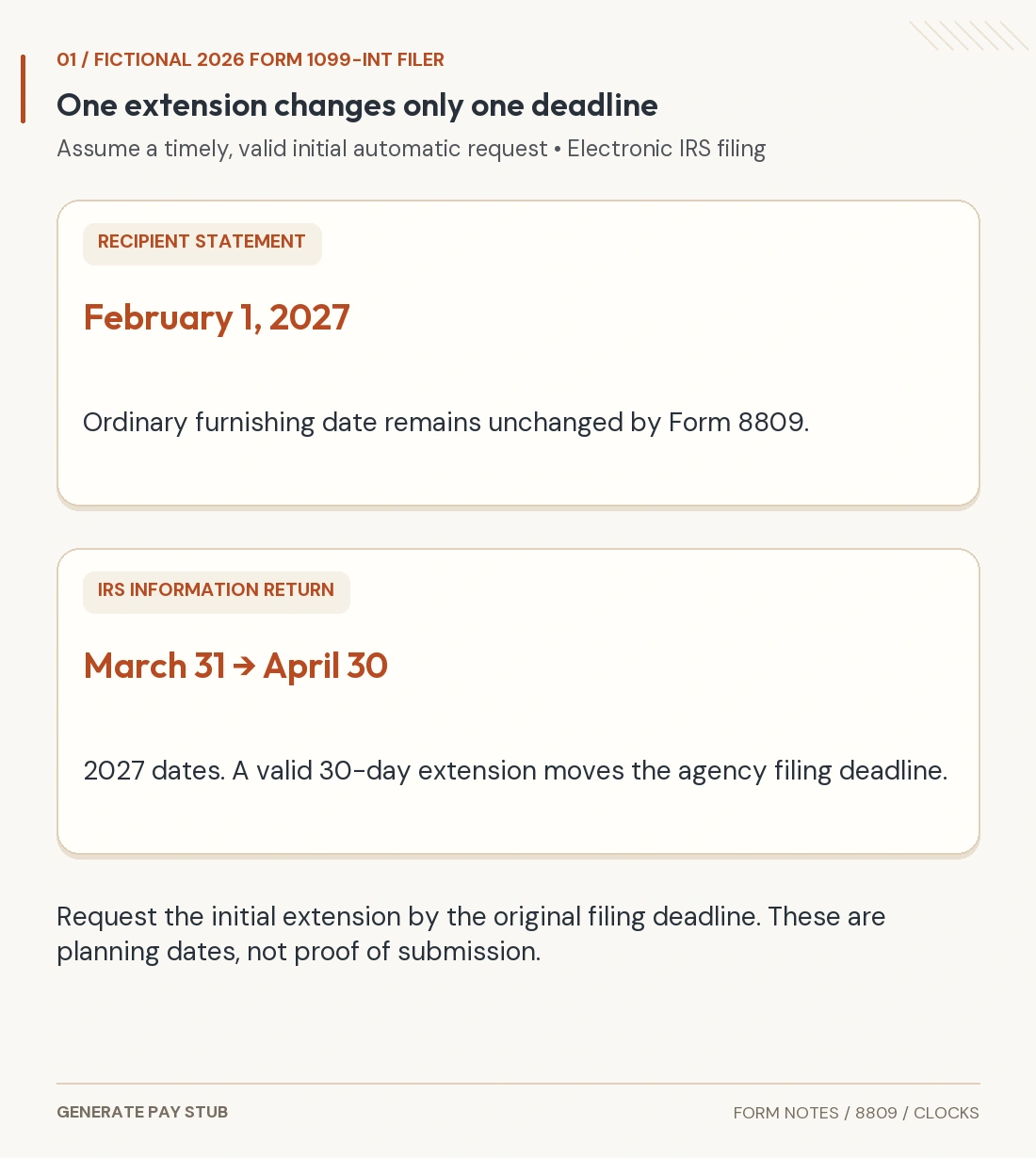
Under 2026 Publication 1099, the ordinary recipient deadline rolls from Sunday, January 31 to Monday, February 1, 2027. The ordinary electronic IRS filing deadline is March 31, 2027.
Thirty days after March 31 is Friday, April 30, 2027. With the assumed valid request, April 30 becomes the agency filing deadline. February 1 remains the recipient deadline unless a separate applicable furnishing extension is obtained.

For a different calendar, start again with the relevant form, year and filing method. A paper deadline is not interchangeable with the electronic deadline. Combining return categories on one request can make the earliest applicable deadline control.
How should you review the Form 8809 fields?
Use the payer or filer identity, not the recipient's identity. Check the original form and its attached instructions before signing:
| Entry | What to verify |
|---|---|
| Lines 1–2 | Legal filer name, matching TIN, mailing address and knowledgeable contact |
| Line 3 | Method used to file the information returns; separate requests for different methods |
| Line 4 | Number of payers/filers only for a consolidated request, with required typed name-and-TIN list |
| Line 5 | Additional-extension checkbox only after the initial automatic extension for the same forms and year |
| Line 6 | Applicable form categories; do not enter counts of individual returns |
| Line 7 and signature | Applicable justification and authorized signature for a nonautomatic request |
For our single Brookline filer, the count of individual 1099-INT statements does not belong on Line 4. That line concerns multiple filers, not how many customers receive statements. The underlying returns use electronic filing, so the method selection reflects electronic returns even if a required extension request itself is mailed.
How do you request extra time to give people their statements?
Use the separate furnishing-extension process. The current Form 15397 and instructions address a one-time extension of up to 30 days for listed recipient statements.
Submit through the stated online or fax route by the recipient due date, no earlier than January 1. Explain the actual need, use the proper issuer information and sign as required. Do not mail this request or assume an 8809 acknowledgment covers it.
In our example, requesting 8809 in March would be too late to solve an unmet February recipient deadline. A calendar should therefore have separate entries for statement preparation, delivery, agency filing and each extension decision.
When and how do you submit the filing-extension request?
Submit once the need is known, within the permitted filing-year window. Requests generally cannot precede January 1 of the year the returns are due and must reach the applicable timely-filing standard by the original due date. An additional eligible request must precede expiration of the initial extension.
The IRS IRIS service supports automatic extension requests and requires appropriate access. Obtain the necessary transmitter credentials early rather than treating the due date as an account-setup deadline.
For 2026 returns filed in 2027, current general instructions replace the retired FIRE intake with IRIS. Older materials may still describe FIRE. Signed nonautomatic requests continue to use the applicable paper route; do not attempt to turn one into an automatic online request.
Save the exact submitted request, acknowledgment or mailing evidence, form categories and resulting due dates. A local PDF, unsent draft or checkout receipt is not proof the IRS received an extension. Continue preparing the underlying returns during the added time.
What does the 8809 document builder provide?
It prepares the request document for your review. Visit the 8809 overview or open the filing-extension request workspace.
The reviewed builder uses the December 2025 original, includes both pages, and separates filer identity, return method, categories, additional-extension status and justification. A consolidated request's separate filer list must be prepared and attached independently. Review applicable signature requirements before submitting.
The tool does not submit a request, grant an extension or change the deadline for recipient statements. Match the generated page with the current IRS route for the exact form; the preparer remains responsible for eligibility and timely submission.
U.S. federal information reviewed November 6, 2026. The worked deadline example concerns 2026 Forms 1099-INT filed electronically in 2027 and assumes a valid initial automatic request without special relief.