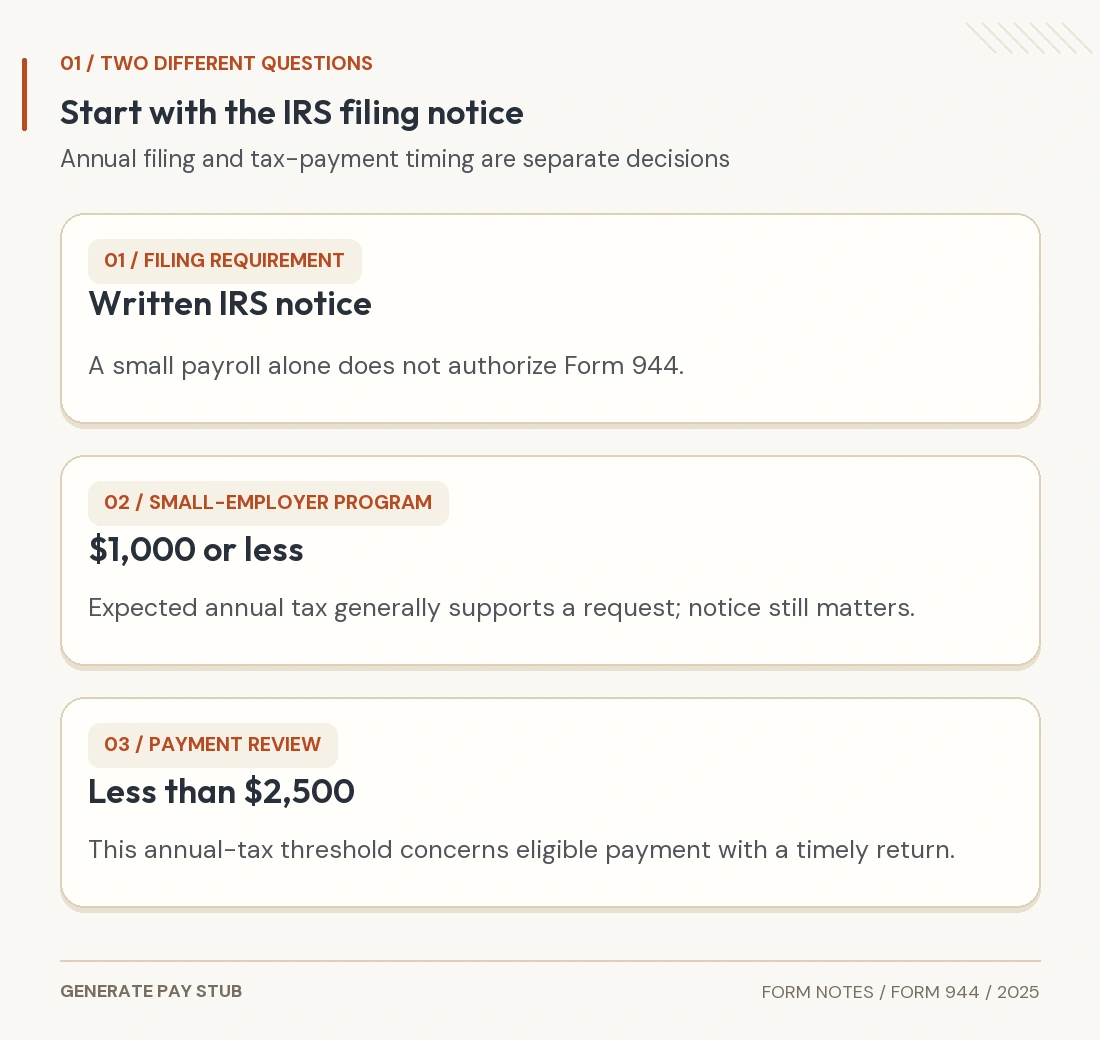
File Form 944 only when the IRS has told your employer in writing to use this annual payroll-tax return. A small tax bill does not by itself let you replace quarterly Forms 941. Once the filing requirement is confirmed, reconcile annual wages, actual withholding, both FICA shares and payment records.
The most useful first check is therefore the IRS notice, before the first wage field. A second check determines when payment or deposits were required. Those checks use different rules.
Reviewed November 5, 2026. This walkthrough covers the final 2025 Form 944 currently supported by the tool. The ordinary 2025 filing dates and the published 2026 change-request windows are already past.
Who can use Form 944 instead of Form 941?
An employer needs the IRS annual-filing notification. The first-page notice on the 2025 Form 944 original makes this requirement explicit. Keep the notification with the employer's filing records.
If the IRS requires Form 944, continue using it for the year even when the actual annual liability grows beyond $1,000, unless the IRS changes the requirement. Do not file four Forms 941 simply because the payroll expanded. Conversely, a Form 941 filer cannot unilaterally switch after calculating a smaller tax bill.
The IRS employment-return overview distinguishes annual Form 944, quarterly Form 941 and the agricultural return. An employer with only household employees or only agricultural employees does not use Form 944 under the ordinary instructions.
If the notice cannot be found or the filing requirement is unclear, resolve that with the IRS before preparing a replacement return. The builder's acknowledgment records the user's confirmation; it does not obtain IRS permission.
Why do the $1,000 and $2,500 thresholds both appear?
They answer different questions. Expected annual employment-tax liability of $1,000 or less is associated with the small-employer annual-filing program. Written IRS authorization still determines the return to file.
The less-than-$2,500 annual-tax rule concerns eligible payment with a timely return. It is not permission to choose Form 944. At exactly $2,500, that particular less-than rule no longer applies; review the applicable deposit rules and exceptions.
Neither figure is a gross-wage limit. The relevant liability includes actual federal income-tax withholding and applicable employer and employee Social Security and Medicare taxes. A wage total alone does not establish it.

Which records should an authorized annual filer collect?
Collect annual payroll totals with enough detail to verify each employee's taxable wage bases. Keep these records together:
- IRS filing notification, legal employer identity and EIN.
- Payroll registers and payment dates for the reporting year.
- Actual federal income-tax withholding by employee.
- Social Security wages and tips with individual annual-cap checks.
- Medicare wages and any Additional Medicare withholding calculations.
- Support for current-year adjustments or an allowable research payroll credit.
- Deposits, applied overpayments and payment confirmations.
- W-2/W-3 reconciliation and any required liability schedule.
Keep an adjustment's evidence with its calculation. A convenient rounded amount should not be used to force agreement between payroll and a draft return.
For 2025, the Social Security wage base is $176,100 per employee. Medicare has no comparable wage cap. A traditional retirement deferral or another benefit may affect compensation and FICA bases differently, so do not assume every wage field must match.
What does a checked Form 944 example look like?
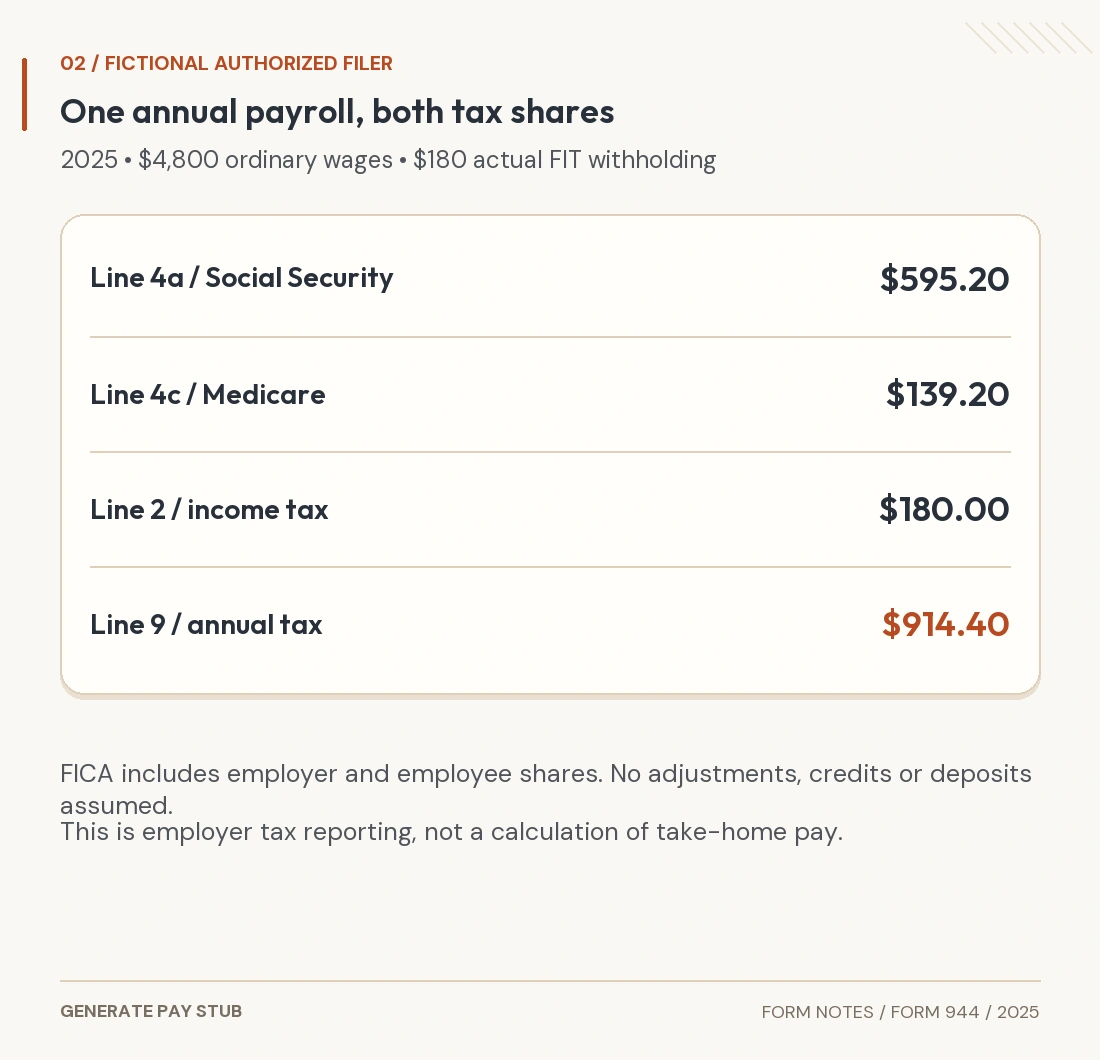
Include both FICA shares when calculating the employer return. Assume an ordinary U.S. employer was properly notified to file Form 944 for 2025. Its one employee received $4,800 ordinary taxable wages during the year, and the payroll records show $180 federal income tax actually withheld.
Assume identical compensation, Social Security and Medicare wage bases; no tips, benefits, Additional Medicare withholding, adjustments, credits, deposits or applied overpayments. The $180 is a supplied payroll-record fact, not a universal withholding amount for $4,800 wages.
| Form entry | Calculation or source | Amount |
|---|---|---|
| Line 1: compensation | Annual payroll records | $4,800.00 |
| Line 2: FIT withheld | Actual withholding records | $180.00 |
| Line 4a: Social Security tax | $4,800 × 0.124 | $595.20 |
| Line 4c: Medicare tax | $4,800 × 0.029 | $139.20 |
| Line 4e: total FICA | $595.20 + $139.20 | $734.40 |
| Line 5: tax before adjustments | $180.00 + $734.40 | $914.40 |
| Line 9: after adjustments and credits | No adjustment or credit in this example | $914.40 |
| Line 11: balance due | No deposits or applied overpayments | $914.40 |
The $734.40 FICA total contains $367.20 employee tax and $367.20 employer tax. Using only the employee share would understate the employer return. This example does not calculate net pay or include FUTA.

How do payments and liability reporting work?
An annual return does not always mean annual payment. Under the 2025 Form 944 instructions, annual net tax below $2,500 can generally be paid in full with a timely return. Our $914.40 example fits that amount test.
Larger annual liabilities require a closer deposit review. The instructions distinguish quarters below $2,500 from quarters at or above it, monthly or semiweekly schedules and the $100,000 next-day rule. A qualifying fourth-quarter payment exception also has conditions. Check the applicable schedule rather than waiting automatically until the return deadline.
Part 2's small-tax choice applies when Line 9 is below $2,500. For a monthly depositor required to complete the monthly boxes, enter liability in the wage-payment month, not the month of a later bank transfer. The year's liability must reconcile with Line 9.
A semiweekly depositor uses Form 945-A, including when the next-day rule causes that status. Schedule B for Form 941 is not the correct annual attachment. Do not fill both alternative liability presentations as if they were two separate taxes.
How should Form 944 agree with employee wage statements?
Reconcile equivalent measures rather than expecting every form total to be identical. Compare compensation, federal withholding, Social Security and Medicare wage bases with the appropriate W-2/W-3 totals, explaining legitimate differences.
For our one-employee assumptions, the compensation and FICA wage bases are each $4,800. The $180 withholding is another distinct measure. The $914.40 employer-return tax total is not a W-2 wage amount.
The W-2 preparation walkthrough gives a separate box review. Complete the required employee furnishing and SSA filing steps as well; filing Form 944 does not accomplish either one.
What 2025 deadlines and correction rules apply?
The ordinary 2025 Form 944 due date was February 2, 2026. Employers that timely deposited the year's tax in full could file by February 10. Those dates have passed as of this guide's review; a newly prepared document cannot make an old payment timely.
The instructions' 2026 filing-change request windows also closed earlier in 2026. Follow the year-specific IRS procedure and obtain the required confirmation instead of assuming a late request changes the return already required.
Correct a previously filed Form 944 using Form 944-X where appropriate. The IRS correction overview identifies the matching correction return. A prior-year error should not be hidden in a current-year adjustment line.
If the business closes or stops paying wages permanently, review the final-return box, last wage date and required statement identifying the payroll-record custodian and location.
How do you finish a complete preparation packet?
Review the original return pages and separate attachments together. Start from the Form 944 overview or open the 2025 Form 944 builder. Its included original packet has two return pages and a voucher page.
Check the notification acknowledgment, year, employer identity, wage bases, withholding, adjustments, deposits, liability presentation and balance or overpayment. Confirm any designee authorization and refund banking information.
Form 945-A, Form 8974 and closing statements are separate when required. Complete the authorized employer signature and applicable preparer declaration. Use Form 944-V only when the printed rules permit mailing a balance payment by check or money order. Required deposits still use the electronic deposit process.
The tool creates the document from entered figures. IRS filing, tax payment and verification of the underlying records remain separate. Keep the signed packet, source workpapers, eventual filing acceptance and payment evidence in the employer's records.
General U.S. federal employment-tax information for the final 2025 form. The example assumes an authorized ordinary employer and excludes territorial, household, agricultural and special-credit situations.