Prepare Form 940 by reconciling annual employee payments, applying the FUTA wage cap to each person, checking the state-unemployment credit and matching the resulting tax to deposits. The return reports federal unemployment tax paid by the employer. It does not replace Form 941 or a state unemployment return.
The useful starting point is an employee-level annual worksheet—not one gross payroll total multiplied by a rate. That worksheet should explain both the wages included and the amounts removed.
Edition and review date: this guide uses the final 2025 Form 940, reviewed November 5, 2026. The current Generate Pay Stub builder offers 2025, not a 2026 draft. The 2025 ordinary deadlines have passed; this article does not describe an on-time filing opportunity today.
Who needs to prepare Form 940?
Most ordinary business employers meet the filing test through wages paid or weeks with employees. The IRS Form 940 topic says the general 2025 test considers $1,500 or more employee wages in any quarter of 2024 or 2025, or an employee during part of a day in at least 20 different weeks in either year.
Do not add ten weeks from one year to ten from the other to create a 20-week year. Count the relevant full-time, part-time and temporary employees under the actual test; a partnership does not count its partners as employees for that test.
Household and agricultural employers have separate rules. Household employers generally report their applicable tax through Schedule H. Certain government, tribal and tax-exempt employers have exclusions or special conditions. Check the employer's status rather than assuming every business with a payroll files the same return.
Form 940 concerns employer FUTA. Employee Social Security, Medicare and income-tax withholding belong to a different return workflow, such as our Form 941 preparation guide. Do not deduct FUTA from employee wages.
What should you collect before entering the annual return?
Assemble records that let another reviewer reproduce the employee-by-employee wage calculation and payment reconciliation. Useful preparation records include:
- The legal employer name, EIN, address and reporting year.
- Annual payroll by employee, including payment dates and applicable benefits.
- Support for each FUTA-exempt payment included in the starting total.
- Each employee's wages remaining after exemptions and the annual cap calculation.
- State unemployment accounts, wage coverage, assigned rates and payment dates.
- Federal FUTA deposit confirmations and any prior overpayment applied.
- Quarterly liability workpapers, when the return requires them.
- Any successor-employer, aggregate-filer, amended or final-return information.
A bank withdrawal described as “payroll tax” may cover several taxes. Identify the tax type, period and amount before counting it as a Form 940 deposit. Similarly, a state contribution payment is not a federal FUTA deposit.
How does the $7,000 FUTA wage cap work for each employee?
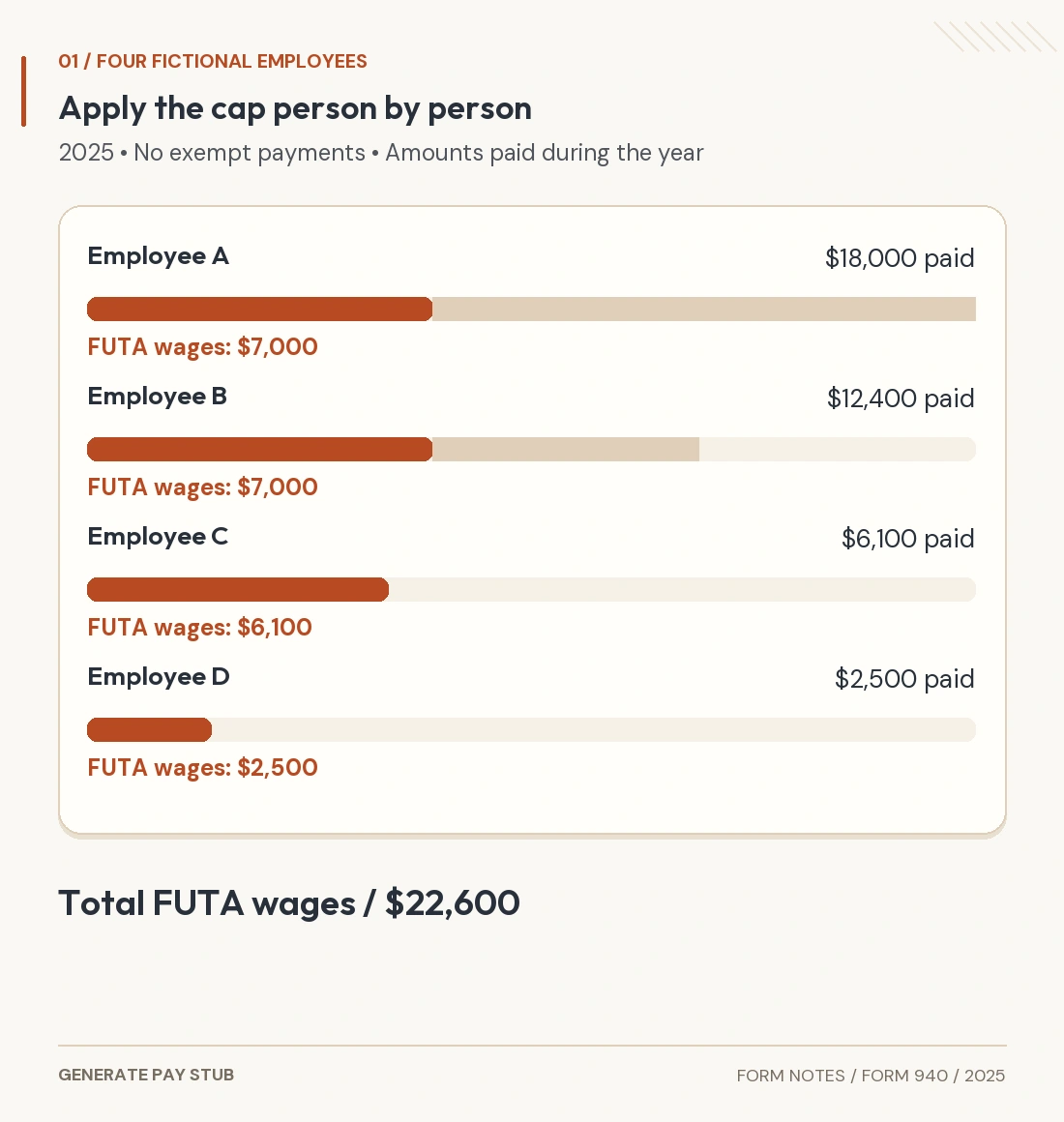
For ordinary covered wages, apply the federal $7,000 annual base separately to each employee after applicable FUTA exemptions. A low-paid employee's unused base does not increase another employee's cap.
Consider four fictional employees paid during 2025 by one ordinary Oregon employer. Assume all payments are ordinary wages, none is exempt from FUTA, all relevant wages have state-unemployment coverage, the employer qualifies for the full state credit and no credit reduction or special adjustment applies.
| Employee | Annual payments | Excess above $7,000 | FUTA wages |
|---|---|---|---|
| Employee A | $18,000.00 | $11,000.00 | $7,000.00 |
| Employee B | $12,400.00 | $5,400.00 | $7,000.00 |
| Employee C | $6,100.00 | $0.00 | $6,100.00 |
| Employee D | $2,500.00 | $0.00 | $2,500.00 |
| Total | $39,000.00 | $16,400.00 | $22,600.00 |
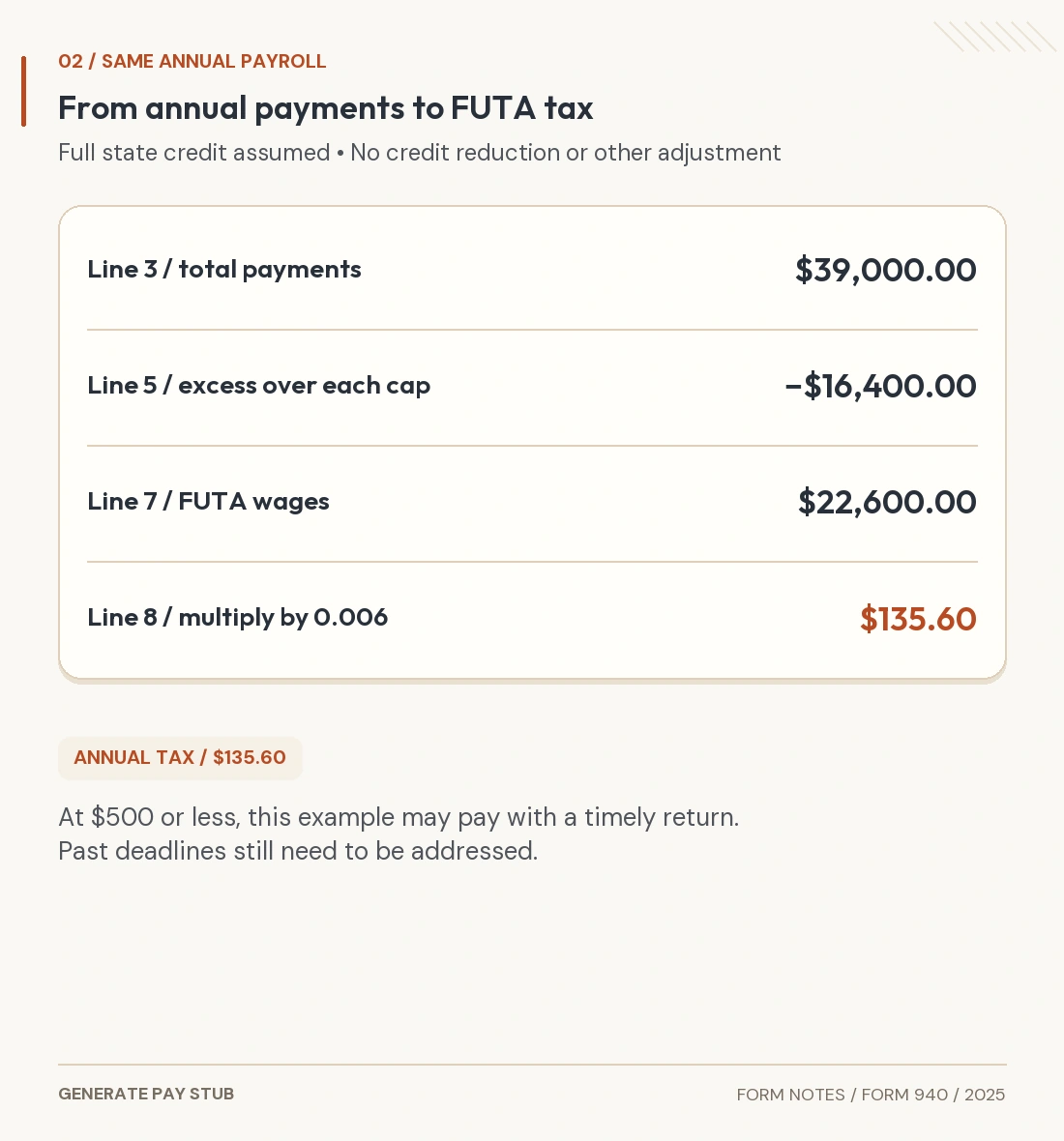
The covered total is $7,000 + $7,000 + $6,100 + $2,500 = $22,600. Neither $39,000 × 0.6% nor four employees × $7,000 gives the correct result for this payroll.

How do these annual totals flow through Form 940?
Reconcile the wage subtotal before calculating the tax. The 2025 IRS original separates payments, exemptions, amounts above the employee caps, taxable wages and later adjustments.
| Entry | Checked amount | Reason |
|---|---|---|
| Line 3: total payments | $39,000.00 | All four employees’ annual payments. |
| Line 4: exempt payments | $0.00 | None assumed; leave nonapplicable lines blank as instructed. |
| Line 5: amounts above individual caps | $16,400.00 | $11,000 plus $5,400. |
| Line 6: exemptions plus excess | $16,400.00 | No exempt amount to add. |
| Line 7: taxable FUTA wages | $22,600.00 | $39,000 less $16,400. |
| Line 8: tax before adjustments | $135.60 | $22,600 multiplied by 0.006. |
| Line 12: tax after adjustments | $135.60 | No Line 9, 10 or 11 adjustment assumed. |
The table displays a zero exemption for explanation; follow the original's direction to leave nonapplicable lines blank. With no federal deposits or prior applied overpayment in this example, Line 14 is also $135.60.
If exempt benefits exist, first determine their correct treatment. Do not deduct the same exempt payment again as an amount above the cap. A state wage base can differ from the federal base, so state taxable wages should not simply be pasted into Line 7.

When does the usual 0.6% FUTA calculation change?
The 0.6% result depends on the state-credit rules. FUTA's gross rate is 6%; the ordinary maximum state credit is 5.4 percentage points. State coverage, payment timing and credit reduction can change the final tax.
The final 2025 Schedule A lists a 1.2% California credit reduction and a 4.5% U.S. Virgin Islands reduction. Those are 2025 figures, not a forecast of the final 2026 list.
For qualifying FUTA wages also covered by state unemployment in a credit-reduction jurisdiction, calculate the applicable Schedule A amount and carry it to Line 11. Multi-state employers also need Schedule A even when every relevant reduction rate is zero. The IRS credit-reduction explanation describes this additional tax.
Line 9 addresses the all-wages-excluded situation. Line 10 uses the official worksheet for partial exclusions or late state payments. A state-assigned 0% experience rate is not automatically the same as wages being excluded from state unemployment tax. These distinctions need the complete 2025 Form 940 instructions.
Does an annual Form 940 mean you can wait until year-end to pay?
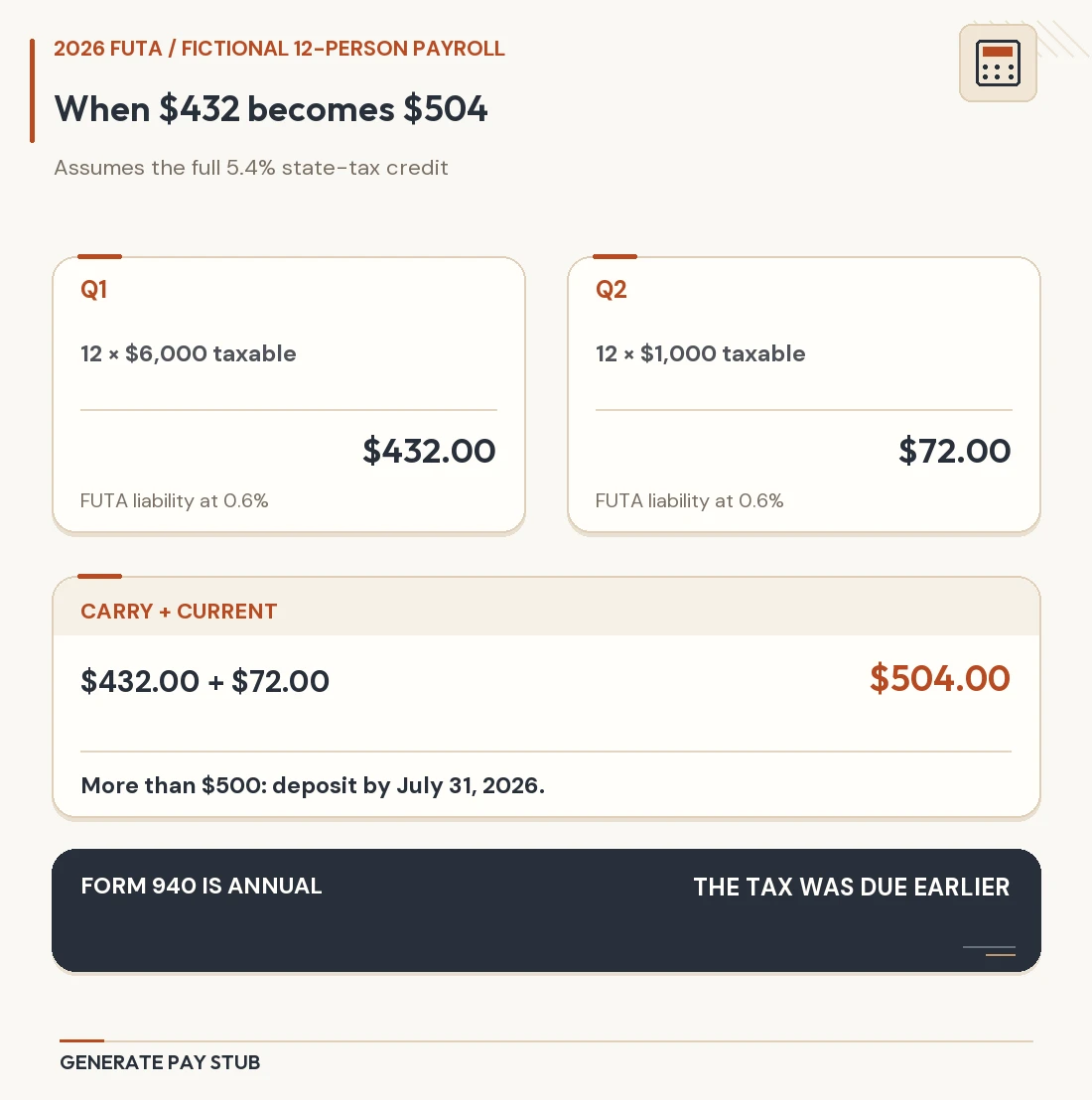
No. Review FUTA liability during the year. Generally, carry an undeposited amount of $500 or less forward; when the cumulative amount exceeds $500, a deposit is required under the quarterly timing rules. The fourth-quarter rules address the remaining amount.
Our entire annual example is only $135.60. With the stated assumptions, it can be paid with a timely return rather than requiring quarterly deposits. That does not excuse late payment now or waive an earlier required deposit in another case.
When Line 12 exceeds $500, Part 5 reports quarterly liabilities, not deposit amounts. Its total must reconcile with Line 12. Keep the liability workpaper and deposit confirmations distinct, even when their annual totals happen to match.
A small remaining balance on Line 14 does not prove every earlier deposit was timely. Form 940-V accompanies an eligible check or money-order payment; it cannot replace a required federal deposit.
Which 2025 deadlines and correction rules matter?
The ordinary 2025 return deadline was February 2, 2026. The instructions allowed February 10, 2026 filing for employers that deposited all FUTA tax when due. Both dates are past as of this article's November 5 review.
If a 2025 return or payment is outstanding, address it promptly using current filing and payment instructions. Do not label a newly prepared PDF “filed” or assume a new document date changes the original obligation.
For an error on a filed Form 940, use an amended Form 940 and the required explanation under its instructions. There is no Form 940-X. A current-year return should not quietly absorb an older annual error.
For the separate current-year payroll-record perspective, see our 2026 FUTA recordkeeping article. Its year-specific discussion is separate from this supported 2025 return walkthrough.
How do you prepare and review the complete packet?
Use the selected edition, then compare the preview against the annual workpapers. The Form 940 overview leads to the 2025 Form 940 builder. Its packet contains the two return pages and the voucher page.
Check the EIN and legal name, return-type boxes, state information, exemption categories, employee-cap workpaper, tax adjustments, deposits and balance or overpayment selection. Complete signatures and any applicable paid-preparer information.
Required Schedule A and aggregate-filer Schedule R are separate attachments; the builder does not generate them. Review designee authorization and any refund banking details carefully. Keep source records and the complete signed packet securely.
Document preparation, IRS submission and tax payment are separate actions. The tool does not verify payroll records, file the return or pay the tax. Retain the eventual IRS filing evidence and payment confirmations alongside your prepared document.
General U.S. federal tax information for the final 2025 form. Examples are fictional and exclude special employers, exempt payments, successor rules, credit reductions and late-payment adjustments unless expressly discussed.