Use Form W-7 to apply for or renew an IRS individual taxpayer identification number when you have a federal tax purpose and are not eligible for a Social Security number. The application usually travels with a federal tax return and accepted identity documents, unless a documented exception applies.
The official W-7 PDF is free, and the IRS does not charge to issue an ITIN. Optional commercial preparation is separate. This guide explains the current December 2024 form and the practical checks needed before a 2026 submission.
Who needs an ITIN, and what does it allow?
Eligibility starts with a federal tax need and SSN ineligibility. The IRS ITIN overview explains that an ITIN is a tax-processing number. It does not authorize employment, change immigration status, provide Social Security benefits or qualify someone for earned income tax credit.
A genuine tax-return filing obligation, refund claim or other recognized federal tax purpose can support an application. Do not apply simply to obtain a general identification document. If an SSN is available or an SSN application is pending, follow the applicable SSN process first.
Tax residency and immigration status are separate determinations. The substantial-presence rules include special day-counting rules; selecting a W-7 category should follow the actual tax-residency analysis.
How do you choose a new application, renewal and reason?
Make both selections: application type and reason. A renewal still needs the applicable reason. The W-7 instructions describe categories for nonresident filers, resident filers, treaty claims, spouses, dependents, students and other qualifying situations.
Treaty and exception cases can require Box h in addition to another reason, the precise exception designation, treaty country and article, and supporting third-party evidence. “Other” is not a way to bypass a required return.
Spouse and dependent applications need a supported filing position or allowable tax benefit. Merely being related to a taxpayer does not establish that an ITIN must be issued. Review the benefit's own current-year rules before attaching an application.
Which W-7 details should match the supporting records?
Compare each entry with the relevant source, rather than reusing one address or name everywhere. The current one-page official form separates these information groups:
| Area | What to reconcile |
|---|---|
| Lines 1a and 1b | Legal name and different birth name against identity records |
| Line 2 | Mailing address where IRS correspondence and returned documents can reach you |
| Line 3 | Required foreign residential information; specific rules apply if no foreign residence remains |
| Lines 4–5 | Birth details and the form’s applicable personal-information entry |
| Lines 6a–6c | Citizenship, foreign tax number and applicable visa details |
| Line 6d | Submitted identity document, issuer, number, expiry and applicable U.S. entry date |
| Lines 6e–6f | Prior ITIN or IRSN and the name under which it was issued |
| Line 6g | Institution or company and length of stay when required |
| Signature areas | Applicant or authorized delegate; acceptance-agent area only for the authorized agent |
For example, the applicant's mailing location can differ from a foreign residence. A document number and a foreign tax number also serve different purposes. Compare spellings, dates and previous-name records before producing the final application.
What belongs in an ITIN application packet?
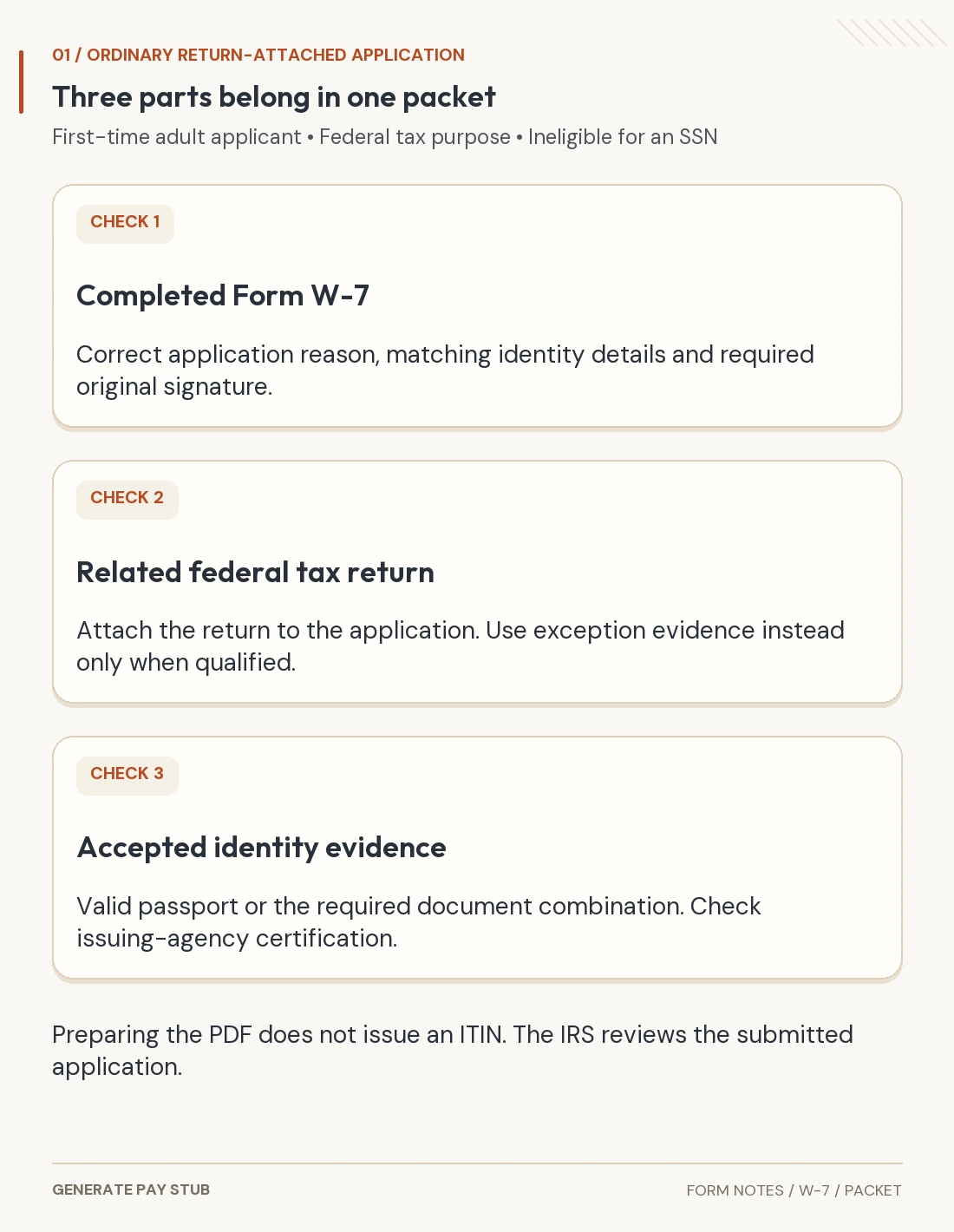
Ordinarily, include W-7, the associated return and accepted supporting evidence. The current IRS application steps say to attach applications to the return rather than filing that return separately. Each family member applying needs their own W-7. Leave the return's SSN area blank for each ITIN applicant as instructed.
For an exception case, substitute the particular evidence the exception requires. A bank letter, treaty explanation or other document is useful only when it meets that specific category's conditions.

Are a passport photocopy or notarized copy enough?
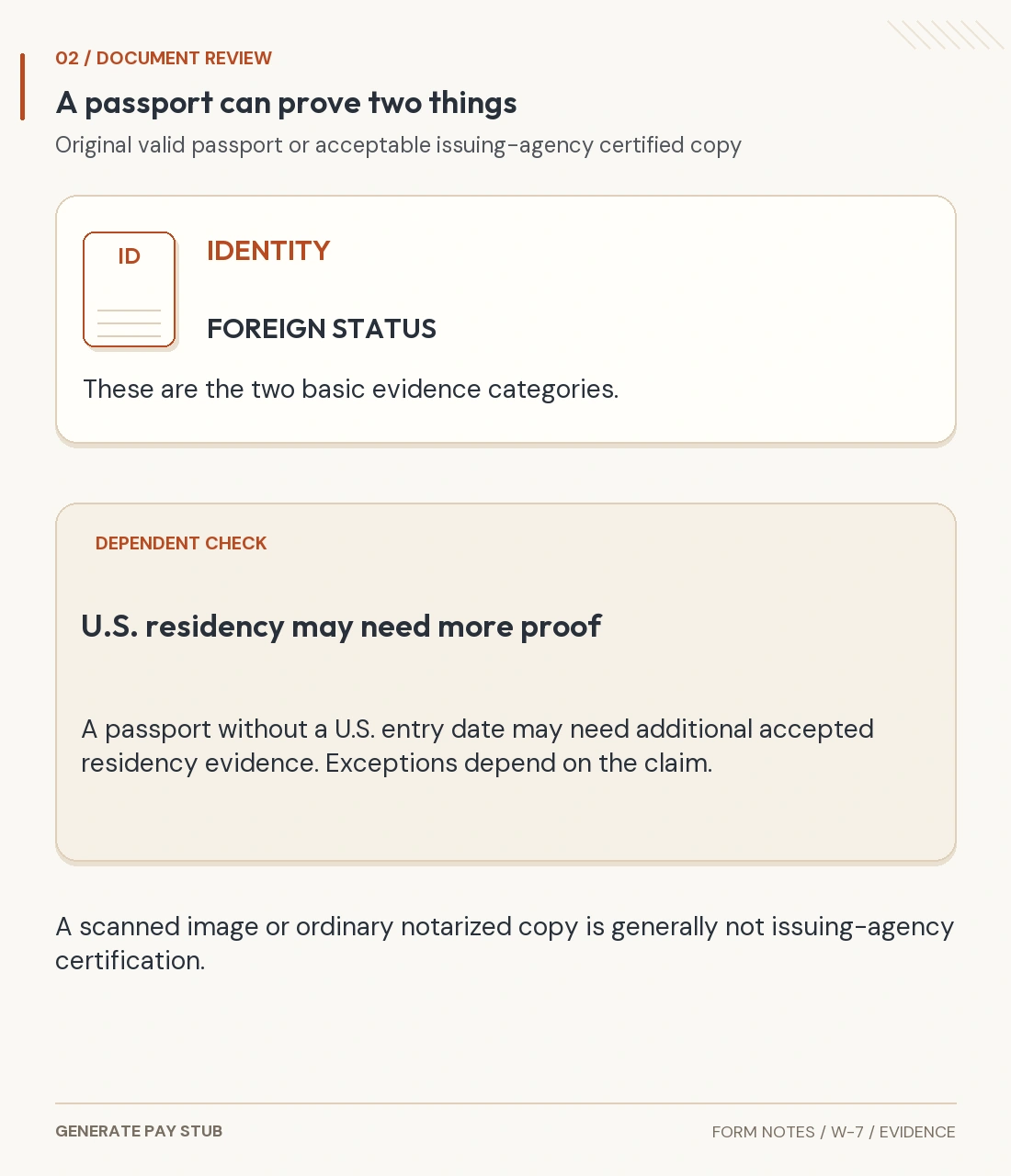
Usually not. The IRS supporting-document rules generally require current originals or copies certified by the issuing agency. Ordinary photocopies, phone scans and routine notarization are different from that certification.
A valid passport generally establishes both identity and foreign status. Without one, use the accepted combination of documents; applicable photograph and age rules matter. Dependent applications may need additional U.S. residency evidence, particularly where a passport lacks an entry date.
Special requirements apply to children, medical or school records, and certain overseas military-family cases. Check the current category instead of assuming one adult applicant's evidence list works for every family member.

What does a careful first-time applicant review look like?
Assume a fictional adult has a valid federal filing purpose, is a nonresident for tax purposes and is ineligible for an SSN. Their return preparer has determined that Form 1040-NR is the correct return. They are not making a treaty claim or using a return-attachment exception.
- Choose a new ITIN application and the nonresident-filing reason supported by those facts.
- Match the applicant name, citizenship and birth details to a current passport. Complete foreign-address information under the nonresident-category instructions.
- Review the return and W-7 together, keeping the applicant's SSN area blank on the return as directed.
- Select an accepted document-authentication or submission route. Print and provide the required original signature.
- Keep a secure copy of the completed packet and delivery evidence, then monitor IRS correspondence.
This example does not determine anyone's residency, treaty entitlement or refund. Its purpose is to show the order of checks before sensitive documents are sent.
When does an ITIN expire, and can you extend without one?
Check prior federal returns before deciding to renew. The current renewal guidance says an ITIN expires after three consecutive tax years of nonuse on a federal tax return. For example, no use for 2023, 2024 or 2025 means expiration on December 31, 2025.
An expired ITIN generally needs renewal when it will appear on a federal income tax return. Use solely on information returns such as Form 1099 does not by itself require renewal. Include the known prior number and prior name in the renewal review; do not treat renewal as a request for an unrelated second identifier.
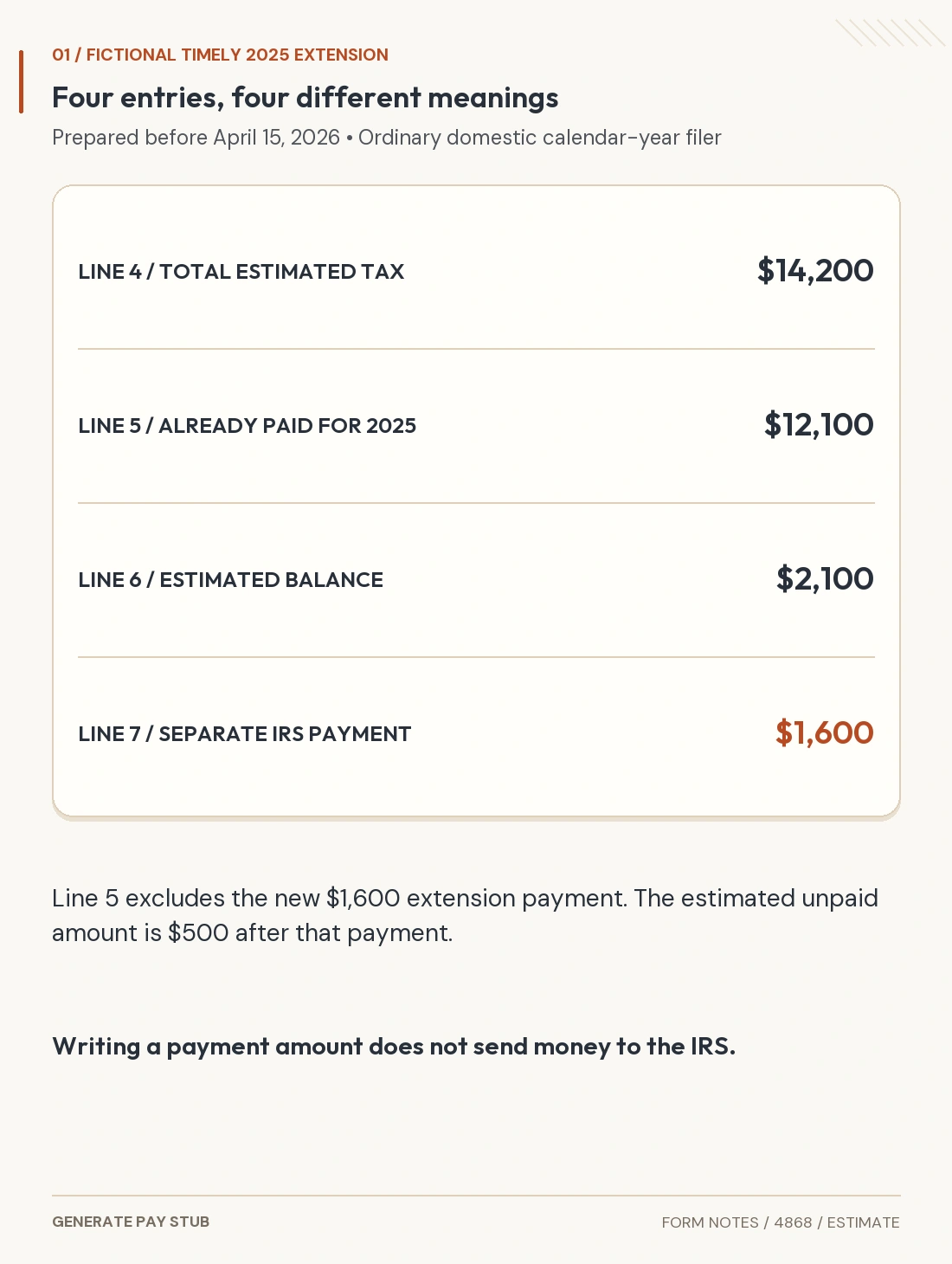
An ITIN is not required to request a filing extension or make estimated payments. IRS guidance describes writing “ITIN TO BE REQUESTED” in the relevant identifier area on the applicable mailed form. Do not attach W-7 to Form 4868 or an estimated-payment voucher. An extension does not postpone payment.
Where do you submit W-7, and how do you follow up?
Choose the IRS route appropriate for the packet and authentication needs. USPS applications use the ITIN Operation address in Austin; private delivery has a different street address. Use the current IRS application page for the exact destination rather than the normal Form 1040 mailing address.
Designated IRS assistance centers and selected VITA sites offer free ITIN services. IRS-authorized acceptance agents and certifying acceptance agents provide different authentication services; fees and appointment availability vary. Ask which documents they can authenticate before attending.
The IRS states a typical notification period of seven weeks, or nine to eleven during January 15–April 30 or for overseas applications. These are estimates, not approval guarantees. Follow requests for further information and contact the IRS if the stated period passes. Separately track any originals mailed for return.
How can the W-7 builder help with preparation?
It organizes entries for review; the applicant still completes the submission process. The W-7 tool overview explains the document, and the application workspace follows the December 2024 revision.
The reviewed tool separates SSN eligibility, reason, applicant identity, addresses, prior identifiers and document details. Its original one-page PDF leaves signature and date lines blank for printing and signing. Supporting attachments, document authentication, IRS submission and ITIN issuance remain separate. Use only information you are authorized to enter, and protect the finished application and any private order link.
General U.S. federal information reviewed November 6, 2026. Uses the December 2024 W-7 revision. The adult example assumes eligibility and a separately established nonresident filing position; no personal identifiers are illustrated.