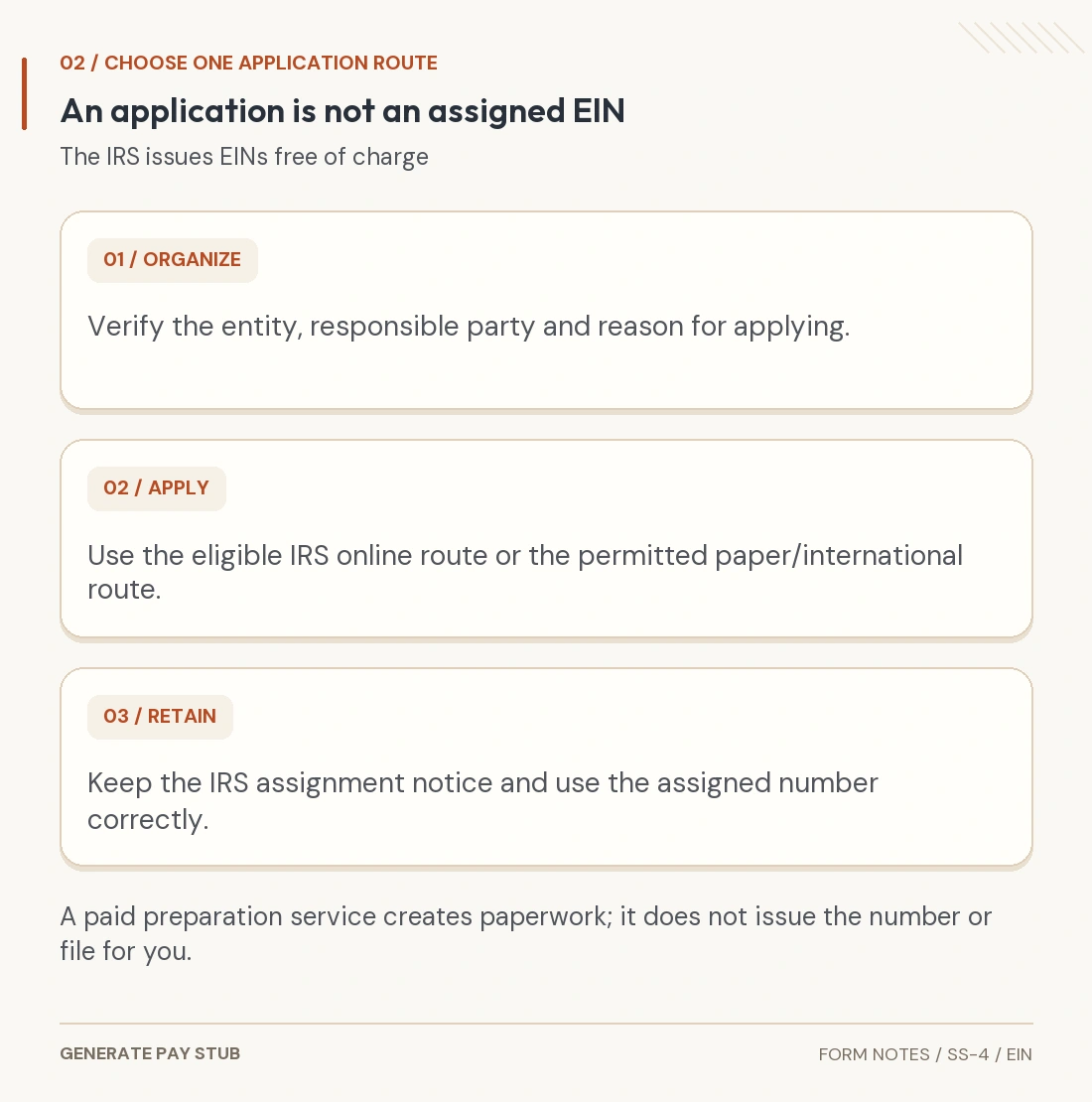
Form SS-4 is an application for an Employer Identification Number, not proof that the IRS has assigned one. Prepare it using the legal applicant, responsible party, correct federal entity classification, reason for applying and applicable payroll information.
The IRS issues EINs free of charge. Eligible applicants can use the official IRS online EIN service. A paid document-preparation tool is optional; its charge is for preparing paperwork, not an IRS fee or a guarantee of issuance.
Reviewed November 5, 2026. This guide follows the current December 2025 SS-4 revision, a continuing application form rather than an annual income-tax return. The fictional example concerns an already formed domestic two-member LLC accepting partnership treatment.
Do you need to apply for an EIN or recover an existing number?
Check the entity's existing records before starting another application. The IRS EIN overview explains who needs a number and how to obtain confirmation of one already assigned.
An employer EIN is a federal tax identifier. It does not replace an individual's SSN or ITIN, create a state-law entity or establish every license a business may need. If creating an LLC or corporation, form the entity through the appropriate state process before applying.
A name or address change generally does not require a new EIN. Ownership and structural changes need the entity-specific rules on the IRS new-EIN guidance. Do not assume either that every change requires a new number or that the old number is always transferable.
If the EIN is lost, seek confirmation through the available IRS process instead of submitting another application merely to obtain a replacement record. Keep the assigned number and IRS notice securely with formation and tax records.
Which EIN application route can you use?
Use one permitted route for the entity, avoiding duplicate applications. Current online-service eligibility includes domestic formation, a principal business location in the U.S. or its territories, and the required responsible-party identification and authorization.
If the online eligibility rules are not met, consult the current SS-4 instructions for fax, mail or the international-applicant telephone route. The online identity requirements should not be assumed identical to every paper-application situation.
The IRS limits EIN issuance to one per responsible party per day, with specified trust and estate treatment. Repeated submissions through different channels can create confusion rather than accelerate a decision.
An online approval may issue the number immediately. That does not promise the same timing for a mailed application, an incomplete submission or a case requiring review. Check current instructions rather than relying on an old address, fax number or third-party processing estimate.
Which names and addresses belong on the application?
Distinguish the legal applicant from its trading name and the person submitting the document. Line 1 identifies the applicant entity or individual under its specific instructions. Line 2 is for a different trade name; a nickname should not displace the legal applicant.
The December 2025 SS-4 original separately provides mailing address, a different physical address, principal business location and responsible-party fields. A physical street-address field is not a second place to put a P.O. box.
Compare spellings with the formation record and existing official documents. Resolve inconsistencies before submitting. An application for an estate, trust, individual or corporation needs the relevant identity instructions, not a copied LLC example.
Who should be named as the responsible party?
Identify the qualifying person with ultimate ownership or effective control. The IRS responsible-party guidance distinguishes that role from a temporary nominee helping establish the entity.
Except for government-entity situations, the responsible party is an individual, not another company. Do not list a formation service simply because it mailed the state paperwork. The preparer, authorized designee and responsible party can be different roles.
Line 7b generally requires the person's SSN or ITIN, with the government-entity exception. The instructions permit “foreign” or “N/A” when the person does not have and is ineligible to obtain an SSN or ITIN. That condition matters; it is not a general workaround for withholding required information.
Transmit the completed application through an authorized private channel. Do not publish identification numbers in example screenshots or email the full packet to an unintended recipient. Our pay-stub EIN guide explains the separate employer-identifier context.
How should an LLC complete the entity-classification fields?
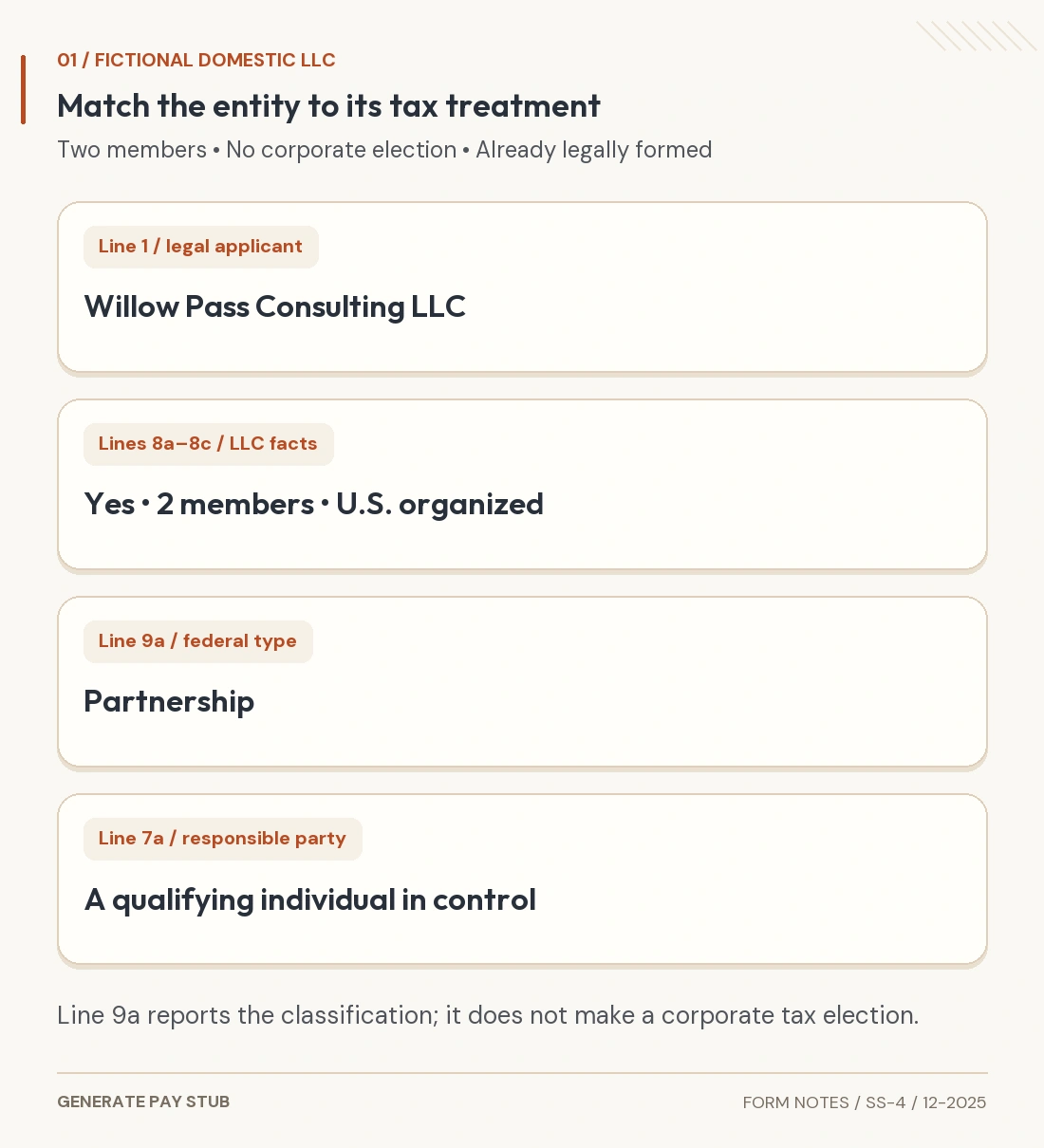
Report both the LLC facts and the applicable federal classification. State-law LLC status does not create a universal “LLC” tax return category. Lines 8a–8c ask about the LLC, member count and U.S. organization; Line 9a follows the federal classification instructions.
A domestic LLC with two or more members generally defaults to partnership treatment. A domestic single-member LLC generally defaults to disregarded treatment, subject to the relevant rules. A corporate election or a foreign entity can change the analysis.
For a domestic two-member LLC accepting the partnership default, the instructions direct the Partnership box on Line 9a. Merely checking an SS-4 classification box does not make a corporate or S-corporation tax election; applicable election forms and requirements remain separate.

What does a fictional two-member LLC field review look like?
Use a consistent set of facts throughout the application. Assume Willow Pass Consulting LLC was legally formed before applying, has two individual members, accepts partnership treatment, uses a calendar year and has never received an EIN.
It expects no employees during the next 12 months, is not a withholding agent and has no planned annuity payments. Its work is management consulting. The responsible party is a qualifying individual with actual control; no identifying number is reproduced here.
| Field | Example treatment | Record to compare |
|---|---|---|
| Line 1 | Willow Pass Consulting LLC | Legal formation document. |
| Lines 8a–8c | LLC: Yes; members: 2; organized in U.S.: Yes | Formation and ownership records. |
| Line 9a | Partnership | Assumed default treatment, no corporate election. |
| Line 10 | Started new business; specify consulting | Actual reason the new entity needs an EIN. |
| Line 12 | December | Assumed valid calendar tax year. |
| Line 13 | Zero in each employee category | Next-12-month hiring expectations. |
| Line 14 | Skip when no employees are expected | Original’s conditional instruction. |
| Line 15 | N/A under the no-planned-employees assumption | No wage, annuity or withholding-agent payment date to report. |
| Line 18 | No | No previous EIN assigned to this entity. |
The example is a consistency review, not a complete signed application. Addresses, responsible-party details, activity fields and other required entries still need accurate authorized information.
What goes in the employee and payroll fields?
Report expected employees by category and use the payroll questions conditionally. Line 13 asks for the highest expected number during the next 12 months, including zeros where appropriate. It is not a request for the number of LLC owners.
When no employees are expected, skip Line 14. When employees are expected, its Form 944 choice has the printed employment-tax conditions and continuing filing implications. See our Form 944 guide before treating annual filing as an automatic option.
Line 15 has specific wage, annuity and withholding-agent instructions. The business start date, entity formation date and first wage date answer different questions, even when two happen to coincide.
What happens after the application is prepared?
Review, authorize and submit through the appropriate IRS process. If you choose an optional prepared PDF, the SS-4 details page leads to the current SS-4 builder. It prepares the application; it does not submit it or assign the number.
Review both original pages. Page 2 provides the IRS “Do I Need an EIN?” guidance; it is not the complete separate SS-4 instruction publication. Complete the required applicant signature and any authorized designee information.
Leave a new application's assigned-EIN area empty until an IRS-assigned number exists. Do not invent an EIN to make a preview look complete. The prior-EIN question is separate and must be answered from the entity's actual history.

After assignment, use the number for its proper business-tax purpose and keep the notice. Changes to responsible-party information have reporting requirements; a fresh SS-4 is not a substitute for the appropriate update.
General U.S. federal EIN information, current revision reviewed November 5, 2026. The LLC example is fictional. Entity elections, foreign ownership, trusts, estates and special employers require their own instructions.