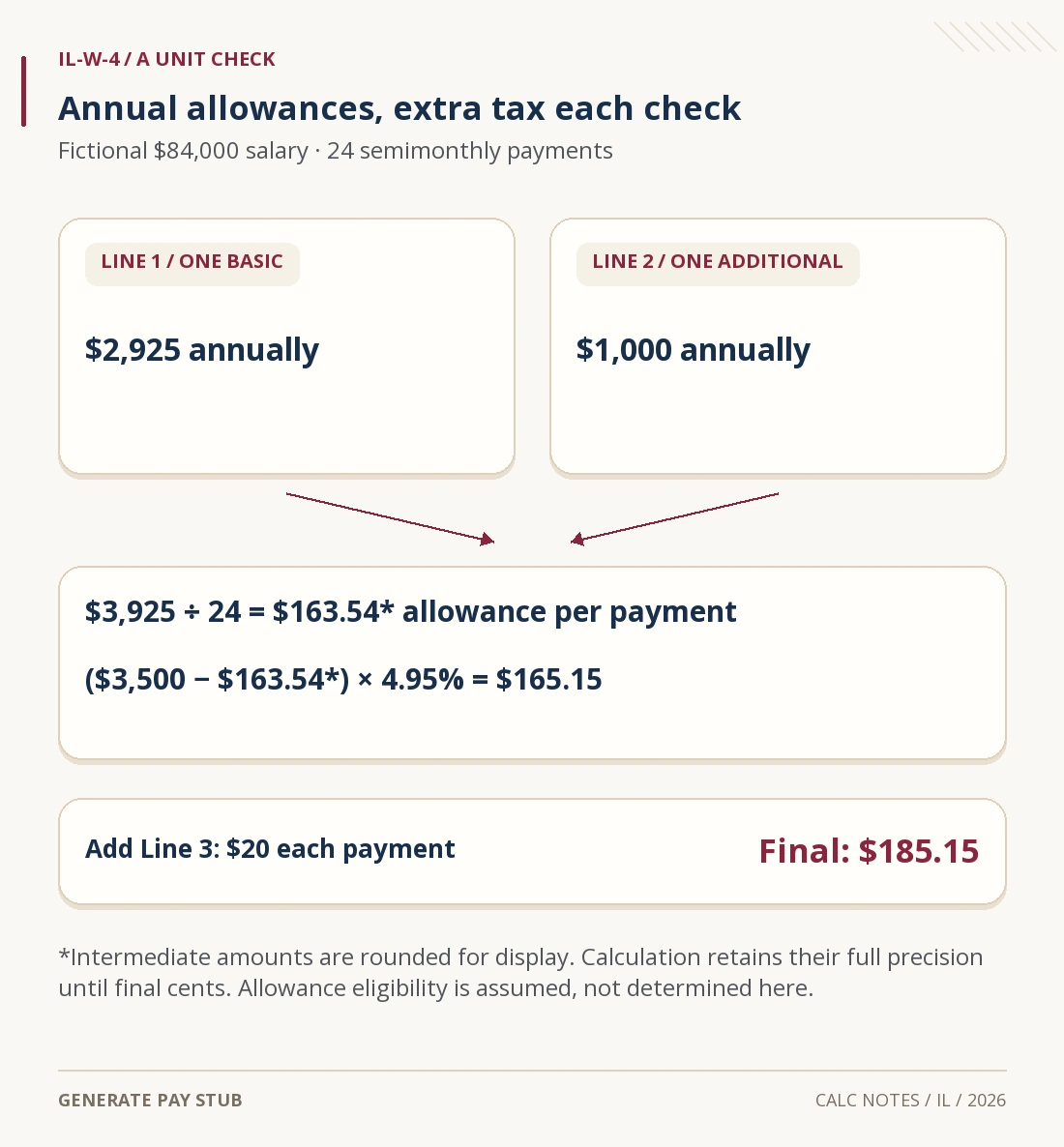
The Illinois paycheck calculator uses separate values for basic allowances, additional allowances and extra withholding per payment. In 2026, a basic IL-W-4 allowance represents $2,925 annually and an additional allowance represents $1,000 annually in the formula. Extra withholding is already a dollar amount for each payment, so it is added after the allowance-based calculation.
This walkthrough checks a fictional $84,000 Illinois salary paid semimonthly. It assumes the employee is entitled to the selected allowances, then tests how the calculator translates those annual values into a $185.15 state deduction per payment.
Set the year, annual wages and IL-W-4 inputs
Open the free Illinois paycheck calculator, select 2026 and enter $84,000 annual gross wages. Choose Semimonthly, which models 24 payments of $3,500. This differs from biweekly pay, which uses 26 periods.
For federal withholding, choose Single and leave multiple jobs, annual credits, other income, deduction adjustments and additional withholding at their zero/default settings. In the Illinois section, enter one basic allowance, one additional allowance and $20 extra state withholding. Set known annual local and other cash deductions to zero.
Assume ordinary employment with one employer throughout the year, Illinois as both residence and work state, and no pre-tax benefits or other adjustments. The wage bases used in the projection equal gross wages. These are controlled calculation assumptions, not recommended elections.
The state controls correspond to lines 1, 2 and 3 of Form IL-W-4: basic allowances, additional allowances and extra withholding from each pay. Enter the allowance counts in the first two fields; do not type $2,925 or $1,000 as the counts.
A checked $3,500 semimonthly payment
With the selections above, the live calculator returns the following amounts. The annual projection adds the 24 modeled payment amounts.
| Pay component | Each payment | Annual projection |
|---|---|---|
| Gross wages | $3,500.00 | $84,000.00 |
| Federal income tax withholding | $402.08 | $9,649.92 |
| Illinois income tax withholding | $185.15 | $4,443.60 |
| Employee Social Security | $217.00 | $5,208.00 |
| Employee Medicare | $50.75 | $1,218.00 |
| Estimated take-home pay | $2,645.02 | $63,480.48 |
The payment arithmetic is $3,500 − $402.08 − $185.15 − $217 − $50.75 = $2,645.02. That net amount multiplied by 24 gives $63,480.48. This is estimated cash after the deductions included in the scenario, rather than a final tax-return calculation.
Only the Illinois controls are being examined here. Changing a federal W-4 election would require a separate comparison; the federal calculator walkthrough shows how to isolate those changes.
Follow the annual allowances into one payment
The official 2026 IL-700-T guide gives a 4.95% withholding rate and a formula using $2,925 for each line 1 allowance and $1,000 for each line 2 allowance. The published table method is another permitted way to find withholding.
In this example, the annual allowance value is (1 × $2,925) + (1 × $1,000) = $3,925. Divide by 24 payments to obtain $163.541666… of allowance value per payment. Subtract that unrounded amount from $3,500, leaving $3,336.458333… for the formula.
Multiply by 4.95% to obtain $165.1546875. Add the requested $20 extra state withholding and round the final result to cents: $185.15. The calculation retains full intermediate precision; rounded intermediate labels in the illustration are for reading convenience.

The state’s current year-specific 2026 withholding booklet preserves the applicable year’s table values. Do not treat a later year’s exemption amount as interchangeable when rechecking 2026 wages.
The $3,925 is not $3,925 of tax saved and is not removed from the employee’s cash pay. It is an allowance value used to reduce the withholding formula’s wage amount.
Compare three runs without changing the federal elections
Keep wages and frequency fixed and change only the Illinois fields. These three runs were checked against the live calculator:
| State elections | Illinois withholding | Estimated take-home |
|---|---|---|
| One basic allowance; zero additional; no extra | $167.22 | $2,662.95 |
| One basic and one additional allowance; no extra | $165.15 | $2,665.02 |
| One basic and one additional allowance; $20 extra | $185.15 | $2,645.02 |
The additional allowance changes the rounded payment deduction by $2.07 in these runs. Its unrounded theoretical effect is $1,000 × 4.95% ÷ 24 = $2.0625; subtracting two already-rounded results can produce a slightly different cent figure. The $20 extra entry then increases withholding by exactly $20 per payment, or $480 over all 24 modeled payments.
Do not enter $480 in the extra field to request $480 over a year. On this schedule, that would request $480 per payment, or $11,520 across the year. Use the amount you want withheld from each payment, as the certificate instructs.
Check allowance entitlement before changing the actual certificate
Form IL-W-4 includes a worksheet for the allowances a person may claim. Additional allowances can arise from age, blindness or the worksheet’s deduction/subtraction calculation; they are not simply a second copy of every basic allowance. The sample assumes one permitted additional allowance without determining a reader’s eligibility.
The certificate also addresses multiple jobs and a working spouse. Review its allocation instructions rather than claiming the same full set of allowances automatically at each employer. A smaller withholding result in the tool does not establish that a larger claim is correct.
The Illinois personal-exemption FAQ explains that return exemption allowances are unavailable above the stated federal AGI limits: $500,000 for joint returns and $250,000 for other filing statuses. The calculator does not collect a complete household AGI profile or determine the final exemption claim. For a high-income or otherwise unusual case, reconcile the certificate choices with the applicable instructions.
Use the employer’s process to submit a completed certificate. Trying a different allowance count on this website does not update payroll or authorize an allowance you cannot claim.
Recognize what the Illinois projection does and does not cover
The tool assumes one employer, a complete year of ordinary Illinois wages and the selected standard schedule. It applies the chosen year’s rule set to the projection and does not rebuild earlier payments under different revisions or elections.
It does not model distinct pre-tax benefit wage bases, special payment methods, every exemption or a part-year employment history. The known annual cash-deduction fields do not supply those tax treatments. Compare actual federal, Social Security, Medicare and Illinois wage figures before diagnosing a statement difference.
The reviewed Illinois result lists no additional supported statewide employee contribution. That does not mean insurance, retirement, garnishments or other deductions cannot appear in actual payroll. Include known cash amounts only after their treatment and payment frequency have been established.
Residency and cross-state work need separate attention. Illinois Publication 130 discusses reciprocity with Iowa, Kentucky, Michigan and Wisconsin and the related nonresidence certificate. A state calculator selection does not determine residency, exemption eligibility or the correct cross-border withholding.
Publication 130 also explains that federal withholding exemption does not automatically eliminate Illinois withholding. Treat the federal and state controls as separate systems and use our net-pay checking guide to investigate a real discrepancy line by line.
Illinois paycheck calculator questions
Is an additional allowance the same as additional withholding?
No. An allowance reduces the formula’s wage amount. Additional withholding adds dollars to the amount withheld from each payment.
Does semimonthly mean every two weeks?
No. The calculator uses 24 semimonthly payments and 26 biweekly payments. The distinction changes the conversion of annual wages and allowances to payment amounts.
Why might the payroll table result differ slightly from the formula?
Wage-bracket ranges and rounded table amounts can differ from a direct formula calculation. Compare permitted methods and the actual elections before assuming a cent difference is an error.
Where are the other state tools?
The free paycheck calculator directory links all state and DC tools. Review the assumptions for each jurisdiction rather than copying Illinois allowance values elsewhere.
Illinois 2026 withholding references, current certificate instructions and three live calculator runs checked November 6, 2026. All worked amounts use the fictional assumptions stated above.