The Kansas paycheck calculator separates personal/spouse allowances from dependent allowances because the two categories have different dollar values. Do not put the combined K-4 total into the personal/spouse field. Also match the K-4 withholding group, which can differ from the household’s federal status.
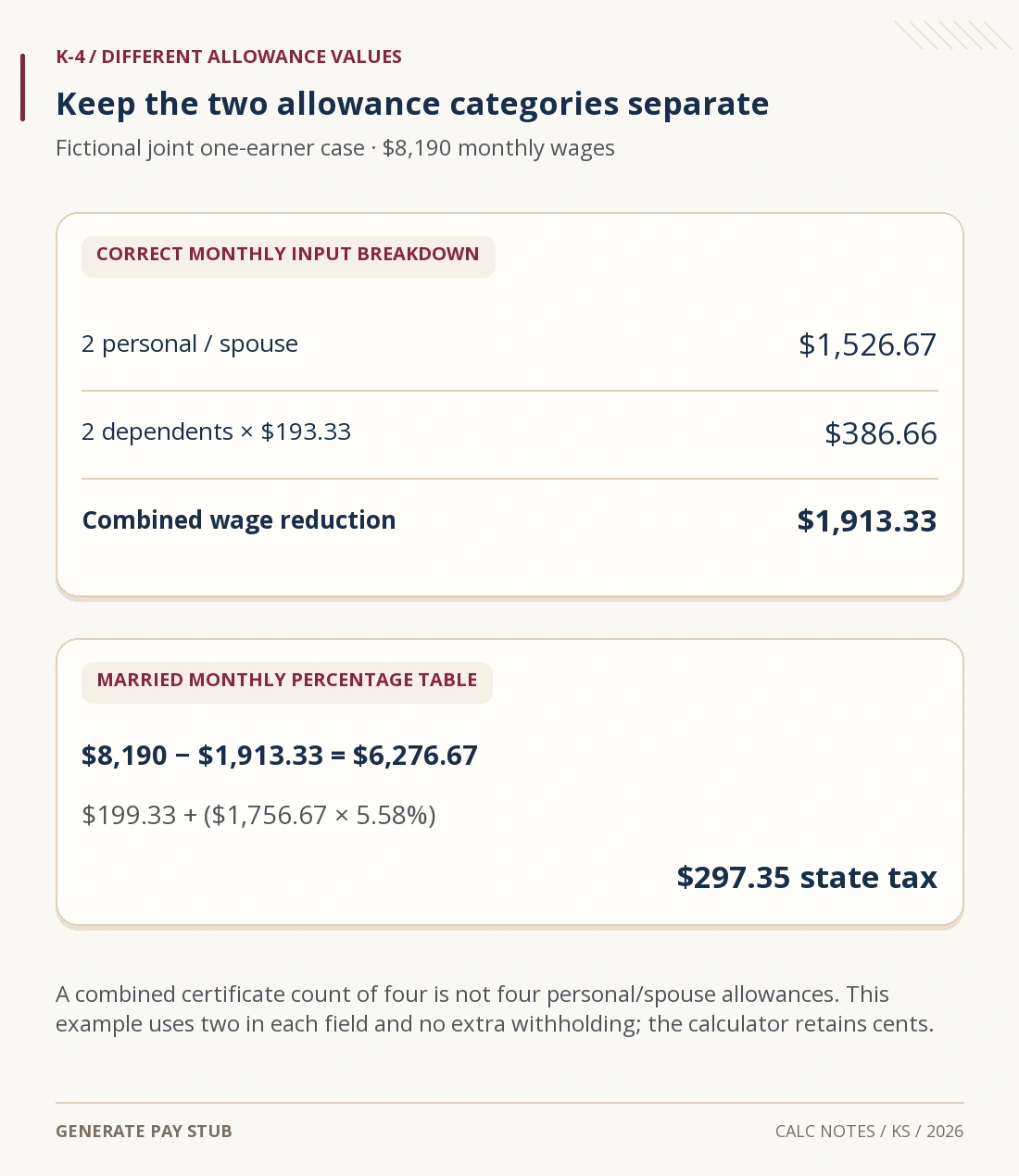
Our fictional joint one-earner example earns $98,280 annually and claims two personal/spouse allowances plus two dependent allowances. The checked result is $297.35 Kansas tax per monthly payment and $6,646.64 estimated cash after the modeled taxes.
Separate the worksheet categories before entering counts
The official K-4 worksheet distinguishes personal/spouse entries, the Head of Household entry and dependents before reporting a combined total. The Kansas paycheck calculator needs the relevant categories separately to value them correctly.
For the joint one-earner case below, the personal and spouse entries total two, and the dependent entry is two. Although those add to four, entering four as personal/spouse allowances would misstate the category. The reviewed field accepts only zero, one or two.
This article does not model a Head of Household claim. If that worksheet entry applies, reconcile its treatment with the actual certificate and current instructions rather than treating the combined count as interchangeable with personal allowances.
The calculator is an estimate using the supplied elections; it neither completes the worksheet nor establishes eligibility for an allowance or exemption.
Choose the K-4 withholding group using the spouse-income facts
The K-4 worksheet directs married employees with an income-earning spouse to the Single allowance rate and married employees whose spouse has no income to Joint. A married federal filing election does not automatically settle the Kansas withholding choice.
Our example assumes a nonworking spouse, one job and an appropriate Joint K-4 election. Federal filing status is separately set to Married Filing Jointly. These aligned choices fit this fictional household; they are not a shortcut for two-earner households.
Set the $8,190 monthly one-earner example
Select 2026, enter $98,280 annual salary and choose Monthly, creating twelve $8,190 payments. Keep the federal multiple-jobs control off and all federal W-4 dollar amounts zero for the comparison.
Use the Kansas Married/Joint group, two personal/spouse allowances, two dependent allowances and no extra state withholding. Supply no local-withholding cash amount or other deduction in this controlled test.
Assume ordinary full-year wages with one employer and Kansas residence and services. Gross wages equal every relevant federal, Social Security, Medicare and state wage base. The federal credits remain zero as an explicit test input even though the state scenario has dependent allowances.
The state’s current KW-100 page continues to publish the schedule for wages paid on and after July 1, 2024. A 2024 effective date on an applicable current guide does not by itself make the schedule unusable for 2026. Check the current publication rather than inventing a newly dated rate.
Apply the monthly allowance amounts before the percentage table
The KW-100 percentage method supplies a $1,526.67 monthly amount for two personal/spouse allowances and $193.33 for each dependent allowance. It uses different amounts for the categories.
For the fictional inputs, two dependents give 2 × $193.33 = $386.66. Total monthly wage reduction is $1,526.67 + $386.66 = $1,913.33. The amount entering the percentage table is $8,190 − $1,913.33 = $6,276.67.
The Married monthly bracket above $4,520 is $199.33 plus 5.58% of the excess. Apply it as $199.33 + (($6,276.67 − $4,520) × 5.58%) = $297.352186, rounded to $297.35.

The $6,276.67 is a withholding calculation base, not take-home pay. Federal withholding and FICA still need to be subtracted from gross when reconciling cash.
Use the published payment-frequency values consistently. Replacing them mid-calculation with differently rounded annual divisions can create cent differences.
Compare two dependent allowances with zero
A second live run changes only dependent allowances from two to zero. It keeps the personal/spouse count at two and retains every other test input. This isolates the effect of that field without choosing a different salary or household group.
| Measure compared | 2 dependent allowances | 0 dependent allowances |
|---|---|---|
| Kansas withholding/payment | $297.35 | $318.93 |
| Estimated cash/payment | $6,646.64 | $6,625.06 |
| Kansas withholding/year | $3,568.20 | $3,827.16 |
| Estimated cash/year | $79,759.68 | $79,500.72 |
The zero-dependent test withholds $21.58 more each month, or $258.96 across the twelve modeled payments. The change affects only Kansas withholding and cash; it does not reduce Social Security or Medicare wages.
A worker should not choose a count only to reach a desired net figure. Use actual certificate facts and review the household’s wider tax position before making a payroll election.
Reconcile the original annual cash result
| Modeled earnings or deduction | Annual amount |
|---|---|
| Gross salary | $98,280.00 |
| Federal income tax withholding | $7,433.64 |
| Kansas income tax withholding | $3,568.20 |
| Employee Social Security | $6,093.36 |
| Employee Medicare | $1,425.12 |
| Estimated remaining cash | $79,759.68 |
Per payment: $8,190 − $619.47 federal − $297.35 Kansas − $507.78 Social Security − $118.76 Medicare = $6,646.64. The year-long projection adds twelve rounded payments.
Insurance, retirement, support orders and other unentered cash deductions can lower the actual deposit. Review the net-pay line checklist when comparing an employer statement.
Understand optional rounding, wage-table results and scope limits
Kansas permits whole-dollar rounding under its percentage method. The reviewed calculator retains cents, so a payroll using permitted whole-dollar rounding or a wage-bracket table can differ from this $297.35 estimate without that difference alone proving an error.
Extra state withholding is a payment-level dollar entry. It adds to calculated withholding; it is not another dependent count or an annual wage reduction.
Known annual local and other inputs subtract supplied cash amounts. They do not calculate local liability or rebuild taxable wages for pre-tax benefits. Federal inputs remain separate; see the federal calculation guide.
Exemption claims, nonresident allocation, special wages, several jobs and a changed certificate need the relevant rules and records. This repeated full-year salary model is not a payroll correction, a signed K-4 or the employee’s final Kansas return.
Kansas paycheck calculator questions
Can I put the combined certificate total in personal/spouse allowances?
No. Separate the categories so each receives the correct dollar value.
Does every married employee use the Joint withholding rate?
No. The K-4 worksheet also considers whether the spouse has income.
Why does my employer show a whole-dollar state amount?
Kansas permits rounding under the percentage method. Confirm the payroll’s method before comparing exact cents.
Is the table base the amount deposited?
No. It is used to calculate state withholding; gross-to-net reconciliation still includes other deductions.
Kansas current withholding publications, K-4 categories and two live 2026 scenarios reviewed November 6, 2026. All household and salary assumptions are fictional.