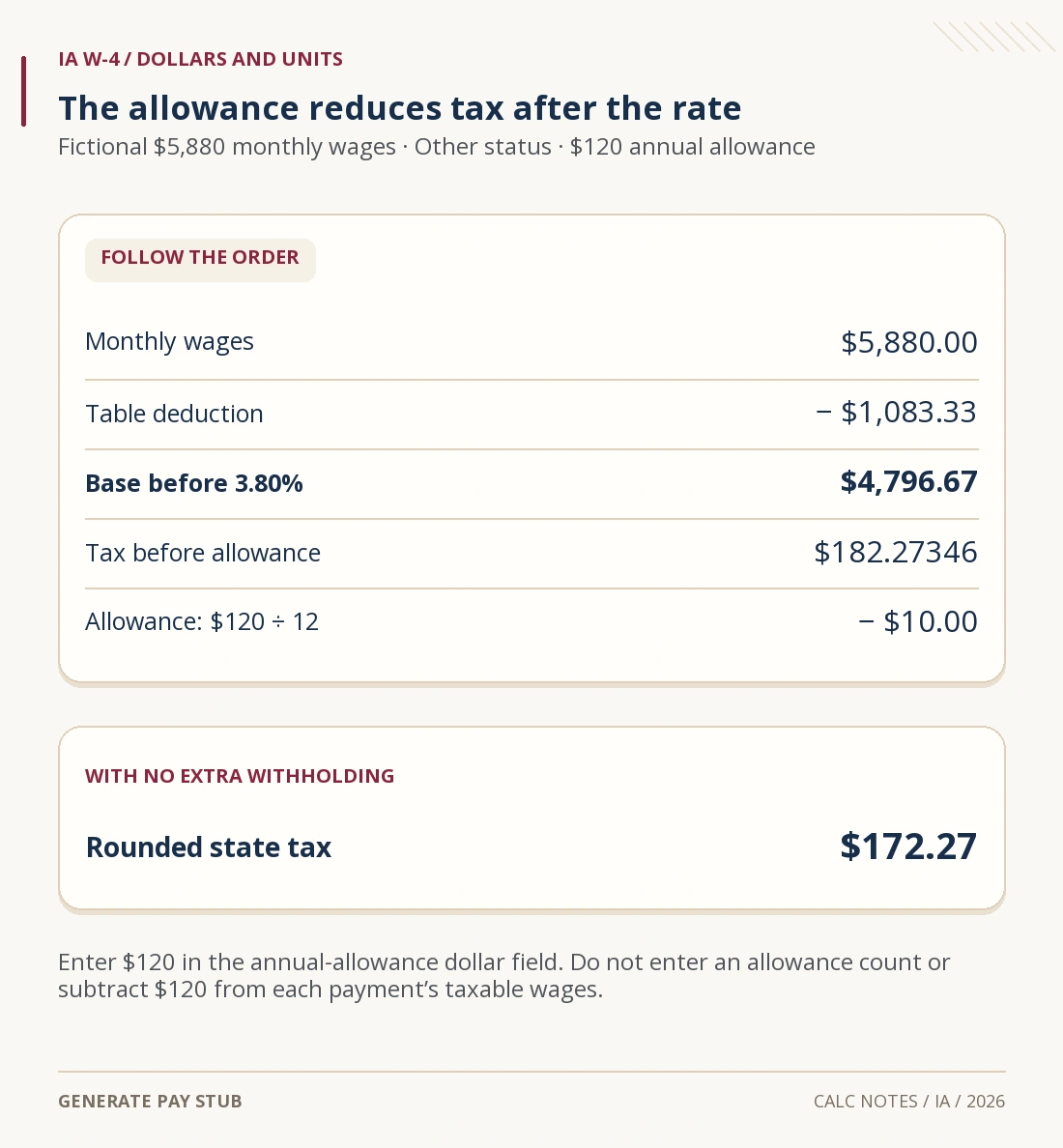
In the Iowa paycheck calculator, enter the IA W-4 total allowance as annual dollars, not as a count. The formula first subtracts the published payroll deduction from wages and applies 3.80%. It then subtracts the allowance’s payment-level share from tax and adds any extra withholding.
For a fictional $70,560 salary paid monthly, a supported $120 annual allowance produces $172.27 Iowa withholding per payment. This guide traces that result, compares a $40 allowance and tests $20 additional withholding without changing the salary.
Use annual dollars rather than an allowance count
The 2026 IA W-4 reports total allowances in dollars on line 7 and additional withholding per payment on line 8. Allowances can arise from different worksheet items, so a single number of dependents is not a substitute for the completed total.
The Iowa paycheck calculator labels its field “total annual allowance amount.” If a valid current certificate reports $120, enter 120. Do not enter 3 because you mentally associate the amount with three $40 items.
For certificates from 2023 or earlier, the 2026 employer formula converts the old allowance count into dollars by multiplying by $40. The revised certificate’s dollar total should not be multiplied by $40 again.
This distinction is about input units, not a recommendation to claim a specific amount. The calculator does not decide which worksheet allowances the household may claim.
Select the IA W-4 group that matches the household
The tool’s current choices are Other, Head of Household and the joint one-earner/surviving-spouse group. Other includes Single, separate filing and joint filing when the spouse has earned income.
A married employee should not automatically select the largest deduction. The spouse-income question affects which state group applies. Federal filing status and the federal multiple-jobs control remain separate inputs.
If using an older certificate, review the state’s legacy mapping as well as the allowance conversion. A current Head of Household choice cannot simply be inferred from an older certificate that offered different status choices.
Build the $5,880 monthly scenario
Choose 2026, supply $70,560 in annual wages and select Monthly. This creates twelve payments of $5,880. For federal withholding, use Single, no multiple-jobs selection and zero values in the federal W-4 dollar fields.
The Iowa setup is Other, $120 annual allowance and no extra withholding. We assume that total is supported by an appropriately completed IA W-4; the example does not establish the reader’s entitlement to it.
Assume continuous ordinary salary with one employer, Iowa residence and work, and no difference among gross and federal, FICA or state wages. Local withholding and other cash inputs have no supplied amount. Insurance, retirement and special earnings do not enter this controlled calculation.
Follow the four-step arithmetic in the correct order
The published monthly deduction for Other is $1,083.33. Use that state payroll-table figure rather than substituting a federal standard deduction or inventing an allowance count.
- Subtract the deduction: $5,880 − $1,083.33 = $4,796.67.
- Apply the rate: $4,796.67 × 3.80% = $182.27346.
- Convert the allowance to a payment amount: $120 ÷ 12 = $10. Subtract it from tax: $182.27346 − $10 = $172.27346.
- Add no extra dollars and round the final payment amount to $172.27.

If ordinary calculated withholding falls below zero, the calculation does not create a negative tax payment to the employee. Extra withholding is a separate addition. This sample remains positive throughout the formula.
Subtracting $120 from each payment’s wages would answer a different calculation. Subtracting $120 from each payment’s tax would also be wrong because the certificate amount is annual.
Compare a lower allowance and a separate extra-dollar election
We changed one input at a time in two additional live tests. The comparison holds the Iowa group, federal inputs, salary and payment count constant.
| State input scenario | State withholding | Estimated monthly cash |
|---|---|---|
| $120 annual allowance; no extra | $172.27 | $4,700.14 |
| $40 annual allowance; no extra | $178.94 | $4,693.47 |
| $120 annual allowance; $20 extra | $192.27 | $4,680.14 |
The $40 allowance gives only $3.333333… of allowance reduction per payment, compared with $10 under the $120 input. After rounding, state withholding is $6.67 higher monthly in that test. Twelve payment differences add to $80.04, rather than exactly the $80 difference between the annual allowance inputs.
The $20 extra test is simpler: it adds $20 to each payment’s tax line and lowers annual cash by $240. It does not change the allowance amount or the taxable wage base.
Choose actual certificate values based on the state instructions and household facts. A smaller withholding amount increases current cash but does not, by itself, establish a lower final Iowa tax bill.
Reconcile the initial annual take-home estimate
| Amount being reconciled | Annual figure |
|---|---|
| Gross salary entered | $70,560.00 |
| Federal withholding estimate | $6,693.24 |
| Iowa withholding estimate | $2,067.24 |
| Employee Social Security | $4,374.72 |
| Employee Medicare | $1,023.12 |
| Cash after modeled deductions | $56,401.68 |
Per payment, $5,880 − $557.77 federal − $172.27 Iowa − $364.56 Social Security − $85.26 Medicare = $4,700.14. Multiplying by twelve reproduces $56,401.68.
The formula’s $120 allowance does not appear as another cash deduction in this reconciliation; its effect is already included in the $172.27 state withholding. Subtracting it again would double-count it.
Check exclusions, wage bases and certificate changes
A known annual local or other cash input can supplement the budget, but it does not calculate a locality’s tax or create a pre-tax wage exclusion. Review the deduction treatment guide when employer benefit elections change taxable wages.
The annual model does not prepare an IA W-4 worksheet, implement an exemption claim or resolve military and nonresident exceptions. A final return can also include items absent from ordinary wage withholding. Do not infer that a blank local field accounts for every possible local or return-level amount.
Several jobs, a spouse’s income, changing elections or a midyear start need more information than one repeated salary setup. For historical checks, use the certificate and payroll method actually in effect for each payment.
The free calculator overview explains the annual input workflow. Calculation is separate from paid statement preparation; an estimate does not show that wages were actually earned or paid.
Iowa paycheck calculator questions
Is the annual allowance field a dependent count?
No. Use the IA W-4 dollar total, or convert a supported pre-2024 certificate under the state instructions.
Does an allowance reduce taxable wages in this formula?
The payment-level allowance share is subtracted after calculating the percentage-based tax. The separate published payroll deduction reduces wages first.
Is extra withholding annual?
No. The reviewed extra field uses dollars for each modeled payment.
Will the calculator change my employer’s IA W-4?
No. Follow the employer’s certificate process for an actual change.
Iowa 2026 formula, certificate controls and three live salary tests reviewed November 6, 2026. Figures illustrate fictional assumptions rather than a personal tax recommendation.