
A pay stub is a record of a payroll payment: the earnings credited to an employee, the amounts withheld, and the resulting pay. Pay Stub Help 101 starts with a practical rule: every number should have an explanation, and every explanation should connect to a payroll record.
This U.S. guide shows how to read a pay stub, test a complete example, understand 2026 employee payroll taxes, and investigate a questionable amount. It also covers missing statements, employer preparation, state requirements, contractor records, and safe sharing. The worked figures are educational; they are not a personalized payroll calculation.
Tax-year scope: the dated rates below apply to 2026. Use the rules for the actual payment year when checking an older statement.
What can a pay stub actually establish?
The Federal Trade Commission's consumer education guide explains that an earnings statement shows pay earned and deductions for items such as taxes and benefits. You might receive it on paper or download it from an employer's payroll service.
Its usefulness depends on the issuing source and accuracy of the underlying data. A professional appearance does not authenticate employment, prove a bank deposit cleared, or establish that a particular withholding treatment was correct.
| Record | Primary question it answers |
|---|---|
| Pay stub or earnings statement | How was this payroll payment broken down? |
| Bank statement | Which transactions were recorded in this account? |
| Form W-4 | What federal income-tax withholding information did the employee provide? |
| Form W-2 | What annual wage and tax amounts did the employer report? |
| Invoice | What payment did a seller or service provider request? |
When someone requests income evidence, get the exact document list and date range first. See our comparisons of pay stubs and bank statements and invoices and pay stubs if you are deciding which records belong in a packet.
How to read a pay stub without mixing the numbers
Dates identify different events
The pay period describes the span covered by the earnings. The pay date identifies the payment. For example, a statement could cover September 7–13 and have a September 18 payment date. This is a fictional schedule, not a rule about how long an employer may wait to pay.
A payroll workweek is another boundary. It is the recurring week used for the applicable weekly overtime calculation, and it may sit inside a longer pay period. Write down all three before investigating missing hours.
Read the column heading before the amount
Current generally refers to this payment. YTD means year to date for the named category. A $50 current retirement deduction and $1,050 YTD retirement deduction are not two deductions from today's check. Likewise, a balance of available leave is not an extra earnings line.
Check the employer and employee identifiers too. If you work for more than one employer, identical dates do not mean two statements describe the same payroll.
A practical payroll glossary
- Gross earnings: compensation before employee deductions. Ask whether noncash taxable items are included in the displayed total.
- Taxable wages: the pay amount used for a particular tax calculation; there can be more than one wage base.
- Net pay: the payment remaining after employee deductions, subject to any separately displayed payroll adjustments.
- FIT/FITW: commonly federal income tax withheld.
- SS/OASDI: commonly Social Security tax; MED often indicates Medicare.
- 401(k), Roth, or retirement: a plan contribution label whose tax treatment needs to be identified.
- ER contribution: often an employer-funded amount; it is not automatically an employee deduction.
- PTO: paid time off; distinguish hours paid this period from hours accrued or remaining.
Abbreviations vary between systems. Request the payroll provider's code legend if a label is unclear. Do not infer a deduction's legal basis or tax treatment from a short code alone.
Does the earnings section match the work and pay agreement?
Hourly pay: check quantities before totals
Pair each earnings line with the time record and rate effective for that work. If a raise took effect partway through a period, there may be multiple rate lines. Combining them into one rate can hide an error; our two-rate pay stub guide illustrates that issue.
Convert minutes correctly when checking decimal hours: 15 minutes is 0.25 hour, so 8 hours 15 minutes is 8.25 hours. Multiplying 8.15 by an hourly rate would price a different amount of time. Ask whether the time report displays decimals or hours and minutes before recalculating.
Salary: check the payroll calendar
For an illustrative $62,400 annual salary divided into 26 equal installments, each installment is $2,400 gross. Dividing that same salary into 24 equal installments gives $2,600. These examples show why “twice a month” and “every two weeks” are different schedules.
Use the employer's actual calendar and salary arrangement. A partial period, unpaid absence, extra payday, or effective-date change may require a different calculation. The equal-installment example does not decide whether a salary deduction is permitted.
Overtime: the regular rate matters
The Department of Labor's Fact Sheet 23 explains the standard federal rule: covered, nonexempt employees generally receive at least 1.5 times their regular rate for worked hours above 40 in a workweek. Hours cannot be averaged across weeks. For example, a 46-hour week followed by a 34-hour week does not erase the first week's six overtime hours.
The regular rate may include more than the basic hourly rate. Bonuses and other compensation can affect it, and being paid a salary does not by itself resolve overtime eligibility. See the DOL's regular-rate overview. State rules and special arrangements may require a different analysis.
Also identify the display method: a system might show overtime at the full overtime rate, or show all hours at straight time plus a separate premium. Do not add another full overtime payment when the base portion is already included.
Which amounts reduce pay, and which change taxable wages?
Federal income tax is a separate calculation
Federal income-tax withholding depends on the applicable wage amount, pay frequency, W-4 information, and calculation method. It is not a universal percentage of gross pay. IRS Publication 15-T provides the federal withholding procedures.
Forms W-4 from 2020 onward do not use withholding allowances. Payroll may still need to process a valid older form under the relevant method. Use the actual form on file rather than asking everyone for an allowance count. Zero withholding can be a legitimate calculated result; investigate the inputs before treating it as an error.
2026 Social Security and Medicare reference
For covered employee wages, IRS Topic 751 gives these 2026 figures:
- Social Security: employee rate 6.2%, with a $184,500 annual taxable-wage limit.
- Medicare: employee rate 1.45%, without an annual wage cap.
- Additional Medicare withholding: 0.9% on wages an employer pays above $200,000 during the calendar year. That payroll threshold does not depend on filing status, although final tax liability does.
The employer also generally pays its own Social Security and regular Medicare shares. Do not deduct the combined employee-and-employer rate from the employee's pay. Additional Medicare has no employer match.
Pre-tax does not mean exempt from every tax
The IRS's retirement contribution guidance distinguishes traditional pre-tax employee deferrals from Roth contributions. Traditional pre-tax deferrals generally reduce federal income-tax wages while remaining subject to Social Security and Medicare; Roth employee deferrals generally remain subject to all three.
Other benefits have their own rules. Identify the specific plan and payroll treatment rather than subtracting every benefit from every tax base. Our gross pay versus taxable wages explanation provides another example.
For any non-tax deduction, ask what authorizes it and when it applies. An employee election, a repayment arrangement, and a legal withholding order are different kinds of supporting records. A blank “custom deduction” field does not determine whether a deduction is allowed.
Does “no tax on overtime” mean the overtime line has no withholding?
No. IRS Publication 15 for 2026 explains the limited federal deduction for qualified overtime compensation and the use of updated W-4 information to account for an expected deduction. The qualifying amount generally concerns the FLSA-required premium above the regular rate, not the entire overtime payment. Eligibility and limits apply, and overtime generally remains subject to Social Security and Medicare. Do not simply remove payroll tax lines because an earnings row says “overtime.”
A worked pay stub example: earnings, taxes, and net pay
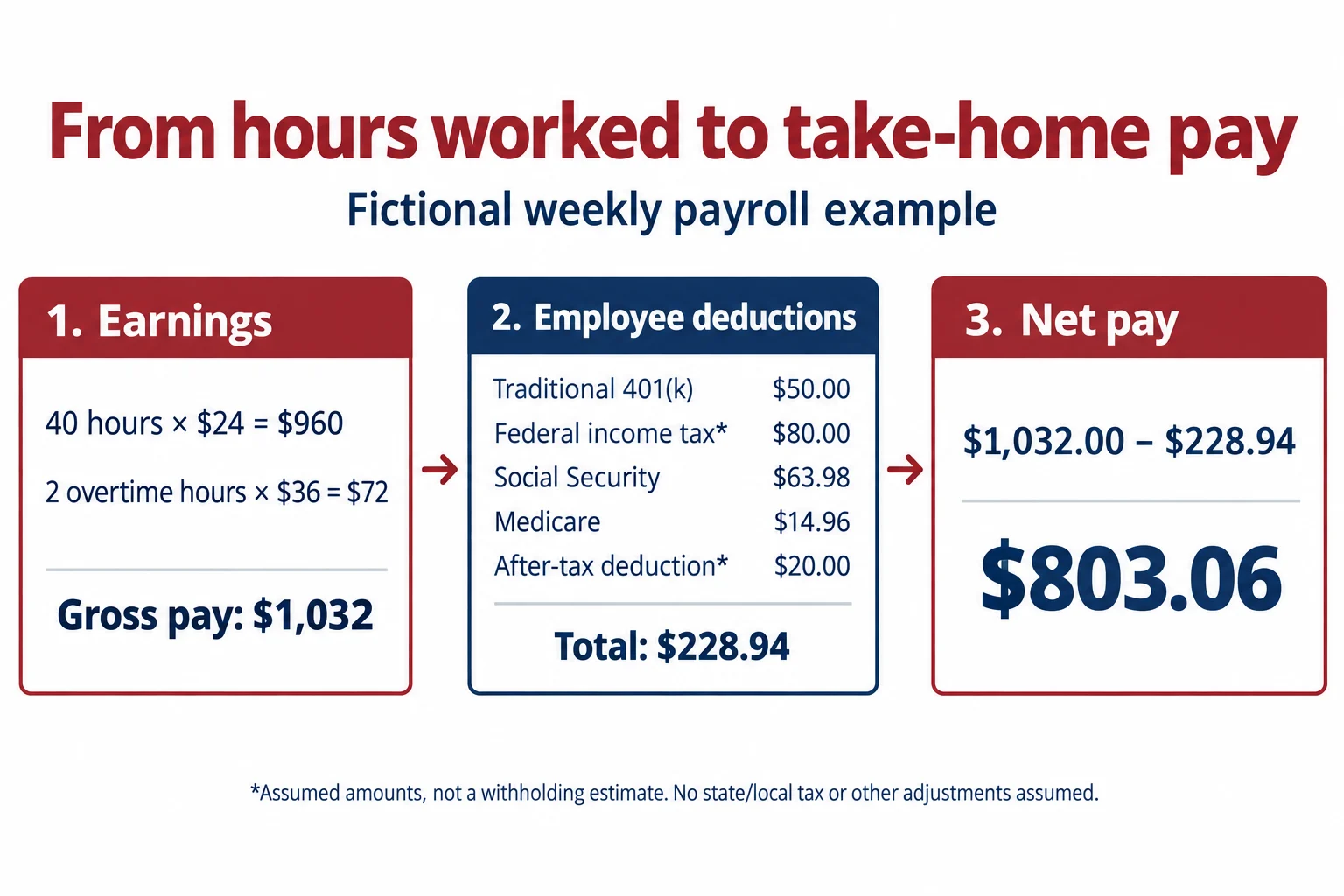
Assume one fictional weekly payment to a covered, nonexempt employee who worked 42 hours at $24 an hour. The regular rate is also $24; there are no bonuses or other rate adjustments. Only the standard federal weekly overtime rule applies in this example.
Also assume a $50 traditional pre-tax 401(k) deferral, $80 federal income-tax withholding, and an authorized $20 after-tax deduction. The employee remains below the Social Security wage limit and Additional Medicare withholding threshold. No state or local tax, reimbursement, noncash benefit, or other adjustment applies.
The $80 income-tax amount is supplied only to demonstrate reconciliation; it was not calculated from a W-4. The $20 deduction is also assumed. These numbers are not a suggested withholding rate or a prediction for someone earning this amount.
1. Establish the gross amount
- Ordinary earnings: 40 hours × $24 = $960.00.
- Overtime earnings: 2 hours × $36 = $72.00.
- Total gross: $960.00 + $72.00 = $1,032.00.
2. Keep the wage bases separate
Under the stated assumptions, federal income-tax wages are $1,032 − $50 = $982. Social Security and Medicare wages remain $1,032. The $20 after-tax deduction does not lower those wage bases.
3. Reconcile employee deductions
- Traditional 401(k): $50.00.
- Federal income tax: $80.00, assumed.
- Social Security: $1,032 × 6.2% = $63.984, rounded to $63.98.
- Medicare: $1,032 × 1.45% = $14.964, rounded to $14.96.
- After-tax deduction: $20.00, assumed.
- Total employee deductions: $228.94.
4. Confirm the remaining payment
$1,032.00 − $228.94 = $803.06 net pay. With no other adjustments and all pay sent to one account, $803.06 is the amount to match to the payroll deposit. The $982 taxable-wage figure is not the starting amount for this subtraction; doing that would count the retirement deduction twice.
If your own result differs by a cent, inspect the original precision and rounding sequence before changing any input. Our pay stub rounding guide explains why rounded display values can behave differently from the underlying calculation.
Use year-to-date totals as a second, independent check
A current payment can add up correctly while its cumulative figures are wrong. Compare each category with the immediately preceding payroll total for the same employer and calendar year. Use this reconciliation only after accounting for separate payments, reversals, and corrections.
Extending the fictional example, suppose previous YTD gross was $20,640, employee 401(k) contributions were $1,000, and net pay was $16,000. These are separate supplied totals, not amounts inferred from the current week's withholding.
- Gross: $20,640 + $1,032 = $21,672.
- Employee 401(k): $1,000 + $50 = $1,050.
- Net: $16,000 + $803.06 = $16,803.06.
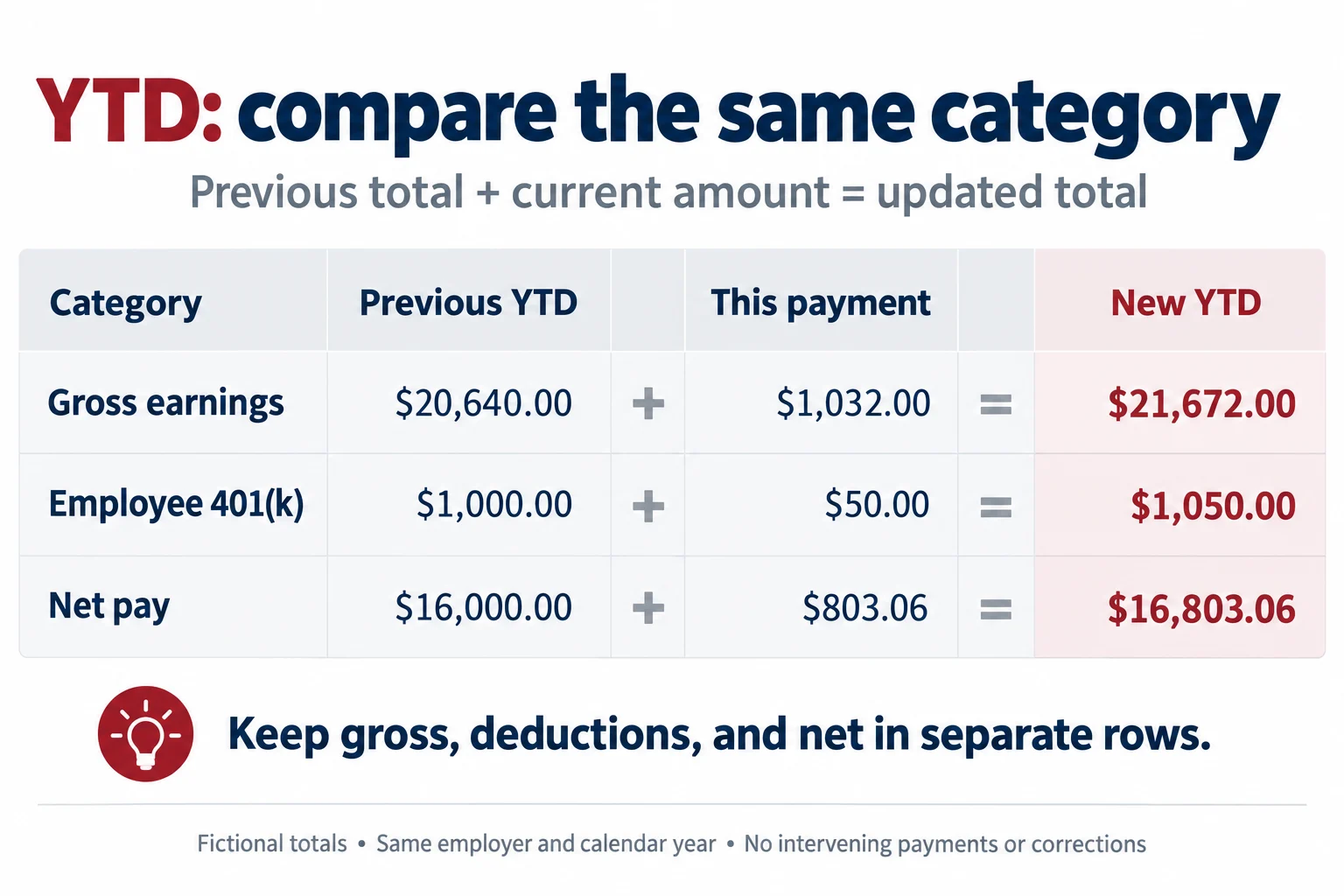
If the change between statements does not equal the current figure, list every payroll transaction between them. An off-cycle bonus, a voided check, or a replacement payment may explain the movement. Ask payroll to identify the entries instead of overwriting the latest YTD value.
Do not estimate earlier statements by multiplying today's pay by a period count. Changes in hours, rates, elections, and adjustments can make that shortcut wrong even when the final annual total appears plausible.
What to do when a statement is missing or looks wrong
Request an existing copy with enough detail
Start with the employer's payroll portal, HR contact, or payroll department. Specify the payment dates you need and ask for the original or corrected earnings statements. If you have left the employer, ask how former employees obtain records and complete the identity check through its established channel.
A useful request is: “Please send my earnings statements for payments dated [dates], including any replacement versions. My employee reference is [appropriate identifier]. Please let me know the secure retrieval process.” Avoid sending a full SSN in an ordinary email simply to identify the request.
Turn a general concern into a specific question
| Concern | Evidence to gather | Question for payroll |
|---|---|---|
| Pay seems too low | Time record and effective pay rate | Which hours and rates produced this earnings total? |
| A deduction is unfamiliar | Deduction label, benefit election, or notice | What is this charge, and what supports the amount? |
| Tax changed unexpectedly | Prior statement and current payroll elections | Did the wage base, election, or calculation method change? |
| Deposit differs from net pay | Payment distribution and bank transaction | Was this payment divided or sent separately? |
| YTD does not reconcile | Prior totals and intervening payments | Which transaction explains the difference? |
Keep two issues distinct: an incorrect statement and an unpaid amount. Issuing a new PDF does not itself transfer missing wages. Request confirmation of any corrected payment, statement, and affected cumulative totals. Retain the original, the corrected version, and the explanation.
If the concern remains unresolved and involves federal wage rights, the DOL Wage and Hour Division provides assistance at 1-866-487-9243. State labor agencies handle applicable state requirements. You can seek guidance without waiting for a document generator to determine the dispute.
Preparing a pay stub: records, requirements, and review
A form's optional fields are not a legal checklist
The DOL pay-stub FAQ distinguishes employer recordkeeping from delivery: the FLSA requires accurate wage and hour records but does not itself mandate pay stubs. State laws can impose wage-statement duties.
For example, California's wage-statement guidance lists employer name and address, earnings, deductions, covered dates, and other required items, with exceptions for certain details. It specifies the last four SSN digits or a different employee identifier on the statement. This is a state-specific example, not a complete nationwide template.
Do not confuse sensitive information required in private payroll files with information that should appear on the delivered stub. Check location-specific display and delivery rules using our state requirements review.
Create from a verified payroll record
For each payment, prepare a small source packet: identity details, the payroll calendar, earnings support, withholding inputs, deduction support, prior cumulative totals, and payment instructions. Use our preparation checklist to organize it.
Before entering data, mark which amounts are employee deductions and which are employer contributions. Identify reimbursements and noncash entries separately. If an amount lacks support, resolve it before generating the document; changing the final net amount to achieve a target conceals the underlying problem.
Use GeneratePayStub.com to format the established information, then compare the preview against the source packet. Confirm that the available layout can represent every necessary earnings and deduction category. A document-creation tool does not perform the employer's payment, tax-deposit, or reporting duties simply by producing a PDF.
Keep contractor and employee records accurate
For federal employment-tax classification, the IRS common-law guidance evaluates the working relationship using behavioral and financial control along with the relationship between the parties. A chosen document title or one scheduling question cannot settle status.
Contractor payments usually do not use ordinary employee payroll withholding, but “contractors never have tax withheld” is too broad. The IRS describes backup withholding and other nonemployee withholding situations. Use actual invoices, payment records, and applicable tax forms. Label any self-prepared summary accurately rather than presenting it as an employer-issued wage record.
Retention and sharing: protect the evidence as well as the file
For employers, different record types have different retention rules. DOL Fact Sheet 21 generally calls for three years for payroll records and two years for records supporting wage calculations. The IRS separately requires employment-tax records to be kept for at least four years; consult its recordkeeping guidance and applicable timing requirements. These are not a single universal destruction date.
Employees should keep accessible copies for reconciliation, tax-document review, and any outstanding dispute or documentation need. Check applicable requirements before deleting records. Maintain restricted access and backups; avoid using full tax identifiers in filenames.
Before sharing a statement, confirm the recipient, requested period, and acceptable format. Ask about redaction before removing fields, and use a secure submission channel when available. Our PDF inspection checklist covers legibility and document handling. Never alter pay or employer details to meet an application threshold.
More pay stub help: frequently asked questions
Is a pay stub needed when wages are paid in cash?
Cash changes the payment method, not the underlying need for accurate payroll records. Check the applicable statement-delivery requirements; California's guidance cited above expressly addresses cash wages.
Should my W-2 Box 1 equal YTD gross?
Not necessarily. Traditional pre-tax retirement deferrals are one reason federal taxable wages can differ from gross earnings. Compare the appropriate annual wage category and investigate adjustments before assuming the forms conflict.
Can a bank deposit tell me the missing gross amount?
No single gross amount can reliably be inferred from a deposit without the payroll details. Several combinations of earnings and deductions can produce the same payment. Request the earnings record.
Does every line on a statement reduce take-home pay?
No. Some lines describe employer funding, accumulated balances, or information already included elsewhere. Use the section headings and payroll explanation to determine which amounts actually enter the deduction total.
Can I regenerate an old statement using current tax rates?
A historical record should reflect the actual historical payroll. Retrieve the original calculation and the rules for that payment year. A correction may require changes beyond the document, including payroll totals or tax reporting.
Will this guide or a generated statement guarantee application approval?
No. The receiving organization sets its evidence and verification requirements. Accurate records help explain income, but a generated statement does not independently authenticate it or promise acceptance.
Your final review: identify the payment, substantiate the earnings, explain each deduction, reconcile the resulting payment, and compare matching cumulative categories. When a step fails, preserve the record and resolve the specific discrepancy before relying on the document.