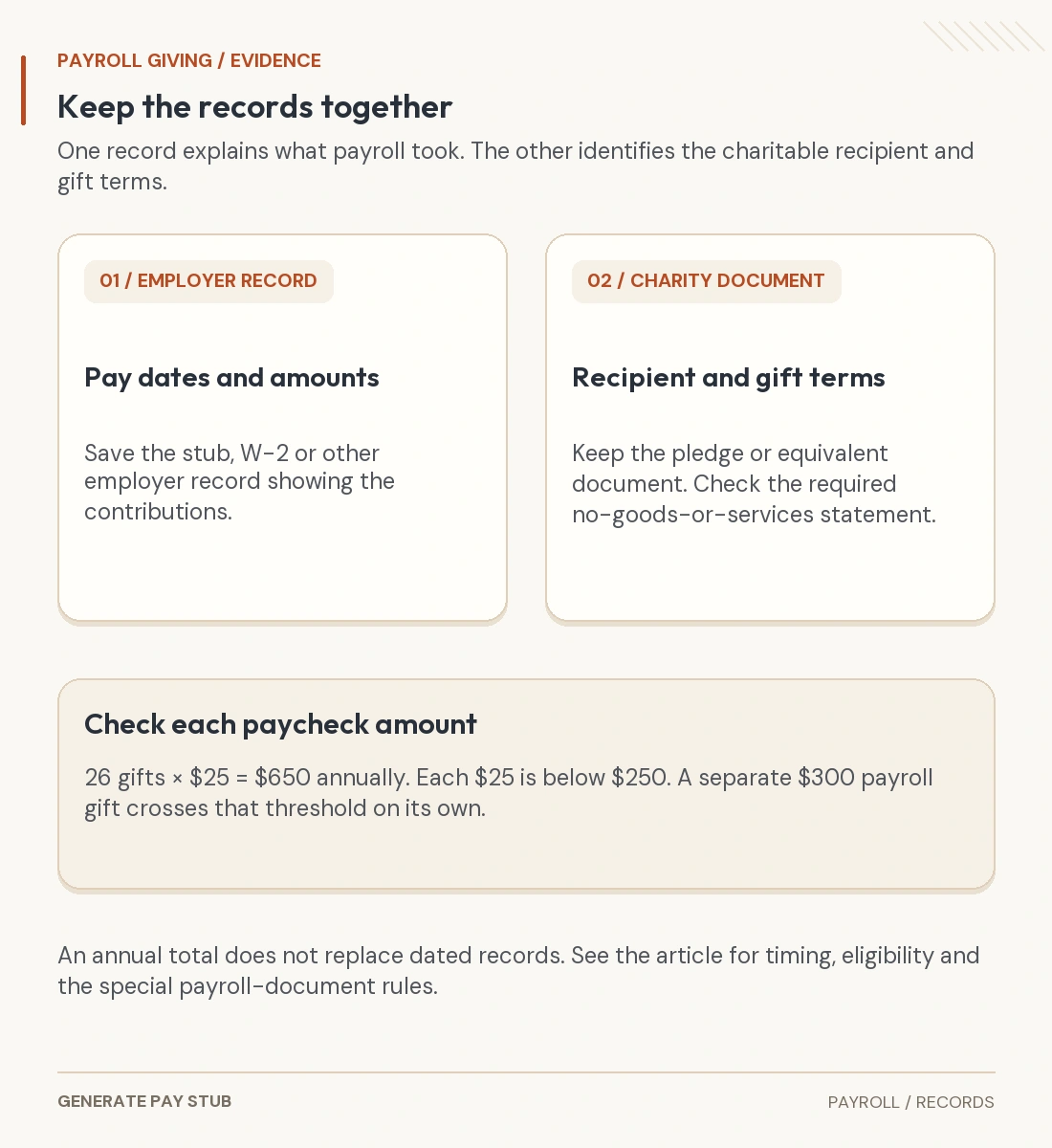
A charitable deduction on a pay stub usually means your employer took an authorized donation from after-tax pay and will send it through the workplace giving program. It reduces the cash you receive. It does not, by itself, reduce federal taxable wages or prove that you qualify for a charitable deduction on your income-tax return. Keep the payroll record and the charity’s supporting document together.
Reviewed November 22, 2026. This U.S. guide covers ordinary employee charitable payroll giving and federal recordkeeping, including the new 2026 non-itemizer deduction. It does not cover every state tax rule, donated property, a charitable trust or a special scholarship-credit program. The examples use invented figures and identified assumptions.
What does “charity,” “CFC” or “United Way” mean on a pay stub?
The label may identify a workplace fundraising campaign, an umbrella organization or the payroll deduction code. Read the enrollment confirmation to identify the actual recipient, amount per payment, start date and any stop date. A campaign’s name is not a universal code for tax treatment.
Compare the current deduction with the amount authorized for this payday. Compare the year-to-date total with the earlier statements. A pledge of $650 for the year is not evidence that all $650 has already been taken or delivered. Our YTD reconciliation guide explains how current and cumulative amounts fit together.
Federal workplace giving offers a useful tax distinction: the Office of Personnel Management’s CFC guidance says charitable payroll contributions are after tax, including other payroll giving programs. Do not group the gift with a qualifying pre-tax health-plan contribution merely because both appear under “deductions.”
How does the donation change take-home pay?
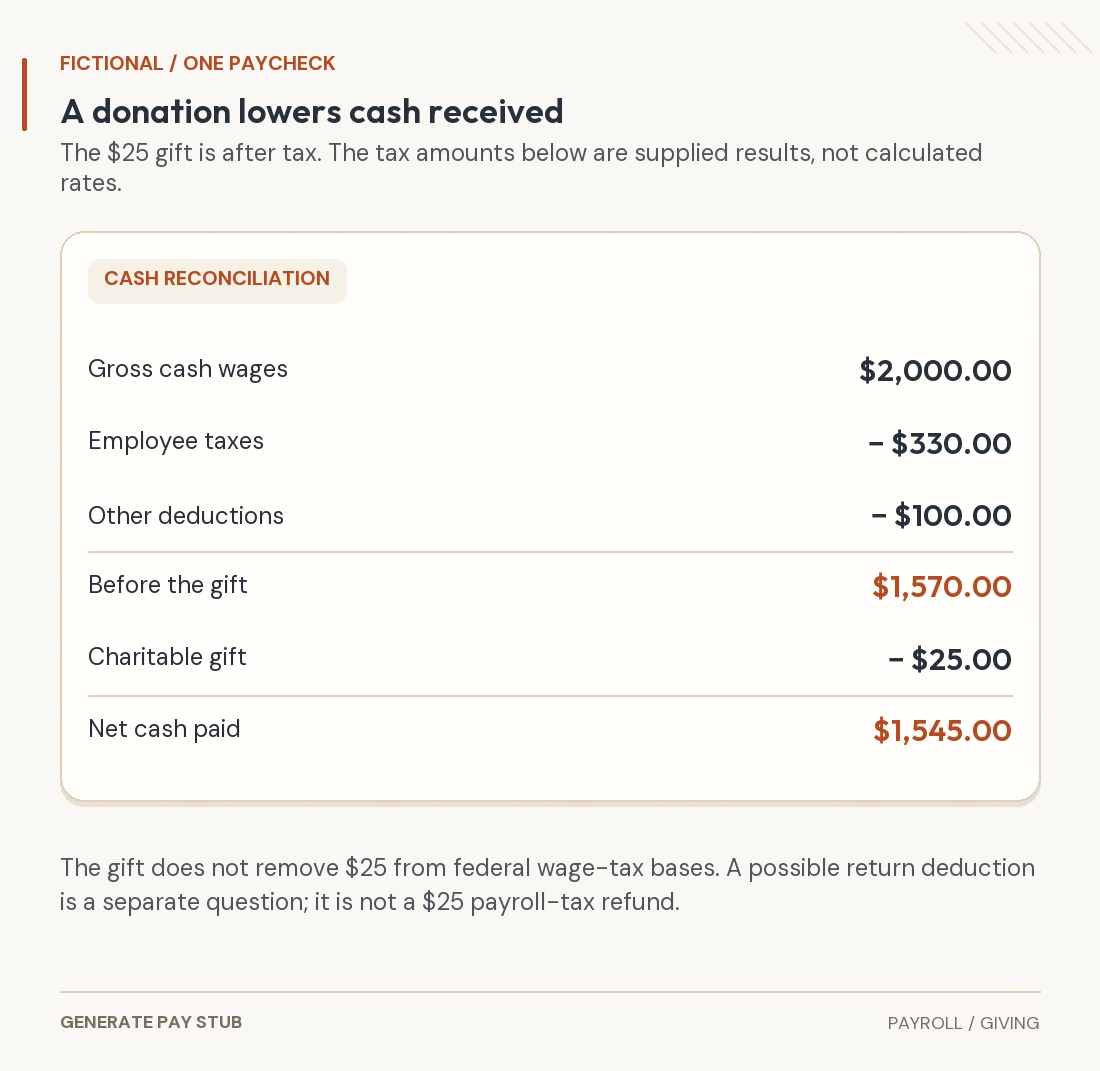
Assume one fictional payment has $2,000 of cash wages, $330 of employee taxes and $100 of other employee deductions. The tax and other deduction amounts are supplied payroll results; this example does not calculate a withholding rate or include reimbursements or noncash income.
| Cash-pay calculation | Amount |
|---|---|
| Gross cash wages | $2,000.00 |
| Employee taxes | − $330.00 |
| Other employee deductions | − $100.00 |
| Cash remaining before the donation | $1,570.00 |
| Authorized charitable deduction | − $25.00 |
| Net cash payable | $1,545.00 |
The arithmetic is $2,000 − $330 − $100 − $25 = $1,545. With every other item held constant, the donation lowers cash by $25. It does not turn the $2,000 wage input into $1,975 of federal taxable wages. Any separate, valid pre-tax adjustment would need its own classification.

If your bank deposit is smaller again, check all payment allocations rather than inventing another gift. For example, a separate $200 transfer to personal savings could leave $1,345 in the main checking account while total net pay remains $1,545. A personal savings transfer is not a second charitable contribution. See split-deposit reconciliation for the payment records to compare.
Which documents support a payroll charitable contribution?
The payroll arrangement has a specific evidence route. The IRS’s Publication 1771, payroll-deduction section, describes using an employer-furnished record together with the charity’s pledge document. Keep both sides of the record:
- Employer evidence: a pay stub, W-2 or other employer-furnished document identifying the withheld charitable amount. Preserve dated payment detail, not just a handwritten annual total.
- Charity evidence: the pledge card or equivalent document prepared by or for the organization. Identify the organization and the required statement concerning goods or services received in exchange.
Publication 1771 specifies obtaining the documents by the earlier of filing the original return or its filing deadline, including extensions. Do not wait for an audit to start requesting the missing acknowledgment. A payroll line with an unexplained code is weaker evidence than a matched set of records identifying the recipient and transaction.
The currently posted Publication 526 is the 2025 edition. Its payroll substantiation instructions explain retaining additional date evidence if none of the otherwise required records shows when the contribution occurred. We use that edition for the established documentation instructions, while using the IRS’s 2026 guidance below for the changed 2026 deduction rules.

Does $650 for the year trigger the $250 acknowledgment rule?
Not merely because the year’s total exceeds $250. The deduction from each wage payment is treated as its own contribution for this threshold. Twenty-six separate $25 deductions total $650, but none of those individual gifts reaches $250. The ordinary recordkeeping requirements still apply.
Now consider a different payment with a single $300 charitable deduction. That contribution crosses the threshold on its own. Check the special payroll-document requirements, including the charity-prepared statement that no goods or services were provided in exchange when that is the case. A single suitable pledge document can cover the payroll contributions; the paycheck amounts and dates must still be traceable.
The IRS’s written-acknowledgment guidance explains the general $250 rule and why documentation must describe any goods or services supplied. If the program actually provided a benefit, do not rely on an inaccurate “nothing received” statement or assume the full payroll deduction is deductible.
What changed for a 2026 charitable tax deduction?
A deduction from wages and a deduction on a tax return are different uses of the same word. The first describes cash withheld from your paycheck. The second describes a potentially allowable reduction in taxable income under the return’s rules. Neither is automatically a dollar-for-dollar tax credit.
If you do not itemize
The IRS’s November 10, 2026 reminder confirms that eligible non-itemizers may deduct up to $1,000 of qualifying cash contributions for 2026, or $2,000 on a joint return. This concerns 2026 contributions reported during the 2027 filing season. It does not authorize payroll to treat gifts as pre-tax wages. Supporting organizations and contributions to establish or maintain donor-advised funds are excluded from this particular deduction.
For a simple illustration, assume a single eligible non-itemizer has only the $650 of qualifying cash gifts described above, proper evidence and no other relevant restriction. The $1,000 cap does not reduce that $650 amount. It also does not produce a $650 refund: the effect on tax depends on the complete return. If otherwise qualifying gifts were $1,300 instead, this deduction’s stated cap would be $1,000.
Publication 6196, dated October 2026, also explains that the non-itemizer deduction is not available to people who are required to itemize. It notes that some eligible churches, government organizations and group-exemption organizations may not appear separately in search results. Missing a search listing alone does not resolve every eligibility question.
If you itemize
The IRS’s 2026 Publication 505 explains the new 0.5%-of-AGI floor for charitable itemized deductions. For a limited illustration, $80,000 AGI produces a $400 floor. If qualifying contributions are $650, the amount above that floor is $250 before any other applicable limitations. This is an illustration of the floor, not a full return comparison or advice to choose itemizing.
Do not add the non-itemizer deduction to an itemized deduction for the same gift. Larger gifts, carryovers, property contributions and high-income limitations need the actual year’s instructions and individual facts. Our AGI guide explains why a pay-stub wage total alone cannot supply the whole return calculation.
How should you check year-end amounts and employer matches?
Build a short reconciliation with four columns: pay date, current gift, cumulative employee gifts and supporting-document reference. For the unchanged $25 election, ten completed deductions should total $250 and twenty-six should total $650. A missed check, unpaid leave or an election change can make the actual total differ from the original pledge.
Ask the campaign administrator to explain any difference between amounts withheld and the recipient’s statement, including processing dates. Do not backdate a contribution or guess its tax year from the work-period dates alone. A late-December deduction and a later delivery deserve a specific timing check rather than an unsupported promise that the pledge belongs to the earlier year.
Keep an employer’s matching gift separate from your own contribution. If you give $650 and the employer separately donates $650 of its funds, the combined charitable support is $1,300, while the employee-gift ledger still starts with $650. Do not claim the match as though it had also been withheld from your wages.
Use the IRS Tax Exempt Organization Search to investigate eligibility, and resolve the identity of a campaign intermediary versus the ultimate charity. Under IRS Topic 506, direct gifts to individuals do not qualify as charitable contribution deductions. A payroll collection for a colleague’s personal fundraiser should not acquire charitable status just because the employer facilitated it.
What should you do about an incorrect or missing donation?
- Compare the election with the specific payday. Identify the effective date, authorized amount and current deduction.
- Rebuild the cumulative total. Include actual deductions and documented reversals rather than the planned annual pledge.
- Ask the correct record owner. Payroll explains what was withheld; the campaign or charity explains receipts, recipient allocation and supporting documents.
- Separate a refund from a formatting correction. Ask how an erroneous withholding will be repaid and how the record will show it. A revised PDF is not a cash refund.
- Retain the resolution. Keep original and corrected records, dates and confirmations through the applicable tax-record retention period.
A focused request might say: “My election effective [date] was [amount] per payment. The [pay date] statement shows [amount]. Please reconcile the difference, confirm the recipient and explain any refund or contribution correction.” Use the employer’s established private channel and omit unrelated account information.
Authorized preparers can use the Pay Stub Generator to present finalized payroll information. Enter a real approved donation only in a field with the correct cash and tax treatment. Preparing a statement does not deliver a gift, create a charity acknowledgment or establish a tax deduction. For an existing employee statement, request the employer’s official record.
Common charitable payroll deduction questions
Should the gift appear as a separate W-2 tax box?
Do not assume there is a dedicated mandatory charitable-contribution box or that every W-2 displays the amount. Retain pay statements or another employer document with the necessary details and obtain the charity document. A blank W-2 field does not erase an otherwise documented payroll gift.
Is a $25 payroll donation a $25 tax saving?
No. In the cash example, it reduces take-home pay by $25. Any allowable federal income-tax deduction is evaluated separately under the filing-year rules; the tax effect is not automatically equal to the gift.
Can I use a recreated stub instead of requesting missing evidence?
A self-prepared statement does not replace the employer-furnished record required for the payroll evidence route. Ask payroll and the charity for the relevant originals or corrected records. Keep calculations as supporting work, without presenting them as an issuer’s confirmation.