Use the New Jersey paycheck calculator’s NJ-W4 rate-table election, allowance count and extra withholding field separately. The table letter chooses an income-tax schedule; allowances reduce the wages used by that schedule; extra withholding adds dollars to each payment. Employee unemployment, workforce, disability and family-leave contributions are additional lines with their own rules.
A fictional $96,000 salary, paid twice a month, makes those distinctions visible. We check the $195.34 state income-tax deduction, then show why take-home pay increases after the unemployment contribution wage limit is reached even though gross pay and income-tax withholding remain unchanged.
Enter the certificate assumptions before comparing net pay
In the free New Jersey paycheck calculator, choose 2026, $96,000 annual wages and Semimonthly. The projection uses 24 payments of $4,000. Select Single for federal withholding, with all W-4 dollar adjustments at zero and multiple jobs unchecked.
For the state inputs, choose rate table A, one withholding allowance and $15 additional withholding per paycheck. Keep known annual local and other cash deductions at zero. Leave the employee contribution programs at standard coverage. This sample assumes one full-year private-sector contributory employer, New Jersey as home and work state, ordinary covered wages, and no benefits or special exclusions that change the wage bases.
Form NJ-W4 defaults Single and Married Separate to rate A. Certain other filing statuses use B when no line 3 election is made. Optional letters C, D and E are elections under the form’s wage-chart instructions, rather than additional filing statuses.
Use the letter supported by the actual certificate. A federal filing-status choice does not replace the New Jersey election, and changing a calculator setting does not submit a signed NJ-W4 to payroll. The one allowance here is assumed to be permitted; this article does not determine a reader’s allowance entitlement.
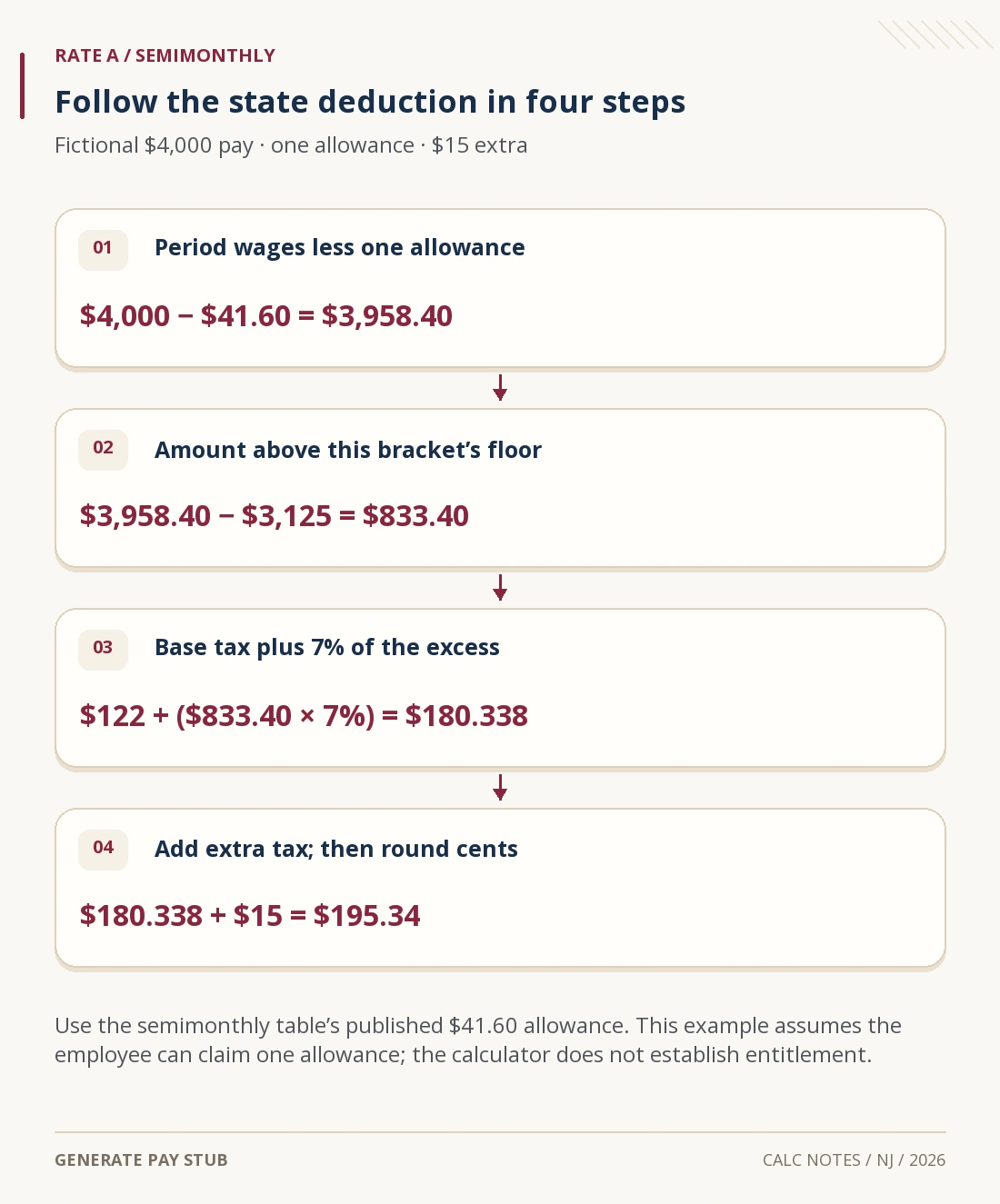
Recalculate the $195.34 New Jersey income-tax line
The official NJ-WT instructions assign a $41.60 allowance value to a semimonthly payment. Use the published period value, rather than dividing a rounded annual allowance into a different figure.
Subtract one $41.60 allowance from the $4,000 wage amount to get $3,958.40 for the table lookup. In the official rate A semimonthly percentage table, this amount falls above $3,125 and within the bracket ending at $20,833. Its formula is $122 plus 7% of the amount above $3,125.
The excess is $833.40. Seven percent is $58.338, making the table amount $180.338. Adding the requested $15 produces $195.338, rounded to $195.34. This uses cents in the wage calculation; NJ-WT also permits rounding wage amounts to whole dollars, which can cause a small difference from payroll using that option.

The additional withholding input is $15 for every payment. On 24 payments it requests $360 over the modeled year. Entering $360 in that field would instead add $8,640 annually. Allowance counts, bracket percentages and extra dollars are different units; inspect each before interpreting a net-pay difference.
The percentage-table document remains applicable to payments on and after October 1, 2020. It is the current official schedule used in this 2026 walkthrough, not a table we have relabeled as newly issued for 2026.
Read the employee contribution rates without copying an employer rate
The Department of Labor’s calendar-year 2026 worker table supplies the following standard employee rates. The same page also contains employer and governmental-reimbursable-worker tables; they are different arrangements.
| Program | Employee rate | Covered wage limit |
|---|---|---|
| Unemployment insurance (UI) | 0.3825% | $44,800.00 |
| Workforce/supplemental workforce | 0.0425% | $44,800.00 |
| Temporary disability insurance | 0.19% | $171,100.00 |
| Family leave insurance | 0.23% | $171,100.00 |
The DOL rates are published as decimal factors: for example, 0.003825 equals 0.3825%, not 0.003825%. Check that conversion before doing a manual calculation.
For a $4,000 fully covered payment below both limits, UI is $15.30 and workforce is $1.70. Disability is $7.60 and family leave is $9.20. Their combined employee deduction is $33.80. They do not replace the separate $195.34 state income-tax withholding.
The official disability and family-leave employer page confirms the 2026 employee limits and explains that the programs have separate funding arrangements. Private plans can apply, so do not assume a standard state-plan projection reproduces every employer’s deduction.
Understand the midyear increase in modeled net pay
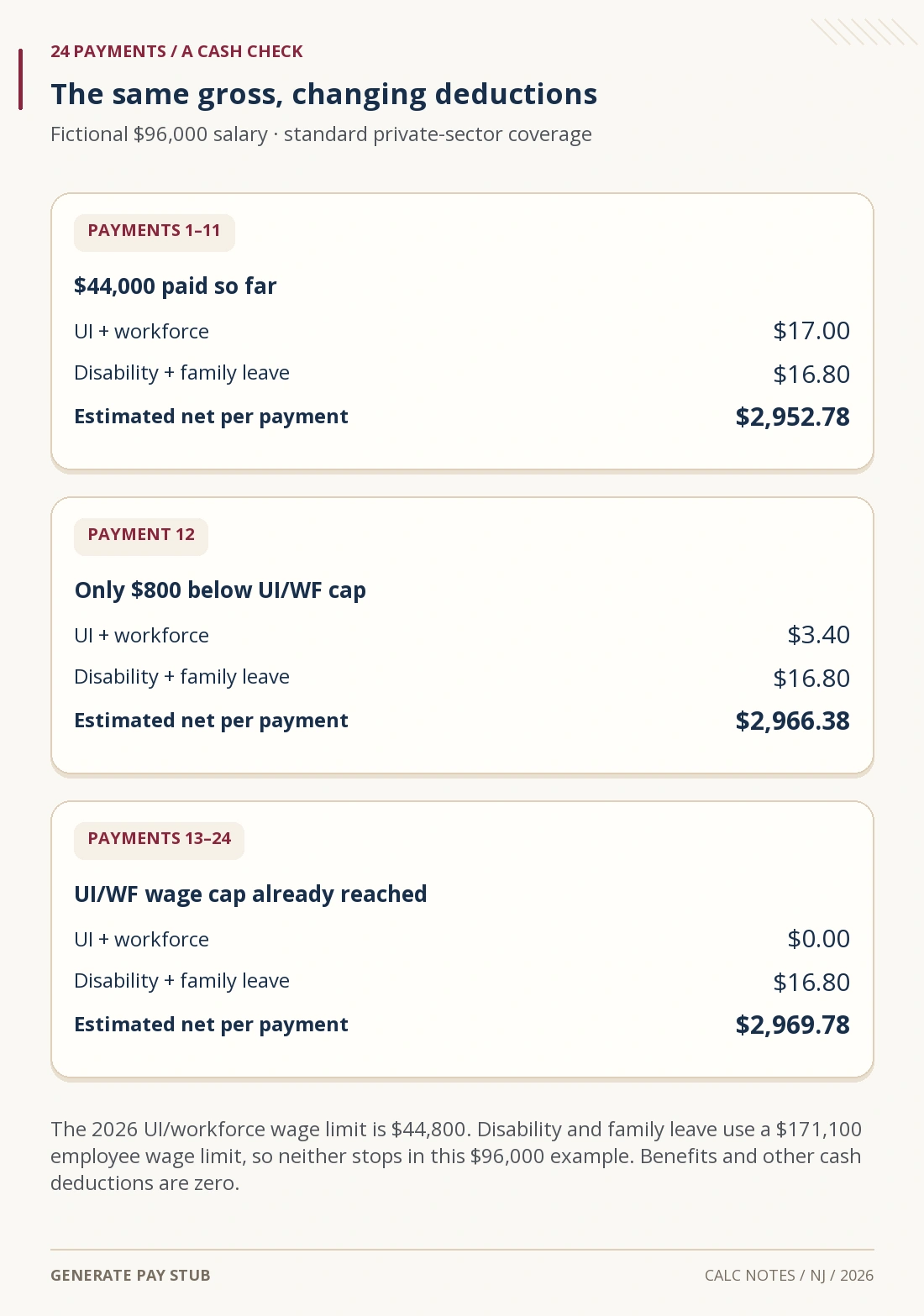
Eleven $4,000 payments bring covered wages to $44,000. Only $800 of payment 12 remains below the $44,800 UI/workforce limit. That payment therefore has $3.06 UI and $0.34 workforce withholding. Later payments have neither of those contributions in this one-employer projection.

Disability and family-leave contributions continue because $96,000 never reaches their $171,100 employee wage limit. Social Security also continues on all sample wages, which remain below its separate 2026 limit.
The constant federal deduction is $512.08, Social Security is $248 and Medicare is $58 per payment. Before New Jersey program contributions, the cash remainder is $4,000 − $512.08 − $195.34 − $248 − $58 = $2,986.58. Subtract $33.80, $20.20 or $16.80 for the three stages to obtain the net amounts pictured above.
Reconcile the annual projection to the payment amounts
| Annual component | Amount |
|---|---|
| Gross pay | $96,000.00 |
| Federal income tax withholding | $12,289.92 |
| New Jersey income tax withholding, including extra | $4,688.16 |
| Social Security | $5,952.00 |
| Medicare | $1,392.00 |
| UI | $171.36 |
| Workforce/supplemental workforce | $19.04 |
| Disability | $182.40 |
| Family leave | $220.80 |
| Estimated take-home pay | $71,084.32 |
The net reconciliation is (11 × $2,952.78) + $2,966.38 + (12 × $2,969.78) = $71,084.32. Its rounded annual-average net is $2,961.85 per payment, which differs from each stage’s actual modeled amount. Keep that distinction when using a paycheck estimate for a recurring household budget.
These amounts reflect withholding and contributions, not a final New Jersey or federal tax assessment. A refund or balance due also depends on the full return, household income, credits and payments. The federal W-4 calculator guide provides a separate controlled comparison for the federal inputs.
Know when the New Jersey projection is incomplete
The calculation assumes all relevant wage bases equal gross pay. Real retirement and benefit deductions can have different federal and New Jersey treatment. The main calculator does not build those separate bases from a complete benefit election history. Its known annual cash fields reduce estimated cash, rather than determining tax exclusions.
Cross-state employment, residency changes and multiple employers also need information beyond this standard setup. NJ-WT discusses the Pennsylvania reciprocal agreement and multistate withholding; selecting New Jersey in the tool does not decide whether that agreement applies to the worker.
The checked output lists no additional excluded program, but that is a description of the reviewed model. It does not prove that the employee has no pension, health, union, garnishment or private-plan deduction. Compare the actual statement’s wage bases, elections and coverage records line by line before deciding a difference is a payroll error.
New Jersey paycheck calculator questions
Does table E mean a fifth filing status?
No. C through E are optional rate elections under NJ-W4. Read the wage-chart instructions before changing the selected letter.
Why are UI and disability not stopping at the same pay amount?
The 2026 worker wage limits differ: $44,800 for UI/workforce and $171,100 for disability/family leave. Use the limit for the particular contribution.
Can I use biweekly when I am paid twice a month?
Use Semimonthly for 24 payments. Biweekly uses 26 and has its own published allowance value and withholding brackets.
Does the free calculator update my NJ-W4?
No. A comparison run estimates amounts. Actual certificate changes must follow the employer’s submission process.
Official New Jersey sources and the live 2026 calculator reviewed November 6, 2026. All figures use the stated fictional private-sector scenario.