The Kentucky paycheck calculator’s ordinary 2026 state formula annualizes wages, subtracts the $3,360 state standard deduction, applies 3.5% and divides back into payments. Its state line does not include local occupational taxes. Any extra withholding is added in dollars per payment.
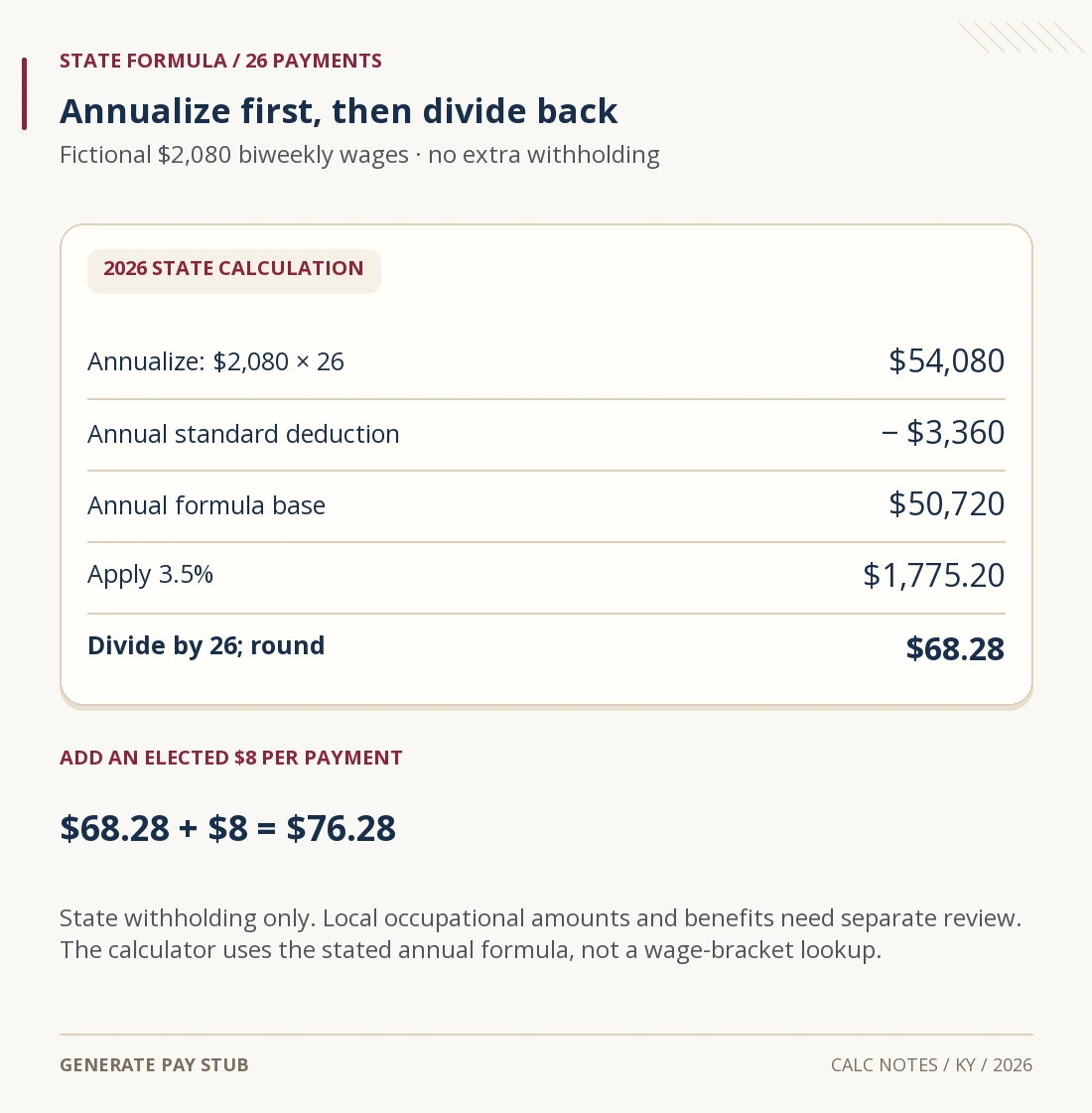
This guide checks fictional $2,080 biweekly wages, or $54,080 over 26 payments. The formula gives $68.28 Kentucky withholding per payment before any extra election. A second test adds $8, producing a $76.28 state line.
Use the 2026 formula rather than multiplying gross by the rate
The DOR’s 2026 deduction announcement sets the annual standard deduction at $3,360. The 2026 Kentucky K-4 confirms the 3.5% rate and that deduction allowance.
The Kentucky paycheck calculator implements the computer formula for ordinary supported payroll schedules. It does not use a family allowance count or a separate state married-status table in the reviewed controls.
Federal filing status still matters to the federal calculation. Its presence on the page does not turn Kentucky’s state formula into a federal-style bracket calculation.
Applying 3.5% directly to the entire gross payment omits the standard-deduction step. Applying the annual $3,360 deduction to each payment would make the opposite mistake: using an annual amount as though it repeats every payday.
Enter the fictional $54,080 salary on a biweekly schedule
Select 2026, type $54,080 annual gross and choose Every Two Weeks. The model makes 26 payments of $2,080. Twice a Month would be a different 24-payment schedule.
For federal withholding, set Single, keep the multiple-jobs control off and leave all W-4 dollar adjustments at zero. The initial Kentucky additional-withholding amount is zero.
The scenario supplies no annual local withholding and no other cash deduction. That deliberately isolates the taxes calculated by the tool; it does not assert that a Kentucky employee has no local obligation or benefits.
Assume a full year with one employer, ordinary wages, Kentucky residence and work, and equal gross, federal, FICA and state wage bases. No benefit arrangement changes taxable wages, and no exemption certificate is assumed.
Trace the state formula from one payment to the annual base
The 2026 computer-formula document describes annualization and conversion back to the payment period. Applying it independently to this invented wage:
- $2,080 × 26 = $54,080 annualized wages.
- $54,080 − $3,360 = $50,720 formula base.
- $50,720 × 3.5% = $1,775.20 annual formula tax.
- $1,775.20 ÷ 26 = $68.276923…; round to $68.28 per payment.

Adding 26 rounded $68.28 deductions gives $1,775.28, eight cents above the unrounded annual formula. Use payment-level amounts when reconciling the projection.
The PDF’s own biweekly illustration contains inconsistent intermediate and final figures. The example here uses the document’s stated formula, the confirmed 2026 deduction and independently checked arithmetic rather than repeating those inconsistent lines.
Test additional K-4 withholding as a payment-level amount
Kentucky’s certificate permits additional withholding per pay period under agreement with the employer. The calculator’s additional field follows that unit.
For the second live run, we changed only the state extra amount to $8. Ordinary $68.28 plus $8 gives $76.28 per payment. Over 26 payments, that election adds $208 of state withholding.
| Scenario output | No extra amount | $8 extra each payment |
|---|---|---|
| State withholding/payment | $68.28 | $76.28 |
| Estimated cash/payment | $1,686.85 | $1,678.85 |
| State withholding/year | $1,775.28 | $1,983.28 |
| Estimated annual cash | $43,858.10 | $43,650.10 |
Federal withholding and FICA do not change because their inputs and wage bases stay the same. The $208 changes when cash is paid toward state tax, not the underlying income or the final tax-return calculation.
With several jobs, a household should examine the combined result rather than repeating this single-job deduction assumption without review. An extra amount tested online is not sent to the employer automatically.
Check annual cash before local taxes and unentered benefits
| Cash calculation item | Annual modeled amount |
|---|---|
| Annual gross wages | $54,080.00 |
| Federal withholding | $4,309.50 |
| Kentucky state withholding | $1,775.28 |
| Employee Social Security | $3,352.96 |
| Employee Medicare | $784.16 |
| Cash before omitted deductions | $43,858.10 |
At each modeled payment, $2,080 − $165.75 federal − $68.28 state − $128.96 Social Security − $30.16 Medicare = $1,686.85. Twenty-six such payments total $43,858.10.
That figure is the result under the stated limited inputs. It is not a promise that an employer will deposit that amount. The net-pay reconciliation guide helps identify other statement lines.
Review local occupational amounts separately
The reviewed calculator does not select a Kentucky city or county, evaluate its local rules or compute an occupational amount. Its general local field accepts an annual cash figure already known to the user.
Obtain the applicable local deduction from reliable payroll records or a separate jurisdiction-specific calculation. Check work location, applicable local rules and the pay period before entering an annual projection. A blank field supplies no cash amount; it does not establish an exemption.
Likewise, the other-deductions cash field does not automatically determine benefit eligibility or tax treatment. An actual pre-tax benefit can change taxable wage bases, whereas a simple cash subtraction leaves this model’s tax calculations unchanged.
Recognize certificate exceptions and payroll situations outside this example
The K-4 provides distinct exemption conditions, including specified military, reciprocity and no-liability circumstances. The calculator’s ordinary additional-dollar control does not implement those claims. Do not try to represent an exemption by choosing a different federal filing status.
Check the employer’s actual calculation method as well. A wage-bracket table may not match a precise computer-formula result for every wage. A different amount alone is not enough to identify a payroll error.
Midyear employment, varying pay, bonuses, several jobs and changing benefits need their own records. The tool repeats one annual setup and does not amend prior checks or prepare a Kentucky return.
For the federal part of the estimate, use the federal W-4 guide. A free calculation is separate from preparing a pay statement or verifying that an employee earned the entered wages.
Kentucky paycheck calculator questions
Does 3.5% apply directly to every dollar of gross in this method?
No. The annualized formula subtracts the state standard deduction first.
Is the $3,360 deduction applied on each paycheck?
No. It is annual. The formula converts the resulting annual tax back into the selected payment count.
Does the state line include occupational taxes?
No. Those are outside the automatic state calculation reviewed here.
Will $8 in the extra field add only $8 for the whole year?
No. It adds $8 to each payment, totaling $208 under this 26-payment example.
Kentucky 2026 sources, formula arithmetic, current controls and both live examples reviewed November 6, 2026. All employee assumptions are fictional.