To estimate a California paycheck, enter annual wages, set federal W-4 choices, then review California DE 4 elections and SDI coverage separately. California income tax withholding and State Disability Insurance are different employee deductions. Changing a DE 4 allowance can change the first line without changing the SDI calculation.
This guide uses the free California paycheck calculator to test a fictional $96,000 salary paid monthly in 2026. It follows the actual controls, checks the state calculation against the published monthly tables and shows how different allowance types affect estimated take-home pay.
Set up the California paycheck calculator
Open the free California paycheck calculator, choose 2026 and enter $96,000 annual gross wages. Select Monthly. The resulting gross payment is $8,000; entering $8,000 in the annual field instead would model an entirely different salary.
For this demonstration, select Single for federal withholding, leave the multiple-jobs option off and leave the federal credit, other-income, deduction and extra-withholding amounts at zero. In the California settings, choose the Single/dual-income/multiple-employer election, one regular allowance, zero estimated-deduction allowances and $25 additional withholding per payment. Use standard SDI coverage, with no local withholding or other annual cash deductions.
The official 2026 DE 4 separates regular allowances on line 1a, estimated-deduction allowances on line 1b and extra withholding on line 2. Federal W-4 elections are separate. Use your actual certificate choices when testing your own pay; these fictional selections do not determine which allowances you may claim.
The California election labeled Single also covers dual-income married employees and multiple-employer withholding situations. Do not assume that a federal joint filing selection alone identifies the right California withholding treatment. Read the state form’s multiple-income instructions when that situation applies.
A checked 2026 example: $96,000 paid in 12 monthly payments
Assume the employee lives and works only in California throughout 2026, has one employer and receives ordinary wages. The example treats the entire wage amount as covered for federal, FICA, California PIT and SDI purposes. There are no pre-tax benefits, excluded compensation or special exemptions.
| Pay line | Each monthly payment | Annual projection |
|---|---|---|
| Gross wages | $8,000.00 | $96,000.00 |
| Federal income tax withholding | $1,024.17 | $12,290.04 |
| California income tax withholding | $454.21 | $5,450.52 |
| Employee Social Security | $496.00 | $5,952.00 |
| Employee Medicare | $116.00 | $1,392.00 |
| California SDI, including PFL | $104.00 | $1,248.00 |
| Estimated take-home pay | $5,805.62 | $69,667.44 |
The monthly cash check is $8,000 − $1,024.17 − $454.21 − $496 − $116 − $104 = $5,805.62. Twelve equal payments give $69,667.44. All four California scenarios discussed below were run through the live tool and checked individually.
The federal component follows the modern W-4 payroll method. For help checking that line without changing California inputs, use our federal calculator walkthrough. The Social Security and Medicare percentages are employee components; the table does not subtract the employer’s matching taxes from wages.
How does the calculator get $454.21 of California withholding?
The tool applies California’s published Method B tables for the selected payment frequency. For this Single monthly example, the 2026 Method B schedule supplies a $476 standard deduction, a $14.03 credit for one regular allowance and the applicable percentage row.
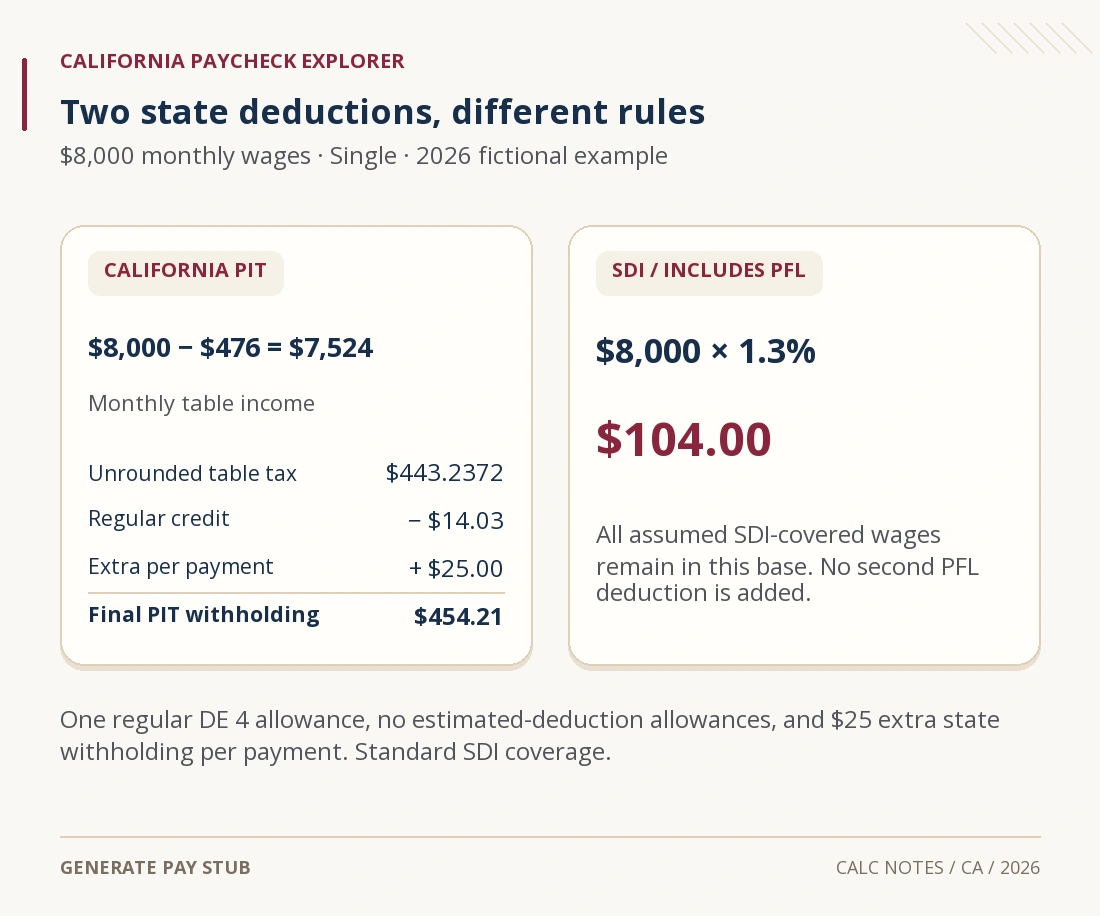
Starting with $8,000, subtract $476 to obtain $7,524 of monthly table income. That lies in the row above $6,060 and not above $30,956. The table calculation is $293.47 + 10.23% × ($7,524 − $6,060) = $443.2372. Subtract the $14.03 regular-allowance credit and add the requested $25 per payment: $443.2372 − $14.03 + $25 = $454.2072, rounded to $454.21.

The 10.23% worksheet row is not a flat tax on all $8,000 and is not a statement of the employee’s final return rate. Published withholding calculations, allowance credits and extra elections are being used to estimate payroll deductions.
The model uses the literal monthly table values. The schedule also permits an annualized approach, so a legitimate employer using another permitted method can have small differences. Compare the method, inputs and rounding before treating a few cents as a payroll error.
A regular allowance and a deduction allowance are not interchangeable
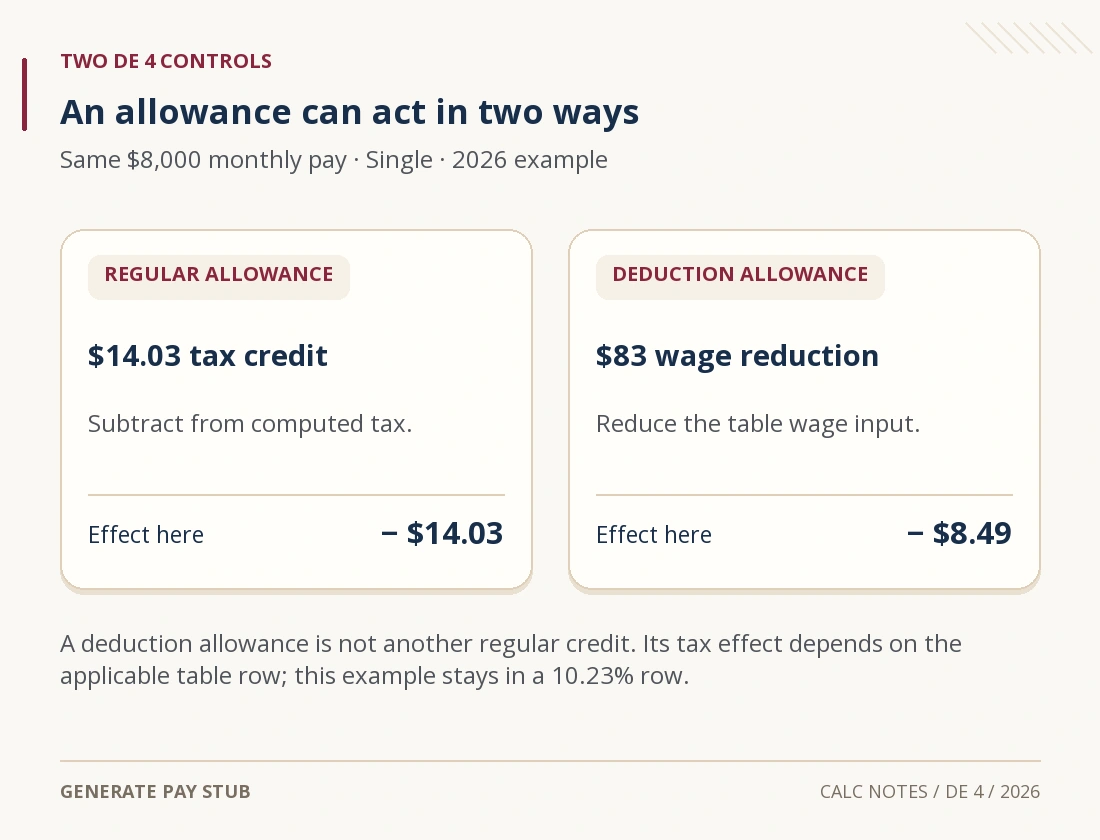
Remove the $25 extra state withholding to isolate the allowance controls. With no regular or deduction allowances, the checked monthly California PIT is $443.24. One regular allowance changes it to $429.21, a $14.03 reduction. Keeping that regular allowance and adding one estimated-deduction allowance changes it to $420.72.
| DE 4 scenario | Monthly California PIT | Monthly take-home |
|---|---|---|
| Zero regular allowances; no deduction allowances; no extra | $443.24 | $5,816.59 |
| One regular allowance; no deduction allowances; no extra | $429.21 | $5,830.62 |
| One regular and one deduction allowance; no extra | $420.72 | $5,839.11 |
| One regular allowance; no deduction allowances; $25 extra | $454.21 | $5,805.62 |
The additional deduction allowance reduces the monthly table wage input by $83; it does not subtract another $14.03 credit. Here the wage input becomes $7,441. The calculation is $293.47 + 10.23% × ($7,441 − $6,060) − $14.03 = $420.7163, rounded to $420.72. Its $8.49 effect differs from the regular allowance’s $14.03 effect.

Changing an allowance in this controlled experiment leaves gross wages, federal withholding and SDI unchanged. Do not translate that into a universal rule that every additional allowance saves the same amount; low-income tests, filing selections and table boundaries can alter the result.
Keep SDI and Paid Family Leave in one contribution calculation
For 2026, standard California SDI withholding is 1.3% of SDI-covered wages, without an annual wage ceiling. The EDD rates page lists the 2026 rate in its historical section; do not substitute a later year’s headline rate when checking 2026 pay.
Here, $8,000 × 1.3% = $104 per payment and $96,000 × 1.3% = $1,248 annually. Paid Family Leave is a component funded through SDI, not a second identical deduction to add to this calculation. The EDD payroll-tax overview also separates employee PIT and SDI from employer-paid UI and ETT.
The coverage selector models the treatment you choose; it does not decide whether your job is covered or approve an exemption. An employer-paid contribution or a voluntary/private plan can require additional wage and plan analysis. Do not simply remove SDI from a real payroll calculation without confirming the actual arrangement.
When does this California projection need more information?
The basic state tool assumes a full year with one employer and California as both the work and residence state. It spreads annual ordinary wages over the selected schedule and applies the selected published table revision. It does not recreate historical table changes within a year.
Actual payroll can require separate wage bases for benefits, noncash items or excluded payments. This projection does not model pre-tax benefit elections. The known annual local-tax and other-deduction fields are cash amounts you supply; they do not automatically find a local rate or reduce taxable wages.
Moving, working across state lines, irregular earnings, bonuses and special employment categories can need facts outside the tool. A lower calculated net amount is not proof that a California return will owe more, and a lower PIT deduction is not proof of a tax saving.
To resolve an actual difference, compare the payment year, taxable wages, frequency, federal elections, active DE 4 and SDI coverage line by line. Our California pay-stub guide covers the record labels and broader state withholding checks. Submit any certificate change through the employer, not through a calculator run.
California paycheck calculator questions
Does the federal W-4 replace California’s DE 4?
The modern W-4 is for federal withholding. California uses the separate DE 4 for state PIT elections; review both sets of settings instead of copying federal credit dollars into state allowance counts.
Is the additional California withholding field annual?
No. It is an amount for each payment. In this monthly example, $25 adds $300 across 12 modeled payments. The separate known annual cash-deduction fields use different units.
Why is SDI unchanged after I add an allowance?
The allowance changes the state PIT worksheet. Standard SDI in this example remains 1.3% of the same covered wages.
Can I compare another state?
Use the state calculator directory and check the new state’s assumptions. A side-by-side estimate is useful for planning, but one state selection does not resolve a move or multi-state wage allocation.
California 2026 source tables, current tool controls and four live scenarios checked November 6, 2026. All salary examples are fictional and depend on the stated coverage and election assumptions.