The Michigan paycheck calculator applies 4.25% to state wages after the MI-W4 exemption allowance, then adds any extra per-payment withholding. Each 2026 exemption reduces the annual calculation base by $5,900; it does not reduce tax or increase cash by $5,900.
For fictional $65,520 wages paid every two weeks, two exemptions give $87.81 state withholding per payment. One exemption gives $97.46. The result also needs a separate city-tax review before it becomes a complete budget.
Use MI-W4 rather than treating federal W-4 as a substitute
The 2026 Michigan withholding guide requires the state certificate and describes direct percentage computation after personal and dependency exemptions. The federal certificate does not replace MI-W4.
The current MI-W4 instructions use line 6 for the personal/dependent count and line 7 for additional withholding if the employer agrees. They caution against claiming the same exemptions with multiple employers or duplicating a spouse’s claims.
A state dependency exemption is not the same input as a federal W-4 credit in dollars. The MI-W4 instructions also distinguish qualifying dependents from whether a federal credit is reduced by income. Use the supported certificate count instead of reverse-engineering it from the desired take-home amount.
The Michigan paycheck calculator accepts the exemption count and additional dollars. It does not sign, file or decide entitlement to the certificate.
Set the $2,520 biweekly salary scenario
Choose 2026, enter $65,520 annual gross and select Every Two Weeks. The projection contains 26 payments of $2,520. Keep the federal status Single, the multiple-jobs checkbox off and all federal W-4 dollar adjustments at zero.
For the first Michigan test enter two valid MI-W4 exemptions and zero additional withholding. No local-tax cash amount or other deduction is supplied. A second run changes only the state count to one.
Assume ordinary full-year wages with one employer, Michigan residence and services, and identical gross, federal, FICA and state taxable wages. There are no pre-tax benefits or special earnings in this controlled setup.
The fictional two-exemption election could reflect an employee and a qualifying dependent, assuming no duplicated claim elsewhere. The comparison does not recommend that a reader change an actual certificate.
Calculate the state line after the exemption reduction
Treasury’s calendar-year table confirms the 2026 rate of 4.25% and annual exemption of $5,900. Use the selected year’s value rather than carrying a prior-year exemption forward.
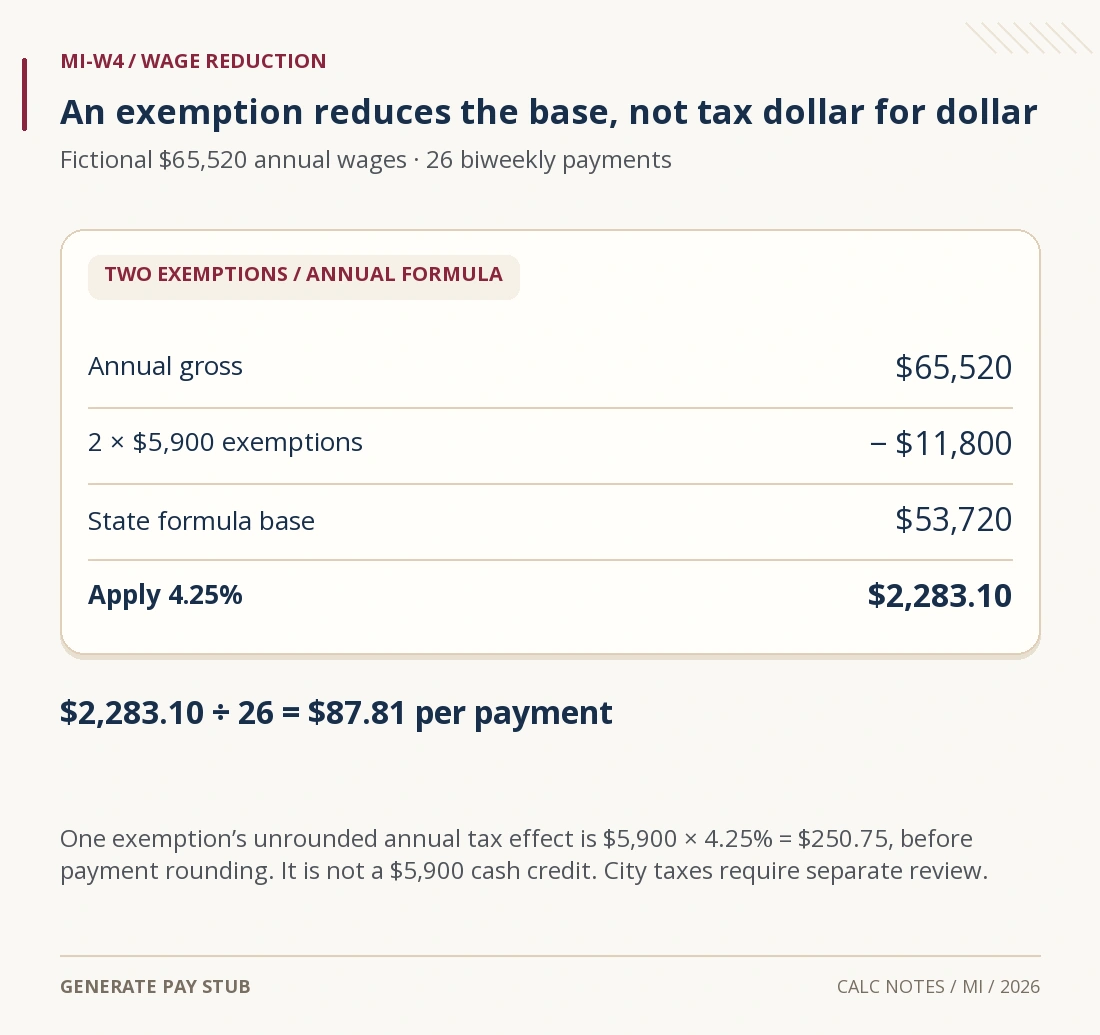
Two exemptions supply 2 × $5,900 = $11,800 of annual base reduction. The sample’s annual base is $65,520 − $11,800 = $53,720. At 4.25%, annual formula tax is $2,283.10.
Divide by 26: $2,283.10 ÷ 26 = $87.811538…, rounded to $87.81 per payment. No extra withholding is added in this run.

For one exemption, the base is $65,520 − $5,900 = $59,620. Annual formula tax is $2,533.85, and $2,533.85 ÷ 26 rounds to $97.46.
The unrounded annual formula difference is $5,900 × 4.25% = $250.75. That illustrates why the exemption is a base reduction rather than a $5,900 tax credit. Payment rounding affects the totals actually displayed by the annual model.
Compare the two count inputs with all other settings fixed
| Outcome compared | 2 exemptions | 1 exemption |
|---|---|---|
| State withheld per payment | $87.81 | $97.46 |
| Estimated cash per payment | $2,020.86 | $2,011.21 |
| State withholding summed annually | $2,283.06 | $2,533.96 |
| Estimated annual cash | $52,542.36 | $52,291.46 |
The rounded payment difference is $9.65, which adds to $250.90 over 26 checks. That is slightly different from the $250.75 unrounded annual formula comparison. Both figures can be correct when their units and rounding stages are identified.
Federal withholding and FICA remain unchanged in these two runs. The state exemption does not automatically change federal credits, Social Security wages or Medicare wages.
Reconcile the initial annual cash estimate
| Earning or deduction included | Yearly amount |
|---|---|
| Gross wages | $65,520.00 |
| Federal withholding | $5,682.30 |
| Michigan state withholding | $2,283.06 |
| Employee Social Security | $4,062.24 |
| Employee Medicare | $950.04 |
| Estimated cash before omitted items | $52,542.36 |
Each modeled payment reconciles as $2,520 − $218.55 federal − $87.81 Michigan − $156.24 Social Security − $36.54 Medicare = $2,020.86. The annual model adds the rounded payment deductions rather than simply reporting an unrounded state formula amount.
A real deposit may also include insurance, retirement, garnishments and other lines absent here. Use the net-pay reconciliation guide to compare the full statement.
Review city income tax independently
Treasury maintains a separate city income-tax resource. A state tax calculation is not a city tax determination, and cities can have their own residence, work-location and filing rules.
For example, the Detroit compensation guidance distinguishes resident compensation from nonresident work performed in the city. Applying a city rate to every worker without checking the relevant facts can misstate the deduction.
The reviewed calculator does not ask for a city or allocate work days. Its local field distributes a known annual cash amount supplied by the user; it does not compute that amount from Detroit or another city’s rules.
Obtain the appropriate city calculation or payroll record separately. Do not interpret the sample’s blank local input as proof that no city tax is due.
Check special certificates, extra dollars and actual wage bases
MI-W4 exemption claims, reciprocity and other special circumstances need their own instructions. The tool’s ordinary count and extra-dollar controls do not decide whether such a claim applies. Zero state withholding in a scenario would not by itself establish exemption from every other payroll deduction.
Additional withholding uses dollars per payment. An agreed $12 extra, for instance, would be $312 over a repeated 26-payment year; it is not a $12 annual adjustment. A signed election still follows the employer’s process.
Known other-cash deductions do not change taxable wages in this model. Qualifying pre-tax benefits can affect different tax bases, so check the benefit deduction guide rather than treating every cash subtraction alike.
Several employers, nonresident work, uneven compensation, a midyear start or changing elections require records beyond one repeated annual salary. The calculator does not prepare the final state or city return, amend payroll or verify that the entered wages were paid.
Michigan paycheck calculator questions
Does one exemption save $5,900 in cash?
No. It reduces this year’s annual state calculation base by $5,900. The tax effect depends on the rate and payment rounding.
Can I claim the same exemptions at every job?
The MI-W4 instructions warn against duplicate claims. Coordinate the actual certificates.
Does the state estimate include Detroit tax?
No. City tax needs a separate review and any known cash amount must be supplied.
Does changing the state count change my federal W-4?
No. State and federal inputs are separate in the reviewed tool.
Michigan 2026 Treasury sources, certificate controls and two live salary tests reviewed November 6, 2026. All employee and election facts are fictional.