The North Dakota paycheck calculator estimates 2026 take-home pay using the state’s percentage method for a federal W-4 dated 2020 or later. Your state filing-status selection matters. An old W-4 allowance count is not an input for this modern method.
A fictional Single employee earning $91,200 in twelve equal payments gets $55 of ordinary North Dakota withholding per month in our live check. Adding $11 of state withholding changes that line to $66. Below, you can trace the wage base, rounding and cash effect without treating an estimate as a completed tax return.
First check the W-4 version used by payroll
North Dakota’s 2026 employer booklet separates pre-2020 certificates from modern W-4s. Section 2 annualizes taxable wages and uses the filing status in Step 1(c). Its calculation does not subtract a legacy allowance amount.
The calculator’s ordinary state controls follow that modern path. If your employer still uses a valid older certificate, ask which withholding method it applies before comparing its statement with this estimate. An allowance-based result can differ even when gross pay matches.
The 2026 National Finance Center bulletin also distinguishes the two versions. Its legacy calculation includes a $5,050 annual exemption adjustment per allowance; its modern calculation applies the annual wage table directly.
Do not place a historical allowance count into a federal dollar-credit field to imitate the old method. Those entries have different meanings and can change the wrong tax line.
Enter the modern North Dakota state settings
Open the North Dakota paycheck calculator and choose 2026. The state section offers Single, Married filing jointly and Head of Household, plus a per-payment additional withholding amount. Its Single group includes married filing separately.
Review the federal and state selections individually. A household’s appropriate filing status is a factual choice; choosing a lower estimated deduction does not establish eligibility for that status.
Federal annual credits, other income, deductions and extra federal withholding belong to the federal calculation. The North Dakota screen does not expose corresponding state credit, deduction or multiple-job adjustment fields. Do not assume that changing a federal election automatically solves your state withholding needs.
If you need a broader introduction to the input units, use the free calculator walkthrough. Enter annual salary in the wage field, rather than an individual check amount.
Build the $91,200 monthly example
We tested $91,200 annual wages with Monthly selected: $7,600 gross for each of 12 payments. Federal status is Single, the multiple-job option is off, and federal adjustments are zero.
State status is also Single. The first run has no extra state amount; the second adds $11 each month. Local and other annual cash entries remain zero in both.
The fictional worker lives and works in North Dakota for the full year, has one ordinary wage job, and has no benefit deductions or special wage exclusions. Gross, federal taxable, state taxable and FICA wages therefore coincide in this example.
These assumptions make the comparison reproducible. They do not describe a worker who moved during the year, received uneven commissions or started a job in September.
Trace the $55 monthly state calculation
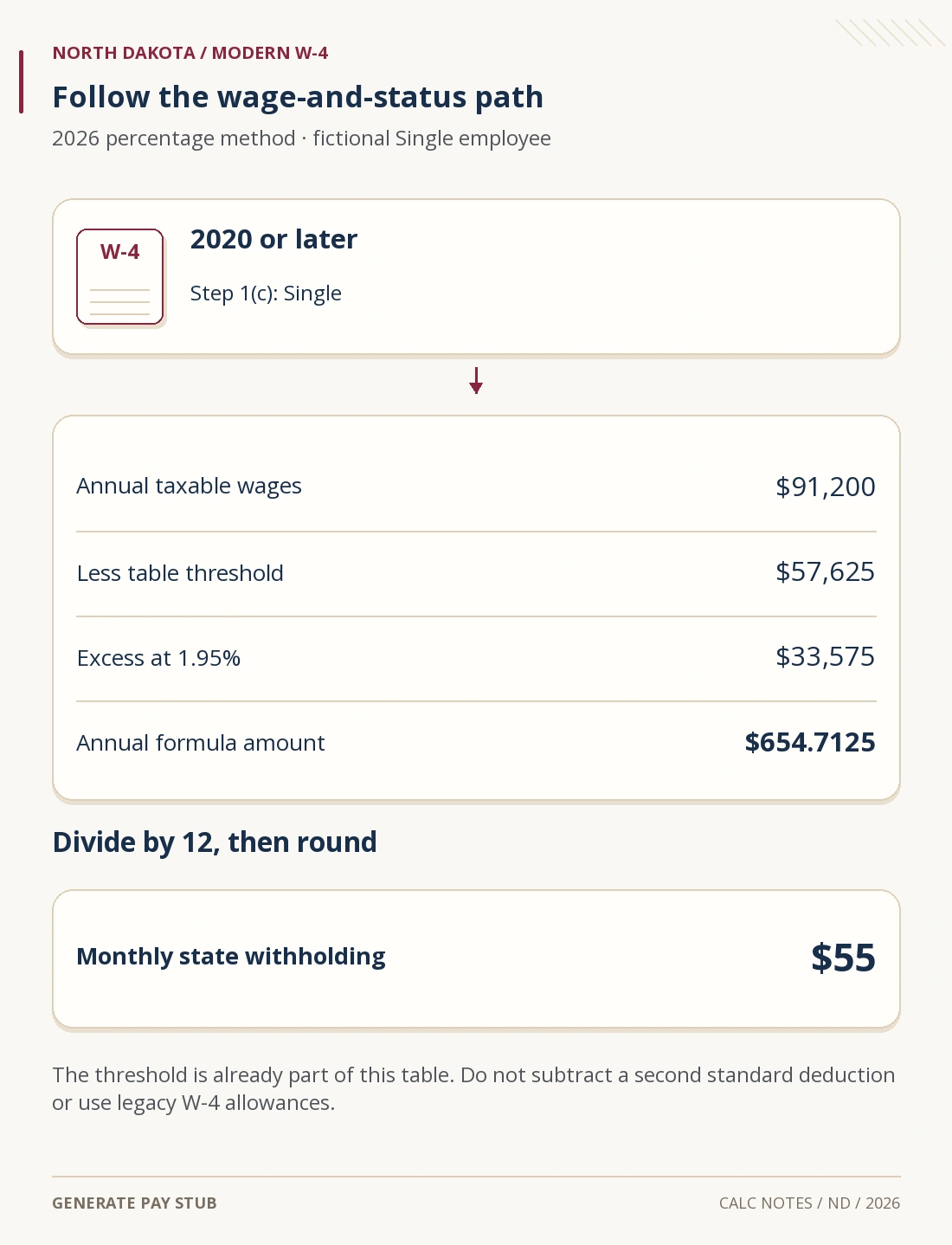
For this modern Single calculation, the 2026 annual table has a zero-withholding range through $57,625. The next band applies 1.95% to the excess. Our salary falls within that band.
Subtract $57,625 from $91,200 to get $33,575. Multiplying by 0.0195 gives $654.7125 of annual formula withholding. Divide by 12: $54.559375. Nearest-dollar payroll rounding produces $55 per month.

The annual estimate adds the rounded deductions: $55 × 12 = $660. That differs from the unrounded $654.7125 formula amount because every modeled payment is rounded separately.
The published annual tables already incorporate their payroll offsets. Subtracting a return standard deduction again would distort this reproduction. Likewise, multiplying all $91,200 by 1.95% would ignore the table’s zero band.
Source detail: the booklet’s printed $1,800 weekly illustration does not reconcile with its updated Single annual table. This guide uses the table values, independently corroborated by the federal bulletin, and checks its own salary case. A wage-bracket lookup can also differ from an exact percentage-method calculation.
Compare $11 of additional state withholding
| Output to compare | No state extra | $11 state extra |
|---|---|---|
| North Dakota per payment | $55.00 | $66.00 |
| Monthly cash projection | $6,027.43 | $6,016.43 |
| State total over 12 payments | $660.00 | $792.00 |
| Cash total over 12 payments | $72,329.16 | $72,197.16 |
The difference is $11 × 12 = $132. Federal withholding, Social Security and Medicare remain unchanged. The additional payment reduces current cash and increases prepaid state tax; it does not independently create a $132 reduction in final tax liability.
The state booklet asks employers to accommodate requests for extra withholding where possible, without prescribing a special state form for that request. Confirm the amount and first affected payday with payroll. The calculator cannot submit an instruction to your employer.
We used whole-dollar extras deliberately. Employer rounding rules, including NFC’s whole-dollar final processing, can matter when a requested extra contains cents.
Read the annual cash ledger before adding missing deductions
| Ledger entry | Year projection |
|---|---|
| Salary before deductions | $91,200.00 |
| Federal income tax withheld | $11,234.04 |
| North Dakota income tax withheld | $660.00 |
| Worker Social Security deduction | $5,654.40 |
| Worker Medicare deduction | $1,322.40 |
| Cash from the modeled wage payments | $72,329.16 |
Each monthly payment reconciles as $7,600 − $936.17 federal − $55 state − $471.20 Social Security − $110.20 Medicare = $6,027.43.
If actual payroll includes retirement contributions, health coverage, a garnishment or another authorized deduction, compare its effect on taxable wages and cash separately. A general cash adjustment cannot determine the legal tax treatment of a benefit. See the deduction wage-base guide.
Check reciprocity, multiple jobs and special situations
The state’s withholding guidance identifies reciprocity for qualifying Minnesota and Montana residents working in North Dakota. Form NDW-R and its conditions matter; this ordinary resident calculation does not determine that exemption.
A zero in the state estimate is not proof that wages are tax-free everywhere. A reciprocal resident may still have home-state obligations. Do not choose a different state merely to make a deduction disappear.
For multiple employers, add actual wages and withholding from each before assessing a shortage. A single annual salary projection has no knowledge of another employer’s payments, investment income, credits or payments already made.
Bonuses, nonresident work allocations and part-year residency need their own treatment. A worker using a legacy certificate needs the matching method rather than a cosmetic adjustment to this one.
North Dakota paycheck calculator questions
Why is there no state allowance-count field?
This tool follows the modern W-4 wage-and-status method. The older allowance procedure is different.
Does the $57,625 threshold mean everyone below it owes no state tax?
No. It is a payroll-table threshold for this status and method, not a complete return analysis.
Why does the annual state total show $660 rather than $654.7125?
The estimate totals twelve separately rounded $55 deductions.
Can this estimate verify income for an application?
No. It forecasts entered wages; it does not establish that an employer paid them.
North Dakota method and live examples reviewed November 6, 2026.