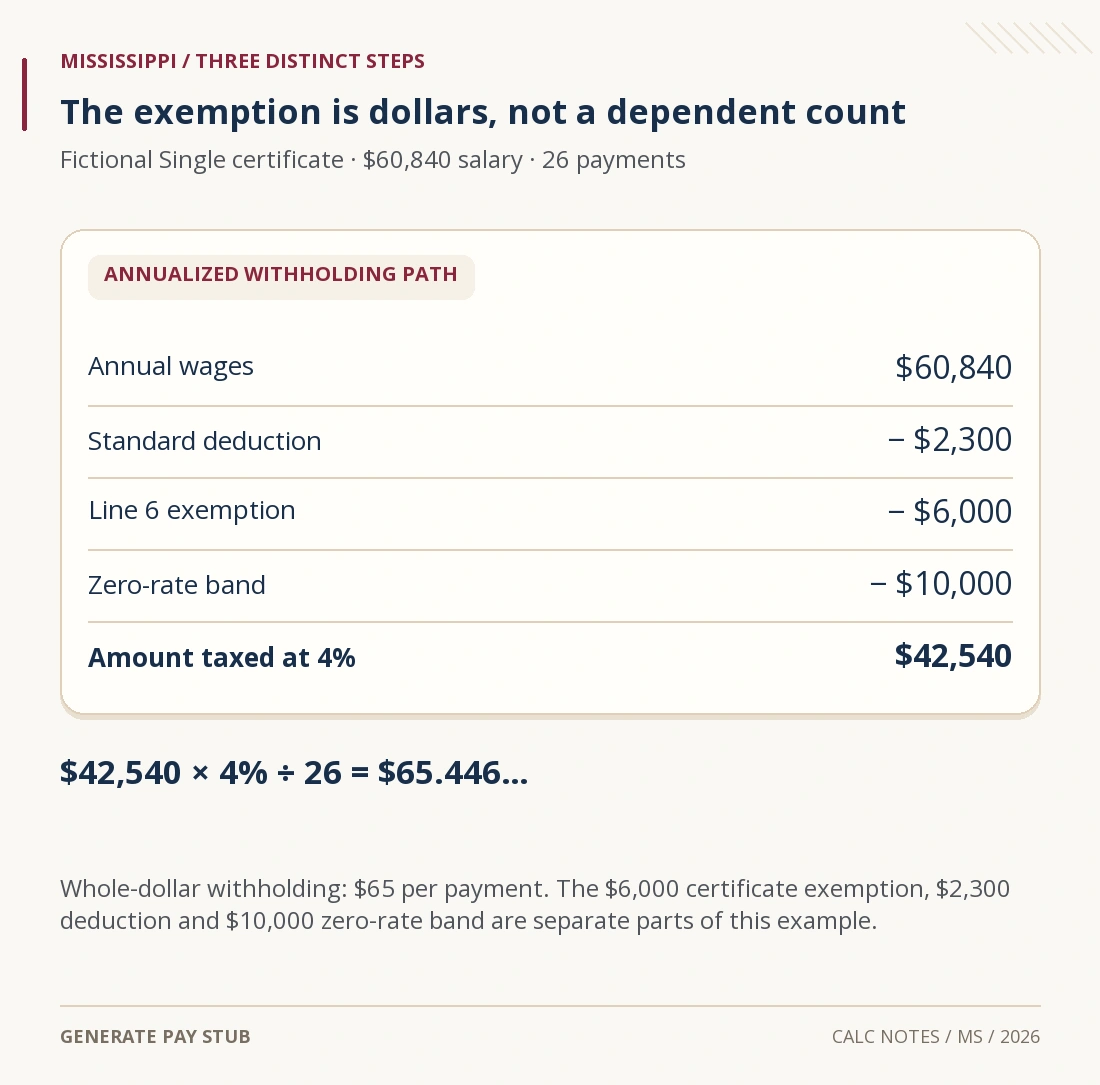
For Mississippi’s 2026 paycheck calculation, enter the total annual exemption dollars from Form 89-350 line 6. The tool separately applies the status-based standard deduction and the $10,000 zero-rate band, then uses 4% on the remaining amount. Entering “1” to represent one dependent would not supply the correct certificate total.
Our fictional Single employee earns $60,840 in 26 equal payments. A $6,000 certificate exemption gives $65 state withholding per check after whole-dollar rounding. A supported $7,500 exemption gives $63. Here is how to reproduce and interpret both results.
Read Form 89-350 line 6 as an annual dollar total
The current Mississippi exemption certificate totals the relevant personal, dependent and other permitted exemptions on line 6. A Single personal exemption is $6,000; a qualifying additional dependent generally supplies $1,500. The taxpayer and spouse are not additional dependents for this purpose.
The same certificate separates the married allocation, head-of-family treatment and age/blindness claims. It also places agreed additional withholding on line 7 as dollars per pay period. Use its actual instructions to establish the total rather than choosing a number to reach a preferred deposit.
The Mississippi paycheck calculator labels its exemption field in annual dollars. For a valid Single claim of $6,000 plus one qualifying $1,500 dependent exemption, the input is $7,500, not 1, 2 or $1,500 alone.
Federal W-4 credits and adjustments belong in the federal section. They do not automatically populate this state certificate total.
Enter a controlled $60,840 salary case
Select 2026, enter annual gross of $60,840 and choose Every Two Weeks. The projection divides wages into 26 payments of $2,340. Select Single for the federal calculation, leave multiple jobs off and keep federal credit, income, deduction and additional-withholding amounts at zero.
For Mississippi select S, enter $6,000 annual exemption and zero extra withholding. Leave the local and other annual cash amounts at zero. A second test will change only the certificate total to $7,500.
Assume full-year ordinary wages from one employer, residence and work entirely in Mississippi, and equal federal, Social Security, Medicare and state wage bases. No benefits reduce taxable wages, no special payments occur and no exemption from withholding is claimed.
This is a comparison of hypothetical supported inputs, not advice to claim a dependent or change a signed certificate. An actual worker must establish the underlying facts first.
Keep the deduction, exemption and zero-rate band separate
The DOR’s computer payroll flowchart for periods in 2026 subtracts the appropriate standard deduction and certificate exemption from annualized wages. Its next stage taxes the excess over $10,000 at 4%, converts to a payment amount and rounds to whole dollars.
For our Single case, $60,840 − $2,300 standard deduction − $6,000 certificate exemption = $52,540. Only $52,540 − $10,000 = $42,540 reaches the 4% calculation.
Annual formula withholding is $42,540 × 4% = $1,701.60. Dividing by 26 gives $65.446153…; the payment amount rounds to $65. With no extra election, that is the displayed state deduction.

The DOR’s year-specific rate table distinguishes 2026’s 4% from 2025’s 4.4% and 2027’s 3.75%. A 2026 estimate should not use a future rate merely because the next year is approaching.
Zero-rated income is part of the formula; it is not an employee’s blanket exemption from all payroll taxes. Federal withholding and FICA can remain even where the state amount is zero.
Compare $6,000 and $7,500 certificate totals
| Result measured | $6,000 exemption | $7,500 exemption |
|---|---|---|
| State withheld each payment | $65.00 | $63.00 |
| Cash each payment | $1,899.04 | $1,901.04 |
| State withholding summed for year | $1,690.00 | $1,638.00 |
| Annual estimated cash | $49,375.04 | $49,427.04 |
In the second case, the amount above the zero-rate band becomes $41,040. Its annual formula tax is $1,641.60; dividing by 26 gives $63.138461…, rounded to $63.
The $1,500 additional exemption changes the unrounded annual formula by $60. But 26 repeated rounded deductions differ by $52: ($65 − $63) × 26. That rounding distinction explains why the annual model’s difference does not equal exactly $1,500 × 4%.
Neither change alters federal withholding or FICA in these tests. State exemption dollars reduce the state formula base, rather than creating a federal wage adjustment or a dollar-for-dollar credit.
Reconcile the first estimate to annual cash
| Cash calculation line | Annual amount |
|---|---|
| Gross earnings | $60,840.00 |
| Federal withholding | $5,120.70 |
| Mississippi withholding | $1,690.00 |
| Employee Social Security | $3,772.08 |
| Employee Medicare | $882.18 |
| Estimated cash before omitted deductions | $49,375.04 |
For one payment, $2,340 − $196.95 federal − $65 state − $145.08 Social Security − $33.93 Medicare = $1,899.04. The annual result sums these rounded payment lines.
Use the gross-to-cash guide to add an actual statement’s remaining deductions. A salary-only illustration cannot predict benefits, retirement contributions or a garnishment that was never entered.
Review household claims and employer procedures first
The DOR’s revised 2026 employer instructions discuss separate status tables and coordinated married claims. Where both spouses work, the permitted joint personal exemption cannot simply be duplicated in full on both certificates. Separate-return circumstances also require attention to allocation instructions.
Head-of-family treatment already accounts for the dependent needed to qualify for that category. Do not add that same qualifying dependent again as an extra exemption. Age and blindness claims have their own restrictions.
If an additional dollar amount is agreed with the employer, it is a payment-level request. For example, $8 extra over 26 identical payments represents $208 during that modeled year; it is not an $8 annual adjustment. Follow the employer’s certificate process.
The ordinary salary controls do not decide a military-spouse exemption, special nonresident allocation or another exceptional withholding treatment.
Understand what this annual estimate leaves to payroll records
The example assumes a single state for residence and services. Work across state lines, unequal pay, bonuses, a midyear start or changes in elections can require payment-specific calculations. A repeated annual model does not reconstruct earlier checks.
Local and other cash fields distribute amounts you already know. They do not determine local law or identify which benefit reduces which taxable wage base. See the deduction treatment guide for that separate review.
Withholding is money prepaid toward tax, not a final return calculation. The free calculator does not file a certificate or return, prove employment or establish that any entered wage was paid.
Mississippi paycheck calculator questions
Should I type the number of dependents into the exemption field?
No. Supply the full annual exemption dollar total from line 6.
Does the $10,000 zero-rate band replace the personal exemption?
No. The calculation uses separate steps for the certificate exemption, standard deduction and zero-rate band.
Why does the annual state amount differ from the unrounded formula?
The model adds payment withholding after whole-dollar rounding.
Can I use the 2027 rate for a 2026 payment?
Use the applicable year’s rules. This guide’s verified scenarios use 2026.
Reviewed November 6, 2026 using Mississippi DOR sources and two live calculator tests. Employee facts are fictional.