The Minnesota paycheck calculator uses your W-4MN status and allowance count to estimate 2026 state withholding. Its annual result excludes Minnesota Paid Leave because the permitted deduction needs coverage and minimum-wage information beyond an annual salary. Check that excluded line before treating the result as a deposit forecast.
A fictional $93,960 salary, paid twice monthly with two Minnesota allowances, produces $202.75 state withholding per payment. This guide follows the chart calculation, compares an extra-withholding election and separates the unpaid premium question from the income-tax answer.
Translate W-4MN into the calculator controls
Minnesota’s certificate guidance calls for W-4MN when employment begins or relevant circumstances change. Without the state form before the first payment, its stated fallback is Single with zero allowances.
The current 2026 W-4MN has a worksheet for the allowance count, a separate per-pay-period additional amount and a distinct exemption section. Its Single-rate choice also covers certain married elections. An allowance is a count here, not an annual dollar credit from federal W-4.
In the free Minnesota calculator, select the applicable state rate category, enter the supported count and add any requested extra dollars. Use the certificate’s instructions for multiple jobs and household circumstances; the interface does not determine entitlement to a claim.
Do not enter a federal tax credit into the state allowance box. Federal elections remain in their own section and affect a different withholding calculation.
Set a twice-monthly salary example
Choose 2026 and $93,960 annual gross, with Twice Monthly as the payment schedule. That means 24 modeled payments of $3,915. A biweekly schedule would have 26, so it would not reproduce this example.
Keep federal filing status Single, multiple jobs unchecked and all modern federal W-4 dollar adjustments zero. Set Minnesota to Single, two allowances and no extra withholding. Enter no local or other cash deduction.
Assume ordinary wages throughout the year with one employer, Minnesota residence and work, and matching federal, FICA and state taxable wage bases. No retirement, insurance, special compensation or cross-state adjustment reduces wages here. These fictional assumptions isolate the controls; they do not recommend a certificate election.
Follow the 2026 chart without taking a second standard deduction
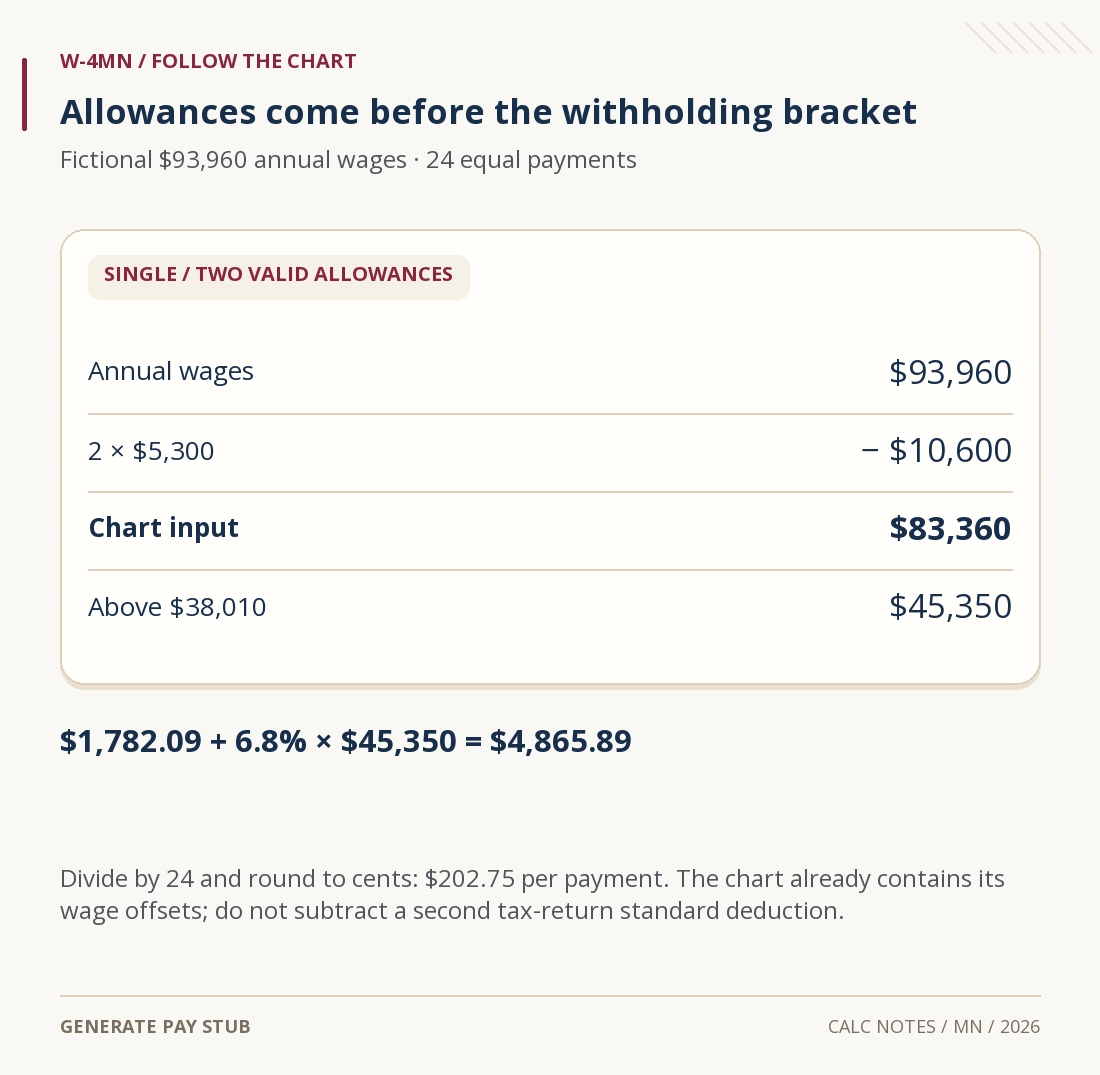
The state’s 2026 withholding instructions, computer formula on page 34, annualize wages, subtract $5,300 per allowance, apply the relevant chart and divide by the number of payments. The chart already incorporates its wage offsets.
First subtract 2 × $5,300 = $10,600 from $93,960. The resulting $83,360 falls in the Single chart’s interval above $38,010 through $114,130.
Use the bracket’s base amount plus its marginal component: $1,782.09 + (($83,360 − $38,010) × 6.8%) = $1,782.09 + $3,083.80 = $4,865.89. This is a withholding formula amount before payment conversion, not the employee’s final tax-return liability.

Divide $4,865.89 by 24 to get $202.745416…; the reviewed tool displays $202.75. The official instructions permit nearest-dollar rounding, so an employer using that option may show a different payment figure.
Do not separately subtract an individual-return standard deduction before this chart. That would apply an additional reduction outside the published payroll sequence.
Test a $15 extra-withholding request
| Model result | No extra | Extra $15 each pay |
|---|---|---|
| State withholding per payment | $202.75 | $217.75 |
| Cash per payment before excluded items | $2,919.37 | $2,904.37 |
| State withholding for the year | $4,866.00 | $5,226.00 |
| Cash for the year before excluded items | $70,064.88 | $69,704.88 |
The second run changes only the state additional amount. Fifteen dollars repeated over 24 payments adds $360 to annual withholding and reduces annual cash by $360. It does not reduce wages or change the federal calculation.
Annual state withholding of $4,866 is the sum of rounded $202.75 payments. The eleven-cent difference from $4,865.89 comes from rounding at the payment stage, not an additional tax.
Read the initial cash result before omitted deductions
| Included line | Annual total |
|---|---|
| Gross salary | $93,960.00 |
| Federal income tax withholding | $11,841.12 |
| Minnesota income tax withholding | $4,866.00 |
| Employee Social Security | $5,825.52 |
| Employee Medicare | $1,362.48 |
| Cash before excluded or unentered deductions | $70,064.88 |
One modeled payment is $3,915 − $493.38 federal − $202.75 state − $242.73 Social Security − $56.77 Medicare = $2,919.37. Minnesota Paid Leave is absent from those deductions, rather than shown as a confirmed zero obligation.
Check the pay-stub cash reconciliation guide when comparing an actual deposit that also contains benefits or other deductions.
Review Minnesota Paid Leave separately
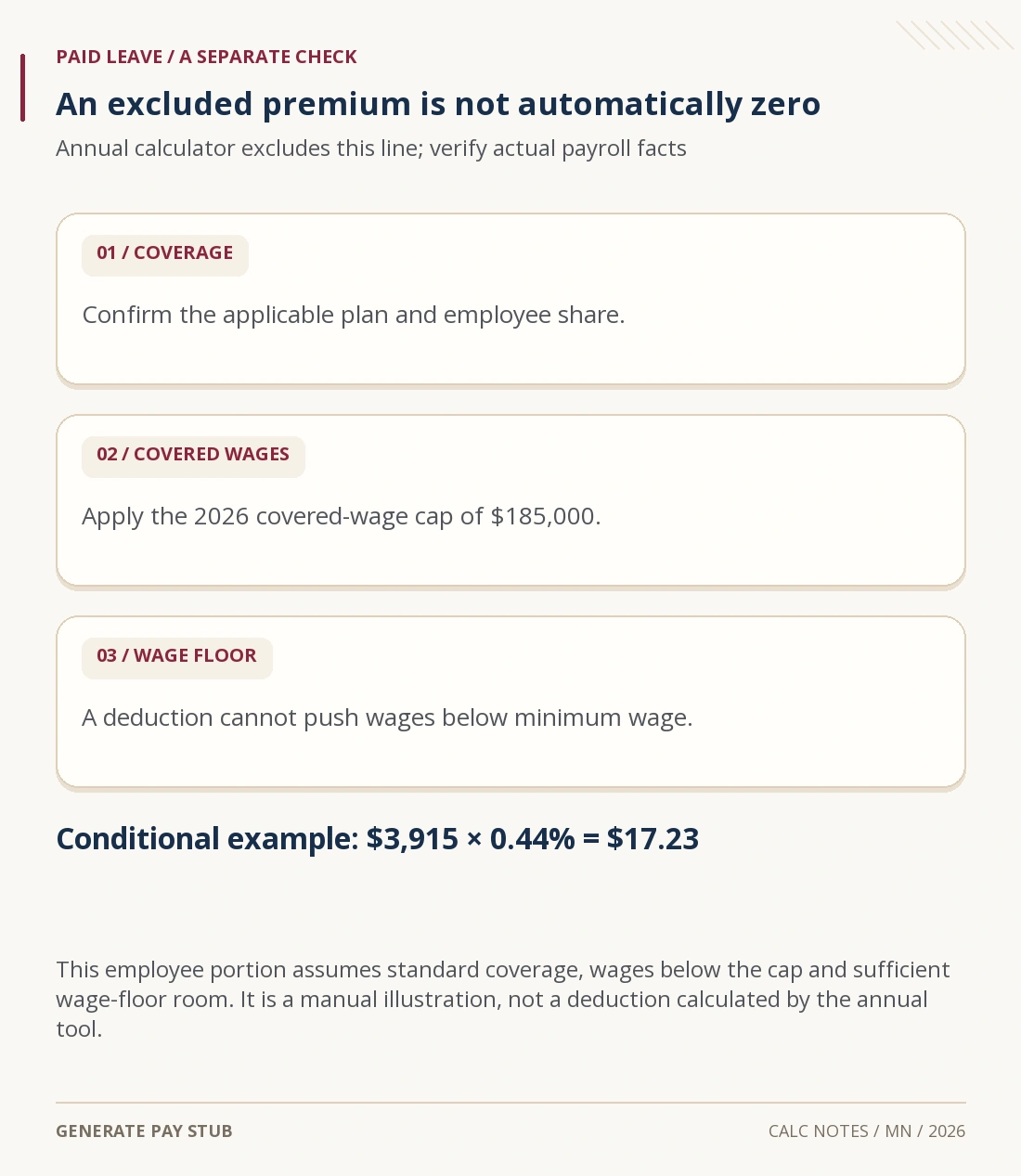
The reviewed annual API identifies MN Paid Leave as excluded. Knowing a percentage alone is insufficient: payroll must establish the applicable coverage, covered wages and permitted employee deduction, including the minimum-wage restriction.
DEED’s 2026 premium designation sets a standard combined rate of 0.88%, with an employee share up to 0.44%. Its qualifying small-employer schedule has a 0.66% combined rate while retaining an employee maximum of 0.44%; do not assume half of 0.66% is the applicable employee maximum. Eligibility for that schedule has additional conditions.
The same designation uses a $185,000 covered-wage cap, reflecting statutory rounding to the nearest thousand. Do not silently substitute an unrounded Social Security wage limit.
The Department of Labor and Industry’s Paid Leave protections prohibit deductions that push wages below minimum wage. Annual salary alone does not establish the available room under the applicable wage floor.

For a separate manual illustration only, suppose standard coverage applies, this payment’s wages remain below the annual cap, the employee owes the full standard share and sufficient wage-floor room exists. Then $3,915 × 0.44% = $17.226, or $17.23 when rounded to cents.
Those assumptions must be checked before subtracting anything from cash. Employer-paid premiums, approved alternative coverage and actual payroll restrictions can change the outcome. A tool exclusion cannot establish an exemption or decide benefit eligibility.
Know when the annual model needs additional records
Multiple jobs, unequal checks, midyear employment, exemption claims, reciprocity and nonresident services require more than this repeated-salary scenario. Consult the appropriate state instructions and actual payroll records before applying a special treatment.
A known annual local or other cash amount can be entered for budgeting, but those fields do not automatically calculate a jurisdiction’s tax or reduce taxable wage bases. Check pre-tax versus post-tax treatment independently.
The free estimate does not submit W-4MN, complete a tax return, certify wages or create proof of earned income. Document preparation is a separate service using accurate underlying records.
Minnesota paycheck calculator questions
Are Minnesota allowances annual dollars?
No. Enter the certificate count; the selected year’s formula assigns its dollar value.
Why might payroll show whole-dollar withholding?
The state permits that rounding option. This reviewed calculator retains cents per payment.
Does a missing Paid Leave line mean I owe nothing?
No. It means the annual model has not calculated the permitted deduction.
Does extra withholding lower my tax rate?
No. It increases amounts prepaid through payroll without changing the underlying rate chart.
Reviewed November 6, 2026 against Minnesota agency guidance and two live calculator scenarios. Figures and employee facts are illustrative.