Nebraska’s paycheck calculator subtracts the payment-period value of W-4N allowances, applies the 2026 percentage table and checks a minimum-withholding benchmark. Its controls do not determine whether an employer is covered by the special rule or whether documentation permits lower withholding. That limitation matters when a large allowance count makes the ordinary result small.
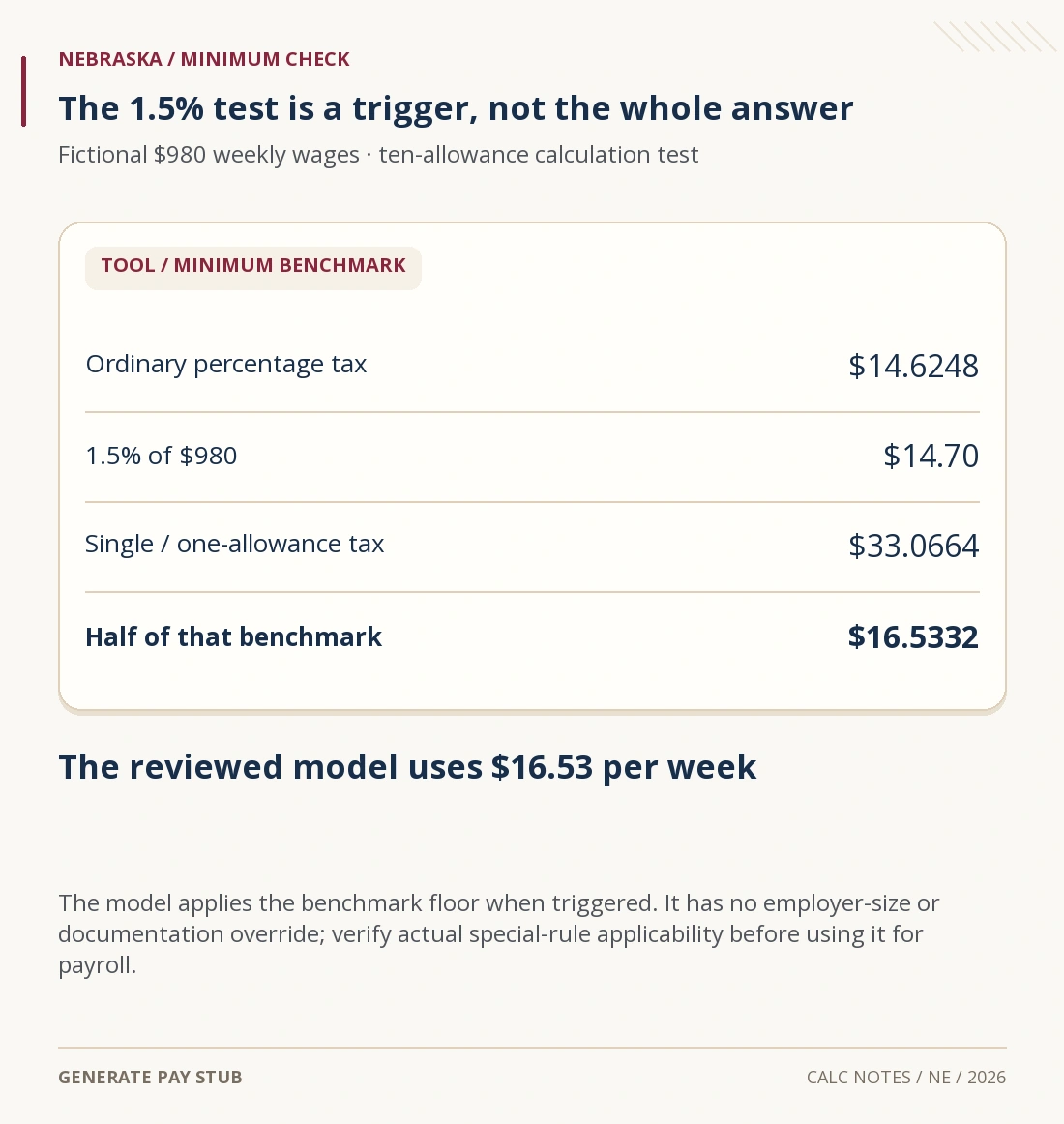
At fictional weekly wages of $980, two allowances produce $30.96 state withholding. A separate ten-allowance test produces $16.53 after the tool’s minimum check. The second figure is not simply 1.5% of wages, and neither test determines what a reader may claim.
Enter the W-4N count separately from federal W-4
The Nebraska allowance certificate uses the worksheet total on line 1 and extra dollars per check on line 2. It directs Head of Household and married-separate employees to the Single category for this withholding purpose.
The free Nebraska paycheck calculator therefore offers Single/head-of-household and Married/surviving-spouse groups, plus an integer allowance count. This count is not an annual dollar amount and not the federal W-4 dependent-credit field.
Work through the actual certificate to establish a supported count. Family facts, other jobs and elections can matter; the calculator cannot certify any of them. A comparison between two counts is a mathematical test, not permission to increase allowances.
A state exemption claim is also distinct from entering several allowances. The ordinary controls do not file or evaluate that claim.
Set a $980 weekly wage example
Select 2026, annual gross of $50,960 and Weekly. The model projects 52 equal payments of $980. Keep the federal setting Single, multiple jobs off and all modern W-4 annual adjustments and payment extras at zero.
For Nebraska use Single with two allowances and zero additional withholding. Enter no local or other cash amount. A separate test changes only the state count to ten so that the minimum calculation becomes visible.
Assume one employer for all 52 payments, Nebraska residence and services, ordinary employee compensation and identical federal, FICA and state taxable wages. There are no benefits or special compensation adjustments.
For the minimum illustration, assume the employer is subject to the special procedures and has no accepted documentation supporting a lower amount. These assumptions should not be transferred to a real payroll without review.
Calculate the ordinary two-allowance result
The 2026 Circular EN instructions assign $46.92 to one weekly allowance. Two allowances remove 2 × $46.92 = $93.84 from $980, leaving $886.16 for the period table.
The 2026 weekly Single percentage table places this amount above $772 through $1,449. Its calculation is $25.85 + (($886.16 − $772) × 4.48%) = $30.964368, rounded to $30.96.
At these inputs, ordinary withholding exceeds $980 × 1.5% = $14.70, so the minimum check does not increase it. No additional state amount is requested.
Use the weekly allowance value and weekly table together. Subtracting an annual $2,440 allowance from a single weekly payment would mix incompatible units.
Follow the benchmark when ordinary withholding is low
Circular EN’s percentage-method instructions describe a minimum acceptable amount based on half the tax for Single with one allowance, or Married with two, when the ordinary calculation is below 1.5% of taxable wages. The percentage is a comparison point, not automatically the final deduction.
In our ten-allowance test, $980 − (10 × $46.92) = $510.80. The ordinary weekly formula becomes $10.76 + (($510.80 − $419) × 4.21%) = $14.62478, below the $14.70 comparison point.
For the benchmark, one allowance leaves $933.08. The weekly Single formula gives $25.85 + (($933.08 − $772) × 4.48%) = $33.066384. Half is $16.533192. The reviewed tool selects this higher floor, then rounds to $16.53.

The state’s special-withholding FAQ generally applies the procedures to employers with 25 or more employees and explains supporting documentation and the acceptable benchmark. The calculator does not ask for employer size or documentation, so it cannot decide whether this floor matches a particular employee’s payroll.
Compare the two inputs without changing federal elections
| Model outcome | 2 allowances | 10-allowance test |
|---|---|---|
| State withholding per payment | $30.96 | $16.53 |
| Estimated cash per payment | $798.39 | $812.82 |
| State withholding for 52 payments | $1,609.92 | $859.56 |
| Estimated annual cash | $41,516.28 | $42,266.64 |
The difference is $14.43 per week and $750.36 over 52 payments. It is not a tax credit and does not establish that either certificate count is correct for a real employee. Federal and FICA lines stay fixed because their inputs are unchanged.
Adding a legitimate state extra amount would increase the selected withholding. For example, an $11 weekly extra represents $572 over 52 repeated payments. It does not reduce taxable wages.
Reconcile the two-allowance cash estimate
| Line in the estimate | Annual amount |
|---|---|
| Gross wages | $50,960.00 |
| Federal withholding | $3,935.36 |
| Nebraska withholding | $1,609.92 |
| Employee Social Security | $3,159.52 |
| Employee Medicare | $738.92 |
| Cash before unentered deductions | $41,516.28 |
One payment reconciles as $980 − $75.68 federal − $30.96 state − $60.76 Social Security − $14.21 Medicare = $798.39. The model sums rounded payment lines to obtain annual totals.
Review the cash reconciliation guide if an actual deposit also contains insurance, retirement or another payroll item.
Check applicability before adopting a low-withholding estimate
The certificate’s employer instructions allow properly documented circumstances to support lower withholding. The reviewed tool has no override for that documentation and no employer headcount control. A result containing its benchmark may therefore differ from an authorized payroll outcome.
This limitation is especially relevant to small employers or workers with accepted substantiation. Ask payroll which method applies; changing a count until a desired number appears does not resolve the missing facts.
Separate-state services, nonresident allocation, special exemptions, bonuses and midyear changes also require records beyond this weekly salary projection. The calculator does not allocate workdays or prepare a state return.
Known local and other annual cash amounts are budgeting inputs. They do not determine a local rule or change taxable benefit treatment; check deduction tax bases separately.
Using the free calculator does not submit W-4N or verify compensation. A pay statement must be based on wages actually earned and paid.
Nebraska paycheck calculator questions
Is the allowance field an annual dollar amount?
No. It accepts the certificate count and applies the payment-period value.
Is the minimum always exactly 1.5%?
No. The reviewed method tests that level and can use a separate acceptable benchmark.
Can the calculator approve documentation for lower withholding?
No. That employer procedure is outside its controls.
Does Head of Household have its own group here?
The state certificate directs that status to the Single withholding group.
Reviewed November 6, 2026 against Nebraska sources and two live input tests. The ten-allowance scenario demonstrates calculation behavior only.