Montana’s 2026 paycheck estimate uses the MW-4 withholding group, the updated annual wage table and any extra amount per payment. The reviewed calculator rounds ordinary state withholding upward to a whole dollar before adding the extra election. It does not use the former Montana allowance count.
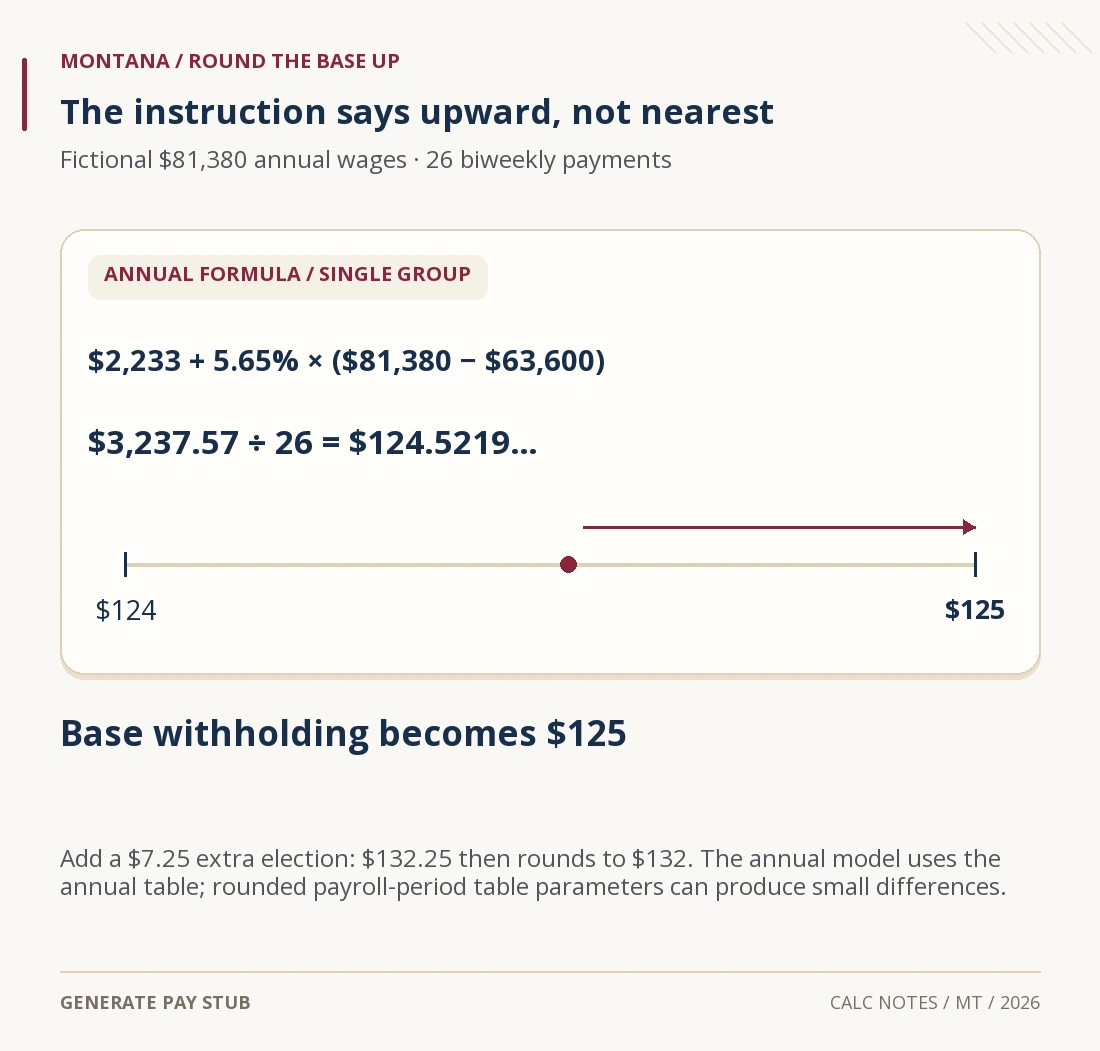
For fictional annual wages of $81,380 paid every two weeks, the Single group produces $125 base withholding. Adding $7.25 extra gives a rounded total of $132. This guide explains the wage thresholds, the rounding choice and certificate features that need separate handling.
Use the 2026 system instead of old allowances
Montana’s 2026 withholding update describes a lower top ordinary rate of 5.65% and wider lower-rate brackets. It also explains that the wage method now relies on filing-status deductions rather than the former Montana personal/dependent allowance system.
A 2025 table or an old allowance-based worksheet will not reproduce the selected 2026 projection. Later-year rates are also different rules, so keep the applicable year visible when comparing estimates.
Open the free Montana paycheck calculator for the actual year, wage and schedule. Its state controls ask for a withholding group and additional dollars; they do not ask for a dependent count.
Withholding is a payroll prepayment. Even a correctly reproduced wage formula does not decide every adjustment, credit or other income item on the final Montana return.
Choose the MW-4 group that matches the certificate
The 2026 MW-4 distinguishes Single/separate, joint/surviving spouse and Head of Household. Its both-spouses-working box calls for similar incomes; significantly unequal earnings or additional jobs instead require the worksheet described in its instructions.
The calculator’s Single/separate/both-spouses-working group corresponds to the relevant shared table. The other choices are the joint group and Head of Household. Do not use the shared group merely because any second income exists; follow the actual certificate and worksheet conditions.
A federal multiple-jobs checkbox is a separate control. Changing it does not complete Montana’s household worksheet. Similarly, choosing a state group does not edit the federal W-4 inputs.
The full certificate includes specified withholding and exemptions as well. Those are different from the ordinary group-plus-extra calculation reviewed here.
Set a $3,130 biweekly wage case
Enter 2026, annual gross of $81,380 and Every Two Weeks. With 26 payments, gross is $3,130 per payment. Federal status is Single, the multiple-jobs box is unchecked and every modern federal W-4 dollar adjustment is zero.
Choose Montana’s Single group with zero additional withholding. Supply no local or other annual cash amount. The second run changes only the Montana extra field to $7.25.
Assume a full year of regular employee wages with one employer, Montana residence and services, no benefits reducing wages and no special exemption. Gross and the federal, FICA and state wage bases are identical in this illustration.
The employee’s facts are fictional. This makes the arithmetic traceable without suggesting that a particular reader qualifies for a certificate election.
Follow the annual table, then round the ordinary payment upward
The 2026 employer guide gives the Single-group annual formula above $63,600 as $2,233 plus 5.65% of the excess. Our excess is $81,380 − $63,600 = $17,780; the formula gives $2,233 + $1,004.57 = $3,237.57.
The $63,600 wage-table threshold incorporates the $16,100 deduction and $47,500 lower-rate span. Do not apply the higher rate to gross wages above $47,500, or subtract $16,100 again before using this wage table.
Dividing by 26 produces $124.521923…. The guide’s explicit formula instruction says to round upward; the reviewed tool therefore uses $125. Some worked examples elsewhere in the same guide describe nearest-dollar rounding. The 2026 federal payroll implementation independently specifies upward base rounding followed by nearest-dollar rounding after extra withholding.

The annual table also contains rounded base amounts. Use the published $2,233 when reproducing this method rather than rebuilding it from unrounded lower-band arithmetic. Payroll-period tables use their own rounded parameters and can produce small differences.
Compare the $7.25 additional election
| Output compared | No state extra | $7.25 extra input |
|---|---|---|
| State withholding per payment | $125.00 | $132.00 |
| Cash per payment | $2,416.57 | $2,409.57 |
| State withholding for the year | $3,250.00 | $3,432.00 |
| Annual cash projection | $62,830.82 | $62,648.82 |
The base $125 plus $7.25 becomes $132.25, rounded to $132. Consequently the repeated change is $7 per check and $182 for the year. That differs from $7.25 × 26 = $188.50 because the model rounds the final state payment.
Federal and FICA deductions are identical across these runs. Additional state withholding is not a pre-tax benefit deduction and does not lower the federal wage base.
Reconcile the initial annual cash result
| Included earning or deduction | Annual amount |
|---|---|
| Gross wages | $81,380.00 |
| Federal withholding | $9,073.48 |
| Montana withholding | $3,250.00 |
| Employee Social Security | $5,045.56 |
| Employee Medicare | $1,180.14 |
| Estimated cash before omitted items | $62,830.82 |
Payment cash is $3,130 − $348.98 federal − $125 state − $194.06 Social Security − $45.39 Medicare = $2,416.57. Multiplying by 26 reconciles the annual total.
Insurance, retirement contributions, a garnishment or another unentered amount can reduce an actual deposit further. See the pay-stub cash guide before treating the projection as a complete statement.
Handle specified amounts and exemptions outside the ordinary controls
MW-4 line 4 permits a specified withholding direction under its instructions; line 5 addresses special exemptions. Neither is the same as adding positive dollars to the ordinary formula. The reviewed calculator does not implement those elections.
Follow the certificate and employer process for a special claim. A zero calculated result alone does not establish exemption, and entering a group does not submit a signed form.
Mixed-state work, several jobs, nonresident rules, supplemental compensation and partial-year employment require additional records. This full-year ordinary wage example does not allocate services or model every payment type.
The local and other cash fields spread known annual amounts without deciding their legal basis. They also do not identify which benefits reduce taxable wages; review pre-tax treatment separately.
The free estimate does not file a return or certify employment. Any generated pay statement must use accurate compensation records.
Montana paycheck calculator questions
Where do I enter Montana personal allowances?
The reviewed 2026 method does not use that former allowance count.
Is the higher-rate wage threshold $47,500 for this Single example?
No. The annual wage table’s corresponding threshold is $63,600 because it already incorporates the deduction.
Does the tool round the base to the nearest dollar?
It rounds the ordinary base upward, then applies the extra election and final rounding.
Does the both-spouses-working group replace the worksheet?
Use the certificate’s conditions. Unequal incomes or additional jobs can require the worksheet and a separate extra amount.
Reviewed November 6, 2026 with current Montana guidance and two live annual-calculator tests.