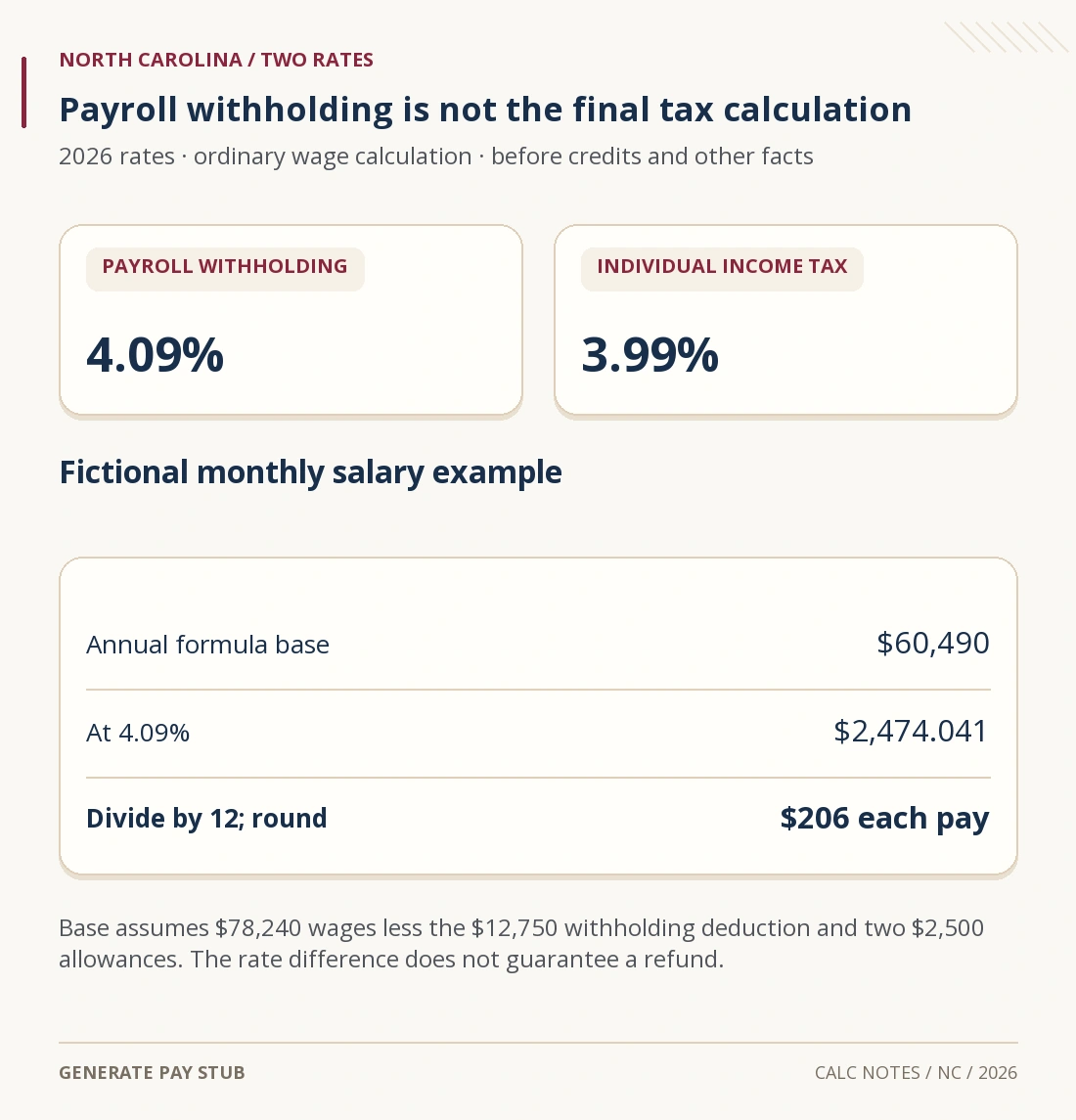
North Carolina’s 2026 paycheck calculator uses a 4.09% payroll withholding rate after the NC-30 deduction and NC-4 allowances. The individual income-tax rate is 3.99%. Those different rates serve different purposes; neither means that 4.09% should simply be taken from every dollar of gross pay.
With fictional annual wages of $78,240 paid monthly, two supported state allowances give $206 withholding per check. Zero allowances give $223. This guide follows both verified results and explains why a payroll deduction is not a complete tax-return calculation.
Distinguish the 4.09% withholding rate from the 3.99% tax rate
NCDOR’s individual rate schedule lists 3.99% for 2026. Its 2026 employer instructions explain that wage withholding uses the individual rate plus one tenth of a percentage point, producing 4.09%.
The extra 0.10 percentage point is part of the payroll method. It is not a new rate for the employee’s final return, and it is not 0.10% of the withholding amount.
A final refund or balance depends on actual taxable income, credits, payments and household circumstances. A slightly higher payroll percentage cannot promise a refund on its own.
Open the North Carolina paycheck calculator with the correct year. Do not replace the current payroll percentage with a headline tax rate or a later-year projection.
Use the NC-4 worksheet rather than counting children automatically
The current NC-4 packet determines allowances using its worksheet, including relevant deductions, adjustments and credits. The count is not automatically the number of dependents.
The certificate puts the allowance total on line 1 and additional whole dollars per payment on line 2. Its instructions address more than one job and coordinated married calculations. Federal W-4 dollar credits are a different input.
In the calculator, choose the appropriate NC-4 status group and enter the actual supported state count. An ordinary Single employee can have zero allowances under the worksheet; zero does not automatically mean an incorrect form.
Our two-allowance illustration assumes a valid worksheet outcome without determining entitlement. A reader should not adopt that count merely because it raises cash in the comparison.
Set the $6,520 monthly wage example
Enter 2026 and $78,240 annual gross. Select Monthly, giving 12 equal payments of $6,520. Use federal Single with multiple jobs disabled and no federal annual adjustments or additional withholding.
For North Carolina choose Single/separate, enter two state allowances and set the extra amount to zero. Local and other annual cash fields also remain zero. The comparison changes only the state count to zero.
Assume ordinary wages from one employer throughout the year, North Carolina residence and work, and no pre-tax benefits or special exemptions. Federal, Social Security, Medicare and state taxable wage bases all equal gross.
The projection repeats this payroll pattern. It is not a record of actual payments or a recommendation for the employee’s elections.
Follow the annualized NC-30 calculation
The 2026 federal payroll bulletin corroborates the $12,750 withholding deduction for Single and Married, $19,125 for Head of Household and a $2,500 annual reduction per allowance.
Two allowances supply $5,000. The example’s net annualized wage amount is $78,240 − $12,750 − $5,000 = $60,490. At 4.09%, formula withholding is $2,474.041.
Divide by 12 to obtain $206.170083… and round to the nearest whole dollar: $206 per payment. The annual calculator sums $206 × 12 = $2,472.

NC-30’s annualized formula uses the same $12,750 deduction for its Single, Married and Surviving Spouse payroll grouping. Do not substitute the married-joint return deduction into that step. The certificate worksheet and payroll formula have distinct roles.
A direct period method may have small differences because its allowance values and offsets are rounded. Check which employer method produced the statement before comparing an intermediate amount.
Compare two allowances with zero allowances
| Measured result | 2 allowances | 0 allowances |
|---|---|---|
| State withheld per payment | $206.00 | $223.00 |
| Cash per payment | $5,116.65 | $5,099.65 |
| Annual state withholding | $2,472.00 | $2,676.00 |
| Annual cash estimate | $61,399.80 | $61,195.80 |
With zero allowances, the formula base is $65,490. Multiplying by 4.09% gives $2,678.541; divided by 12 it is $223.21175, rounded to $223.
The actual repeated difference is $17 per payment, or $204 during the year. It is a withholding difference, not evidence that either employee’s final tax liability differs by $204.
The two allowances change the unrounded annual formula by $5,000 × 4.09% = $204.50. The 50-cent difference from the repeated result comes from whole-dollar payment rounding. Federal withholding and FICA do not change in these two tests.
Reconcile the two-allowance annual cash estimate
| Included earning or deduction | Annual amount |
|---|---|
| Gross pay | $78,240.00 |
| Federal withholding | $8,382.84 |
| North Carolina withholding | $2,472.00 |
| Employee Social Security | $4,850.88 |
| Employee Medicare | $1,134.48 |
| Cash before omitted items | $61,399.80 |
One monthly payment is $6,520 − $698.57 federal − $206 state − $404.24 Social Security − $94.54 Medicare = $5,116.65. The twelve-payment cash sum is $61,399.80.
Use the cash reconciliation guide if an actual check contains additional benefit or other deductions.
Check special certificates and missing payroll items
NC-4 EZ and NC-4 NRA have their own eligibility and completion instructions. This guide’s regular resident example does not determine nonresident-alien treatment or a withholding exemption. The ordinary controls cannot validate a special claim.
A supported extra amount is per payment. For example, $14 requested each month would add $168 across 12 equal payments. The certificate calls for whole dollars; entering a value in a calculator does not replace an employer agreement or signed instruction.
Multiple jobs or working spouses may require the state worksheet even when the federal section has already been completed. An annual salary on one screen cannot reconcile every employer’s actual year-to-date withholding.
Local and other cash inputs distribute known annual amounts. They do not compute local law or decide whether an insurance or retirement item reduces taxable wages. Check benefit wage bases separately.
Unequal wages, bonuses, a midyear move or a changed election require additional records. The estimate neither prepares a return nor verifies that the entered salary was earned.
North Carolina paycheck calculator questions
Why does payroll use 4.09% when the income-tax rate is 3.99%?
The 2026 instructions add 0.10 percentage point for wage withholding.
Is one child always one NC-4 allowance?
No. Use the certificate worksheet’s resulting count.
Can I insert the married-joint return deduction into this formula?
No. Reproduce the payroll method’s specified deduction and the actual allowance election.
Does the higher payroll rate guarantee a refund?
No. The final tax return depends on additional facts.
Reviewed November 6, 2026 against North Carolina sources and two live monthly examples.