A New Hampshire paycheck estimate still needs federal W-4 and FICA information even though the state does not tax individual W-2 wages. Any New Hampshire Paid Family and Medical Leave insurance premium depends on actual coverage and funding; the reviewed salary tool does not apply a universal employee PFML percentage.
This guide uses a fictional $75,400 salary to show a $2,379.77 biweekly cash estimate before other deductions. It then tests a federal extra-withholding request and explains how to check a voluntary plan premium without confusing it with state income tax.
Understand the wage-tax position for 2026
The New Hampshire revenue department states that individual reported W-2 wages are not subject to state income tax. Its separate interest-and-dividends tax was repealed for taxable periods beginning after December 31, 2024.
The repeal is relevant when reviewing older articles that still discuss an investment-income tax. It is not a new wage deduction and does not remove federal income tax from a paycheck.
In the New Hampshire paycheck calculator, no state allowance count or state filing-status election is required for this ordinary wage scenario. The federal settings still need attention.
Keep the scope clear: this example concerns an employee who lives and performs services in New Hampshire. Residence in the state alone does not make the tool a calculator for every other state where work might occur.
Build a $2,900 biweekly salary estimate
Set the year to 2026 and annual gross to $75,400. Choose Every Two Weeks, producing 26 payments of $2,900. Twice Monthly would mean 24 payments and would change the check amount even at the same annual salary.
Use federal Single for the first run. Switch the multiple-jobs option off. Leave annual credits and other-income adjustments at zero, with no annual deduction or payment-level extra. Leave local and other annual cash inputs at zero.
Assume full-year ordinary wages paid by one employer. Federal, Social Security and Medicare wages all equal gross; no pre-tax benefits, special compensation or exemption applies. We have not inserted an insurance premium.
These fictional assumptions are needed to reproduce the example. An actual household’s W-4, benefits and work history can produce different results at the same headline salary.
Follow the federal deductions that remain
The IRS FICA explanation describes two ordinary employee components: Social Security at 6.2% and Medicare at 1.45%. Wage limits and higher-wage provisions require their own checks. Our wages remain below those thresholds and have no special exemption.
For a $2,900 payment, employee Social Security is $179.80 and Medicare is $42.05. The live tool calculates federal income-tax withholding of $298.38 under the stated modern W-4 settings.
| Included cash line | Yearly amount |
|---|---|
| Gross salary | $75,400.00 |
| Federal income-tax withholding | $7,757.88 |
| New Hampshire wage income-tax withholding | $0.00 |
| Employee Social Security | $4,674.80 |
| Employee Medicare | $1,093.30 |
| Cash before other deductions | $61,874.02 |
Each modeled check is $2,900 − $298.38 − $179.80 − $42.05 = $2,379.77. Multiplying by 26 gives $61,874.02. This figure excludes benefits or other amounts not entered.
A federal withholding line is a prepayment toward income tax. It is not the same as a final household tax calculation or a guarantee of a refund.
Test a $20 federal additional-withholding request
The IRS uses Form W-4 for federal withholding. In a second live test, change only the federal per-payment extra amount to $20. Keep wages, filing status, annual adjustments and all other fields fixed.
| Result compared | No federal extra | $20 extra each pay |
|---|---|---|
| Federal withholding per payment | $298.38 | $318.38 |
| Cash per payment before other items | $2,379.77 | $2,359.77 |
| Federal withholding for the year | $7,757.88 | $8,277.88 |
| Annual cash estimate | $61,874.02 | $61,354.02 |
Twenty dollars repeated 26 times moves $520 from cash to federal withholding. It does not create a New Hampshire tax and does not reduce Social Security or Medicare wages.
The field is per check, unlike the federal annual credit, other-income and deduction entries. Entering $520 there would request $520 every payment rather than $520 across the year.
Review voluntary paid-leave premiums with policy records
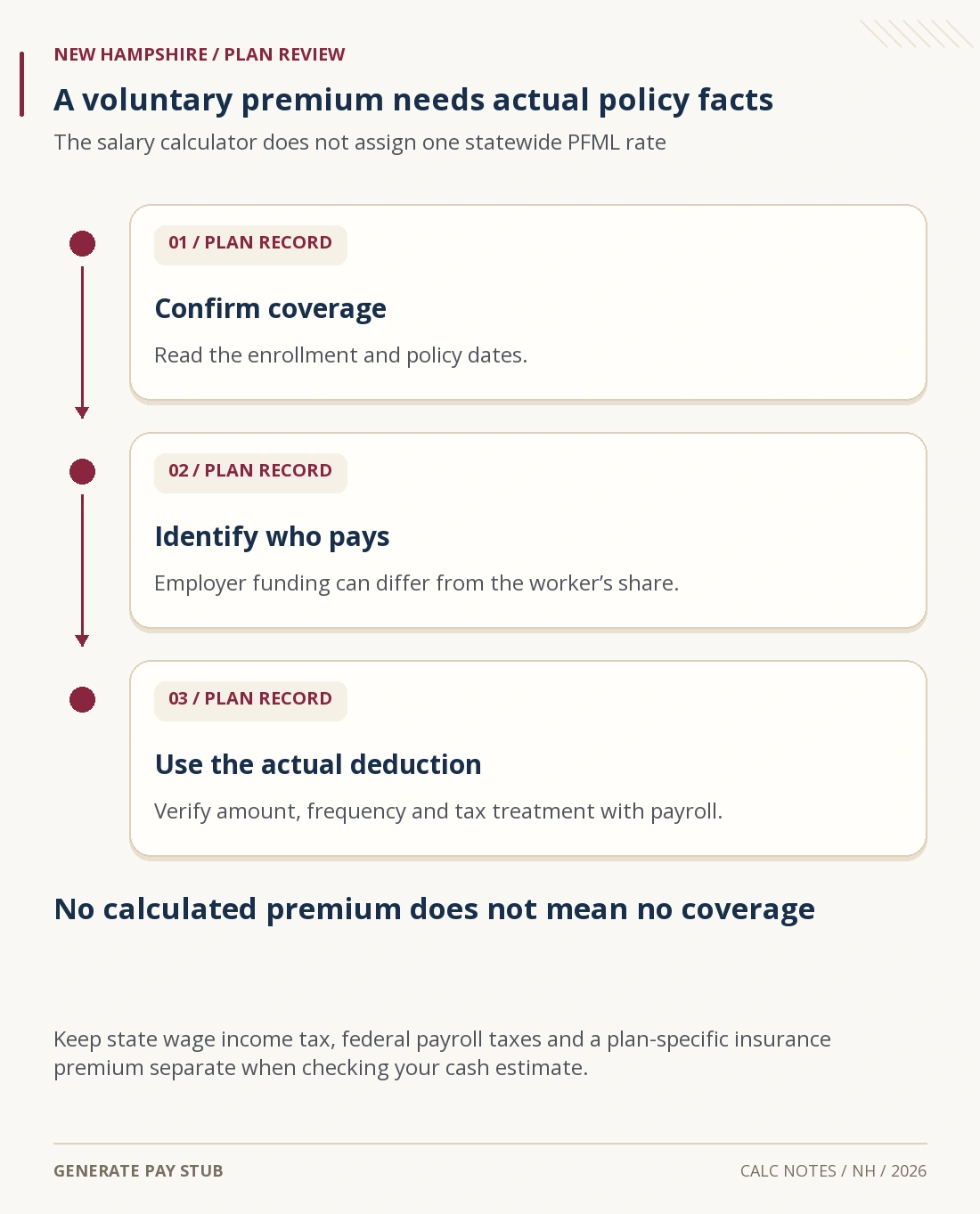
The state’s NH PFML employer fact sheet describes a voluntary insurance program, with payroll collection depending on the arrangement. It is not a universal employee income-tax rate.
MetLife, the state’s insurance partner, confirms that employer group premiums are individually underwritten. The employer may fund the premium, share it or pass the cost to participating workers, subject to the plan. Individual coverage has separate conditions.
Therefore an employee’s actual deduction needs enrollment, policy, funding and payment-frequency information. The reviewed calculator does not collect those details or calculate the premium from salary.

Ask payroll for the covered period, the total premium, the employer-funded portion and the amount actually deducted from wages. Check whether any payment is made directly to the insurer instead of through the paycheck.
This guide does not calculate leave benefits, decide eligibility or infer the tax treatment of benefit payments. Those questions require the plan and applicable current guidance.
Translate actual amounts into a cash budget carefully
Suppose a separate, verified post-tax deduction is $8 on each of 26 checks. Its annual cash amount would be $208. That is simple budgeting arithmetic, not a quoted NH PFML premium or a recommended coverage level.
If the item truly belongs in the tool’s other-cash field, $208 annual input would spread $8 per modeled payment. Confirm its actual tax treatment first: that field does not reduce taxable wage bases or establish a pre-tax benefit arrangement.
New Hampshire’s wage-withholding law identifies permitted deductions and authorization conditions. Typing a cash amount into a budget cannot authorize an employer to withhold it.
Use the tax-base guide for deductions to distinguish a cash subtraction from a wage reduction. Then use the net-pay reconciliation to compare the entire statement.
Check the model’s limits before relying on the result
The annual scenario assumes all 26 equal wages and elections repeat. Several employers, part-year work, a changing W-4, bonuses, leave payments or a premium that begins midyear require a more detailed projection.
The local input also accepts a known annual cash figure; it does not compute another jurisdiction’s withholding or allocate remote-work days. Resolve residence and service-location questions independently.
The calculator is free to use for an estimate. It does not enroll a worker in insurance, transmit W-4, file a return or prove that the salary was earned. Any prepared pay record must reflect actual compensation.
New Hampshire paycheck calculator questions
Does New Hampshire wage-tax treatment remove federal tax?
No. Federal withholding and FICA remain separate calculations.
Is there one mandatory NH PFML employee rate in this tool?
No. It does not calculate plan-specific voluntary premiums.
Is the federal extra field an annual amount?
No. The example’s $20 repeats every payment.
Does no premium line mean no coverage?
No. Check the actual plan, funding and deduction records.
Reviewed November 6, 2026 using agency/insurer information and two live calculator tests. Wages and elections are fictional.