The Maine paycheck calculator uses W-4ME allowances, an income-dependent withholding deduction and whole-dollar payment tax under the revised August 2026 method. It also calculates a separate standard employee PFML contribution. An annual per-payment average may hide contributions ending when covered wages reach the cap.
This guide checks a $120,000 fictional salary, where the Single withholding deduction is partly phased out, and a separate $240,000 case showing the PFML limit. Both use one employer and the revised table throughout the projection.
Use the revised withholding instructions instead of return figures
Maine’s August 2026 Tax Alert announces revised withholding guidance reflecting deduction changes and the new 2% income-tax surcharge. The revised withholding booklet distinguishes its calculation inputs from the headline standard deductions used for a return.
The Maine paycheck calculator uses the revised method for its 2026 scenario. It does not reconstruct the employer’s earlier checks before that revision. Do not substitute a return deduction into the payroll formula or describe a repeated revised-table projection as actual historical withholding.
Set the $10,000 monthly W-4ME scenario
The 2026 W-4ME has state withholding status, an allowance count, additional dollars and distinct exemption claims. The reviewed calculator provides the ordinary status, allowance and extra-dollar controls; it does not complete the certificate or establish an exemption.
For our first test, select 2026, $120,000 annual wages and Monthly. Federal status is Single, the multiple-jobs selection is off and federal W-4 dollar adjustments are zero.
For Maine select Single, one supported W-4ME allowance, no extra withholding and standard PFML treatment. No local-tax cash amount or other deduction is entered.
Assume ordinary full-year employment with one employer, Maine residence and work, and equal gross and all relevant tax and program wage bases. The one allowance is a fictional valid election, not a claim that every Single employee should use one.
Calculate the withholding deduction before subtracting allowances
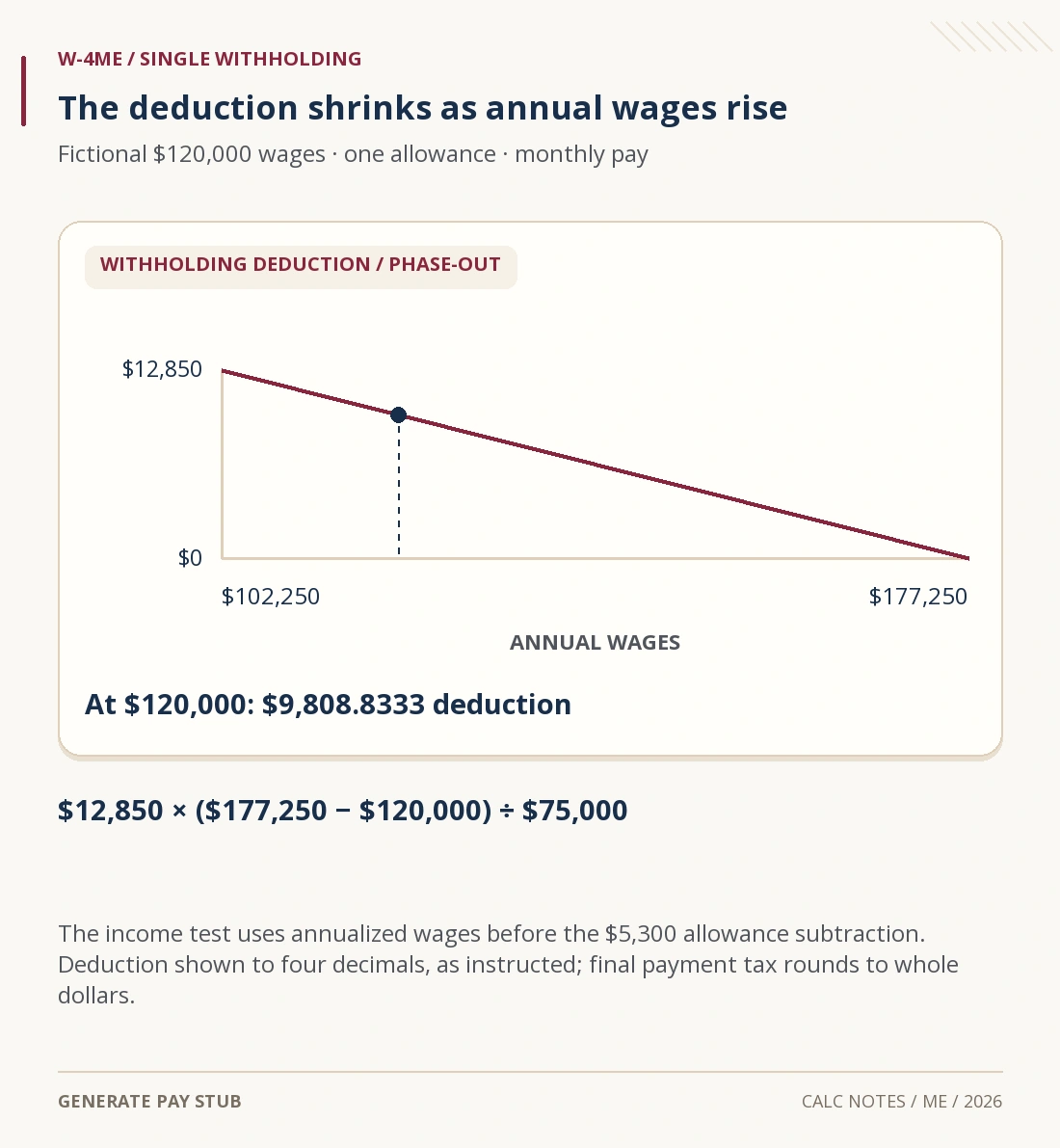
Under the revised percentage method, the Single withholding deduction starts at $12,850 and phases out between $102,250 and $177,250 of annualized wages. The income test uses wages before the allowance subtraction. Each regular allowance is valued at $5,300 annually.
At our $120,000 salary, the remaining deduction is $12,850 × ($177,250 − $120,000) ÷ $75,000 = $9,808.8333, rounded to four decimal places as instructed.

One allowance reduces the base by $5,300. The annualized table income is therefore $120,000 − $5,300 − $9,808.8333 = $104,891.1667. Testing the phase-out against income already reduced by the allowance would give the wrong deduction for this method.
Finish the state line with whole-dollar payment rounding
The applicable Single annual schedule gives $4,117 plus 7.15% of income over $64,850. Our calculation is $4,117 + (($104,891.1667 − $64,850) × 7.15%) = $6,979.94341905.
Divide by twelve to obtain $581.661951… and round payment withholding to the nearest whole dollar: $582. Twelve such deductions total $6,984. That projected annual sum need not equal the unrounded annual formula amount.
The revised method also provides a surcharge for annualized income above $1 million under Single withholding or $1.5 million under Married withholding. Neither fictional salary in this guide reaches those thresholds. Other return filing categories and threshold rules should not be inferred from the tool’s two withholding groups.
Check PFML separately from the state income-tax line
The Department of Labor’s current employer contribution guide explains the employer-size rules: the combined premium is generally 1% for the larger-employer category and 0.5% for the smaller category, with no more than 0.5% of wages passed to employees. Actual coverage and employer cost sharing still matter.
The PFML contribution guide links covered wages to the Social Security annual limit and describes program reporting. The final 2026 SSA wage base is $184,500.
For standard employee treatment in the first scenario, $10,000 × 0.5% = $50 per payment, or $600 annually. All $120,000 stays below the cap. That contribution is outside the $582 state income-tax line.
A coverage selector is not a determination that an employer has a valid exemption or approved replacement plan. Use employer records and the applicable program guidance rather than changing treatment only to increase net pay.
See why a contribution average does not describe every payment
A second live scenario uses $240,000 annual wages, paid as twelve $20,000 payments, with the same Single state group, one allowance and standard PFML. This is a separate fictional salary test; it does not change the first employee’s historical pay.
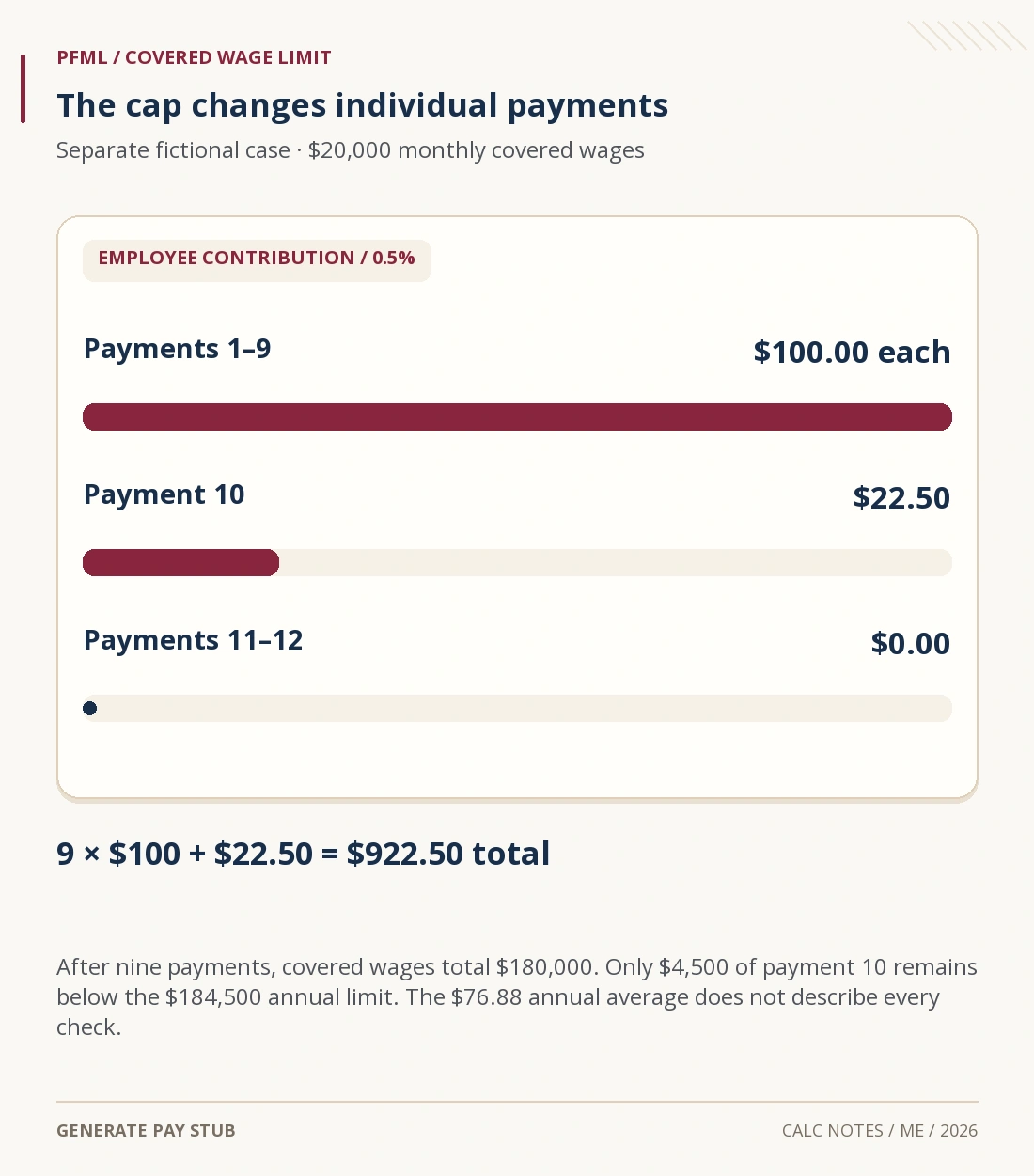
After nine payments, cumulative covered wages are $180,000. The tenth payment has only $4,500 below the $184,500 limit, so its PFML contribution is $22.50. The last two payments add no PFML contribution under these one-employer assumptions.

| Payment group | New wages subject to PFML | Employee contribution |
|---|---|---|
| Each of payments 1–9 | $20,000.00 | $100.00 |
| Payment 10 | $4,500.00 | $22.50 |
| Each of payments 11–12 | $0.00 | $0.00 |
| Full modeled year | $184,500.00 | $922.50 |
Nine × $100 + $22.50 = $922.50. Dividing that total by twelve gives $76.875, displayed as a $76.88 average. Budgeting every check at the average would miss the actual contribution pattern.
Other taxes can also change at their own thresholds. A PFML cap does not establish that all payroll deductions stop. The separate Medicare threshold guide explains why Medicare requires a different test.
Reconcile the initial $120,000 annual cash result
| Included payroll amount | Annual total |
|---|---|
| Gross earnings | $120,000.00 |
| Federal income tax withholding | $17,570.04 |
| Maine income tax withholding | $6,984.00 |
| Employee Social Security | $7,440.00 |
| Employee Medicare | $1,740.00 |
| Employee PFML contribution | $600.00 |
| Estimated cash after these amounts | $85,665.96 |
Per payment: $10,000 − $1,464.17 federal − $582 Maine − $620 Social Security − $145 Medicare − $50 PFML = $7,138.83. Twelve payments give $85,665.96 before unentered benefits or other deductions.
Review unsupported facts and the actual payroll history
The calculator’s federal adjustments do not automatically change Maine taxable wages. Follow state guidance rather than assuming every federal deduction has the same Maine treatment.
Known annual local and other cash amounts are supplied inputs, not calculated local rates or pre-tax exclusions. A full benefit-related tax-base change needs more than a cash subtraction.
This annual model does not reconstruct earlier 2026 table usage, prior employment, changing elections or separate certificates. Special exemption, nonresident and approved private-plan circumstances need the appropriate records and rules.
Payroll deductions also serve a different purpose from the employer’s quarterly contribution remittance. The PFML guide describes reporting and rounding conventions; the employee’s payment-level cents should not be mistaken for a complete employer filing calculation.
Use the calculator overview for the broader workflow. Neither this estimate nor a selected coverage option proves eligibility for leave benefits, files a return or creates an employer payroll record.
Maine paycheck calculator questions
Why not enter the headline return deduction in the withholding formula?
The revised booklet supplies its own payroll calculation inputs and warns that they differ from return amounts.
Does the allowance change the income used to test the deduction phase-out?
No. The phase-out test here uses annualized wages before the allowance subtraction.
Is PFML part of the $582 state tax line?
No. The first example has a separate $50 employee PFML deduction.
Can every payment use the annual-average PFML amount?
Not as a description of actual deductions. In the cap example, contributions change from $100 to $22.50 and then zero.
Maine revised 2026 instructions, contribution guidance, visible controls and both live salary scenarios reviewed November 6, 2026. All employee examples are fictional.