A Pennsylvania paycheck estimate needs separate checks for state income tax, the employee unemployment contribution and local withholding. In an ordinary covered 2026 wage example, Pennsylvania PIT is 3.07% and the employee UC contribution is 0.07%. The free calculator can calculate those components, but it needs a known annual dollar amount for local withholding.
This walkthrough uses a fictional $67,600 salary with 26 biweekly payments. It checks the two Pennsylvania percentages, adds a clearly identified local budgeting amount and explains why a correct state rate alone does not establish complete take-home pay.
Set up the Pennsylvania paycheck calculator
Open the free Pennsylvania paycheck calculator. Select 2026, enter $67,600 annual gross wages and choose Biweekly. This produces $2,600 gross across each of the 26 modeled payments.
For the federal comparison, select Single and leave the multiple-jobs checkbox off. Set federal annual credits, other-income adjustments, deduction adjustments and extra withholding to zero. Keep standard Pennsylvania UC coverage, with other annual cash deductions at zero.
The Pennsylvania page has no additional state allowance-count fields in this basic model. That is separate from the federal W-4 controls, which still affect the federal withholding line. A filing choice or annual federal credit should not be treated as an exemption from the Pennsylvania flat-rate wage calculation.
Assume one employer, a full year of ordinary employment, Pennsylvania work and residence, and wages fully subject to the modeled taxes and UC contribution. The initial run leaves known annual local withholding at zero so that its absence is visible. That zero is an input choice, not a finding about any particular municipality.
A checked $2,600 biweekly payment
The first column below shows the live estimate before local withholding. For the second run, suppose payroll has already determined a fictional $728 total annual local withholding amount for this scenario. Enter $728 in the known annual local field. We are not assigning a local rate or claiming this amount applies to your address.
| Pay component | Before local input | With $728 annual local |
|---|---|---|
| Gross wages | $2,600.00 | $2,600.00 |
| Federal income tax withheld | $232.38 | $232.38 |
| Pennsylvania PIT | $79.82 | $79.82 |
| Employee Social Security | $161.20 | $161.20 |
| Employee Medicare | $37.70 | $37.70 |
| Pennsylvania employee UC | $1.82 | $1.82 |
| Known local amount per payment | $0.00 | $28.00 |
| Estimated take-home pay | $2,087.08 | $2,059.08 |
The full second payment check is $2,600 − $232.38 − $79.82 − $161.20 − $37.70 − $1.82 − $28 = $2,059.08. Multiplying by 26 gives $53,536.08 in estimated annual net pay. Without the local input, the checked annual net is $54,264.08; the $728 difference is exactly the cash amount entered.
These are planning outputs under controlled assumptions, before benefits or other omitted adjustments. The local field changes estimated cash remaining without recalculating the state, federal or FICA wage bases.
Separate Pennsylvania PIT, employee UC and local withholding
State personal income tax: 3.07% in this wage example
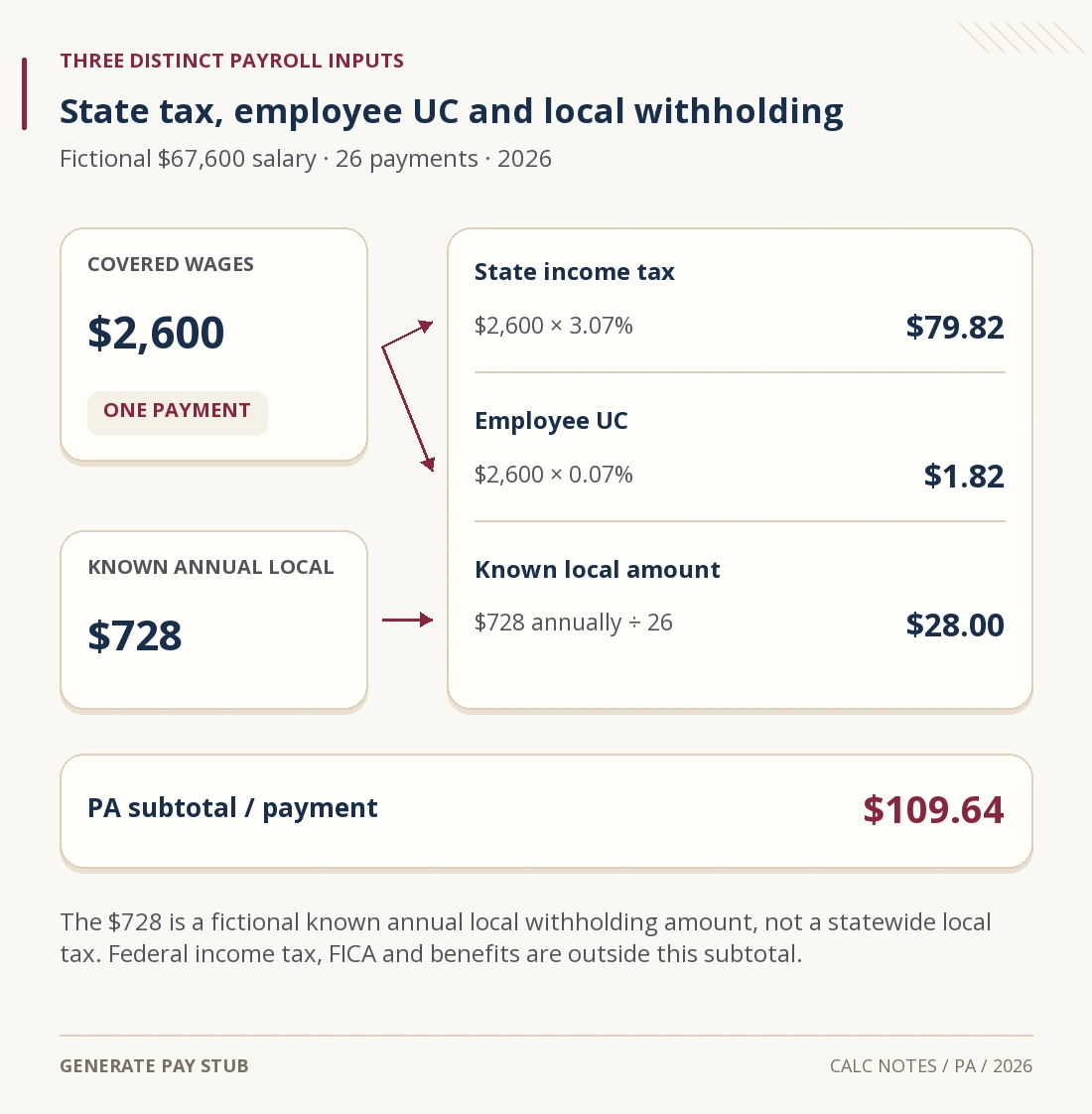
The Pennsylvania Department of Revenue’s withholding guidance identifies the 3.07% flat rate on taxable compensation. Here, $2,600 × 0.0307 = $79.82 per payment and $67,600 × 0.0307 = $2,075.32 annually.
Employee unemployment: 0.07%, with a different purpose
The Department of Labor and Industry’s employee-withholding page lists 0.07%, expressed as 0.0007. It applies to total gross wages in covered employment and is not limited by the employer contribution wage base. The Commonwealth’s January 2026 payroll memo independently confirms the 2026 PIT and employee UC percentages.
For this payment, $2,600 × 0.0007 = $1.82; the annual amount is $47.32. Entering 0.07 as a decimal would mean 7%, a hundred times the intended 0.07% rate. Keep the percent sign and decimal conversion distinct when checking your arithmetic.
Local withholding: a known amount supplied separately
In the fictional second run, $728 ÷ 26 = $28 per payment. That comes from the entered annual cash amount, not from multiplying wages by a statewide local rate. Together, the three Pennsylvania/local components shown here total $79.82 + $1.82 + $28 = $109.64 per payment.

How do you find the right local withholding input?
The state selection does not identify your home municipality, school district, worksite or PSD code. The Pennsylvania DCED local-withholding FAQs explain the residency certification and address-search process. Under the general Act 32 EIT framework, the resident rate and work-location nonresident rate are compared; the higher applicable rate is used.
Philadelphia has separate Wage Tax treatment. Local Services Tax can also be a separate payroll item with its own payment and exemption rules. Do not apply a generic 1% local estimate to every Pennsylvania address or assume a municipal tax already includes every local deduction.
For a practical input check, gather the current home and work addresses, applicable PSD information, the employer’s residency certification and the local deductions actually identified by payroll. Determine which amounts belong in the year’s projection and whether they apply on all payments. Then total the known annual cash withholding for the calculator.
If the amount is still unknown, describe the output as a projection before unverified local withholding. The missing information remains missing even when the calculator returns a precise net amount. Its local field does not determine rates, certify an exemption or submit local tax forms.
Check wage bases and federal elections separately
The state tool begins from the same gross figure for federal, FICA, Pennsylvania and covered UC wages. A real employer can have different taxable wage bases because of benefit or compensation rules. Do not assume an amount excluded for federal income tax receives identical Pennsylvania treatment.
The basic estimate does not model pre-tax benefit elections. Its known annual local and other-deduction fields reduce cash without changing taxable wages. For a benefit comparison, obtain the applicable wage bases and payroll treatment first; our taxable-wage explanation shows why this matters.
The federal $232.38 in this scenario is a separate calculation. Under the ordinary modern W-4 percentage method, annualized wages less the method’s adjustment produce $59,000; $5,800 + 22% × ($59,000 − $57,900) = $6,042 before conversion to 26 payments. Payment rounding gives $232.38. See the federal calculator guide and 2026 IRS Publication 15-T for that method.
When does the same-state example need a different review?
Cross-state employment and reciprocity are outside this simple Pennsylvania-resident/worker setup. Pennsylvania has compensation reciprocity agreements with Indiana, Maryland, New Jersey, Ohio, Virginia and West Virginia, subject to the rules and exceptions in the Department of Revenue’s residency guidance. Choosing Pennsylvania in a calculator does not decide which agreement or certificate applies.
A move, telework arrangement, part-year job or nonemployee earnings can also require information not collected here. The coverage choice for employee UC models the selection; it does not approve exclusion from covered employment.
The annual projection uses equal scheduled wages and the selected published rules. It does not reconstruct historical in-year changes, irregular earnings, bonuses or every special exemption. Compare an actual pay statement by wage base and deduction, using our net-pay reconciliation guide if the deposit differs.
Pennsylvania paycheck calculator questions
Is the employee UC contribution the employer’s unemployment rate?
No. The 0.07% employee contribution is a distinct deduction in this covered-wage example. Do not substitute the employer’s assigned contribution rate or its taxable wage limit.
Does a federal credit lower Pennsylvania withholding automatically?
The federal credit control changes the federal withholding worksheet. It does not change the ordinary flat Pennsylvania PIT percentage or determine a Pennsylvania exemption.
Can I enter a local percentage in the annual local field?
No. That field expects dollars for the year. Determine the correct local withholding outside the calculator, then enter the known annual amount.
Where can I find the other free state tools?
Use the paycheck calculator directory. Check each state’s own certificate, coverage and local-tax assumptions before comparing net amounts.
Pennsylvania 2026 references and two live calculator scenarios checked November 6, 2026. The $728 local amount is fictional and must not be used as a local rate or address-specific recommendation.