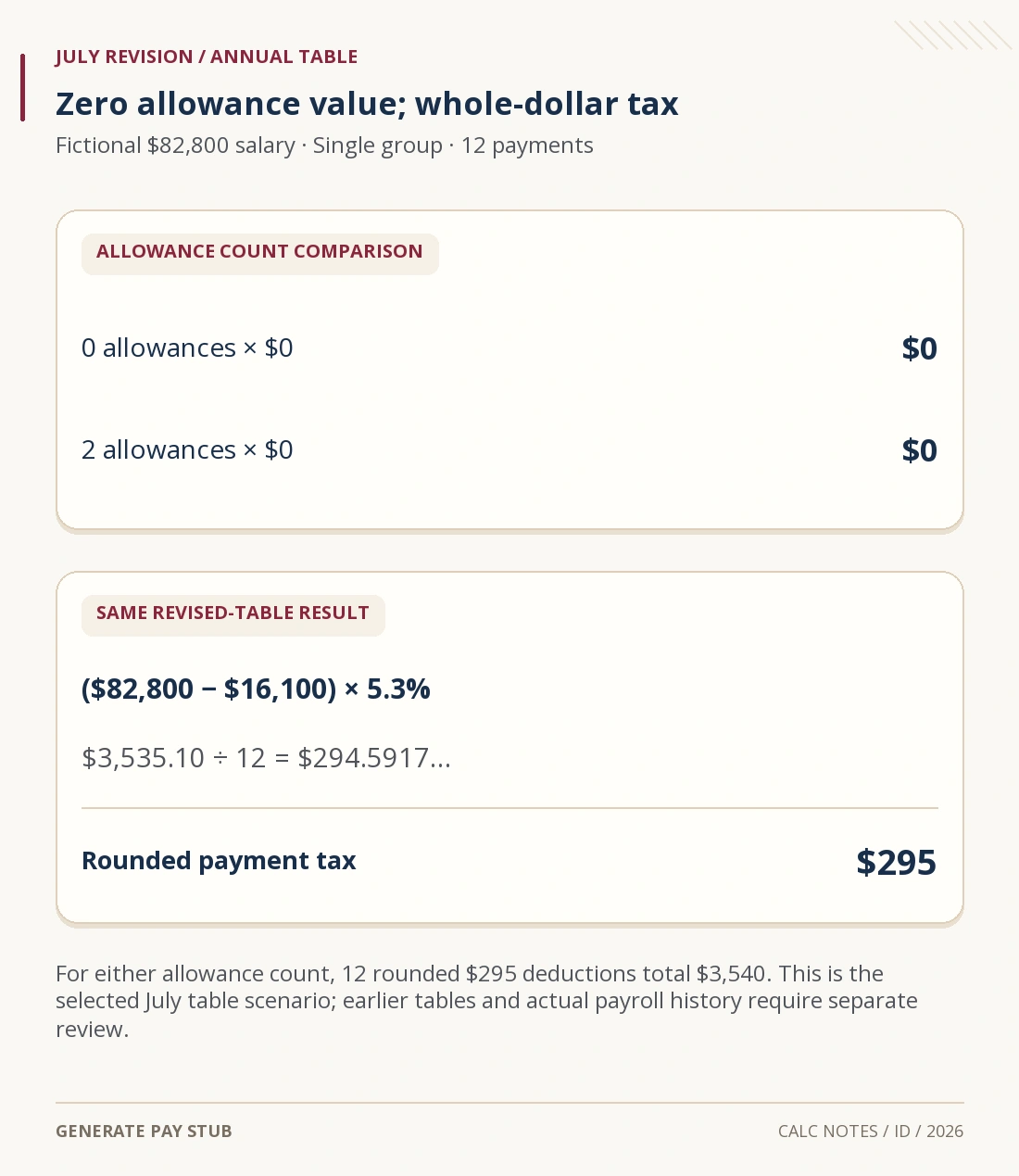
For Idaho’s July 23, 2026 revised table, increasing the child-tax-credit allowance count does not reduce the calculator’s state withholding: each allowance has a zero value. The tool then rounds calculated state withholding per payment to whole dollars before adding any extra amount you enter.
Those two details explain the fictional $82,800 salary below. With either zero or two allowances, the revised-table result is $295 monthly Idaho withholding. A separate $10.25 extra-withholding test raises that line to $305.25.
Choose the published table rather than relying on the year alone
The Idaho Tax Commission’s computing-withholding guidance directs employers to use revised tables going forward without recalculating earlier payroll. It also says the child tax credit has sunsetted, leaving a zero allowance amount, and calls for whole-dollar rounding under the annualized method.
The Idaho paycheck calculator includes a published-table selector. This article uses the July 23, 2026 revised table. The preceding-table setting is available for a different payroll scenario; it should not be selected merely because it yields a preferred net amount.
One chosen revision is applied throughout the tool’s full-year projection. The tool does not automatically split a calendar year into the employer’s earlier and later table usage.
Enter a $6,900 monthly example
Use 2026, $82,800 annual gross and Monthly. The model divides that salary into twelve equal payments of $6,900. Federal status is Single, with the multiple-jobs setting off and every W-4 dollar adjustment zero.
For Idaho choose the Single/Head of Household/separately group, revised table, zero allowances and no additional withholding for the initial run. No annual local-tax cash amount or other deduction is supplied.
Assume one employer, twelve months of ordinary wages and Idaho as both the residence and work state. Gross wages equal federal taxable, Social Security, Medicare and Idaho wages. No retirement deferral, insurance exclusion or special earnings change those bases.
These deliberately controlled facts make the rounding and allowance tests visible. A real household or payroll record can require different inputs; the example does not recommend a certificate election.
Understand what the zero allowance value does
The revised method multiplies the allowance count by zero. At zero allowances, 0 × $0 = $0; at two, 2 × $0 = $0. Neither test subtracts anything from the annual wage base.
We ran both counts with all other settings held constant. The state withholding, federal withholding, FICA and net results were identical. This is expected behavior for the selected revised table, rather than evidence that the calculator ignored a dollar-valued allowance.
Do not carry an old per-allowance value into this revised-table test. Likewise, do not infer that the allowance count necessarily had no effect under every earlier table. A historical comparison needs its own published revision and certificate facts.
Follow the annual table and round the payment result
The actual July 23, 2026 percentage tables show a $16,100 Single annual threshold and 5.3% on the excess. The Married annual threshold is $32,200. Use the annual table when following this calculator’s annualized method.
For the fictional Single worker, the calculation is ($82,800 − $16,100) × 5.3% = $3,535.10 before conversion to payments. Divide by twelve: $294.591666… becomes $295 after whole-dollar rounding.

Adding twelve rounded deductions gives $3,540, which is $4.90 above the unrounded annual formula. That difference is a rounding consequence in this projection; it is not another tax rate.
The agency’s web walkthrough still contains a Married example using $32,000, while its linked July annual table says $32,200. The calculator follows the dated table. Our worked example is Single and uses the $16,100 figure directly from that table.
Check what changes when extra dollars are added
The third run retains two allowances and adds $10.25 per payment. The ordinary calculated $295 becomes $305.25. The tool preserves the cents in this elected extra amount; it does not round the whole combined line back to $305.
| Input variation | State withheld/month | Estimated net/month |
|---|---|---|
| 0 allowances; no extra | $295.00 | $5,294.98 |
| 2 allowances; no extra | $295.00 | $5,294.98 |
| 2 allowances; $10.25 extra | $305.25 | $5,284.73 |
Across twelve payments, the extra totals $123 and reduces projected annual cash from $63,539.76 to $63,416.76. Neither the extra dollars nor the allowance comparison changes the fictional taxable wages.
An extra-withholding election affects payments toward tax. It does not itself reduce the final tax due or prove that the selected amount is appropriate for the whole household.
Reconcile annual cash under the original assumptions
| Earnings or deduction | Modeled yearly total |
|---|---|
| Gross salary | $82,800.00 |
| Federal withholding | $9,386.04 |
| Idaho withholding | $3,540.00 |
| Employee Social Security | $5,133.60 |
| Employee Medicare | $1,200.60 |
| Estimated cash after these lines | $63,539.76 |
The monthly arithmetic is $6,900 − $782.17 federal − $295 Idaho − $427.80 Social Security − $100.05 Medicare = $5,294.98. Twelve payments reproduce the $63,539.76 annual result.
Actual cash may also reflect insurance, retirement contributions, garnishments or other deductions absent here. The net-pay checking guide explains how to account for each statement line.
Compare actual facts before treating a difference as an error
Start with the employer’s table revision and withholding method. The annualized method uses annual thresholds; a calculation built directly from a rounded pay-period threshold is a different route and may differ near a rounding point.
Next compare taxable wages, payment frequency, state status and extra dollars. Federal controls remain independent; see the federal W-4 estimate guide when checking that portion.
The known annual local and other cash fields do not calculate local rates or establish pre-tax exclusions. They subtract supplied cash amounts without rebuilding the tax bases.
Cross-border services, changing certificates, supplemental pay, several jobs and midyear starts require additional review. A full-year scenario does not recreate an actual year-to-date payroll ledger or prepare a final Idaho return.
Idaho paycheck calculator questions
Why did changing two allowances to zero make no difference?
Under the July 2026 revised table used here, both counts multiply by a zero allowance value.
Why is the state amount shown as $295 instead of $294.59?
The selected annualized method rounds ordinary computed payment withholding to the nearest whole dollar.
Is the $3,540 annual total the final return liability?
No. It sums twelve modeled payroll deductions. Final tax depends on the return’s complete facts.
Does selecting a revised table fix earlier checks automatically?
No. This tool holds the selected revision constant and does not amend an employer’s payroll.
Idaho 2026 table, agency guidance, calculator controls and three live scenarios reviewed November 6, 2026. Examples use fictional salary and certificate assumptions.