The 2026 West Virginia paycheck calculator uses the updated rate-cut tables and the IT-104 payroll election. The standard table applies unless a qualifying employee elects the optional one-earner/one-job table. Add any agreed extra withholding before rounding the paycheck’s state tax to a whole dollar.
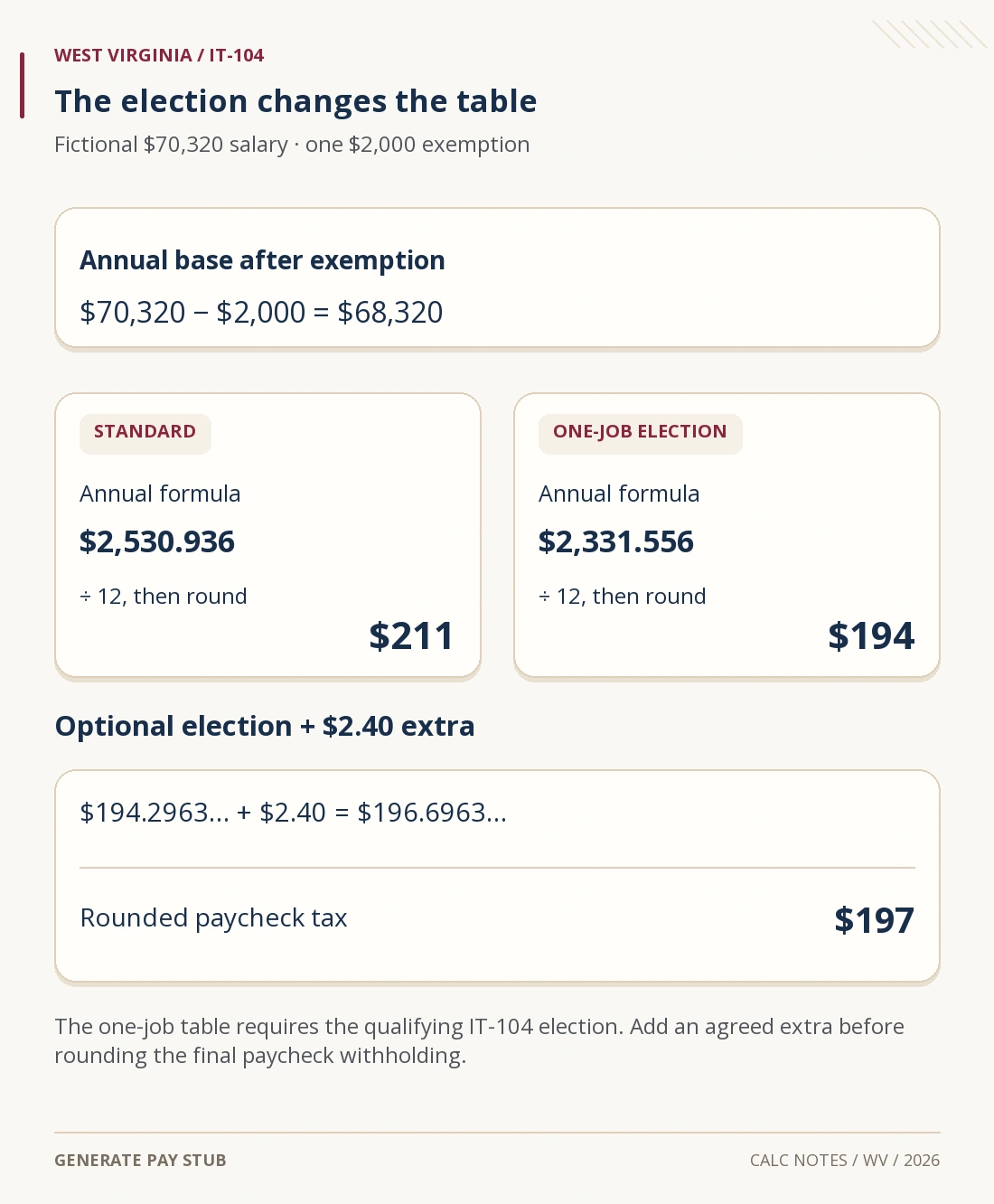
A fictional $70,320 salary with one exemption produces $211 monthly state withholding under the standard table or $194 under the elected one-job table. Those amounts are different withholding projections for supported certificate choices, rather than two different tax bills for the same income.
Use the updated 2026 schedule for the current estimate
The Tax Division’s 2026 rate-cut guidance explains the five-percent income-tax reduction enacted March 31, 2026 and retroactive to January 1, 2026. It links the updated employer withholding tables.
A five-percent rate cut does not mean five percentage points come off every paycheck deduction. The current published rates range from 2.11% to 4.58%, with the relevant thresholds and base amounts depending on the table.
The calculator uses the revised schedule throughout its annual projection. It does not reconstruct an employer’s earlier 2026 checks that used the preceding schedule or automatically perform a midyear payroll correction.
That distinction matters when reviewing year-to-date withholding: an updated estimate of twelve equal future-style payments is not a record of twelve actual payments already made.
Check the IT-104 election rather than relying on the federal filing label
Form IT-104 permits the lower one-job table for a Single or head-of-household employee, or a married employee with a nonworking spouse, receiving wages from only one job, when the employee makes the election.
The standard two-earner/two-or-more-jobs table remains the starting method without that election. A federal Single setting does not automatically establish the separate state choice.
The form also records exemptions and any additional withholding agreed with the employer. Do not claim a spouse or dependent again on another certificate. Use the count supported by the actual facts and form instructions.
For the comparison below, assume a qualifying Single employee with one job and one valid exemption. We compare the standard method without the optional election against the properly elected optional method. We are not telling a two-job employee to select the lower table.
Set up $70,320 as twelve $5,860 payments
Open the West Virginia paycheck calculator, select 2026, enter $70,320 annual wages and choose Monthly.
Use federal Single with no multiple-jobs adjustment and all federal dollar adjustments at zero. In the West Virginia controls enter one IT-104 exemption and zero additional withholding. Run the standard and optional one-job elections separately.
Assume ordinary wages, one private employer, a complete year living and working in West Virginia and no benefit exclusions. All wage bases equal gross pay. Known local and other annual cash deductions remain zero.
The certificate is supplied to payroll separately. A calculator selection does not notify the employer, sign IT-104 or change an existing payroll election.
Compare the two annual withholding-table calculations
The March 2026 percentage publication provides a $2,000 annual reduction per exemption. One exemption leaves $70,320 − $2,000 = $68,320.
For the standard table, that base is above $45,000. Its annual formula is $1,462.88 + ($68,320 − $45,000) × 0.0458 = $2,530.936. Dividing by twelve gives $210.911333…, rounded to $211 monthly.
For the optional one-job table, the applicable formula is $1,950.50 + ($68,320 − $60,000) × 0.0458 = $2,331.556. Dividing by twelve gives $194.296333…, rounded to $194.
The same top percentage appears in both examples, but the threshold and accumulated base tax differ. Multiplying all gross wages by 4.58% would reproduce neither method.
A calculation made directly from the publication’s rounded monthly thresholds can differ slightly from annualizing first. Compare the method as well as the inputs when reconciling a real check.

Add the elected extra before rounding the final amount
The agency’s withholding instructions require whole-dollar rounding. The calculator adds the requested per-pay extra before rounding that combined amount.
In our third live run, the optional one-job calculation has $2.40 extra per payment. The sequence is $194.296333… + $2.40 = $196.696333…, then round to $197.
Compared with the no-extra rounded amount of $194, the displayed difference is $3 per check. Across twelve payments the difference is $36, rather than $28.80. This is the effect of rounding the complete withholding calculation.
Keep extra withholding distinct from a cash-only deduction. The state setting changes the withholding line; an annual other-deductions amount has a different purpose and input unit.
| Result for twelve monthly payments | Standard | One-job elected | One-job + $2.40 extra |
|---|---|---|---|
| State tax each month | $211.00 | $194.00 | $197.00 |
| Annual state withholding | $2,532.00 | $2,328.00 | $2,364.00 |
| Annual projected cash | $55,768.08 | $55,972.08 | $55,936.08 |
Check the optional one-job cash projection
| Annual wage or employee deduction | Annual amount |
|---|---|
| Gross salary | $70,320.00 |
| Federal income-tax withholding | $6,640.44 |
| West Virginia income-tax withholding | $2,328.00 |
| Employee Social Security | $4,359.84 |
| Employee Medicare | $1,019.64 |
| Cash before unentered items | $55,972.08 |
For one month, $5,860 − $553.37 federal − $194 state − $363.32 Social Security − $84.97 Medicare = $4,664.34. Twelve payments produce $55,972.08.
Every annual tax total in the comparison sums rounded monthly deductions. Unknown health premiums, retirement contributions or other payroll items would require their actual amounts and wage treatment before this becomes a useful deposit estimate.
Review older checks, reciprocal wages and the final return separately
West Virginia’s withholding FAQ explains that amounts withheld are credited toward the employee’s income tax. Changing an election changes the timing and amount of prepayments, not the legal tax rate for that person’s return.
When checking earlier 2026 payments, keep their actual table, certificate, wages and tax withheld. The rate cut’s retroactive tax-year effect does not make the updated annual calculator a historical payroll ledger.
IT-104’s reverse side includes IT-104NR for qualifying residents of Kentucky, Maryland, Ohio, Pennsylvania or Virginia whose only West Virginia source income is wages or salaries, plus specified military-spouse cases. Follow the relevant certificate conditions rather than assuming every nonresident is exempt.
The tool does not decide reciprocal eligibility, perform multistate allocation, process pensions or implement a low-income exclusion election. No other statewide employee program is added in this ordinary scope; that is not a promise that all payroll deductions are zero.
Our year-end withholding review can help organize the actual records needed beyond a repeated-payment estimate.
West Virginia paycheck calculator questions
Does Single automatically mean the optional state table?
No. The qualifying one-job election is separate.
Does the revised annual result reproduce every earlier 2026 check?
No. Earlier payroll may have used the preceding schedule.
Why can a $2.40 extra change this example’s deduction by $3?
The tool adds it before rounding final withholding to a whole dollar.
Is the lower withholding total a guaranteed tax saving?
No. Final liability and available credits are determined on the return.
Updated West Virginia tables, IT-104 and three live calculator scenarios checked November 6, 2026.