Oklahoma’s 2026 paycheck calculator uses your OK-W-4 withholding group, state allowance count and any extra state amount per payment. Each allowance reduces the annualized formula wage base by $1,000; it is not a $1,000 tax credit. The calculated state deduction is rounded to whole dollars.
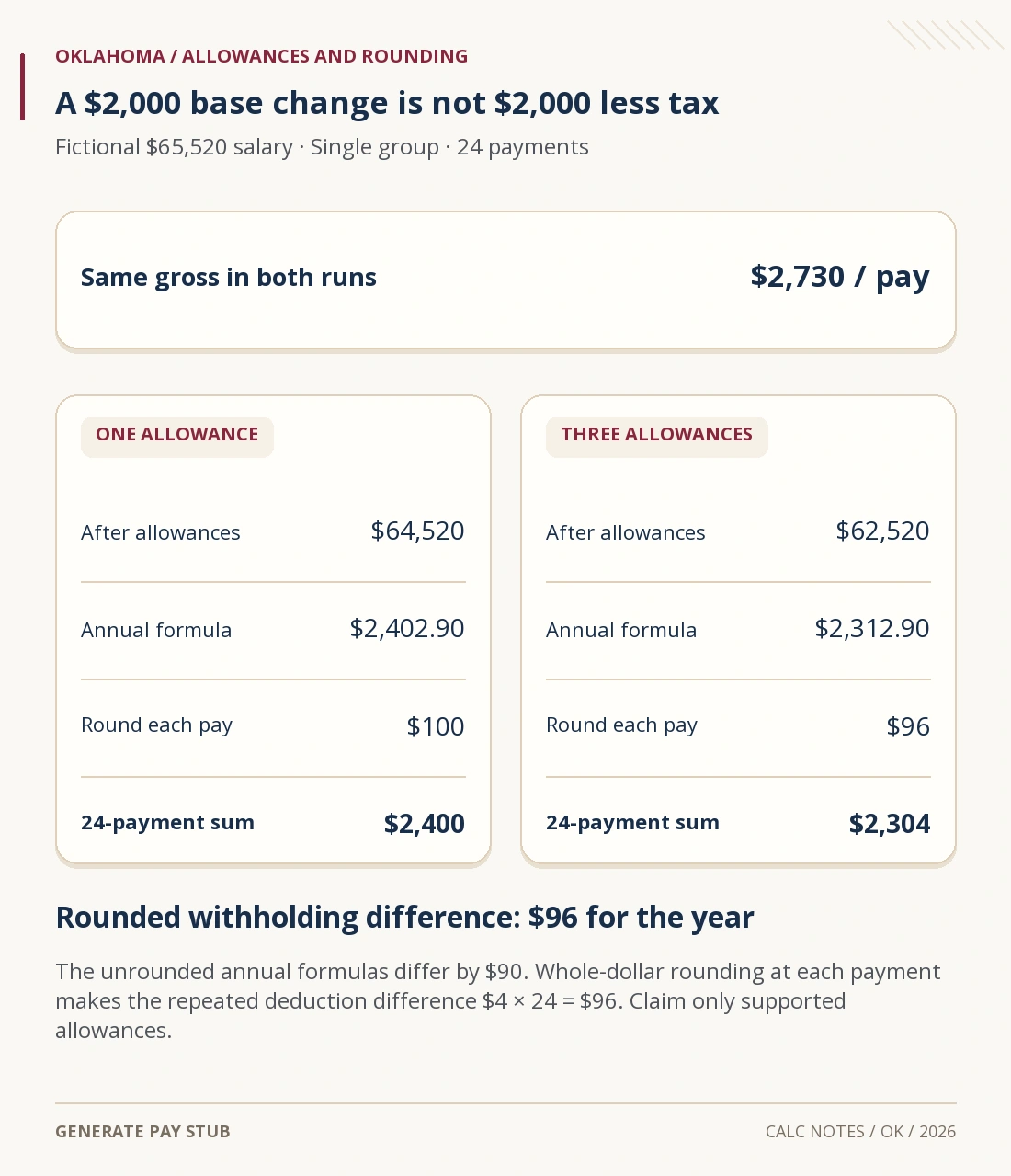
Our original twice-monthly example follows a $65,520 salary. One valid allowance produces $100 of state withholding per payment; three produce $96. The comparison explains the annual-table calculation, the effect of rounding and the facts to check before changing an election.
Match the OK-W-4 withholding group and count
The 2026 Oklahoma withholding packet uses Single and Married table groups. A certificate electing Married but withholding at the higher Single rate uses the Single table. That payroll election does not itself change the employee’s legal filing status.
Oklahoma’s business help guidance directs employees who want to change or increase state withholding to complete a new OK-W-4. An estimate on a website cannot deliver that election to payroll.
Read the existing state certificate before entering the count. Do not substitute a federal W-4 credit-dollar amount, and do not copy a count from a hypothetical example simply because it raises estimated cash.
The state packet highlights underwithholding risks for married couples with dual incomes. Review the combined household situation when selecting the supported group and any additional amount; a single employer’s wage projection cannot see the spouse’s income.
Set up a $2,730 twice-monthly payment
Use the free Oklahoma paycheck calculator. Choose 2026, enter $65,520 annual wages and select Twice a month, giving 24 payments of $2,730.
Set federal status to Single with no multiple-job adjustment, annual credits, other income, deductions or extra federal withholding. Choose the Oklahoma Single/higher Single group, one state allowance and no additional state amount.
Keep local and other annual deductions at zero. Run the estimate, then change only the state count from one to three. Both counts are assumed to be valid in their respective fictional circumstances; the exercise does not determine entitlement.
Assume one employer, constant ordinary pay, full-year Oklahoma residence and work, and no pre-tax benefits. Federal, state and FICA wage amounts are the same here.
Twice a month means 24 modeled payments. Every two weeks means 26. A different frequency changes the gross payment and the number of rounding events, so it must match the case you intend to compare.
Calculate the state amount using the annualized method
For one allowance, subtract $1,000 from $65,520 to get $64,520. In the 2026 annual Single table, this reaches the band with $109.25 plus 4.50% of wages above $13,550.
The excess is $64,520 − $13,550 = $50,970. Its percentage component is $50,970 × 0.045 = $2,293.65. Add $109.25 to obtain $2,402.90.
Divide by 24: $100.120833… . Nearest-whole-dollar rounding yields $100 for a payment. The annual projection therefore totals $100 × 24 = $2,400.
Do not apply 4.50% to every dollar of the original salary. The allowance reduction, table threshold and fixed component all belong to this calculation.
Compare one allowance with three allowances
| Checked output | 1 allowance | 3 allowances |
|---|---|---|
| State withheld from one payment | $100.00 | $96.00 |
| Cash from one payment | $2,184.38 | $2,188.38 |
| 24 state deductions added together | $2,400.00 | $2,304.00 |
| 24 cash payments added together | $52,425.12 | $52,521.12 |
With three allowances, the reduced wage base is $62,520. The annual formula is $109.25 + ($62,520 − $13,550) × 4.50% = $2,312.90.
Dividing by 24 gives $96.370833… and rounds to $96. Federal withholding and FICA remain identical in these two runs because we changed only the state allowance count.
Separate the formula change from the rounded-check change
The two unrounded annual formulas differ by $90: $2,000 of additional base reductions × 4.50%. But the actual modeled payment deductions differ by $4, and $4 × 24 = $96.

The packet requires percentage-method amounts below 50 cents to round down and amounts from 50 cents to round up. Consequently, the change visible across a series of whole-dollar deductions can differ from an unrounded annual comparison.
Published period tables use rounded period thresholds and allowance values. An employer using those tables may not reproduce every intermediate annualized figure exactly. Identify the method before diagnosing a small discrepancy.
State withholding is a payment toward income tax. Higher cash from a changed allowance election does not, by itself, mean the final tax bill becomes smaller.
Reconcile the one-allowance cash result
| What the projection contains | Year total |
|---|---|
| Gross wage payments | $65,520.00 |
| Federal withholding deduction | $5,682.48 |
| Oklahoma withholding deduction | $2,400.00 |
| Employee Social Security withheld | $4,062.24 |
| Employee Medicare withheld | $950.16 |
| Cash remaining in this example | $52,425.12 |
For an individual payment: $2,730 − $236.77 federal − $100 Oklahoma − $169.26 Social Security − $39.59 Medicare = $2,184.38. Repeating it 24 times gives $52,425.12.
An actual check may include insurance, retirement or other authorized items absent from this case. Use the gross-to-cash explanation to reconcile them without assuming that every deduction reduces taxable wages.
Resolve a mismatch before changing the certificate
First compare the payroll year, payment frequency, state taxable wages, actual OK-W-4 group and allowance count. Then check whether an additional state amount is already on file and whether the employer uses period tables or annualization.
The additional state input is a payment-level instruction. For example, $6 extra on each of 24 payments adds $144 during a full repeated year. It is distinct from an annual $6 adjustment or a federal extra.
Our test deliberately leaves every optional cash item at zero. The calculator’s local and other fields distribute known annual amounts; they do not calculate a jurisdiction’s law or decide whether a deduction is authorized.
Special wages, nonresident allocations, tax exemptions and unequal pay require facts outside this controlled case. For benefits, confirm the correct wage basis with payroll rather than entering a pre-tax contribution only as a cash subtraction. See how deductions affect different tax bases.
The state withholding overview describes withholding as credit against the employee’s income tax. A final return considers additional facts that this wage comparison does not calculate.
Oklahoma paycheck calculator questions
Is an allowance worth $1,000 less tax?
No. It reduces the formula wage base by $1,000 annually.
Which group matches Married but withholding at the higher Single rate?
Use the Single group to reproduce that certificate election.
Why do two additional allowances change the repeated total by $96 here?
Whole-dollar rounding occurs on each of the 24 payments.
Does this create a pay stub or certify wages?
No. It estimates entered wages. Actual wage records and the separate document service serve different purposes.
Oklahoma rules and two live allowance examples checked November 6, 2026.